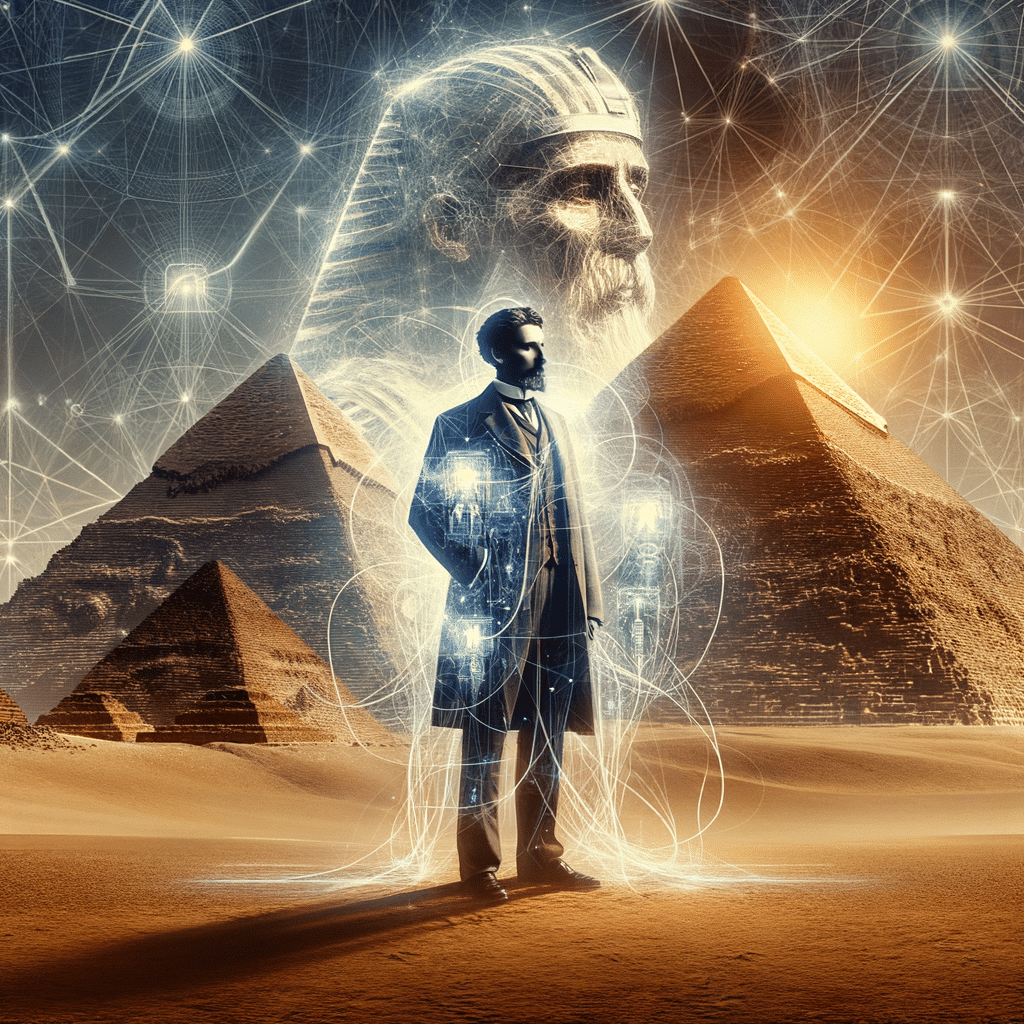
Nikola Tesla, the Serbian-American inventor, and visionary, held a lifelong fascination with the ancient Egyptian pyramids, which extended far beyond their architectural grandeur. Tesla, renowned for his contributions to the development of alternating current electricity and pioneering wireless communication, speculated that these ancient structures harbored secrets relating to energy that modern science had yet to understand.
Unearthing the Mysteries: Tesla’s Pyramid Theories
Tesla’s intrigue with the Egyptian pyramids, particularly the Great Pyramid of Giza, was no passing fancy. He found it fascinating that, contrary to what historians and archaeologists generally believe, these enormous structures served a more practical and possibly technologically advanced purpose than simply serving as tombs for the pharaohs who had passed away.
His research led him to theorize that the pyramids may have unique qualities or functions that were still unknown, particularly in the realm of energy. Tesla postulated that the pyramids could have been designed and constructed to serve as energy sources. He hypothesized that they might have functioned as giant power plants or energy amplifiers, which could collect and channel the naturally occurring electrical currents from the Earth’s atmosphere.

Tesla’s Observations on Pyramid Radiation and Energy
Observations of unusually high radiation levels near the Great Pyramid served as fuel for Tesla’s theories. He conjectured that the pyramid’s construction materials and geometric shape could have been intentionally selected and designed to harness and store potential energy properties. These speculations were rooted in the inventor’s extensive studies of electromagnetism and his groundbreaking work in wireless energy transmission.
Tesla was particularly interested in the concept of resonant energy and how the pyramids might resonate with the Earth’s energies. He believed that if these ancient structures were indeed energy resonators, they could potentially be used to tap into the abundant and untapped sources of energy that surround us.
The Inspiration Behind Tesla’s Wireless Energy Ambitions
The pyramids’ enigmatic nature and Tesla’s theories about their purpose were a significant influence in his pursuit of wireless energy and its potential applications. Studying the pyramid structures instilled in him a sense of wonder about their original functions and the lost knowledge that could unlock new ways to harness energy.
Tesla’s visionary ideas about wireless energy transmission, which included his plans for the Wardenclyffe Tower project, were, at least in part, inspired by his thoughts on the pyramids. He imagined a world interconnected through wireless power, drawing upon natural and sustainable energy sources, much like what he theorized the pyramids might have been designed to do.
Legacy of Tesla’s Pyramid-Inspired Endeavors
Throughout his career, Tesla turned to the pyramid structures for inspiration, seeking unconventional uses of energy and structural designs that could capture natural forces. This interest was not merely theoretical; it was an integral part of his inventive process. Tesla’s work on the transmission of electrical energy without wires, his fascination with the Earth’s ionosphere, and his experiments with high-frequency currents can all be traced back to the inspiration he drew from the ancient Egyptian pyramids.
While mainstream science has not substantiated Tesla’s theories about the pyramids’ energy-related functions, his ideas continue to intrigue researchers, historians, and enthusiasts of alternative histories. The pyramids remain a testament to ancient ingenuity, and for Tesla, they symbolized a lost chapter of human history that held the secrets to a future of unlimited, wireless energy.
In conclusion, Tesla’s enchantment with the pyramids reminds us that the pursuit of knowledge is often driven by a sense of wonder about the past, and the belief that ancient civilizations might have held sophisticated understandings of the world that could benefit future generations. Tesla’s legacy is not only in the technology he created but in his ability to look beyond the accepted narratives, to seek inspiration in the mysteries of antiquity, and to imagine a world transformed by the power of natural and harmonious energy systems.




Leave a Reply