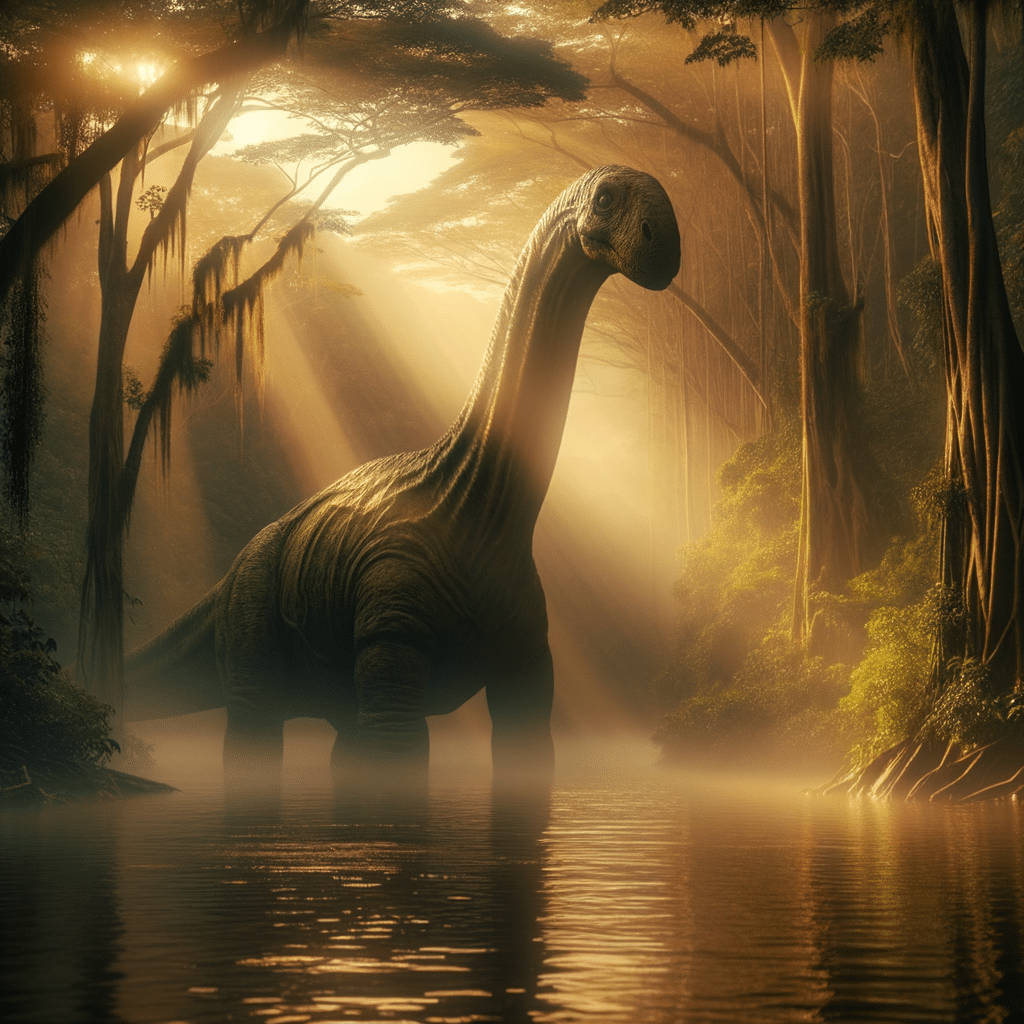
People claim to live in isolated regions of the Congo River basin, home to a fabled creature known as the Mokele-mbembe. The scientific community does not acknowledge the existence of this creature, yet it has gained recognition in the field of cryptozoology and in popular culture that focuses on living dinosaurs and extinct species. The Lingala language gives rise to the creature’s name, which translates to “one that stops the flow of rivers” or “ill-favored river creature.” People describe it as a monster resembling a sauropod, roughly the size of an elephant, but characterized by a long neck and tail. It is believed to be herbivorous because it spends a significant amount of time in marshes and rivers, where it consumes flora for sustenance.
Local folklore and mythology have long claimed that the Mokele-mbembe have been hiding in the Congo basin for many generations. Over a long period of time, indigenous peoples have spoken of a giant beast that lives in the swamps and rivers and periodically confronts the inhabitants. Other reports describe its skin as sticky, reddish-brown in color, and resembling the texture of a hippopotamus. Stories depict it as generally cautious, but potentially aggressive when threatened. Tiny trees, plants, ferns, and other aquatic flora from its marshy habitat are believed to make up the majority of its diet (Mackal, 1987).

Searching for Mokele-mbembe
Over the course of several decades, cryptozoologists, explorers, and researchers have embarked on a number of trips in the Congo basin in an effort to discover evidence of the existence of the Mokele-mbembe. On the basis of the accounts of native people, Captain Paul Newyn Wycherley undertook one of the earliest documented hunts for the creature, based on native people’s accounts. He journeyed along the Likouala and Kasai rivers in 1919 and 1920. Despite discovering large, unidentified traces, he was unable to locate the animal itself.
In 1976, the well-known cryptozoologist Roy P. Mackal made repeated journeys into the Congo’s swamps and jungles. During these expeditions, he recorded footprint casts and other intriguing data, but he did not find any confirmed sightings of Mokele-mbembe. After hearing stories from locals about a creature that resembled a dinosaur that lived in tunnels, Japanese scientists Koji Chujo and Kyosuke Takahashi went on an expedition to study certain regions of Equatorial Guinea later in the season of 1981 (Takabayashi, 1988). However, they were unable to find anything. In 1992, John Cavlitch and Bill Gibbons embarked on an excursion to Lake Tele, a distant body of water rumored to be home to the Mokele-mbembe. However, they did not find any evidence to support their claim.
Founded in 2001 and led by Canadian explorers Minnow Films, the Crypt Safari crew spent several months traveling along the Congo River. During this time, they listened to countless legends from local tribes concerning the creature. In 2009, researchers from the BBC carried out a search in the Kouilou region of the Congo, which received a lot of media attention. The mission came back empty-handed, despite the fact that they observed and documented some intriguing footprints and evidence. The majority of expeditions follow a pattern that is very similar: they search distant areas of the Congo basin, collect accounts of traditional folklore, and document gigantic footprints or other circumstantial signs, but they are unable to acquire definitive photographic or physical evidence of Mokele-mbembe’s presence. However, the strong allure and potential of discovering a living dinosaur almost certainly ensures the conduct of further expeditions into the heart of the Congo in the coming years (Nugent, 2016).
Individuals believe that the Mokele-mbembe is a probable surviving relic of sauropod dinosaurs from the Cretaceous period, despite the fact that there is no actual evidence to support the appearance of this creature. The vast and largely uncharted geography of the Congo basin may harbor small pockets of yet-to-be-discovered megafauna, according to hypotheses. On the other hand, the vast majority of paleontologists and zoologists believe that this is extremely improbable, considering the enormous size that such a population would require in order to continue existing (Loxton, 2012). Many people believe that the reported sightings could be the result of erroneous encounters with well-known animals like elephants and rhinoceroses, or even brief observations of geological structures due to poor viewing conditions.

Dinosaurs Still Alive?
The story of Mokele-mbembe perfectly aligns with the broader narrative, piquing interest in the possibility that some dinosaur species may have escaped extinction and persist in isolated regions of the earth today. The tremendous size of the Mokele-mbembe, in addition to its lengthened neck and tail, places it in the same category as the traditional body plan of sauropod dinosaurs such as Apatosaurus and Diplodocus. This makes it a strong contender for the “living dinosaur” category, which aims to spark imaginations.
The Congo basin, widely considered one of the planet’s most isolated and unexplored locations, boasts large swaths of lush rainforest and hazardous marshes. Due to this, it is a spot that seems tantalizingly conceivable as a potential location where relic dinosaur populations could perhaps continue to exist without being discovered. The indigenous people of the Congo have been passing down stories about the Mokele-mbembe for centuries. These stories lend the legend an aura of authenticity and timelessness that is in line with the concept that dinosaurs have survived to the present day (Emmer, 2010).
The Mokele-mbembe’s existence would be a notable example of some dinosaurs evading the catastrophic meteor hit that triggered the mass extinction event that occurred 66 million years ago. If the Mokele-mbembe is indeed a relic of the Sauropod lineage, then its existence would be a noteworthy example. Mokele-mbembe embodies that sense of excitement and mystery about what undiscovered megafauna might still be hiding in Earth’s most remote places, despite the fact that the majority of scientists regard the idea of living dinosaurs as unlikely. This lends credence to the notion that dinosaurs were never completely extinct.
Conclusion
Skeptics believe that the Mokele-mbembe is more consistent with mythology and folklore than it is with zoological reality. It is possible that stories about huge river behemoths serve as cultural metaphors for the difficulty of living a demanding life in a demanding environment. Nevertheless, it has been successful in capturing people’s imaginations and gaining fame in popular culture as the standard example of a living dinosaur. The creature’s existence and behaviors have sparked the production of numerous works of fiction, television shows, and documentaries. Ultimately, until conclusive evidence emerges, the Mokele-mbembe is likely to remain an intriguing manifestation of nature.
References
Emmer, R. (2010). Mokele-mbembe: Fact Or Fiction?. Infobase Publishing.
Loxton, D. (2012). Mokele Mbembe!. Skeptic (Altadena, CA), 17(3), 65A-65A.
Mackal, R. P. (1987). A Living Dinosaur?: In Search of Mokele-Mbembe. Brill Archive.
Nugent, R. (2016). Drums Along the Congo: On the Trail of Mokele-Mbembe, the Last Living Dinosur. Open Road Media.
Takabayashi, T. O. K. U. H. A. R. U. (1988). The First Japanese-Congolese Mokele-Mbembe Expeditions. Cryptozoology: Interdisciplinary Journal of the International Society of Cryptozoology, 7(67), 63.



Leave a Reply