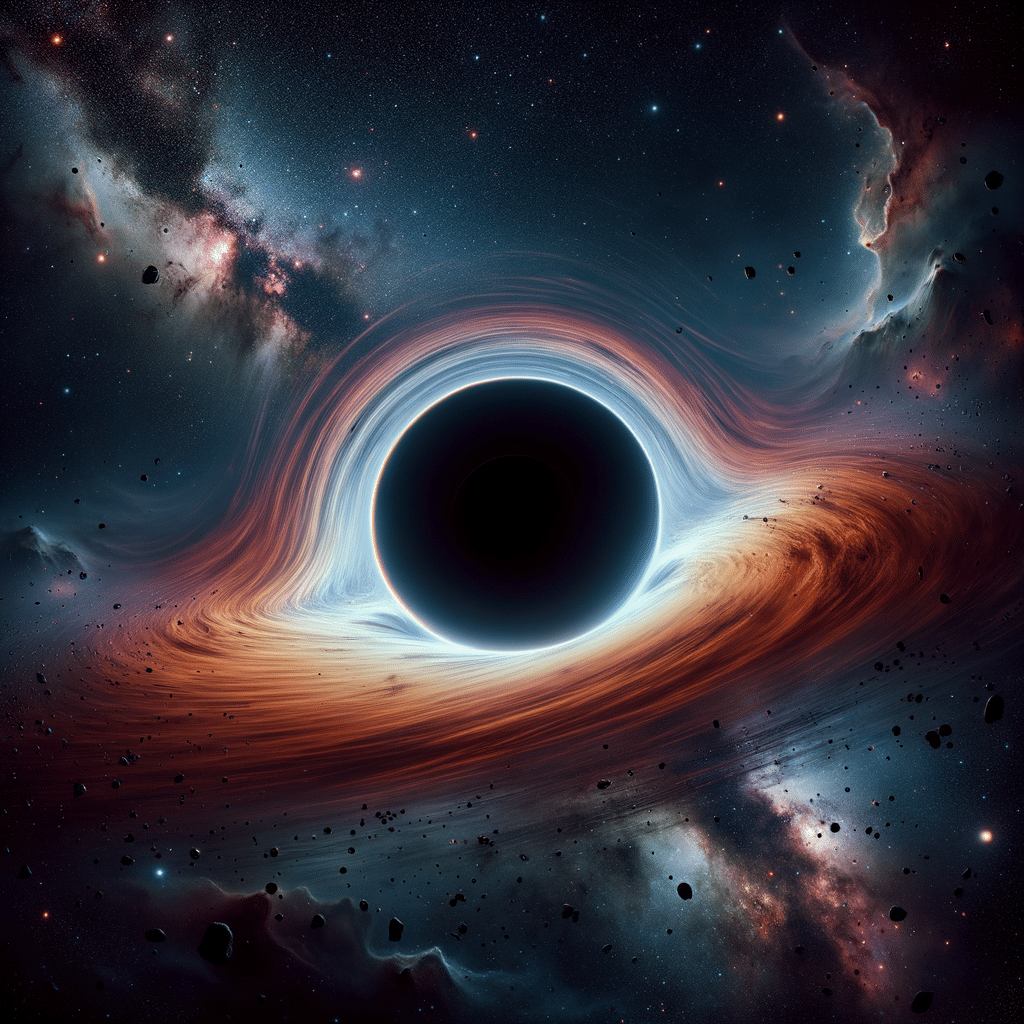
Few objects in the vast cosmos captivate people’s attention and provoke both scientific research and paranormal conjecture like black holes. These cosmic giants, where space and time themselves disintegrate, have emerged as an intriguing nexus of paranormal beliefs and established science. Scholarly research and paranormal speculation continue to focus on black holes as science strives to unravel their mysteries.

Black Holes Description
Space regions known as black holes have such intense gravity that nothing can escape from them—not even light—once it crosses the event horizon. These cosmic phenomena arise when enormous stars die and collapse inward, creating a singularity, a point of infinite density. John Michell first introduced the idea of an object so huge that light cannot escape in 1783; however, he referred to them as dark stars. Albert Einstein’s general relativity theory established the theoretical foundation for understanding black holes in 1915, although physicist John Wheeler did not coin the term black hole until 1967 (Crothers, 2006).
There are important turning points in the scientific history of black holes. In 1916, Karl Schwarzschild used Einstein’s equations to create the first mathematical solution that described black holes. Stephen Hawking’s seminal research in the 1970s enabled the discovery that black holes generate radiation, now known as Hawking radiation. Humanity made history in 2019 when the Event Horizon Telescope took the first-ever picture of the shadow cast by a black hole in the galaxy M87 (Volonteri & Bellovary, 2012).
A pillar of many paranormal hypotheses is Hawking radiation, which postulates that black holes gradually release particles before evaporating. Some supernatural theorists interpret this event as evidence of black holes’ ability to alter and transfer energy between dimensions. They contend that black holes may be able to transfer awareness, spiritual energy, or even souls across spatial borders if they are able to emit radiation in spite of their strong gravitational attraction (Visser, 2003).
Paranormal Theories
The idea that black holes are dimensional portals is one of the most enduring paranormal theories about them. Some theorists propose that these cosmic occurrences are portals to alternate realms or parallel universes. Science fiction has not only popularized this idea, but some metaphysical groups have also found it appealing. According to some theorists, black holes’ tremendous twisting of spacetime may allow for the passage across parallel worlds by constructing bridges between other realities. These theories frequently cite wormholes, also known as Einstein-Rosen bridges, as possible scientific evidence for their assertions (Bhattacharjee, 2017).
The potential for time travel through black holes has captivated people all across the world. Paranormal aficionados go beyond Einstein’s ideas, which imply that time moves differently near black holes because of strong gravitational influences. They suggest that because of their powerful gravitational fields, black holes might act as cosmic time machines that enable items or creatures to travel through time in either a forward or backward direction. Some claim that advanced civilizations are already using black holes to manipulate time, explaining the numerous UFO and paranormal occurrences observed on Earth (Deutsch & Lockwood, 2016).
Internal civilizations represent an intriguing subgroup within the realm of black hole ideas. According to certain theories, advanced extraterrestrial life may have discovered a method to live inside or near black holes by taking advantage of their special characteristics for sustenance and safety. According to these hypotheses, even if the harsh environment around black holes is lethal to humans, it may be home to completely new kinds of life or consciousness. Some even think that whole cosmic cultures might exist outside the event horizon, imperceptible to our standard observational tools.
The mystical and spiritual explanations of black holes present another level of paranormal belief. Some mystics and spiritual seekers view black holes as catalysts for cosmic enlightenment. They propose that a transcendence of ordinary consciousness might be associated with the total breakdown of physical laws within black holes. These ideas occasionally draw on those from quantum mechanics, speculating that awareness itself could make it through a black hole and emerge in a different form.
In particular, paranormal researchers have seized upon Hawking radiation as purported proof of the mystical nature of black holes. They propose that the separation of particle-antiparticle pairs at the event horizon, which is a quantum phenomenon, is a physical representation of spiritual separation and reconciliation. Some mystics compare the slow evaporation of black holes caused by Hawking radiation to different religious ideas of reincarnation and spiritual transformation, interpreting it as a cosmic cycle of death and rebirth. Some have suggested that black holes maintain magical ties with everything they have ever swallowed, forming a cosmic network of consciousness that transcends space and time because of the quantum entanglement inherent in Hawking radiation (Visser, 2003).
Recent particle physics research has also raised concerns about the paranormal. There have been apocalyptic predictions about the possible repercussions of the Large Hadron Collider tests, which some people were afraid might produce miniature black holes. Some people believe that these experiments have the potential to destroy reality, unleash otherworldly beings, or create doors to evil universes. Despite scientists constantly clarifying the precautions and physical restrictions to avoid such situations, these anxieties persist in some cultures.
Beyond these particular hypotheses, some aficionados of the paranormal suggest that black holes are cosmic beings or sentient entities that have a profound impact on human consciousness over enormous distances. Others assert that black holes’ strong gravitational attraction also impacts spiritual energy, potentially confining souls or facilitating communication with other worlds. These supernatural interpretations frequently entwine numerous cultural and religious ideas regarding cosmic forces and their impact on human existence.
Hawking radiation has been especially appealing to paranormal theorists because it incorporates quantum physics, a field already recognized for its paradoxical qualities. They contend that supernatural or paranormal events could manifest in these harsh environments if standard physics collapses at the quantum level close to black holes. Some even propose that Hawking radiation could be a means of communication with non-physical entities or carry encoded information about other dimensions.

Skepticism
From the standpoint of skepticism, black hole paranormal hypotheses offer an intriguing example of how scientific enigmas can give rise to supernatural conjecture. The main problem with paranormal black hole hypotheses is their inability to falsify. Although these ideas frequently employ language that sounds scientific, they usually make assertions that are not amenable to scientific testing or verification. There is no quantifiable method to support or refute paranormal researchers’ claims that black holes act as consciousness gateways or dimensional portals.
Skeptics point out that a lot of hypotheses about paranormal black holes are based on misconceptions or incorrect interpretations of real physics. For example, Einstein-Rosen bridges (wormholes) are theoretical concepts even if they are mathematical solutions. The common paranormal assertion that black holes could function as time machines or dimensional portals often overlooks the fact that any object approaching a black hole would face forces that would destroy it long before it reached any hypothetical gateway.
The idea that highly developed societies could reside inside black holes is one example of how paranormal notions frequently ignore fundamental physics. The intense radiation and gravitational pull would make it impossible for any form of life to survive. Skeptics contend that proponents of these theories ignore the basic physics that would refute their assertions and instead deliberately cherry-pick scientific ideas.
Many paranormal black hole hypotheses exhibit what skeptics refer to as quantum mysticism—the improper use of quantum mechanical ideas to bolster supernatural assertions. Although there are odd and counterintuitive phenomena in quantum mechanics, paranormal researchers frequently take these ideas beyond their scientific bounds. The idea that Hawking radiation demonstrates spiritual ties or consciousness transfer exemplifies this kind of appropriation of scientific ideas.
Additionally, skeptics point out that paranormal black hole ideas frequently adhere to well-known supernatural thought patterns. Common motifs in supernatural belief systems throughout history include the belief in hidden realms or dimensions, the attribution of consciousness or spiritual importance to natural phenomena, and the relationship between cosmic events and human consciousness. These ancient tendencies of magical thinking find a new emphasis in the intense and strange nature of black holes.
Anxiety over scientific progress frequently sparks fear-based notions concerning black holes, such as worries that the Large Hadron Collider would release demons or create black holes that would kill the entire planet. Skeptics point out that these anxieties usually result from a combination of pre-existing supernatural beliefs and an ignorance of the scope and character of scientific research. According to skeptics, the continued existence of paranormal black hole beliefs in spite of contradicting scientific data implies that they serve cultural or psychological purposes rather than being accurate representations of real-world physical phenomena. These ideas satisfy people’s need for spiritual meaning in natural occurrences, offer straightforward, understandable explanations for complicated science, and offer solace in the face of cosmic mystery.
Skeptics agree that there is one benefit to paranormal notions about black holes, though: they show how interested the general public is in cosmic occurrences and occasionally encourage them to learn more about real astrophysics. The difficulty is in directing this curiosity toward scientific knowledge while preserving the awe that initially captivates people with these cosmic enigmas. Skeptics contend that paranormal conjecture is not nearly as fascinating as the actual science of black holes, with their bizarre physics, mind-bending consequences, and true mysteries. Our ability to detect, measure, and begin to comprehend these extraordinary cosmic objects demonstrates the victory of human reason and scientific methods over supernatural beliefs.
The existence of conflicting paranormal hypotheses regarding black holes, many of which contradict one another despite claiming the same scientific foundation, further damages their credibility from a skeptical standpoint. This demonstrates how these theories frequently represent societal and individual attitudes rather than empirical facts. Black hole theories come from a variety of imaginative places.
Conclusion
The discrepancy between Black Hole paranormal beliefs and scientific knowledge illustrates humanity’s insatiable curiosity. Supernatural interpretations endure, offering substitute explanations that appeal to individuals looking for significance beyond the realm of pure physics, even while scientists continue to uncover astounding discoveries about these cosmic occurrences via meticulous investigation and observation. As our knowledge of black holes advances, they continue to serve as reminders that the universe may arouse both scientific curiosity and awe and that there are still mysteries in the cosmos that test our comprehension of reality itself.
References
Bhattacharjee, S. (2017). Science Behind Paranormal Activities. International Journal of New Technology and Research (IJNTR), 3(3), 108-112.
Crothers, S. J. (2006). A brief history of black holes. Progress in Physics, 2, 54.
Deutsch, D., & Lockwood, M. (2016). The quantum physics of time travel. Science Fiction and Philosophy: From Time Travel to Superintelligence, 370-383.
Visser, M. (2003). Essential and inessential features of Hawking radiation. International Journal of Modern Physics D, 12(04), 649-661.
Volonteri, M., & Bellovary, J. (2012). Black holes in the early Universe. Reports on Progress in Physics, 75(12), 124901.



Leave a Reply