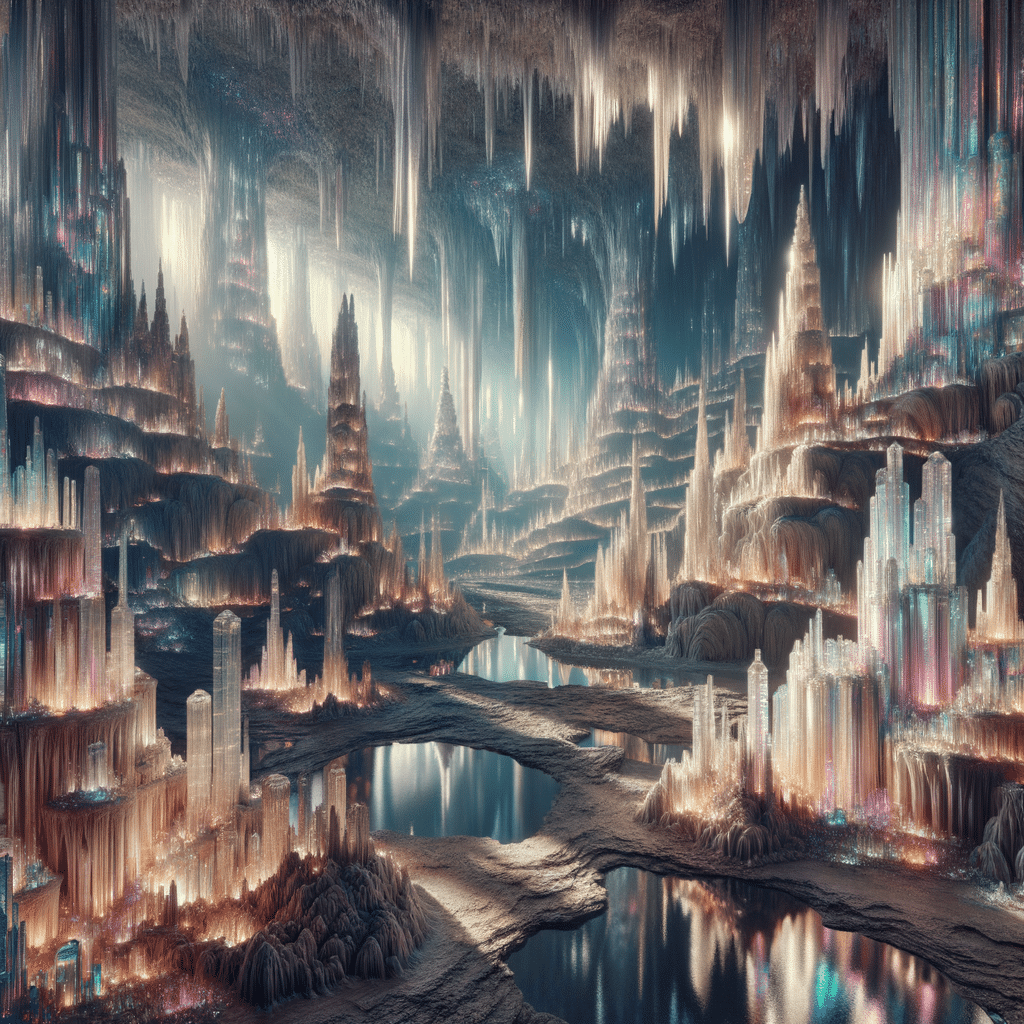
For ages, the relationship between crystals and interdimensional gateways and portals has fascinated people, permeating both contemporary popular culture and old mythology and spiritual beliefs. The connection between crystalline structures and dimensional gates continues to inspire both mystical practices and entertainment culture, from imaginary gateways between worlds to naturally existing geometric forms in the soil. This essay examines this topic.

Description
Crystals are solid materials whose parts, such as atoms, molecules, or ions, are arranged in a highly ordered microscopic structure, forming a crystal lattice that extends in all directions. These geometric patterns create distinct shapes and properties, leading to various optical, electrical, and metaphysical associations. Because of their piezoelectric characteristics and their widespread use in spiritual rituals across many cultures, quartz crystals in particular have attracted a lot of interest (Starza, 2022).
In both mythology and contemporary fiction, dimensional portals are hypothetical openings that offer entry to multiple universes and dimensions or link disparate points in spacetime. People often perceive these routes as geometric tunnels that challenge accepted physics, shimmering gateways, or swirling vortices. The idea of interdimensional travel has been a mainstay of conjecture regarding parallel worlds and cosmic connectivity, despite the lack of scientific proof.
Both contemporary New Age rituals and a number of older traditions root the idea that crystals can open gateways. Many primitive societies regarded certain crystals as keys to the spirit world. Ancient Egyptian literature mentions crystals as a means of divine communication. According to modern spiritual traditions, certain crystal formations—especially clusters of quartz and terminated points—have the ability to concentrate and intensify energy in order to produce portals between dimensions. Some followers believe that they can create energy vortexes that facilitate communication or travel across dimensions by arranging crystals in geometric patterns.
History
Historical folklore from many cultures frequently describes crystals as dimensional portals. Native American beliefs describe sacred crystals that may provide access to the spirit world, while Celtic legends describe crystal caves that lead to the fairy kingdom. Medieval European alchemists documented theories about the use of crystalline structures to access other planes of reality. These beliefs frequently intertwined with stories of mystics and shamans using crystals for dimensional exploration and astral projection.
Celtic and Native American crystal folklore reveals rich customs around these enchanted portals. Crystal caves were thought to be the natural entrances to Tír na nÓg, the Land of the Young, which was home to the Tuatha Dé Danann and fairies, according to Celtic legend. Arthurian legends tell the most famous story of Merlin finding refuge and prophecy in the Crystal Cave. According to descriptions, the walls of these caves glistened with quartz and other minerals, evoking an unearthly ambiance where the boundary between realms became increasingly hazy (Daimler, 2014).
Crystal caves in Cornwall and Wales were especially prominent in Celtic folklore, with tales of miners discovering enigmatic passageways strewn with crystals that purportedly led to fairy kingdoms. These stories frequently included time distortion, whereby travelers to these caves would emerge to discover that, while just hours appeared to have passed in the crystal realm, years had passed in the mortal world.
Different tribes and geographical areas held different views regarding crystals as portal openings in Native American cultures. The Cherokee revered quartz crystals as a means of communication between the spirit world and medicinal practitioners. The Cherokee believed these crystals, known as Ulunsuti, to be fragments of the first sun, capable of bridging the spiritual and material realms. In ceremonies, medical professionals would use these crystals to get spirit guides’ predictions and healing expertise (Hall, 2012).
Hopi traditions utilize crystals to establish connections with various spiritual realms, often in conjunction with kivas, or ceremonial rooms. Some tribes in the Southwest held similar beliefs, reverencing natural crystal formations in caves as sites where the world-world boundary was especially permeable. The Navajo continued their traditions of employing crystal gazing for spiritual journeying and divination, using specific crystals believed to have been given by the Holy People. The Navajo believed these crystals to be genuine portals, enabling spirits to navigate and engage with the material world, rather than mere tools for observing other realms.
When compared to modern New Age ideas about crystal portals, these indigenous beliefs were firmly rooted in complex cosmological systems and were usually only shared by spiritual leaders who had been trained in-depth on how to use these powerful tools. They handled the actual crystals with utmost respect, frequently stored them in holy bundles, and utilized them only in certain rituals, adhering to strict guidelines.

Modern Impact and Skepticism
The idea of portals and crystals has had a big impact on popular culture, especially in fantasy and science fiction. For instance, in the 1974 television series Land of the Lost, crystalline pylons served as control mechanisms and temporal gateways for the mysterious dimension that imprisoned the Marshall family. An essential component of the show’s mythology, these light crystals could be controlled to create portals to other eras and dimensions. Crystals became a recurrent theme in portal-based stories thanks to this depiction (Larsen, 2016).
A wide range of other works, including the Dark Crystal movie, video games, and novels, frequently use crystals as keys, power sources, or real portals to other realms. This cultural embedding has established a feedback loop between traditional beliefs and contemporary narrative, strengthening the public’s mental association between crystalline structures and interdimensional transit.
Although many different cultural and spiritual beliefs firmly ingrain the link between crystals and interdimensional portals, modern science does not support it. There are a number of intriguing and scientifically proven characteristics of crystals that have probably contributed to their ethereal reputation over time. These include their highly ordered atomic lattice structures, complex light refraction and reflection capabilities, a variety of electromagnetic properties, and piezoelectric effects, which occur when crystals produce electricity under pressure. Crystals also display intriguing phenomena at the quantum level that are consistent with contemporary physics concepts.
However, conjecture and religious belief, rather than scientific reality, firmly anchor the more fantastical claims about crystals’ powers, such as opening dimensional portals, channeling interdimensional energy, distorting space-time, or enabling interdimensional travel. Although crystals exhibit fascinating quantum characteristics, these occurrences only happen at the atomic level and do not translate into the macro-level dimensional effects required to construct portals or dimensional gates.
The scientific community has not found any peer-reviewed evidence to support the idea that crystals can form temporal or spatial portals. Anecdotal evidence and spiritual beliefs, rather than empirical data or repeatable laboratory outcomes, are the main sources of support for claims of crystal-portal links. With their geometric patterns and ordered atomic arrangements, crystals’ highly structured nature probably helped explain why they have historically been associated with power and dimensional alteration in a variety of cultures. Despite its cultural significance, current knowledge about quantum physics and crystalline characteristics does not support this relationship. In this intriguing field of human conjecture, the gap between confirmed crystal qualities and professed portal-creating abilities is still unresolved by scientific evidence, underscoring the difference between cultural beliefs and empirical reality (Saito, Nojima & Iwasa, 2016).
Conclusion
The connection between portals and crystals illustrates an intriguing nexus between spirituality, natural science, and artistic expression. The lasting popularity of the idea shows humanity’s enduring fascination with the potential of accessing other realms of existence, even if the scientific world does not back assertions that crystals open dimensional gates. The crystal-portal connection has evolved from ancient mystical traditions to contemporary entertainment, encouraging future generations to investigate the limits between the known and the unknown.
References
Daimler, M. (2014). Pagan Portals-Fairy Witchcraft: A Neopagan’s Guide to the Celtic Fairy Faith. John Hunt Publishing.
Hall, J. (2012). Crystals and Sacred Sites: Use Crystals to Access the Power of Sacred Landscapes for Personal and Planetary Transformation. Fair Winds Press (MA).
Larsen, K. (2016). Elsewhere and elsewhen: Parallel universes and the dangers of interdimensional travel in Land of the Lost. Antae, 3(1), 87-99.
Saito, Y., Nojima, T., & Iwasa, Y. (2016). Gate-induced superconductivity in two-dimensional atomic crystals. Superconductor Science and Technology, 29(9), 093001.
Starza, L. (2022). Pagan Portals-Scrying: Divination Using Crystals, Mirrors, Water and Fire. John Hunt Publishing.



Leave a Reply