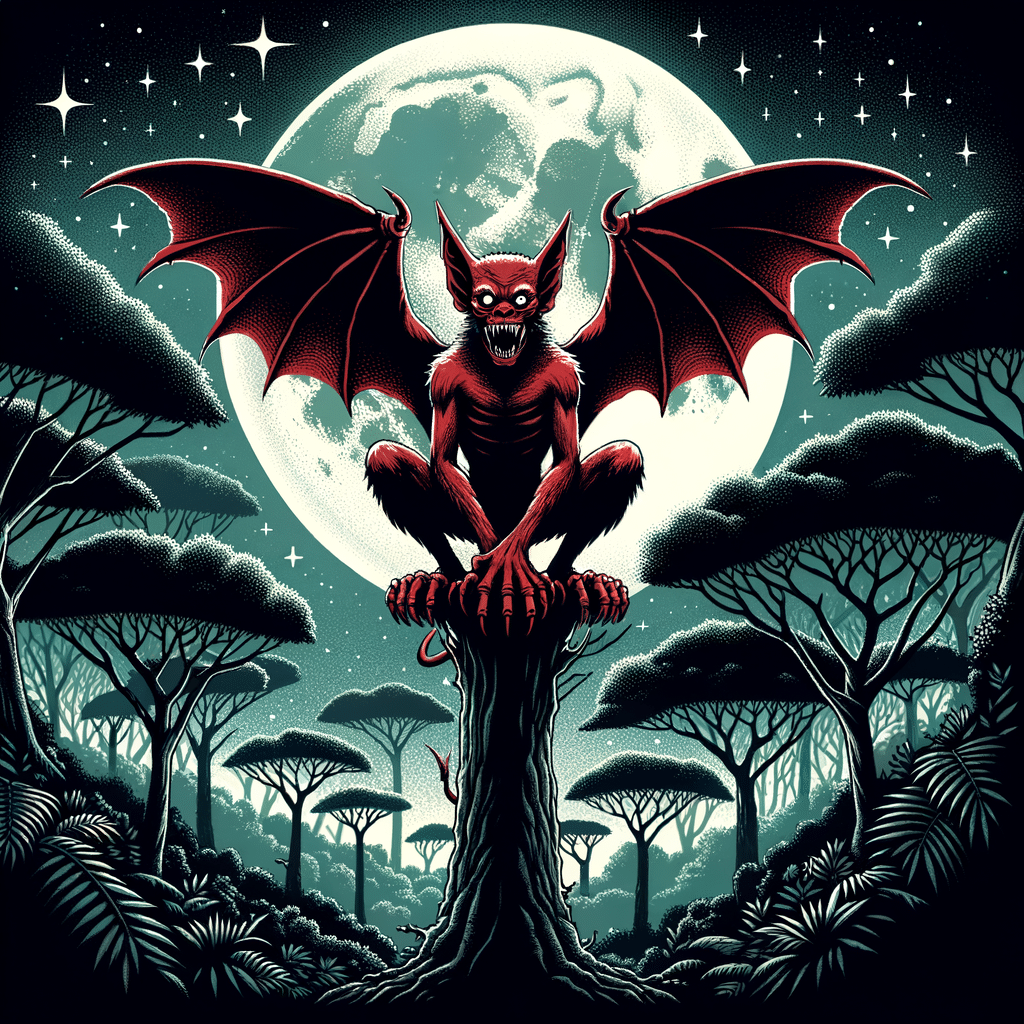
Among the most recognizable vampire-like creatures in world folklore is the Sasabonsam, a terrifying entity from West African mythology, especially among the Ashanti people of Ghana. With its distinct look and evil character, this forest-dwelling creature has frightened and captivated generations, acting as a warning and a testament to the close relationships that exist between African communities and their forest habitats.

Description
People describe the Sasabonsam as a humanoid creature that resembles a bat and can grow up to 20 feet in height. Iron teeth or fangs, blood-red eyes, and incredibly long legs with hooks or claws at the extremities are some of its most remarkable characteristics. Its ability to use these hooked feet to hang upside down from trees, ready to capture unsuspecting tourists, is perhaps its most unique feature. According to some reports, the creature has enormous, leather-like wings and long, matted hair covering its body (Dalgish, 1980).
People frequently depict the Sasabonsam as acting violently against them. It is known to capture and devour hunters who venture too far into the forest, particularly at night. According to legend, the beast actively seeks to destroy anyone who might shield others from its predators, especially hunters and priests. Unlike many other supernatural beings, the Sasabonsam, despite possessing extraordinary powers, is considered a physical being rather than a spirit.
From pre-colonial periods to the present, the Sasabonsam myth changed to reflect shifting social situations. The creature’s original role was that of a woodland guardian, warning of the perils of going too far into unexplored terrain. Because the Sasabonsam was believed to defend sacred forests from outsiders, some people started to identify it with resistance to foreign encroachment throughout the colonial era. Some people see the Sasabonsam as a protector of nature against exploitation, reflecting the myth’s current environmental preservation concerns.
All around the world, mythology features similar animals, indicating common human fears and narrative styles. The Cambodian Kephn are tree-dwelling predators like the Sasabonsam. Though more humanoid, the Filipino Manananggal also preys on unsuspecting tourists. Despite being more well-known, the Eastern European vampire legend is similar to the Sasabonsam in a number of ways, including its nocturnal habits and violent nature. These similarities show how mythological reactions to common human anxieties of the dark and the unknown are comparable throughout cultures (Konstantinos, 1996).

Environmental and Cultural Preservation
As African communities deal with more environmental issues and cultural pressures, the Sasabonsam’s relationship to environmental conservation and cultural preservation has changed dramatically, especially in the late 20th and early 21st centuries. To conserve the environment, modern versions of the Sasabonsam tale reflect current ecological issues. We have rewritten traditional tales of the beast attacking people who venture too far into the forest as warnings against mining and deforestation. Storytellers and environmental activists have depicted the Sasabonsam as a protector against people who would destroy the forest for financial gain in Ghana and the neighboring areas, where illicit mining (galamsey) has seriously harmed the ecosystem. Some legends now describe the creature as exclusively targeting illegal miners and logging enterprises, rather than traditional hunters.
Cultural preservation holds equal importance. As urbanization and Western influences continue to impact traditional African civilizations, the Sasabonsam narrative has evolved into a means of conserving indigenous knowledge systems. The deep woodland where the creature lives is a metaphor for traditional sacred areas that are becoming more and more endangered due to development. Contemporary storytellers use the Sasabonsam story to emphasize the importance of upholding customary forest management techniques and honoring sacred groves, which are forest regions historically preserved for religious purposes (Koranteng-Green, 2018).
Through a number of intricate cultural systems that combine traditional beliefs with sensible environmental care, the Sasabonsam myth encourages the conservation of forests. The creature’s indicated habitat preferences naturally buffer sensitive forest regions. These beliefs have historically inhibited overexploitation of these ecologically important zones, as the Sasabonsam is believed to inhabit the deepest regions of old-growth woods, particularly near giant trees and dense canopy areas. By avoiding heavy hunting or logging in certain regions, people would unintentionally protect biodiversity hotspots and preserve the integrity of the forest (Adom, 2019).
The myth also enforces temporal limitations on forest use. Reports indicating the Sasabonsam’s peak activity at night have led to the restriction of nighttime forest operations, inadvertently safeguarding nocturnal creatures and enabling the forest ecosystem to recover from human activity during the day. This conventional method of time management is similar to contemporary conservation techniques that impose limitations on activities during crucial wildlife times.
People believe that the Sasabonsam is responsible for selective targeting, acting as a complex regulatory mechanism. The myths state that the beast specifically hunts out people who enter the forest with the intention of causing destruction or who take more than they need. This part of the narrative opposes exploitative behavior and encourages the sustainable use of resources. Building on this basis, contemporary environmental educators now use the Sasabonsam story to illustrate ideas like responsible resource use and sustainable yield.
Sasabonsam and Storytelling
Traditional storytellers, known as griots, have preserved and modified the Sasabonsam narrative over the years in various West African societies. Their transmission and preservation techniques provide intriguing insights into the continued relevance of oral traditions in modern-day African society. This creature can be used for several different narrative purposes (Bunson, 2000).
Griots traditionally told Sasabonsam stories during evening parties. They would captivate their audience with certain vocal styles, dramatic pauses, and call-and-response rhythms. Instead of just recounting stories, these storytellers would tailor their tales to the audience and the societal issues of the day. For example, an adult story can concentrate on deeper themes of environmental stewardship or societal responsibility, while a children’s tale might highlight the creature’s function as a social boundary enforcer.
Current storytellers have modified these age-old techniques for use on modern platforms. Radio shows in Ghana and Côte d’Ivoire tell Sasabonsam stories in both native languages and English, reaching urban listeners who might otherwise become disconnected from these cultural stories. Using the Sasabonsam’s traditional dread to encourage respect for protected areas, some modern storytellers have included the animal in instructional programs about forest conservation.
Professional storytellers at cultural events and educational institutions have assumed the role of cultural interpreters. This is helping audiences who might otherwise reject the Sasabonsam as superstitious understand its deeper meaning. They frequently make comparisons between the contemporary scientific understanding of forest ecosystems and the traditional ecological information ingrained in the myth.
The Sasabonsam has achieved modest but increasing notoriety in popular culture. Despite not being as prevalent as other mythological animals, it has made appearances in a variety of media, including video games and horror novels. Writers frequently incorporate the Sasabonsam into contemporary African stories as a symbol for cultural preservation or environmental conservation. The creature has also appeared in documentaries about African folklore and served as the inspiration for character designs in a number of fantasy video games.
Conclusion
The Sasabonsam’s lasting influence demonstrates the relevance of traditional African mythology in contemporary society. It continues to enthrall audiences as a multifaceted character who represents moral transgression, environmental hazards, and fears of the unknown while offering insights into West African cultural values and their historical development. The myth of Sasabonsam serves as a reminder that, despite having basic parallels with mythical traditions around the world, every society creates its own distinct means of comprehending and responding to the natural world.
References
Adom, K. (2019). Indigenous knowledge for environmental sustainability education in Ghana: Myths. Agriculture & Food: E-Newsletter, 1(3), 43-45.
Bunson, M. (2000). The Vampire Encyclopedia. Gramercy.
Dalgish, G. M. (1980). A Dictionary of Africanisms-Some Notes. Dictionaries: Journal of the Dictionary Society of North America, 3(1), 100-105.
Konstantinos. (1996). Vampires: The Occult Truth. Llewellyn Worldwide.
Koranteng-Green, E. K. (2018). The Multiplicity of Ahonhom (Spirits) in the Akan Spiritual Cosmology. Journal of Philosophy, Culture and Religion, 39, 101-105.




Leave a Reply