
Deep inside the rich forests of North America are cryptid creatures that have caught human imagination and inspired innumerable horror and wonder stories. From the terrible cries of the Dogman to the towering silhouette of Bigfoot and the eerie presence of the Wendigo, these beasts have become firmly ingrained in folklore, witness stories, and traditional customs. Although some reject these species as mere legends, many eyewitnesses nevertheless document encounters that defy our knowledge of wilderness life.

The Creatures
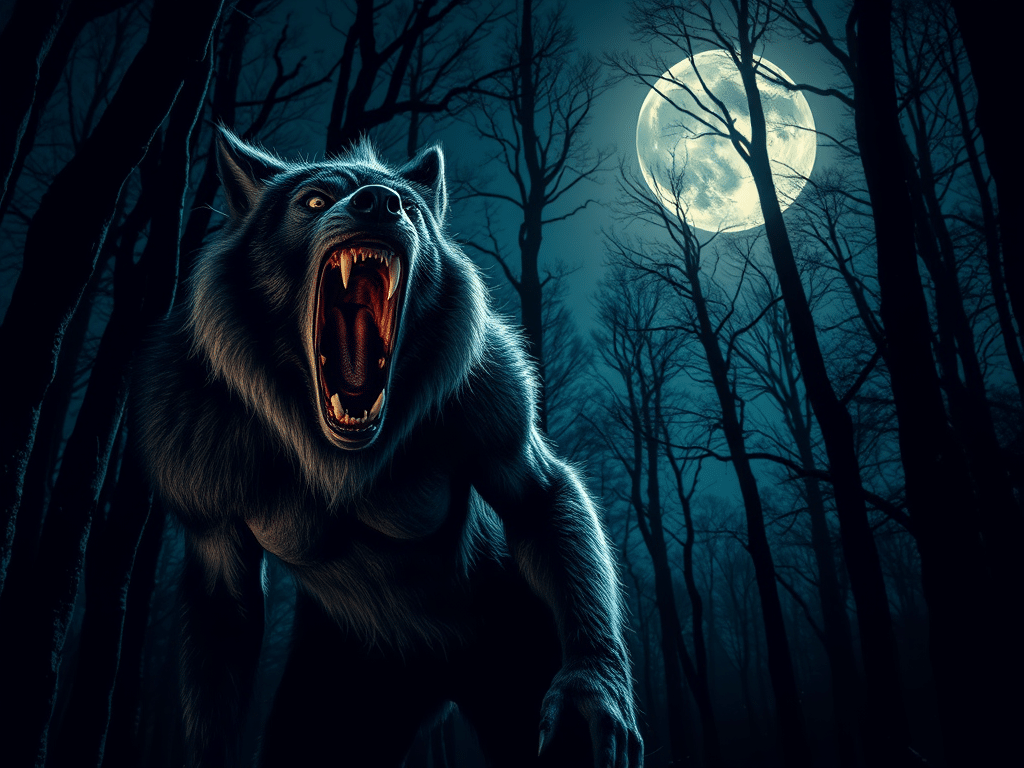
Mostly reported in Michigan and Wisconsin, the Dogman is seven to eight feet tall with a canine head atop a muscular, humanoid torso. Witnesses describe the Dogman’s fur as thick and dark, varying from deep black to dark brown, with some mentioning the presence of silver-tipped guard hairs. Perhaps its most terrifying feature is its eyes, which emit a terrible amber or yellow in darkness and are believed to possess an unpleasant intelligence. With its hands ending in retractable, razor-sharp claws and feet resembling those of a big wolf, the monster leaves unique tracks that baffle both trackers and researchers. Its facial features blend almost human-like expressions with wolf-like traits, including a strong muzzle loaded with sharp fangs and a great bite force. Its ability to stand and walk both as a quadruped and biped is well-known among witnesses; it moves between the two poses with ease (McMahon, 2024).
Covering eight to ten feet tall, Bigfoot—also known as Sasquatch—is characterized as a huge, ape-like creature with reddish-brown or black fur. Reportedly thicker and longer across the shoulders and head, the creature’s fur produces a unique shape. Its most unique characteristics are a flat nose, clearly human-like feet measuring up to 24 inches in length, and a strong forehead ridge. Often reaching to the knees, the creature’s shoulders are remarkably broad and feature long, strong arms that dangle lower than those of a human. The creature’s head, which sits straight on its shoulders and shows little neck, has a distinct point. Despite its frightening scale, witnesses claim that the creature has a somewhat elegant walk and can travel stealthily through deep vegetation. Often noted by witnesses as a combination of wet dog, rot, and musk, Bigfoot smells clearly and powerfully (Coleman, 2009).
Based on customs of Algonquian-speaking peoples, the Wendigo is maybe the most horrific of the three. Usually featuring an emaciated, skeleton person standing up to fifteen feet tall, descriptions highlight ashen, stretched skin drawn tightly over obvious bones. Its enormous antlers, bent and blackened from decay, often resemble those of a mature elk, crowning a skull-like head with sunken, blazing eyes that seem to flutter like dying embers. The creature’s always-skinny look reflects its ravenous appetite for human flesh. People describe its limbs, arms, and legs as unusually thin and lengthy, with joints bending in unimaginable directions. The creature’s ribs are easily seen through its tight, grayish skin; its fingers finish in long, ebony talons. Some stories have the Wendigo with ice crystals developing on its body and frost spreading across adjacent surfaces as it moves (Jusiak, 2015).

Creature Behavior
Complex and territorial predators are revealed by dogman behavior patterns. Often marking their boundaries with deep claw marks on trees and unique howls combining wolf-like traits with nearly human-like vocalizations, these animals are known to establish and defend particular areas. Often adopting complex ambush techniques and displaying the capacity to forecast and intercept prey’s escape paths, they show amazing intelligence in their hunting and stalking actions. Witnesses say these entities follow hikers for kilometers, observe from tree lines, and sometimes approach cottages or automobiles with seemingly natural curiosity. Dogmen regularly perform intimidating actions during contacts, including standing straight to show their full height, baring their teeth, and deep, menacing growls. They hardly make physical contact, though, which suggests they might be more concerned in establishing dominance than in inflicting damage.
Bigfoot behavioral characteristics point to a highly intelligent, social species that deliberately avoids human interaction while keeping intricate family units. These entities use a range of vocalizations, including the well-known wood knocks, whoops, and long howls that might travel kilometers across woodland terrain. They show tool use in the form of well-built stick constructions that seem to be territorial markings or shelter frames and stripped branches used as probing tools. Tracking food supplies like berry patches, fish runs, and game animals, Bigfoot groups sometimes follow seasonal migration patterns. Their social system seems to consist of organized group movements and member injury care. When they come across people, they usually use avoidance techniques, including hiding behind trees, making distracting noises, or leveraging their amazing capacity to remain immobile for long lengths of time (Newton, 2011).
The Wendigo behaves mostly in a predatory and supernatural manner. Wendigos, unlike other creatures, are claimed to be converted people cursed by cannibalism and avarice, leading to an unquenchable hunger always present. They are particularly active in the winter and during famine when their hunting becomes more ferocious. These creatures have extraordinary mimicking skills, able to replicate human voices, animal noises, and even the sounds of distressed children to attract prey. Their hunting techniques show a terrible intellect, sometimes isolating possible victims by means of psychological warfare before to strike. Wendigos are said to play with their prey, employing several supernatural means—including disorientation, false trail creation, and hallucinations—to cause bewilderment and hopelessness. Often accompanying their presence are unexpected temperature changes, inexplicable storms, and extreme fear among possible prey.
Though some stories point to a complicated relationship, interactions between these cryptid creatures themselves are little known. Though both are claimed to fear and flee from the sight of the Wendigo, Native American customs tell of Bigfoot and Dogman avoiding each other’s domains. Some observers said they heard simultaneous vocalizations from several species, implying possible territorial conflicts or communication.
Safety in the Woods
Several safety precautions are advised for anyone exploring regions where these cryptid creatures are reported. Always go in groups and keep awareness of your surroundings, especially in the morning and evening when activity is apparently most common. Carry several light sources and create consistent noise to prevent surprising any life. Traditionally, people carry holy herbs like tobacco or sage, which some say provide protection, especially against the Wendigo.
For those exploring places where these species have been documented, thorough safety precautions are absolutely vital. Travel in groups of three or more always; power in numbers has always worked against all three monsters. Always be vigilant of your surroundings, especially in the morning and evening when activity is supposedly highest. Children should be familiar with fundamental wilderness safety rules, including keeping close to the group and instantly answering calls (Fiedeldey, 1994).
Create a strong communication schedule before visiting any far-off location. If possible, carry a variety of communication devices, including satellite phones, as reports of these species often occur in areas with insufficient cellular coverage. Keep consistent contact with someone outside your group who has your exact position and intended path. Carry a variety of light sources, such as powerful torches and headlamps with spare batteries, as all three cryptid creatures are known to be more active in low-light environments.
To prevent startling any critters, make your presence known by consistent noise—that of chatting, singing, or bell carrying. But if you hear odd noises, especially human-like calls—particularly pertinent to Wendigo encounters—do not react or investigate. Indigenous customs advise bringing holy plants like sage, tobacco, or sweetgrass to fend off these entities, especially the Wendigo. Certain believers also advise carrying silver things, which supposedly deter Dogmen.
When camping in the woods overnight, set up a defensive campground. If at all feasible, arrange several light sources around your campsite and keep a fire burning all through the night. Arrange tents in a circle instead of a line, with inward-facing entrances. Food smells might draw these animals; hence, store it in bear-resistant containers and hang it far from your tent. To let you know about any approaching entities, think about arranging bells or noisemakers all around your perimeter.
Should you come across any of these scryptid creatures, keep cool and steer clear of quick motions. Avoid running away, especially in situations involving Dogman and Wendigo, as this can trigger their predatory tendencies. Back away gently and keep visual contact; avoid direct eye contact since this could be seen as a challenge. Raise your arms and stand close to one another to give your group more apparent size. Some witness stories claim that using strong lights—especially strobe effects—may discourage these monsters.
Carry legal, acceptable defensive weapons from your region. One non-lethal deterrent advised as perhaps successful against all three species is bear spray. If necessary, a robust walking staff can serve as both a defense weapon and a hiking tool. Based on legends implying these elements resist otherworldly creatures, some studies advise carrying iron or silver objects. Situational awareness, however, is the most crucial instrument; pay attention to strange air changes, strong inexplicable smells, or sudden silence of animals, which usually precedes meetings.
Conclusion
Both scientific and cryptozoological societies still hotly argue over the existence of these enigmatic entities. Although tangible evidence is still elusive, the similarity of witness tales across many countries and civilizations suggests more than just myth. Unquestionably, these species affect our cultural consciousness and our interaction with the wilderness, whether they are actual, mistaken animals or products of human imagination.
References
Coleman, L. (2009). Bigfoot!: The True Story of Apes in America. Simon and Schuster.
Fiedeldey, A. C. (1994). Wild animals in a wilderness setting: An ecosystemic experience?. Anthrozoös, 7(2), 113-123.
Jusiak, K. (2015). The Embodiment of the Taboo: the Images of Wendigo in Literature and Their Rendition in Modern Media. (Doctoral dissertation, Adam Mickiewicz University in Poznań).
McMahon, D. (2024). Cryptids and Historical Memory: The Asserted Antecedents of the Michigan Dogman. Queering Blackness, 258.
Newton, M. (2011). When Bigfoot Attacks. CFZ Press.



Leave a Reply