
The way ancient Egypt interacted with shapeshifters and transformation stories differed greatly from the werewolf stories that later developed in European folklore. Although the society revered wolves highly and included notable wolf-headed gods in their pantheon, the idea of people turning into wolves or other animals acquired an especially Egyptian character. Understanding the way ancient Egyptians saw the link between people, animals, and their gods depends on knowing the difference between divine metamorphosis and curse-based lycanthropy.

Overview
Egyptian knowledge of metamorphosis was based more on the divine domain than on mortal sins or illnesses. Particularly the Book of the Dead, ancient religious writings show gods assuming different animal forms as expressions of their power rather than as curses or punishment. This basic divergence from later European werewolf stories reflects a perspective in which the line separating humans from animals was considered naturally permeable for divine beings but not always for mortals (Ogden, 2021).
Lycopolis, a city in Egypt, epitomizes the respect for wolves and wolf-headed gods in that country. This important religious complex featured ceremonially mummified wolves and temples honoring wolf gods during the Pre-dynastic period, about 3100 BC. Archaeological data points to these wolves as revered animals, representatives of the divine rather than ferocious monsters or cursed entities.
Several well-known wolf-headed gods from the Egyptian pantheon personified good qualities and defensive powers. In contrast to later Western depictions of wolves as symbols of evil or chaos, these gods were associated with guidance, safeguarding, and upholding cosmic order. Rather than a sad metamorphosis, the gods’ capacity to present themselves in several forms was considered evidence of their strength and wisdom.
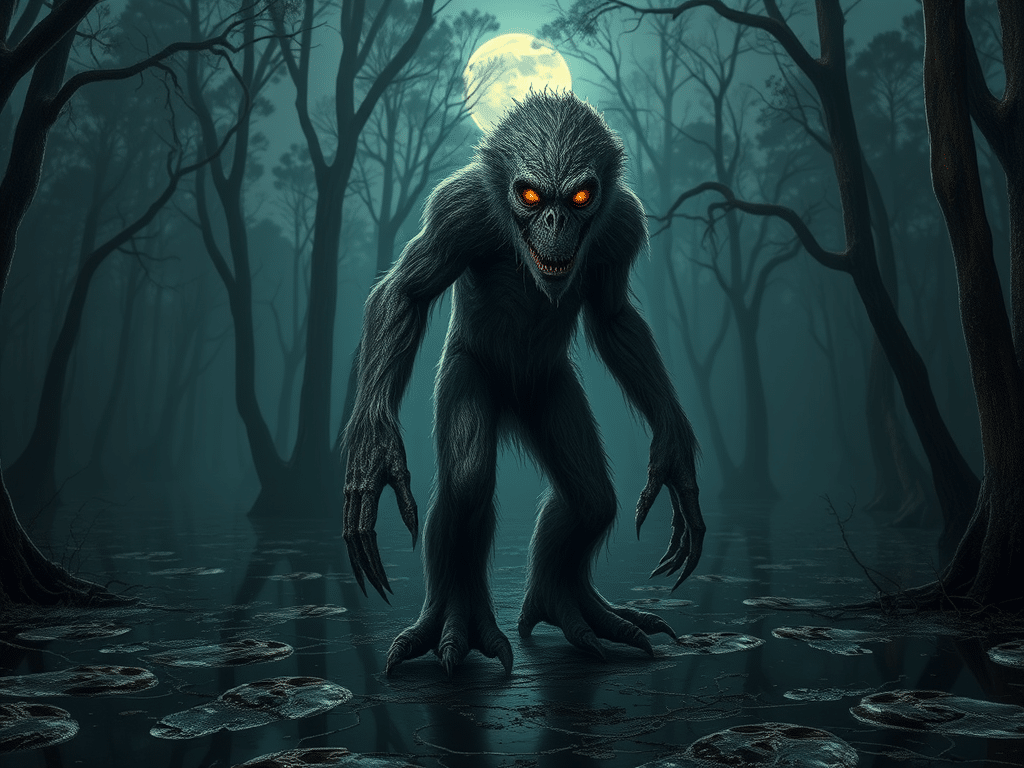
Fascinatingly, some academics have found similarities between ancient Egyptian wolf-headed gods and contemporary descriptions of dogmen, humanoid canine entities found all throughout the globe. Although there is no direct historical proof connecting these events, some scholars propose that ancient interactions with unidentified canine beings might have shaped Egyptian religious symbolism. Mainstream academics, on the other hand, usually dismiss such links as retroactive searches for historical precedence for modern cryptozoological assertions.
The nature and purpose of divine wolf-headed entities and alleged dogmen define their differences most importantly. While contemporary dogmen usually describe enigmatic physical animals, Egyptian gods were seen as transcendent beings with cosmic roles. Some paranormal investigators have tried to close this discrepancy by implying that, although ancient Egyptians would have come across such creatures, they would have seen them through a religious rather than a cryptozoological prism.
Modern cryptozoological research occasionally suggests Egyptian wolf-headed deity imagery as possible proof for a lengthy history of dogmen contacts. These ideas sometimes draw on the exact anatomical precision of some Egyptian paintings of wolf-headed entities, implying they might have been derived from real-world observations. Egyptologists, however, credit the meticulous study of real wolves and their religious relevance for this precision.
Wolf Headed Egyptian Gods
Wolf-headed gods were essential in ancient Egyptian religion; each had different but often overlapping purposes in the cosmic order. Knowing these gods helps one to better understand Egyptian religious philosophy and their favorable relationship with wolves, which contrasts strongly with later cultural perceptions of these creatures.
Possibly the most well-known wolf-headed god, Anubis was the main god of death, mummification, and the next world. His black-headed wolf shape represented not death itself but rather renewal and the rich Nile soil. Preserving the dead, he played vital roles in the hereafter trip, including the weighing of the heart ceremony, which decides a soul’s destiny. Anubis’s protective rather than predatory character reflects how Egyptians saw wolves as defenders rather than enemies (Steiger, 2011).
Known as opener of the ways, Wepwawet was both a royal protector and a military god. His relationship with the pharaohs and military battles reveals how Egyptians linked strategic thought and leadership with wolf qualities. Though both gods occasionally played overlapping roles in funeral settings, his gray or white wolf head set him apart from Anubis as one of Egypt’s oldest gods (Duquesne, 2013).
One of the four sons of Horus, Duamutef stood for a more specific protecting agent. His wolf-headed figure showed up on canopic jars and funeral tools as guardian of the stomach in mummification rites and defender of the eastern direction. His part shows how wolf images evolved from important gods into useful funeral customs.
These wolf-headed gods’ linked connections mirrored Egyptian ideas of cosmic harmony. Anubis and Wepwawet, sometimes referred to as brothers, worked together rather than against one another; Duamutef worked within the four sons of Horus. This cooperation among wolf gods highlights even more their favorable theological connections.
Mummified wolves in Lycopolis (present-day Asyut) offer physical evidence of wolf reverence in archaeology. The city’s commitment to wolf gods and the preservation of real wolves shows how religious ideas turned into useful worship and ceremonial activities, therefore linking the symbolic and literal wolf respect. The fact that these gods are shown in Egyptian art and architecture over several dynasties points to their ongoing significance. Their images illustrate how vital they were to both official religion and public worship; they show up in royal tombs, temples, and religious writings. Their consistent portrayal throughout thousands of years points to their roles staying rather constant despite other religious shifts (Teeter, 2002).
Later cultural exchanges—especially with Greeks and Romans—sometimes resulted in syncretic hybrids or reinterpretations of these wolf gods. Still, their fundamental protecting and guiding roles stayed mostly unaltered even as other facets of Egyptian religion developed. This tenacity reflects the basic relevance of wolf symbolism in Egyptian religious philosophy.

Modern Impact
Modern studies have improved our knowledge of these gods by verifying that, as once thought, their animal sides derived from wolves rather than jackals. This discovery validates historical narratives and religious books, as ancient Egyptian and Greek sources repeatedly identified them as wolf gods. The interaction between ancient Egyptian wolf gods and contemporary dogmen begs important issues regarding how various societies understand and classify inexplicable events. Although ancient Egyptians obviously fit their wolf-headed entities into a religious context, modern stories usually follow cryptozoological or paranormal ones. The cultural setting shapes the interpretation of odd or unexplained events, as this comparison highlights.
Egypt’s wolf-headed gods reflect a sophisticated religious system in which animal features were considered as divine strengths rather than basic or terrifying traits. Their responsibilities in protection, direction, and preserving cosmic order show how Egyptian society saw wolves as honorable, knowledgeable animals fit for divine connection. This positive religious symbolism is quite different from later Western religions, which sometimes denigrated wolves and their symbolism.
The many roles and connections between these gods show how complicated Egyptian religious thought was. In Egyptian religious thought, animal parts represented divine traits instead of limits. Ancient Egyptians conveyed notions about death, monarchy, protection, and cosmic order through their wolf-headed gods that stayed powerful throughout the lengthy history of their civilization and still captivate academics and fans today.
Although modern paranormal investigators have tried to retroactively find werewolf-like animals in ancient Egyptian civilization, most experts contend that these interpretations mirror modern prejudices rather than historical fact. Egyptologists usually think that hieroglyphics that show people and animals mixed together are more symbolic than literal representations of transformations. However, some theorists use these drawings as proof that people believe in shapeshifters.
Though they usually depict temporary ritual affiliation with animal spirits rather than bodily change, Egyptian magical books and spells sometimes refer to human-animal transformation. During other occasions, priests would wear animal masks and skins to establish a spiritual relationship with divine powers without suggesting real shapeshifting. This habit might have helped to explain later Greek and Roman misreadings of Egyptian religious practices.
Popular culture frequently adopts and reinterprets Egyptian mythology, incorporating werewolf elements not present in the original texts. Movies, novels, and games all show Egyptian mummies or priests turning into wolves, fusing Western werewolf clichés with Egyptian aesthetic cues. Though imaginative, this cultural blending has little factual basis in ancient Egyptian ideas (Foran, 1956).
The absence of conventional werewolf mythology in ancient Egypt has not stopped modern storytellers from integrating Egyptian motifs into lycanthropy tales. Some writers and filmmakers have developed tales connecting werewolf curses to ancient Egyptian magic or implying that wolf-headed gods were indeed primordial werewolves. More than historical accuracy, these imaginative versions mirror modern storytelling tastes.
Recent zoological and archaeological discoveries have helped define the interaction between ancient Egypt and wolves. The knowledge that the Egyptian jackal is really a kind of gray wolf has changed the meaning of many religious symbols and cultural relics. This scientific realization clarifies the lack of werewolf-like transformation stories and helps explain the predominance of wolf images in Egyptian art and religion.
Conclusion
Although ancient Egypt lacked the classic werewolf or dogman narratives known to modern viewers, it had a rich mythology including wolf-headed gods and animal symbolism. Their theological and cultural perspective allowed human-animal hybrid gods and divine change without generating the curse-based lycanthropy beliefs emerging in other societies. Knowing this allows us to value the special nature of Egyptian mythology and see how contemporary interpretations have sometimes placed later werewolf traditions onto ancient Egyptian ideas.
References
Duquesne, T. (2013). Wepwawet. The Encyclopedia of Ancient History.
Foran, W. R. (1956). Lycanthropy in Africa. African Affairs, 55(219), 124-134.
Ogden, D. (2021). The Werewolf in the Ancient World. Oxford University Press.
Steiger, B. (2011). The Werewolf Book: The Encyclopedia of Shape-Shifting Beings. Visible Ink Press.
Teeter, E. (2002). Animals in Egyptian religion. In A History of the Animal World in the Ancient Near East (pp. 335-360). Brill.


Leave a Reply