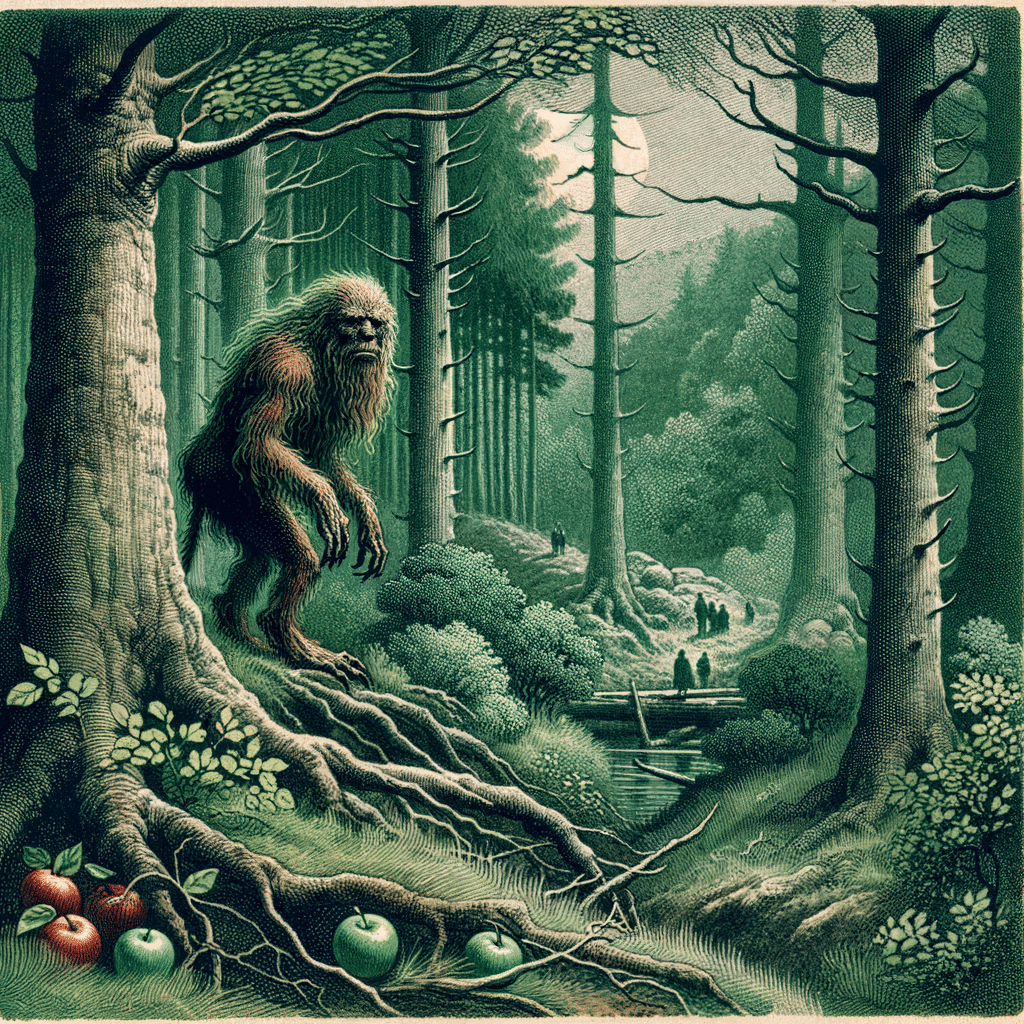
Particularly in the woodlands surrounding York County and the Susquehanna River Valley, the Albatwitch fills a strange niche in Pennsylvania legend. Described in local stories for years, this little cryptid reflects a confluence of indigenous culture and European settlement customs that combined to produce a uniquely American legendary being. Local stories often mention the Albatwitch, despite its lesser fame compared to Bigfoot or the Jersey Devil. The name of the monster itself is significant since it is thought to come from a Pennsylvania Dutch term meaning apple-snitch, which describes the critter’s most infamous activity. Local storytellers frequently underline that although the Albatwitch is very unknown outside of Pennsylvania, its profound regional roots and ongoing oral tradition spanning many cultures and generations make it one of the most culturally genuine cryptids in American folklore.

Description
Usually, the Albatwitch is characterized physically as a little, bipedal creature about 4 to 5 feet tall with a hunch that makes him seem even smaller. Ranging from reddish-brown to almost black, its body is coated with dense, matted hair or fur, which offers excellent camouflage in the forested areas it supposedly lives in. With hands made of movable fingers able to grasp things with unexpected agility, the creature has excessively long arms reaching almost to its ankles. Often called simian or ape-like, its face has deep-set eyes that shine amber or reddish in the dark, a flat nose, and a broad mouth full of keen teeth fit for its omnivorous diet. Some stories claim that the Albatwitch’s feet are exceptionally big and flat, which creates unique imprints that folklore lovers report finding in muddy riverbanks and woodland floors after rainstorms. Said to move with incredible agility through trees, the Albatwitch can leap between branches and climb trunks with ease, which implies evolutionary adaptability to forest settings (Ocker, 2022).
The behavioral patterns ascribed to the Albatwitch focus mostly on its interactions with people and its unique feeding practices. Folklore says these animals are extremely shy and usually shun human interaction, instead choosing the isolation of thick forest regions where they build rudimentary homes from branches and leaves. Said to be mostly nocturnal, they come out at dark to hunt for food mostly made up of fruits, berries, nuts, and little animals. Their alleged love of apples and their tendency to steal this fruit from orchards, picnickers, and campers define them most uniquely. Many stories highlight their tendency to throw the apple cores back at the people from whom they had stolen, demonstrating a playful rather than evil attitude. This lighthearted antagonism implies a complicated connection with people defined more by territorial cohabitation than total enmity or friendship. Local stories say Albatwitches create a secret language to coordinate actions while still hidden from human notice using a succession of whistles, clicks, and low hooting sounds that could be mistaken for owl calls by the uninformed (Furek, 2024).
The Albatwitch legend’s origins may be found among the indigenous Susquehannock people who lived in the area before European colonization. These Native Americans described tiny, forest-dwelling creatures that lived alongside people and had unique ties to the natural environment. German and Dutch immigrants to Pennsylvania in the 18th century brought their mythology, including stories of dwarfs, kobolds, and other wood spirits. The cultural interaction between these groups likely contributed to the development of the Albatwitch tale by incorporating the Pennsylvania Dutch word “apple-snitch” (Äpfel-schnitz) to refer to these forest beings. Early stories tell of run-ins between farmers and the animals, especially during harvest times when orchards and fields would be rich with food. Occasionally, historical colonial-era papers mention “strange little men of the woods” who would steal from farms and gardens, implying that the Albatwitch tale was already well known by the time of the American Revolution. These early reports often portrayed the creatures as more numerous and daring when they went to the borders of towns during severe winters, as food became limited in their woodland surroundings.
Though there is no conclusive physical proof of the creature itself, the archeological record of the region offers some tantalizing background for the evolution of the Albatwitch mythology. Susquehannock artifacts often depict little, hunched figures, which some folklore historians believe could be representations of the beings later dubbed Albatwitches. More fascinating are the tales handed down through generations of the Susquehannock about the “little brothers of the forest,” who sometimes helped lost hunters by leaving trails of berries or nuts leading back to known routes and who served as guards of untamed areas. These kind traits stand in sharp contrast to the more naughty actions Europeans attributed to the animals, implying a change of the story via cultural interpretation.

Myth Through Time
Over ages, the history of the Albatwitch legend mirrors shifting societal views and environmental circumstances. Reportedly, sightings fell as industry encroached on natural habitats in the 19th century, and the animals were thought to flee deeper into residual wilderness near the Susquehanna River. During this time, the Albatwitch changed in folklore from a true belief to a cautionary story taught to youngsters to prevent them from straying too far into the woods or robbing from orchards. Urban growth and traditional agricultural life in the area shrank; therefore, the early 20th century saw the legend sink even more into obscurity. Interest in the monster, however, never entirely vanished; oral traditions in families with deep origins in the area kept it alive. Sometimes local newspapers ran stories from senior citizens who said they had met the animals as children, framing these tales as odd remnants of a more superstitious past. Some folklorists credit a short revival in Albatwitch sightings during the Great Depression to rising human activity in forested areas as people foraged for food and supplies under economic distress (Wilson, 2010).
Different historical eras saw the Albatwitch legend’s sociological role change dramatically as it adapted to meet the requirements of the communities that retained the legends. For indigenous peoples, the animals symbolized a link to the natural world and reflected spiritual values about honoring forest resources. For Pennsylvania Dutch settlers, the Albatwitch became a simple excuse for lost food in trying times and a means to place limits on children’s discovery. By the Victorian era, the story had been linked with moral teaching; tales underlined how the animals punished waste and greed by pursuing those who took more than their fair share from nature. Grandparents cautioned kids that “the Albatwitches know” when someone takes fruit without permission or leaves picnic garbage in the woods, so this moralistic aspect of the story continued far into the 20th century. These adaptive qualities of the story serve to clarify its exceptional endurance throughout generations and cultural changes (Grieve-Carlson, 2020).
Rising interest in cryptozoology and local folklore in the latter part of the 20th century brought the Albatwitch legend’s modern version back to life. Starting in the 1970s, revived sighting reports appeared to match more general cultural movements toward environmental consciousness and a desire to protect natural areas. Celebrating both the cryptid and the area’s folk legacy, the town of Columbia, Pennsylvania, welcomed the story by creating an annual Albatwitch Day festival in the early 2000s. Modern narratives sometimes try to harmonize the folklore with scientific possibilities, implying the Albatwitch might reflect relict populations of unknown primates, misidentified known animals like bears or escaped exotic pets, or psychological projections of human anxiety about wilderness areas. Unlike many cryptids that surfaced in the television era, professional folklorists have observed that the Albatwitch has preserved exceptionally consistent descriptive qualities over centuries of narratives, which gives the story some credibility not always present in more recently surfaced cryptozoological events. Scholars researching the transmission and preservation of folklore in American societies have taken the Albatwitch seriously because of its regularity.
Reflecting local ecological and cultural circumstances, some areas of Pennsylvania and surrounding states have produced intriguing regional versions of the Albatwitch mythology. Occasionally, the more hilly areas to the north refer to the animals as cave-dwellers who emerge only during specific seasons. Closer to the Chesapeake Bay, mythology occasionally depicts them as competent fishermen constructing little dams to catch fish in shallow rivers. Some versions of the story link the Albatwitch to other enigmatic events, including strange stone formations in creek beds that local people ascribe to the animals’ activity or unexplained lights in the woods. While preserving fundamental qualities that characterize the central narrative, these regional differences show the natural way in which folklore adapts to local environments and communal experiences. Some families in the area say they have “special knowledge” of the Albatwitch passed down through generations, including techniques to draw or repel the creatures, such as placing particular fruit arrangements as gifts or using particular herbs to keep them away from gardens and orchards (Nesbitt & Wilson, 2016).
The digital age has changed the Albatwitch tale even more, as internet forums and social media let fans share experiences, supposed photographic evidence, and speculations regarding the creature’s existence. Modern interpretations can include environmental concerns, which remind people of their complicated relationship with the natural world and position the Albatwitch as a symbol of wild areas threatened by human development. Equipped with night vision technology and recording devices that would have been unthinkable to the early folklorists who first recorded these stories, paranormal investigative teams often undertake expeditions in locations linked with Albatwitch sightings. Though scientific skepticism prevalent in modern conversation about cryptids shapes the Albatwitch, it nonetheless motivates a group of believers who plan frequent “expeditions” into places where sightings have been recorded. Hoping to catch proof of the animals, these organizations sometimes mix conventional mythology with contemporary scientific methods, using motion-triggered cameras and audio recording devices. Though detractors say most pictures are generally hazy or ambiguous, following the trend known to cryptozoological study, the rise of cellphones has resulted in more claimed photographic evidence.
Though not as popular as animals like Bigfoot or the Loch Ness Monster, literature and popular culture have included the Albatwitch mythology in many different ways. Often blending conventional stories with imaginative fiction that broadens the mythology, regional writers have released compilations of Albatwitch stories. Ranging from family-friendly documentaries examining the cultural relevance of the folklore to horror flicks that distort the dangerous qualities of the Albatwitch, several independent films have drawn on the legend as motivation. Creating digital archives that preserve oral traditions that could otherwise be lost, amateur cryptozoologists run devoted websites documenting historical records and modern occurrences. The Albatwitch has been featured in at least one graphic novel series that reinterprets the animals as ancient guardians of dimensional gateways buried in the Appalachian forest; it has also appeared in many role-playing games. Though scientific agreement is doubtful concerning the genuine existence of such beings, these imaginative interpretations show the adaptability of the story and its continuing cultural relevance.
Psychological studies of Albatwitch mythology reveal fascinating trends in how societies manage cultural transitions and adapt to environmental changes. The species’ apparent retreat into wilder areas reflects human concerns about urbanization and the loss of connection to natural habitats. Their unclear moral standing—neither fully good nor truly evil—reflects the complicated interaction between human societies and the wilderness, which both endangers and supports those societies. Some academics argue that the ongoing Albatwitch story serves as a form of cultural resistance to modernity, thereby preserving elements of indigenous knowledge and rural legacy within more uniform societies. The primary focus of apple theft in these stories is connected to ancient mythical concepts of forbidden fruit and the temptations of the wilderness, which are prevalent in many cultural traditions. These psychological foundations clarify why, in spite of extensive scientific knowledge and the loss of conventional supernatural belief systems in mainstream American society, the legend nonetheless speaks to modern audiences.
Conclusion
More than just a peculiar footnote in American cryptozoology, the Albatwitch illustrates the complex interplay of cultural interaction and adaptation that characterizes much of American folklore. The legend has shown extraordinary persistence and flexibility, from indigenous beginnings to Pennsylvania Dutch influence and from cautionary children’s stories to contemporary festival draws. The Albatwitch connects contemporary individuals to the cultural legacy of the Susquehanna River Valley, regardless of whether they perceive it as a real creature, a metaphorical representation of nature, or merely an entertaining local tale. The apple-stealing beast will likely remain a part of the area’s folklore as long as apple orchards thrive and forests exist in Pennsylvania, thereby reminding us of the lasting influence of myth on our understanding of the natural world and our role within it. The Albatwitch is proof of how much people need to fill the natural world with narratives that mirror our hopes, anxieties, and sense of wonder—a need that endures even in our technological era and may even be growing stronger as direct encounters with wild wilderness become more uncommon in contemporary life.
References
Furek, M. W. (2024). The Lost Tribes of Bigfoot. Untold Publishing.
Grieve-Carlson, T. (2020). Fairies, Demons, and Nature Spirits:’Small Gods’ at the Margins of Christendom ed. by Michael Ostling. Magic, Ritual, and Witchcraft, 15(2), 291-293.
Nesbitt, M., & Wilson, P. A. (2016). Cursed in Pennsylvania: Stories of the Damned in the Keystone State. Rowman & Littlefield.
Ocker, J. W. (2022). The United States of Cryptids: A Tour of American Myths and Monsters. Quirk Books.
Wilson, P. A. (2010). Monsters of Pennsylvania: Mysterious Creatures in the Keystone State. Stackpole Books.




Leave a Reply