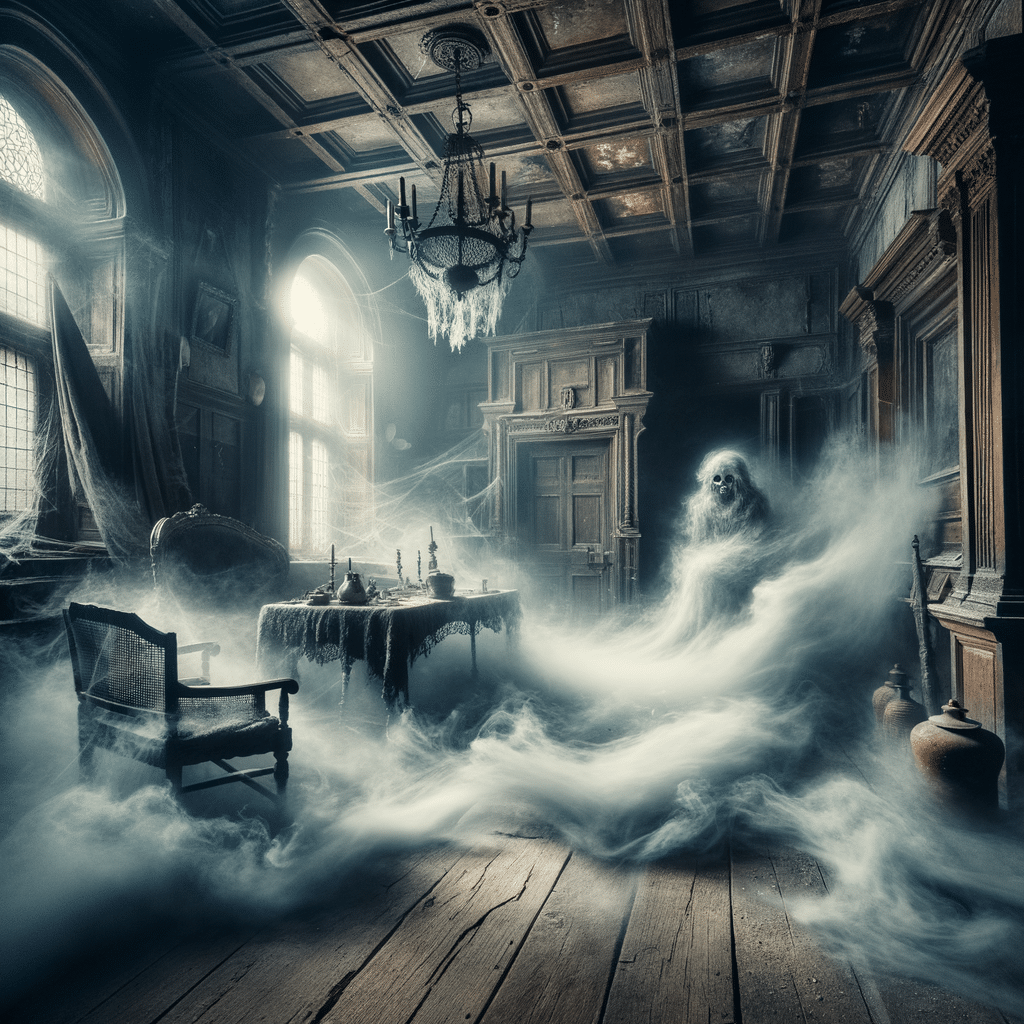
Many different stories exist about paranormal creatures, with countless spectral events documented over millennia and across civilizations. Among these enigmatic manifestations, funnel ghosts are a particularly fascinating group of apparitions that has attracted both believers in and skeptics of paranormal activity. From abandoned buildings to old woodlands and mist-covered moors, these unique entities—which have a whirling, vortex-like look—have been documented in many places throughout the globe. Their conical or funnel-shaped form distinguishes them from conventional ghost sightings and results in specialized study within paranormal research groups and a vast array of cultural interpretations trying to explain their nature and goal.

Description
Usually found in places with high atmospheric moisture or at twilight, funnel ghosts show as translucent, whirling columns of mist or energy. Witnesses say they have a clear funnel- or tornado-like form that rotates with different strengths; occasionally they seem virtually immobile and other times they move deliberately across a landscape. Some reports mention minor luminosity or color variations that correspond to changes in the funnel ghost’s apparent emotional condition or energy level, but their coloration typically ranges from pale white to bluish-gray. Unlike conventional apparitions that preserve a human form, funnel ghosts are amorphous, whirling masses that periodically combine into vaguely humanoid forms before disintegrating back into their usual vortex pattern (Goodwyn, 2011).
Funnel ghosts’ behavior shows various constant trends across recorded sightings, which helps to explain their reputation as clearly intentional beings. Funnel ghosts usually emerge from regions of transition—doorways, windows, woodland clearings, or the lines separating various environments—and travel in spiraling, occasionally chaotic patterns that viewers commonly characterize as searching or investigating. Although electrical disturbances and sudden drops in temperature typically occur before funnel ghosts appear, these entities rarely interact directly with physical objects, in contrast to poltergeists or other violent manifestations. Many reports point to these beings appearing more often in places where major emotional events have happened or in the presence of people going through strong emotions; they seem drawn to emotional energy (Whitehurst, 2019).
Although many basic motifs appear in the stories explaining these events, the folklore surrounding funnel ghosts varies significantly among different regional traditions. In Celtic beliefs, they are sometimes understood as travelers between worlds, spirits caught in transition between the mortal realm and the afterlife, their funnel form indicating the path or portal down which souls must pass. Eastern European mythology describes them as weather spirits or wind walkers, beings that regulate atmospheric conditions and act as heralders of approaching storms or seasonal changes. In some parts of North America, Native American customs see these expressions as breath spirits, the outward form of ancestral knowledge that surfaces to direct the living through periods of community transformation or crisis.

Analysis
The vast tapestry of mythical interpretations reaches even into different cultures’ conceptions of funnel ghosts and their meaning. Japanese mythology tells about uzu-rei, or spiral spirits, that guard holy sites and show up when seasonal celebrations or moon phases loosen their lines between worlds. These beings are sometimes connected in Nordic traditions with frost whirls, said to be the ghosts of people who died in blizzards, eternally seeking warmth and refuge. Middle Eastern stories tell of desert dancers, funnel-shaped djinn rising from the sands during specific astrological alignments bearing messages from long-buried ancient civilizations.
Though none of them fully point out all recorded sightings, scientific ideas on funnel ghost events tend toward more logical explanations. Particularly in places where temperature variations produce natural updrafts, meteorologists speculate that many encounters may arise from special atmospheric conditions that produce visual vortices of condensation or dust. Certain electromagnetic fields, according to neurological studies, can activate the temporal lobe and cause hallucinations the brain understands as whirling, ethereal forms. Especially in wooded areas where decaying matter creates various gases and tiny particles, environmental scientists think that glowing fungus spores or small bits of matter carried by the wind might be possible reasons for these sightings (Jinks, 2019).
Parapsychological theories provide other explanations, bridging empirical investigation with more metaphysical interpretations of funnel ghost events. Some scientists propose these expressions reflect concentrated kinds of psychic energy, either produced unintentionally by live people (a kind of externalized psychokinesis) or lasting emotional imprints left on surroundings by powerful past events. In certain situations, the residual energy idea suggests that some places can hold onto and replay emotional or energetic patterns, using funnel shapes that show how this energy naturally flows as it decreases. Other parapsychologists suggest that these entities might be linked to events from other dimensions—places where the barrier between different realities becomes thin for a moment, letting energy from other worlds appear in our reality in a swirling pattern shaped by the rules of moving between dimensions (DiBenigno, 2011).
Documented interactions with funnel ghosts have produced similar patterns of physical and psychological impacts on witnesses that paranormal researchers find especially important. Unusual sensory sensations, including a unique metallic taste, ringing in the ears, or the sensation of static electricity on exposed skin, have been reported by several visitors. Time distortion often goes along with these sightings; witnesses report minutes that seemed to span hours or longer passing in what seemed like moments. Most fascinating are the emotional impressions left on viewers by ghost experiences; many people report feeling emotions they identify as not their own, implying these entities may transmit or cause emotional states as a means of communication.
With differing degrees of effectiveness and trustworthiness, modern paranormal investigative methods have tried to capture and examine funnel ghost events. Sometimes during alleged funnel ghost events, specialized equipment, including electromagnetic field detectors, thermal imaging systems, and full-spectrum cameras, records aberrant data. Especially fascinating are the unique patterns caught on thermal imaging—spiraling temperature variations moving against ambient temperature gradients and dominant air currents. Sometimes low-frequency vibrations outside of the range of human hearing are captured in audio recordings during these episodes; some researchers suggest that funnel ghosts may use infrasound to communicate. Despite these technical methods, obtaining convincing scientific evidence remains challenging; opponents contend that these results are merely distortions of natural events through the lens of paranormal expectations (Sweet, 2004).
Conclusion
Ultimately, funnel ghosts are a remarkable subcategory of paranormal events that still eludes clear explanation after centuries of research and documentation. Although funnel ghosts do not provide unequivocal proof of supernatural origins, their unique appearance, behavioral patterns, and consistent effects on witnesses suggest that they are more than mere misidentifications of natural events. Whether they stand for neurological reactions to environmental stimuli, residual psychic energy, atmospheric anomalies, or actual entities from beyond our grasp of reality, funnel ghosts remind us of the limits of our knowledge and the ongoing mystery of human experience. These ghostly whirlwinds exist in a space between stories and science as our understanding grows and new ways to investigate come up, pushing us to broaden our ideas of what could be possible and encouraging us to keep exploring the strange events that are hard to understand.
References
DiBenigno, M. (2011). ” I Am Not Alone in My Fascination”: Cultural Fear and the” True” Wilmington Ghost Story (Doctoral dissertation, University of North Carolina Wilmington).
Goodwyn, M. (2011). Ghost Worlds: A Guide to Poltergeists, Portals, Ecto-Mist, & Spirit Behavior. Llewellyn Worldwide.
Jinks, T. (2019). Psychological perspectives on reality, consciousness and paranormal experience. Palgrave Macmillan.
Sweet, L. (2004). How to Photograph the Paranormal. Hampton Roads Publishing.
Whitehurst, P. (2019). Haunted Monterey County. Arcadia Publishing.



Leave a Reply