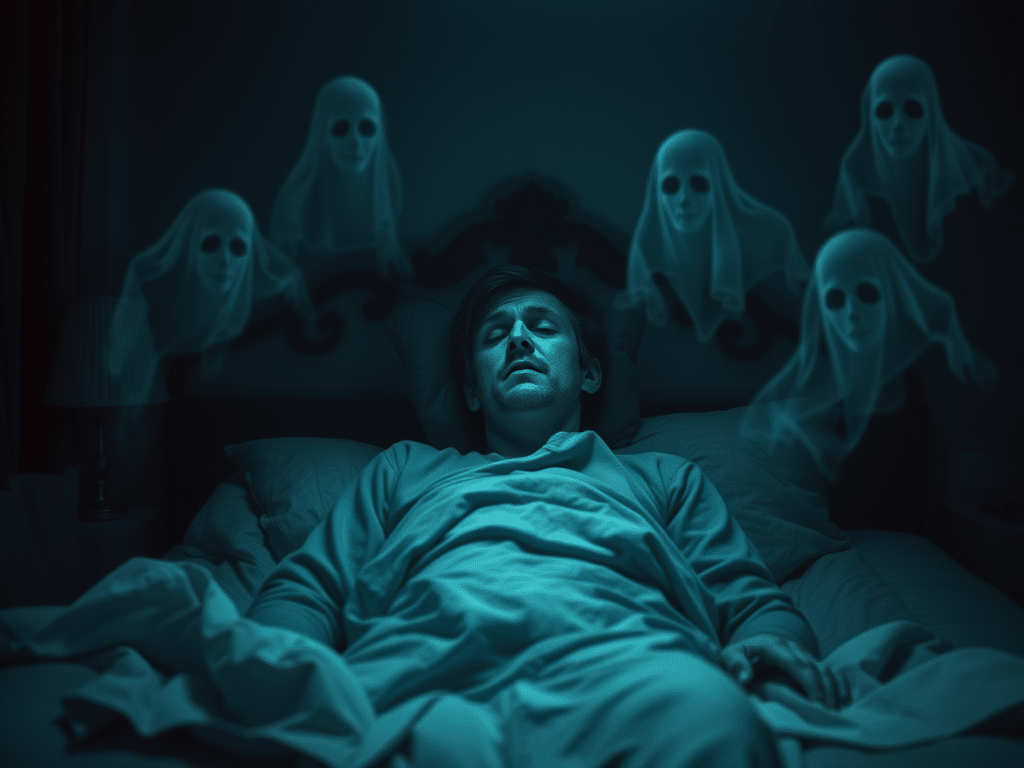
Ghosts and Nightmares: Key Points
-
The intersection of ghosts and nightmares represents primal human fears, with cultures worldwide believing the sleeping mind becomes vulnerable to spiritual visitation in liminal dream spaces.
-
Paranormal nightmares differ from ordinary dreams through hyper-realistic quality, physical aftereffects like unexplained bruises, and encounters during sleep paralysis episodes interpreted as ghostly attacks.
-
Haunted locations consistently correlate with residents experiencing intense nightmares, with dream terror often preceding physical paranormal manifestations across different cultures and times.
-
Theories range from paranormal explanations of spiritual consciousness interacting with sleeping brains to skeptical views about anxiety causing both perceived hauntings and nightmares.
-
Supernatural nightmares cause severe sleep disruption, anxiety, trauma symptoms, and family conflicts, spawning protective rituals and an industry dedicated to paranormal sleep disturbances.
-
The persistence of these accounts across cultures suggests the phenomenon touches something fundamental in human consciousness, blurring boundaries between waking and sleeping, living and dead.

Introduction
The mystery of ghosts and nightmares has persisted across millennia, captivating human imagination. These domains embody two fundamental anxieties: the concealed perils of the nocturnal and the intrusions of the subconscious. Ghosts, frequently perceived as the manifestations of the deceased, are believed to inhabit the realm of the living. Conversely, nightmares assail individuals during periods of vulnerability, blurring the boundaries between conscious awareness and subconscious processes. This convergence of experiences has been documented in diverse cultural contexts, implying that the demarcation between the tangible world and the dreamscape may be less distinct than commonly assumed. This essay will look at the supernatural beliefs connected to ghosts and dreams, the features of supernatural nightmares, and the different ideas that try to explain their mysterious connection.
Ghosts and Nightmares
In many cultures, the idea of the sleeping mind has been around for a long time as a way for ghosts to talk to people who are still alive. Many cultures view dreams as a liminal space where ghosts can communicate with people while they sleep, convey messages, warn of danger, or even inflict harm. The Greeks thought that dreams took place in a world where the minds of the dead could talk to people who were still alive. Furthermore, many Indigenous cultures believe that elders often visit their children and grandchildren in their dreams to give them advice or teach them new things. “Dream visitation” is a theme in many different types of stories, from Japanese legends about yurei showing up in dreams to Celtic stories about the sidhe entering people’s minds while they sleep. These narratives from various cultures suggest that the dream world, because of its intangible nature, might be more open to ghostly appearances than the physical world. This idea implies that the night is a time when unusual experiences are more likely to happen.
Paranormal nightmares are different from regular unpleasant dreams. They are more intense, have specific themes, and cause lasting feelings of unease. People who claim to have had magical nightmares often describe them as having a feeling of hyper-reality, where the dream seems more real than waking life. During these dreams, people often report feeling physical sensations, like being touched, unable to move, or watched by an unseen presence. Common experiences include repeatedly seeing the same ghostly figure, having accurate dreams about deceased people the dreamer doesn’t know, and having nightmares that multiple people experience in the same place. Sleep paralysis, characterized by an inability to move upon awakening and the sensation of a malevolent presence, has been interpreted as a supernatural assault across numerous cultures. This phenomenon, from the “Old Hag” of Newfoundland to contemporary accounts of “shadow people,” has been attributed to ghostly entities. Individuals who have endured these episodes frequently exhibit unexplained physical manifestations, such as bruises, scratches, or the movement of objects, blurring the boundaries between the dream state and waking reality.
Historically and cross-culturally, sleep paralysis has been understood through a supernatural framework. These distressing nocturnal occurrences have often been associated with ghosts, spirits, and other malevolent beings. Davies (2003) examines the historical associations between the “nightmare” phenomenon and numerous mythical beings, such as ghosts, demons, fairies, and the spirits of the dead. He illustrates how diverse European societies attributed nightmares to the actions of ghosts, revenants, and vampires. Throughout history, the mysterious occurrences of sleep paralysis have always been understood in terms of supernatural beliefs.
In medieval Europe, the conceptualization of nightmares was a complex amalgamation of medical understanding, religious doctrine, and folklore. Gordon (2015) investigates medieval European perspectives on nightmares, drawing upon ecclesiastical teachings, classical dream theories, and Galenic medical practices. Furthermore, he examines the Anglo-Saxon medical texts’ treatment of the mara spirit alongside the depictions of demonic or ghostly assaults found in Anglo-Norman literature of the 1100s. These medieval narratives frequently feature the sensation of being suffocated or tormented by a spectral or malevolent entity, a sensation often associated with sleep paralysis and hypnagogic or hypnopompic states.
Numerous trends observed by researchers of paranormal phenomena indicate a correlation between ghostly encounters and the experience of nightmares. People who live in haunted locations often report experiencing intense or recurrent nightmares. This observation implies a potential connection between the spirit or energy associated with the haunting and the dream state. Certain paranormal investigators propose that ghosts might derive sustenance from the fear elicited by nightmares or that they utilize dreams as a primary mode of communication, given the substantial energy expenditure required for physical manifestation. Furthermore, historical accounts from locations with reported hauntings frequently document the onset of nightmares preceding any observable ghostly activity in the waking world. Consequently, the evidence suggests that spirits may initially establish their presence within the dream realm prior to transitioning to physical manifestations. Moreover, people who allege they suffer from demonic entities or malevolent spirits often report experiencing a multitude of distressing dreams. These nocturnal terrors appear to function as a mechanism for diminishing psychological resilience. The consistent nature of these experiences across diverse geographical locations, historical periods, and cultural contexts suggests a genuine correlation, rather than a mere coincidence or cultural appropriation.

Theories
Numerous scientific and supernatural paradigms endeavor to connect the relationship between apparitions and night terrors. Certain proponents of the supernatural posit that consciousness persists in an energetic state subsequent to physical demise. This particular form is believed to facilitate a more direct interaction with the brain’s electromagnetic activity during sleep. This activity, which exhibits varying frequencies contingent upon the sleep stage, may be more receptive to subtle spiritual influences. Furthermore, another perspective posits that locations associated with traumatic deaths or suffering become “imprinted” within the environment. While individuals are asleep, their brains might access these records, manifesting as nightmares that diverge significantly from typical dream experiences. Psychologically, skeptics contend that this connection is entirely subjective: individuals residing in purportedly haunted locations often exhibit heightened anxiety, which, in turn, precipitates nightmares, subsequently interpreted in a manner that reinforces their preexisting beliefs regarding the supernatural. Some researchers suggest a possible middle ground: some people might be more sensitive to electromagnetic fields or infrasound in their environment. These conditions could evoke feelings of haunting, disrupt their sleep, and trigger vivid nightmares. The most intriguing ideas suggest that several factors might be involved at the same time. Mental, physical, and possibly even supernatural elements could all come together to create these supernatural dreams.
Contemporary research consistently correlates sleep paralysis with the belief in malevolent supernatural entities across various cultures and historical epochs. Cox (2015) explains the historical view that sleep paralysis was caused by attacks from entities like the Incubus or the Nightmare during sleep. He further investigates the correlation between sleep paralysis, the cultural belief in the dab tsog (a spirit associated with nightmares), and Sudden Unexplained Nocturnal Death Syndrome within Southeast Asian communities. These nocturnal entities are derived from ancient mythologies; for instance, Lilith, a Sumerian female demon, was reputed to visit individuals during the night, subjecting them to attacks while they slept.
Modern viewpoints on sleep paralysis take into account both its neurological foundations and its connection to common supernatural occurrences. Hurd (2010) examines the frequent occurrence of vivid and distressing hallucinations, such as those of ghosts and vampires, experienced by individuals afflicted by sleep paralysis. He analyzes these experiences through the framework of contemporary dream research, proposing that these frightening hallucinations are connected to archetypal figures often identified as ghosts, goblins, or demons. Sharpless and Doghramji (2015) examine the varied cultural interpretations of sleep paralysis and their influence on narratives concerning malevolent entities, extraterrestrial encounters, shadowy figures, and existential dread. They note that the term “nightmare” originally referred to a distinct being, a “night-fiend,” whose purpose was to inflict harm.
The cross-cultural consistency of sleep paralysis experiences suggests a common biological foundation, alongside the influence of diverse cultural frameworks. Adler (2011) analyzes the traditional understanding of “nightmare” as a nocturnal visitation by a malevolent spirit attempting to asphyxiate its victim. He observes the parallels in encounters with pressing spirits across cultures and eras, despite the resulting variations in interpretation. A traditional nightmare is a ghost or monster that appears at night, causing a feeling of breathlessness. This usage is different from the modern use of the word “nightmare,” which refers to any unpleasant dream.
Researchers studying sleep paralysis have found that the hallucinations experienced during it are very real and intense. People who have these experiences often say they feel their fears are coming true while they are awake. A nightmare disorder is diagnosed when someone has sleep paralysis and also has fearful thoughts. Solomonova (2018) examines the phenomenon of individuals encountering vivid and lifelike imagery, which is subject to diverse cultural interpretations; for instance, the “ghost oppression phenomenon” observed in Hong Kong and the Khmer refugees’ belief in being “pushed down” by a ghost. Cheyne (2003) investigated the frightening hallucinations experienced by individuals during sleep paralysis, characterizing them as “waking nightmares.” These experiences often involve sensations akin to being attacked or experiencing a home invasion, accompanied by a potent sense of an evil presence, and, at times, auditory and visual perceptions of people, animals, and supernatural entities. Across numerous cultures, these traditions of nocturnal assaults encompass the fear of death instigated by nocturnal demonic spirits, thereby linking these experiences to cultural interpretations of ghostly encounters that persist in contemporary paranormal narratives.
Impact
Dreams featuring apparitions exert influences on individuals and societies that extend beyond mere nocturnal disturbances. These dreams possess the capacity to reshape perceptions of one’s environment and personal safety. Frequent encounters with supernatural nightmares can disrupt sleep patterns, precipitate anxiety disorders, and even elicit symptoms analogous to post-traumatic stress disorder. The situation becomes more severe when the dreamer believes they have no control over the experiences or when others doubt their accounts. Families residing in purportedly haunted dwellings report that shared nightmares can engender a form of collective trauma, potentially fracturing familial bonds due to divergent perspectives on whether to remain or depart, the veracity of the experiences, and the appropriate measures to safeguard children from psychological harm.
In locales steeped in ghostly reputation, elaborate tales often emerge, detailing the unsettling dreams these places supposedly induce. This folklore encompasses prayers, rituals, and specific behaviors designed to shield one’s slumber from the supernatural. Over time, these practices become woven into the fabric of local culture, passed down through the ages. Consequently, a whole industry has sprung up: paranormal investigators, spiritual cleansers, and sleep specialists all attempt to assist those grappling with such experiences, though the efficacy of their approaches remains a topic of discussion. Regardless of whether these nightmares stem from genuine supernatural forces or are simply products of suggestion, environmental factors, or psychological influences, their impact on individuals’ well-being and conduct is undeniable and quantifiable.
Conclusion
Ghosts and dreams are interconnected, revealing fundamental aspects of the human psyche and our engagement with the enigmatic. A significant number of individuals worldwide continue to report such experiences, regardless of whether these incidents are regarded as authentic supernatural phenomena, complex psychological responses to external stimuli, or a synthesis of both. The enduring prevalence of these narratives across diverse cultures and historical periods implies that the relationship between spectral apparitions and the dread of dreams penetrates a profound dimension of the human mind. As we continue to study the mysteries of the supernatural and the sleeping mind, the link between ghosts and nightmares remains one of the most fascinating and unsettling aspects of human life. This observation reinforces the notion that fear transcends the boundaries of wakefulness and sleep, and perhaps even the divide between the living and the deceased.
References
Adler, S. R. (2011). Sleep paralysis: Night-mares, nocebos, and the mind-body connection. Rutgers University Press.
Cheyne, J. A. (2003). Sleep paralysis and the structure of waking-nightmare hallucinations. Dreaming, 13(3), 163-179.
Cox, A. M. (2015). Sleep paralysis and folklore. JRSM Open, 6(7), 2054270415598091. https://doi.org/10.1177/2054270415598091
Davies, O. (2003). The nightmare experience, sleep paralysis, and witchcraft accusations. Folklore, 114(2), 181-203.
Gordon, S. (2015). Medical condition, demon or undead corpse? Sleep paralysis and the nightmare in medieval Europe. Social History of Medicine, 28(3), 425-444.
Hurd, R. (2010). Sleep paralysis: A guide to hypnagogic visions and visitors of the night. Hyena Press.
Sharpless, B. A., & Doghramji, K. (2015). Sleep paralysis: Historical, psychological, and medical perspectives. Oxford University Press.
Solomonova, E. (2018). Sleep paralysis: Phenomenology, neurophysiology, and treatment. In K. C. R. Fox & K. Christoff (Eds.), The Oxford handbook of spontaneous thought: Mind-wandering, creativity, and dreaming (pp. 435-456). Oxford University Press.

Leave a Reply