Darvaza Gas Crater, the Doorway to Hell: Key Points
-
The Darvaza Gas Crater, known as the “Door to Hell,” is a 70-meter-wide burning pit in Turkmenistan that has been ablaze for over 50 years.
-
The crater was created in 1971 when Soviet geologists accidentally collapsed the ground while drilling and ignited the escaping gas, expecting it to burn out quickly.
-
Many visitors report seeing demonic faces in the flames and experiencing intense dread, though skeptics attribute this to psychological phenomena and toxic gas exposure.
-
Scientists believe the crater tapped into one of the world’s largest natural gas reserves, explaining why it continues burning after decades.
-
The crater causes environmental damage through emissions but has become a tourist attraction, with unsuccessful government attempts to extinguish it.
-
The Darvaza Crater represents the unintended consequences of industrial activity and has become a global symbol of human error meeting nature’s power.

Introduction
The Darvaza Gas Crater, a fiery pit in Turkmenistan’s Karakum Desert, has acquired a truly chilling moniker: the Door to Hell. This enormous blaze, roughly 70 meters wide and 30 meters deep, has been burning nonstop for more than fifty years, its glow illuminating the barren desert. The crater’s unending fire and its hellish visage have turned what started as an industrial mishap into a captivating geological wonder, attracting curious travelers from all over the world, eager to see this strange sight.
Crater Description
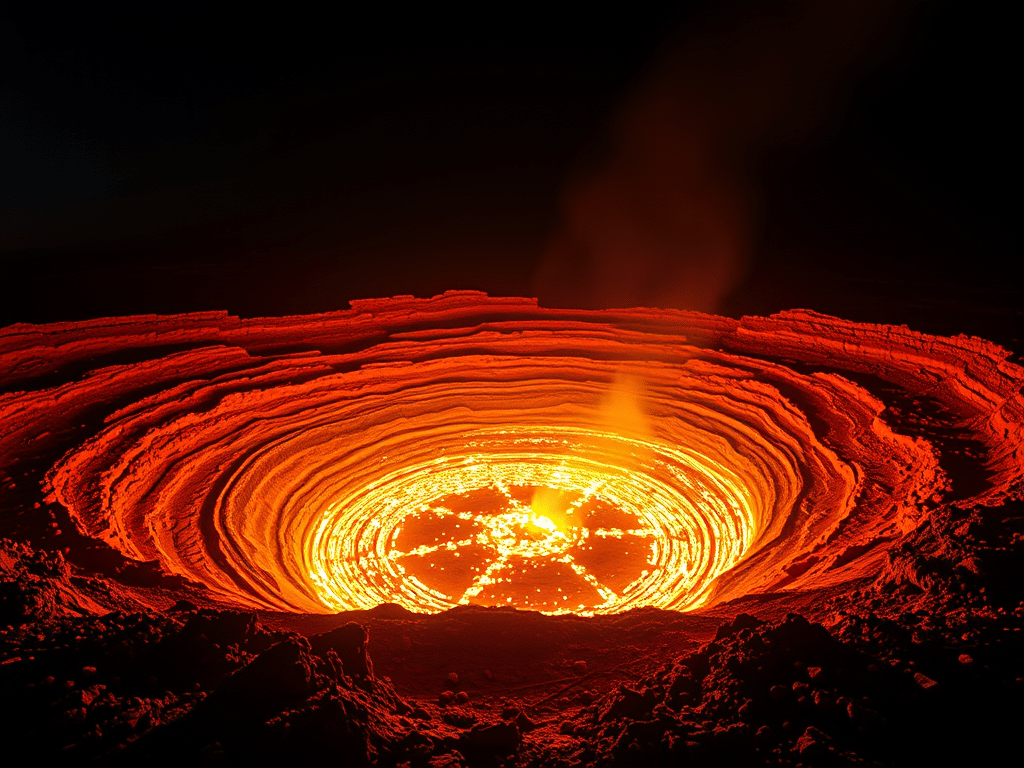
The crater itself is a sight that seems almost from another realm. The circular hollow is a cauldron of hundreds of tiny flames, their flickering light a constant across the surface, sustained by the natural gas that perpetually escapes from the ground. By day, the crater is a desolate, charred pit, a stark contrast to the surrounding sandy desert. But when night descends, it becomes a blazing inferno, visible from great distances. The heat is so intense that getting too close to the edge is perilous, and the roar of the burning gas provides an unsettling backdrop, amplifying the crater’s otherworldly feel. The extreme temperatures and poisonous gases have rendered the surrounding area barren, a stark, lifeless zone that only deepens the hellish imagery the site evokes.
The story of the Darvaza Gas Crater begins in 1971. Soviet geologists, searching for oil in the Karakum Desert, accidentally hit a huge underground natural gas pocket. The drilling rig’s weight caused the ground to give way, forming a large crater and releasing a dangerous amount of methane gas into the air. The result posed a significant threat to nearby villages and the local wildlife. To avoid a potential environmental disaster and protect public health, the geologists decided to set the gas ablaze, thinking it would burn out in a matter of weeks. But the plan turned out to be a serious error. The crater has been burning ever since, for over fifty years now, fueled by what seems to be a vast reservoir of natural gas buried deep beneath the desert.
Recent satellite-based investigations have substantially altered our understanding of the timeline and ecological consequences of the Darvaza Gas Crater, thereby contesting the prevalent 1971 origin narrative. A pivotal 2025 study, leveraging historical Landsat imagery, established that the crater’s combustion commenced between late 1987 and early 1988, thus refining the previously ambiguous date of the fire’s ignition and implying that the conventional account may be inaccurate by over fifteen years (Valverde et al., 2025). This discovery carries considerable ramifications for assessing the crater’s overall environmental footprint and prompts a reevaluation of the veracity of the Soviet-era accounts that have shaped public perception of the location.
Furthermore, the same research team utilized sophisticated hyperspectral satellite technology to quantify the crater’s current methane emissions with unparalleled accuracy. Between 2020 and 2025, satellites identified 44 separate methane plumes originating from the site, with emission rates fluctuating between 1,000 and 3,000 kilograms per hour (Valverde et al., 2025). The research indicates that total methane emissions during the period from 2020 to 2025 alone amounted to 71±21 kilotonnes; furthermore, based on their updated chronology of the crater’s formation, the investigators propose that cumulative emissions have surpassed 900±300 kilotonnes since the onset of combustion (Valverde et al., 2025). These data underscore the Darvaza crater’s status as a substantial and persistent source of greenhouse gas emissions, thereby significantly contributing to climate change, notwithstanding its remote setting and relatively modest physical dimensions.
The crater’s geological setting within Turkmenistan’s Amu-Darya hydrocarbon province provides a rationale for its persistence and continuous emissions. Ghassemi and Garzanti (2019) characterize the location as a 30-meter-deep fire pit located within one of Central Asia’s most important natural gas areas, which provides the geological context for understanding the flames’ long-term existence. Their review presents the widely accepted origin story, detailing how a Soviet oil rig collapsed into the pit in 1971. Subsequently, a geologist chose to ignite the resulting gas-fed flames to eliminate the gas and mitigate broader environmental pollution (Ghassemi & Garzanti, 2019). Nevertheless, recent satellite data suggesting a 1987-1988 ignition date challenges this account, implying that either the collapse and ignition occurred at different times or that the frequently repeated narrative necessitates significant revision.
![[[File:Darvaza gas crater, Jähennem derwezesi, Door to Hell, Gates of Hell, Derweze, Turkmenistan.jpg|Darvaza_gas_crater,_Jähennem_derwezesi,_Door_to_Hell,_Gates_of_Hell,_Derweze,_Turkmenistan]]](https://i0.wp.com/connectparanormal.net/wp-content/uploads/2026/01/Darvaza_gas_crater_Jahennem_derwezesi_Door_to_Hell_Gates_of_Hell_Derweze_Turkmenistan.jpg?resize=300%2C200&quality=89&ssl=1)
Paranormal Door to Hell
The Darvaza Crater’s paranormal connections and supernatural associations have developed naturally based on its appearance and the local folklore associated with the site. A strange feeling of foreboding often washes over those who come close to the crater, both locals and tourists alike. They describe it as if they’re standing on the edge of something otherworldly. The name “Door to Hell” hasn’t helped matters, fueling countless tales and myths about the crater being a real portal to the underworld. Some people even claim to have heard screams or seen faces in the flames, though these stories remain unproven by science. The fire’s unending presence has sparked further speculation. Could something supernatural be keeping it alive? To some, it seems almost impossible that the gas hasn’t run out after all these years, despite initial expectations. Religious interpretations have also surfaced. Some see the crater as a sign of divine retribution or a warning of the apocalypse, especially considering its isolated location and its terrifying appearance.
Among the most unsettling tales from those who’ve ventured near the Darvaza Crater are the reports of faces—demonic, tortured—seemingly materializing within the flames. Numerous people have stated that after gazing into the fire for a while, particularly after dark, they start to see human-like faces twisted in pain or displaying sinister expressions rising from the flickering blaze. Some visitors describe feeling a surge of terror, nausea, or psychological strain that appears to worsen the nearer they approach the crater’s rim. Several accounts detail panic attacks or an urgent need to escape the vicinity. Skeptics point to pareidolia, the brain’s tendency to detect familiar patterns, like faces, in random visuals, coupled with the effects of heat, toxic gases, and the crater’s eerie reputation. Some researchers posit that the flames’ flickering, coupled with the disorienting effects of intense heat and the accompanying crackling sounds, generates a sensory overload that the brain finds difficult to interpret logically. Despite these rational explanations, the consistent accounts from diverse visitors, representing a range of cultural backgrounds, have only amplified the crater’s enigmatic status and solidified its connection to supernatural phenomena.
Several hypotheses have been advanced to elucidate the crater’s persistence and the apparently inexhaustible supply of natural gas that fuels its flames. The most widely accepted scientific explanation suggests that the crater is connected to one of the world’s most substantial natural gas reserves. Estimates indicate that Turkmenistan possesses the fourth-largest natural gas reserves globally, thereby making it plausible that the Darvaza field could sustain combustion for decades or even centuries. Geologists believe that geological activity constantly replenishes the subterranean gas reservoir, or that the initial estimation of the reserve size was significantly incorrect. Other theories propose a web of interconnected gas pockets beneath the crater, a complex system that keeps the fire burning even as individual pockets run dry. More fringe theories, often found in pseudoscientific circles, have suggested everything from underground volcanic eruptions to paranormal energy, though these lack solid proof and are usually disregarded by scientists.
The crater has also been examined as a potent symbol of the Anthropocene and humanity’s connection to fossil fuels. Mulvogue’s 2017 analysis of Adrien Missika’s film concerning the Darvaza crater characterizes it as an “otherworldly scene,” which functions as a metaphor for the novel geological epoch defined by human influence on Earth. This examination correlates the crater’s fiery nature with themes of human reliance on fossil fuels and the impending climate crisis, positing that the crater’s depiction as a “fiery portal to the underworld” operates not as a supernatural locale, but rather as a vivid visual manifestation of the repercussions stemming from extractive industries and carbon-centric economies (Mulvogue, 2017). Consequently, this interpretation recontextualizes the “Door to Hell” moniker, shifting it from a supernatural connotation to a critique of the environmental devastation potentially wrought by human industrial endeavors for posterity.
Impact
The Darvaza Gas Crater’s influence permeates environmental, economic, and cultural spheres, thereby impacting both local and global viewpoints. The crater, from an environmental standpoint, is a persistent source of carbon dioxide and other greenhouse gases, a factor in climate change and a squandered opportunity for energy generation. Economically, it’s morphed into an unlikely tourist draw, luring intrepid souls to one of the planet’s most isolated and unforgiving places. This has provided a financial boost to local tour operators and put Turkmenistan on the international map. The Turkmen government has had a rocky history with the crater. Former President Gurbanguly Berdimuhamedow, citing environmental and economic worries, ordered its extinguishment in 2010, a command that never came to fruition. Culturally, the crater has become an enduring symbol, featured in documentaries, photographs, and media reports globally, a stark illustration of human misjudgment and nature’s raw power. The site has also prompted significant inquiries concerning resource allocation, environmental stewardship, and the enduring ramifications of industrial mishaps in isolated areas.
Furthermore, the significance of local community narratives has become a crucial aspect of how visitors comprehend and engage with the Darvaza crater. Thomas (2025) investigates the influence of oral traditions and mythic legends, disseminated by local nomadic populations, on shaping tourists’ perceptions of the site as a location of dark heritage. These community narratives emphasize themes of resilience in the face of environmental degradation and challenging living circumstances, thereby providing a context that elevates the crater from a mere geological anomaly to a site imbued with narratives of human adaptation and survival (Thomas, 2025). Oral histories within local communities, concerning their connection to the crater and its importance, are essential for comprehending its multifaceted legacy, encompassing both environmental devastation and cultural significance.
Recent scientific investigations of the Darvaza Gas Crater illuminate its dual role as an environmental challenge, a tourist destination, a cultural emblem, and a philosophical catalyst for contemplation regarding human influence. The updated chronology, derived from satellite imagery, underscores the potential for substantial historical ambiguities even in well-documented locations, while the quantification of methane emissions offers tangible evidence of the crater’s persistent environmental impact (Valverde et al., 2025). The Darvaza Gas Crater, a dramatic geographical feature, has become a rich tapestry of meaning, woven from local stories, tourist fascination, academic study, and government action. This single location serves as a cautionary tale, a reminder of industrial mishaps, and a vivid illustration of how people interpret unsettling events through narrative and cultural lenses. It remains a potent symbol of our current era, the Anthropocene.
Recent reports suggest that the Turkmenistan government is now working to lessen the crater’s emissions and its impact on the environment. In their 2025 analysis presented at the Copernicus Meeting, Valverde, Irakulis-Loitxate, Gorroño, and Guanter reported that, following the 1971 ground collapse, authorities initially mitigated the situation by igniting the escaping gas; however, the Turkmen government’s fire reduction initiatives have only recently commenced. Notwithstanding these governmental actions, satellite data continues to reveal over 20 emissions events each year, with emission rates fluctuating between 1,000 and 3,000 kilograms per hour, thereby contributing to the release of thousands of tonnes of methane into the atmosphere annually (Valverde, Irakulis-Loitxate, Gorroño, & Guanter, 2025). The difficulty inherent in extinguishing or controlling such a large and persistent gas fire underscores the challenges associated with remediating extensive industrial accidents, especially those involving significant underground hydrocarbon reserves.
Conclusion
The Darvaza Gas Crater is a stark reminder of how human actions can reshape the world and of nature’s capacity to both enthrall and frighten. What started as a standard geological exploration morphed into a never-ending blaze, a fire that has raged for more than fifty years, against all expectations, and has become a global curiosity. Whether seen as a warning about the need to protect the environment, a one-of-a-kind tourist attraction, or simply a strange occurrence deserving of its “Door to Hell” moniker, the crater persists, a vivid illustration of the fragile balance between human endeavors and the raw power of nature.
References
Finch, M., & Mahon, M. (2022). Facing the strategic sublime: Scenario planning as Gothic narrative. Vector–Journal of the British Science Fiction Association.
Ghassemi, M. R., & Garzanti, E. (2019). Geology and geomorphology of Turkmenistan: A review. Geopersia, 9(1), 125-140.
Mulvogue, J. S. (2017). Catastrophe aesthetics: The moving image and the mattering of the world. Transformations, 29, 71-87.
Pfanz, H., Yüce, G., D’Alessandro, W., Pfanz, B., Manetas, Y., Papatheodorou, G., & Raschi, A. (2019). The gates to hell in antiquity and their relation to geogenic CO₂ emissions. In Toxicology in Antiquity (pp. 185-219). Academic Press.
Thomas, A. (2025). Narratives of the past: The contribution of local community’s storytelling practices in transforming society’s perspectives on dark heritage tourism sites. Emerald Publishing.
Valverde, A., Irakulis-Loitxate, I., Gorroño, J., & Guanter, L. (2025). Analysis of methane emissions from the Darvaza gas crater (No. EGU25-11171). Copernicus Meetings.
Valverde, A., Irakulis-Loitxate, I., Gorroño, J., Pei, Z., & Guanter, L. (2025). Satellite-based assessment of methane emissions from the Darvaza gas crater. EarthArXiv.



Leave a Reply