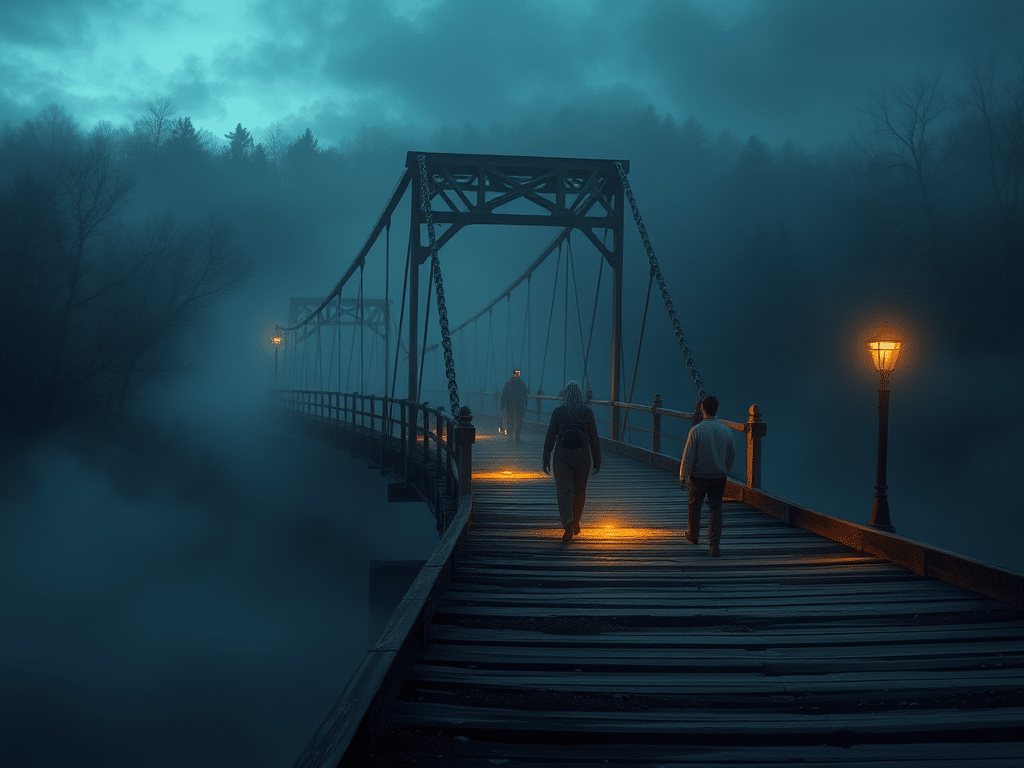
Haunted Bridges: Key Points
-
Bridges are liminal spaces in paranormal lore that symbolically connect the living and dead worlds, making them natural settings for ghost stories across cultures.
-
Bridge ghosts typically include victims of violent deaths, construction workers who perished during building, and spectral guardians who control passage or warn travelers of danger.
-
Notable haunted bridges include Scotland’s Overtoun Bridge, where dogs mysteriously leap to their deaths; America’s “Cry Baby Bridges,” where infant cries are heard; and Japan’s Nihonbashi Bridge, with tales of executed criminals’ spirits.
-
Theories range from psychological factors like height-induced anxiety to environmental causes like unusual acoustics and electromagnetic fields, though skeptics attribute stories to dramatic settings and human pattern-seeking.
-
Haunted bridge legends impact local economies through ghost tourism, help preserve historical memory, and motivate preservation efforts, but they also create public safety concerns from trespassing curiosity seekers.
-
These enduring legends serve as cautionary tales and frameworks for processing tragedy, with bridges continuing to accumulate supernatural stories as modern equivalents of ancient haunted crossroads.

Introduction
Bridges hold a distinctive place within American supernatural folklore, acting as central elements in ghost narratives, regional tales, and the practice of legend-tripping. These constructions transcend their function as simple crossings; they embody liminal spaces, connecting the everyday with the otherworldly, and offering tangible sites where communities forge and sustain their cultural identities through storytelling. Bridges frequently serve as the most prevalent settings for local legends and ghost stories. Bird (2002) designates isolated bridges, alongside peculiar houses and cemeteries, as a category of location where local legends often emerge. These physical structures function as “concrete points of reference for supernatural legends, providing a rationale for their existence” (Kinsella, 2011). Bridges, due to their physical presence, serve as effective focal points for supernatural stories, thereby connecting these narratives to particular, accessible sites.
Bridges as Liminal Spaces in Supernatural Folklore
Haunted bridges are a staple of global folklore, and some have gained a certain level of fame, drawing in investigators, curious tourists, and those eager to share a good story. The Overtoun Bridge in Scotland, for instance, is well-known. Numerous dogs have perished from its heights over the years. Locals have their theories, ranging from a ghostly presence to some unseen force that drives the animals to leap. Cry Baby Bridge is a name used for many bridges across the United States. Each has its twist on a similar tale: a baby was discarded from the bridge, and those who stop and listen can supposedly hear the baby’s cries in the night.
People in Ohio claim that a woman in white haunts the Airtight Bridge. She appears to be crossing, occasionally causing mishaps or disappearing when someone gets too close. Locals fiercely debate her identity and the reason she haunts the bridge. Ghost stories have a long history on Japan’s Nihonbashi Bridge in Tokyo. These include accounts of executed criminals whose spirits are believed to haunt the waters beneath, frightening anyone who dared to cross after dark. These two examples are just a small sample of the many haunted bridge legends out there. Most places have local ghost stories about these structures that connect one side to another.
The inherent liminality of bridges further strengthens their supernatural connotations. Goldstein, Grider, and Thomas (2007) observe that ghost stories frequently occur in liminal environments, specifically citing bridges as locales that exist “betwixt and between” and are therefore appropriate settings for hauntings. This positioning, situated between two distinct locations—neither entirely one nor the other—establishes a symbolic boundary between realms, a concept that folklore frequently utilizes. Zibart and Ferrell (2013) build upon this idea, suggesting that bridges are often perceived as symbolic, liminal spaces “between worlds,” thus making them natural venues for the appearance of paranormal events. Consequently, numerous haunted bridges exhibit a disjunction from their established contexts, a characteristic that legends leverage to authenticate the associated narratives (Kinsella, 2011). This environmental discord—exemplified by an antiquated, forsaken structure juxtaposed against a developed setting—serves as a catalyst for supernatural interpretations.
The substance of haunted bridge legends demonstrates discernible patterns across diverse locales. McNeill and Tucker (2018) identify recurring motifs, such as tales of spectral apparitions, clanking chains, and construction-related accounts involving a laborer or infant interred within newly poured concrete, frequently rooted in the archaic notion of human sacrifice. These construction legends furnish origin narratives for the hauntings, thereby anchoring supernatural occurrences in sorrowful historical circumstances. Illustrative instances demonstrate the diverse manifestations of paranormal occurrences linked to bridges. Bird (2002) recounts the tale of the High Bridge, which spans the Minnesota-Wisconsin border, where the specter of a night watchman is purported to traverse the structure, bearing a green lantern, on the anniversary of his demise. Newman (2016) presents a compilation of accounts from over 300 bridges throughout the United States, detailing a range of paranormal phenomena, such as invisible contact, residual spirits stemming from homicides and self-inflicted deaths, and disembodied vocalizations.
Regional adaptations of bridge legends integrate local circumstances and preoccupations. Tremeear (2013) examines paranormal activity surrounding the Clark and LaSalle Bridges on the Chicago River, encompassing reports of screams, cries, moans, and photographic apparitions, while also alluding to a “floating morgue” located beneath the Wells Street Bridge in the aftermath of the Eastland steamship disaster. Branning (2021) talks about the Old Route 66 Querino Canyon Bridge, which has a history of deadly accidents. He also says that travelers might hear echoes from the canyon below. Zibart and Ferrell (2013) cite multiple versions of legends surrounding the Old Richardsville Road Bridge, including stories of a pregnant woman’s suicide and a child being run over by a large vehicle on the bridge.
The Cultural Functions of Bridge Ghosts
The ghosts that inhabit haunted bridges serve functions that extend far beyond simple supernatural scares, operating as cultural agents that preserve memory, warn the living, and mark certain deaths as particularly significant within community consciousness. Newman (2016) categorizes the paranormal phenomena at bridges into distinct types—invisible contact, residual hauntings, and interactive spirits—suggesting that these ghosts exist on a spectrum from passive imprints of past trauma to active entities that respond to and engage with the living. The ghost of the night watchman described by Bird (2002), who continues his rounds with his green lantern on the anniversary of his death, represents a spirit bound by duty and routine, unable or unwilling to relinquish his earthly responsibilities even in death. This type of ghost speaks to cultural anxieties about labor demands and the difficulty of finding rest while simultaneously honoring the dedication of workers who maintained infrastructure and protected communities. The construction worker ghosts described by McNeill and Tucker (2018), particularly those allegedly entombed in concrete, serve as permanent witnesses to the human cost of progress and development, ensuring that deaths occurring during bridge construction are not forgotten or dismissed as mere statistics. These spirits transform anonymous laborers into memorable presences, giving voice to those who might otherwise remain nameless in historical records.
The nature of bridge ghosts also reflects how communities process different types of death and assign meaning to tragedy. Goldstein, Grider, and Thomas (2007) note that bridges serve as settings for culturally specific ghost legends like La Llorona, demonstrating how these structures become sites where different traditions of supernatural belief intersect and merge. The ghosts of suicide victims, such as the pregnant woman mentioned by Zibart and Ferrell (2013), carry particular cultural weight, representing despair, abandonment, and the failure of community support systems. These spirits often take on warning functions, cautioning others against similar desperation or alerting the living to dangers the bridge presents. Child ghosts, including those reportedly sacrificed in construction or killed in accidents, evoke especially strong emotional responses and serve to remind adults of their responsibilities to protect the vulnerable, while the disembodied screams and cries documented by Tremeear (2013) at Chicago River bridges connected to the Eastland disaster represent collective trauma that refuses to fade quietly into history. The variety of ghost types—dutiful watchmen, sacrificed workers, desperate suicides, innocent children, and disaster victims—demonstrates that bridge hauntings serve as repositories for different categories of community memory and different moral lessons, with each type of spirit fulfilling distinct narrative and cultural purposes within the broader folklore tradition.

Legend-Tripping and Ritualized Engagement
Bridge legends are not simply recounted; they are brought to life through legend-tripping, a practice wherein individuals journey to allegedly haunted sites to directly encounter the supernatural. Bird (2002) observes that narratives linked to locations such as the High Bridge frequently adopt a ritualistic form, are recounted en route or at the site itself, and are integral to a broader undertaking. This ritualized narration shifts the story from a passive form of amusement to one of active engagement. McNeill and Tucker (2018) examine the behaviors of those who visit haunted bridges, noting that they engage in a sequence of prescribed actions believed to elicit ghostly manifestations, which can be interpreted as a rite of passage into adulthood or a form of teenage rebellion. These ritualized actions establish a defined structure for supernatural interactions, thereby affording participants a degree of control over their involvement with the paranormal. Kinsella (2011) observes that sites such as the Pope Lick Trestle exemplify locations frequently frequented for legend-tripping, often by adolescents, thereby underscoring the demographic most drawn to these experiences. The case study undertaken by McNeill and Tucker (2018), “The Haunted Bridges Near Avon and Danville and Their Role in Legend Formation,” elucidates the specific legends and rituals linked to visits to these haunted bridges, illustrating how individual locations cultivate their own distinctive traditions while simultaneously participating in wider patterns of bridge folklore.
Beyond their role as sources of amusement or adolescent defiance, haunted bridge legends fulfill significant cultural functions. Bird (2002) posits that local place legends serve as a means for communities to forge and articulate their cultural identities. The narratives associated with particular bridges foster a sense of local uniqueness and collective understanding, thereby designating those familiar with the stories as members of a specific community or area. The inherent accessibility of bridges renders them democratic venues for folklore. In contrast to private property or hazardous sites, numerous bridges—particularly those that are abandoned or of historical significance—are readily accessible for visitation. Branning’s (2021) examination of the historical Sanders Bridge, spanning the Puerco River, highlights its transformation from a vehicular thoroughfare to a pedestrian-accessible site, thereby demonstrating how such structures can be adapted into folklore destinations subsequent to the cessation of their primary function. The documentation and conservation of bridge-related ghost stories have garnered considerable attention from both academic and popular audiences. Newman (2016) offers a thorough compilation that chronicles the oral history and ghost story traditions associated with these structures, categorizing the most compelling narratives into identifiable classifications for the benefit of readers. These compilations serve a dual purpose: they contribute to the preservation of folklore traditions and provide helpful guidelines for modern-day legend-trippers in search of their own supernatural encounters.
Conclusion
Haunted bridges constitute a notable subset within American supernatural folklore, serving as transitional zones wherein communities navigate their connections to history, the supernatural realm, and their own cultural self-perceptions. The enduring physicality of bridges, coupled with their inherent liminality, fosters optimal conditions for the genesis and perpetuation of ghostly tales. Through the act of legend-tripping, these narratives transcend simple narration, evolving into lived experiences, especially for adolescents who are drawn to initiation rituals or who wish to assert their independence from adult oversight. As both tangible structures and narrative focal points, haunted bridges exemplify the enduring vitality of folk tradition within modern American society, offering spaces where the supernatural remains both accessible and culturally significant.
References
Bird, S. E. (2002). It makes sense to us: Cultural identity in local legends of place. Journal of Contemporary Ethnography, 31(5), 519-547.
Branning, D. (2021). Arizona’s Haunted Route 66. History Press.
Goldstein, D., Grider, S., & Thomas, J. B. (2007). Haunting experiences: Ghosts in contemporary folklore. University Press of Colorado.
Kinsella, M. (2011). Legend-tripping online: Supernatural folklore and the search for Ong’s Hat. University Press of Mississippi.
McNeill, L. S., & Tucker, E. (Eds.). (2018). Legend tripping: A contemporary legend casebook. University Press of Colorado.
Newman, R. (2016). Haunted bridges: Over 300 of America’s creepiest crossings. Llewellyn Worldwide.
Tremeear, J. (2013). Illinois Haunted Route 66. Arcadia Publishing.
Zibart, A., & Ferrell, A. (2013). Legend-tripping at the Old Richardsville Road Bridge. Western Kentucky University Digital Commons.



Leave a Reply