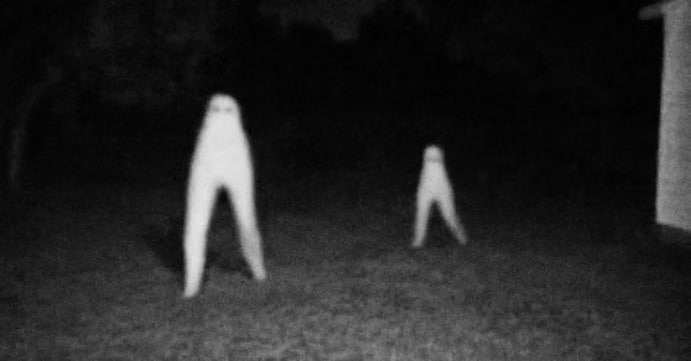
Fresno Nightcrawlers: Key Points
-
The Fresno Nightcrawlers are cryptids first captured on 2007 security footage, characterized by extremely long pale legs, short bodies, and no visible arms or facial features.
-
These entities appear exclusively at night in pairs, moving with a smooth gliding gait and leaving no physical trace.
-
The phenomenon began with 2007 Fresno footage and a 2011 Yosemite sighting, with disputed claims of connections to Native American folklore.
-
Skeptics suggest the footage shows birds captured at odd angles or elaborate hoaxes using puppets and costumes.
-
Alternative theories propose interdimensional beings, extraterrestrial drones, or undiscovered species, though these struggle to explain biological impossibilities.
-
The Nightcrawlers represent unique modern cryptids known through security cameras rather than eyewitness accounts, becoming prominent internet folklore regardless of their true nature.

Introduction
The Fresno Nightcrawlers are one of the strangest and most recognizable cryptids in modern folklore. They have a strange look that doesn’t seem to fit with what we know about biological forms. These things were first seen on home security video in Fresno, California. They have caused a lot of debate among cryptozoologists, skeptics, and paranormal fans. The strange shape of these creatures and the unexplained events surrounding their appearances have made them famous all over the world in the field of cryptozoology.
Overview
The Fresno Nightcrawlers look very much the same in both recorded sightings and video footage, which makes them very interesting to researchers. People say that these things have short, heavy bodies that look almost like they’re missing parts and very long, pale legs that make up most of their height. Based on what most witnesses and video evidence show, they are between three and four feet tall, and their leg-like parts move in a unique way that looks like pants or fabric blowing in the wind. There are no arms, faces, or other body parts that you would normally see on land animals (Quinney, 2024) that can be seen on these creatures. Their bodies look white or light gray.
Fresno Nightcrawler sightings have shown few but very regular patterns of behavior, which adds to the mystery surrounding these beings. The creatures move with a smooth, gliding motion that looks like it was done by a machine or a doll, as if the legs were moving without any muscles being visible. People have only seen them at night, usually in pairs, walking deliberately across yards, fields, and roads, not seeming to notice or care about the people watching. The entities don’t seem aggressive or hungry or interacting with their surroundings in any way other than moving. They also seem to disappear as quickly as they appear, leaving no physical evidence of their presence.
Historical Sightings and Cultural Folklore
The Fresno Nightcrawlers first came to people’s attention through online videos and reports from witnesses, some of whom said they saw the creatures moving around the area. The most important piece of evidence is apparently home video footage of these beings moving, with clear lower bodies and no visible limbs. Folklore from different parts of the world also tells stories about meetings with strange beings that can’t be explained. This shows that people tend to think of strange sightings through the lens of legends and myths (Guimont, 2021).
As was already noted, the history and folklore of Fresno Nightcrawler reports really began in 2007 when a Fresno resident used his home security camera to record two strange beings walking through his front yard. The homeowner set up the camera after his motion-sensor security system kept going off. The video that he got showed two pale, leg-like figures walking across his yard early in the morning. Even though the original video was grainy and short, it was interesting enough to get the attention of paranormal researchers. It was later shown on the TV show Fact or Faked: Paranormal Files, which did its own investigation. A second important sighting happened in Yosemite National Park in 2011, when similar creatures were caught on a park ranger’s personal security camera. This added to the geographical scope of the event and suggested that these creatures might live in different places in California (Offutt, 2025).
People have seen nightcrawlers, but they also have cultural meanings in Native American folklore, where some experts say they can find similarities and precedents for these kinds of beings. Some analysts think that some Native American groups in the Fresno area had stories about beings that were similar to the ones seen in the video. However, solid proof of these stories existing before the 2007 video is still hard to find and is being disputed. Even though there aren’t many historical accounts that can be checked, the creatures have been embraced by many indigenous groups online. Some say they are ancient spirits or guardians of the land. This cultural acceptance has given the event more meaning, turning it from a simple cryptozoological curiosity into something that has deeper connections to land, history, and the unknown animals that may have lived in North America before modern records were made.

Theoretical Explanations and Scientific Analysis
Theories about the Fresno Nightcrawlers range from the ordinary to the supernatural. This shows how far apart the skeptical and believing groups are. The simplest answer is that the video only shows birds, mostly owls, flying with their legs forward, which could make their legs look like they are walking when caught on low-resolution cameras at night. Others doubters say the videos show complicated hoaxes that might have been made with puppets, models that are moved by strings, or people wearing outfits with long white fabric legs and bodies that can’t be seen. As proof of intentional fabrication meant to go viral or draw attention to otherwise unremarkable home videos, some analysts have pointed to the inconsistent movement patterns and the cameras’ handy placement.
Different ideas offer stranger explanations for the Nightcrawlers that involve supernatural or extraterrestrial events. Some researchers think these things might be beings from other dimensions that sometimes step into ours. This would explain why they appear and leave without leaving any physical signs. Others think they might be living things from another world, like robots or drones sent to watch Earth. Their strange bodies are thought to be the result of engineering rather than evolution. A more speculative theory says that the Nightcrawlers are an unknown species of land animal that has stayed out of human sight by only being active at night and being very rare. However, this theory has trouble explaining how such a noticeable animal could have evolved without leaving any fossils or being caught on wildlife cameras placed in their supposed habitat.
The footage that has been analyzed scientifically and technically has produced mixed results, with different experts coming to very different conclusions based on the same data. Video forensics experts who have looked at the Fresno footage say that the quality and clarity make it very hard to make a firm analysis. However, some have found what they say are signs of digital manipulation or compression artifacts that could mean the footage was tampered with. Biologists and zoologists who have watched the videos are generally skeptical that such a creature exists. They say that it doesn’t seem to have a center of mass, there aren’t any visible joints or other anatomical structures that would allow it to move, and it can’t move without some kind of support structure. Other experts, on the other hand, say that the fact that the reports were all the same, the movement seemed natural, and the witnesses were clearly confused all point to the fact that something truly strange was caught on camera.
Cultural Impact and Environmental Context
There are some disagreements about whether or not these creatures are real, but the Nightcrawlers have become a social phenomenon that changes how people think about the difference between cities and rural areas, especially in Fresno. Community stories about these entities can help people form their own identities and be strong in the face of urban myths (Vescovi, 2024; Schroder et al., 2018). Understanding the surroundings where these sightings happen helps you understand how they affect people. The city of Fresno is in the San Joaquin Valley, which is known for its unique landscapes and ecosystems, as well as air quality problems caused by farming and city life (Benner & Pastor, 2015; Meng et al., 2010; Anu et al., 2015). The difference between rural and urban landscapes raises ecological concerns about the animals that may live in or come from these places and how their habitats might be affected. No matter how true the stories about the Nightcrawlers are, the local environment has a big impact on how they are told.
Also, air pollution and the health effects it has on the area have been the subject of many public health talks. Asthma rates have gone up in the San Joaquin Valley because of high amounts of ozone and particulate matter (Meng et al., 2010). This has led to community health initiatives. It’s possible that this will also affect the stories people tell about strange experiences, since changed landscapes and damaged environments can make people think of paranormal things and the natural world.
Even though the Fresno Nightcrawlers only happened for a short time, they show how fear, interest, and folklore affect culture as a whole. As cities grow, so does the area where people live and work that connects to rural areas. This means that people are more likely to come into contact with wildlife, and legends have different ways of explaining these interactions (Kim & Christy, 2021). The stories about the Nightcrawlers are often cultural touchstones that help people in the community get to know each other, find funny ways to deal with fear, and form their sense of who they are (Wang et al., 2006).
Additionally, conversations about how to accept folklore events in city settings and the stories that follow show a conflict between doubt and faith (Guimont, 2021; Schroder et al., 2018). Many people in the area are both skeptical and amused by the Nightcrawlers, seeing them as part of the fun local legend. These kinds of stories give people a place to talk about important issues like local ecology as well as have fun conversations that bring people together.
Conclusion
As an example of how modern technology can both help and hinder the search for unknown animals, the Fresno Nightcrawlers hold a special place in the field of modern cryptozoology. Traditional cryptids like Bigfoot and the Loch Ness Monster are mostly based on eyewitness accounts and unclear photos. The Nightcrawlers, on the other hand, are mostly known from video evidence caught by security cameras. While this technological evidence gives the phenomenon some credibility, it also makes it more open to closer examination and the chance of a sophisticated hoax. The creatures have become internet folklore, with a huge number of artistic interpretations, animated movies, and cultural references that make it hard to tell the difference between real research and fun. No matter if the Fresno Nightcrawlers are a complicated hoax, a mistaken identification of common phenomena, or something real, they continue to amaze people and remind us that even in this highly technological age, mystery and wonder can still come from the dark of a suburban California night.
References
Anu, N., Selvasembian, R., Antony, R., & Selvaraju, N. (2015). Evaluation of optimization methods for solving the receptor model for chemical mass balance. Journal of the Serbian Chemical Society, 80(2), 253-264. https://doi.org/10.2298/jsc131124052a
Benner, C. and Pastor, M. (2015). Collaboration, Conflict, and Community Building at the Regional Scale. Journal of Planning Education and Research, 35(3), 307-322. https://doi.org/10.1177/0739456×15580024
Guimont, E. (2021). Megalodon. M/C Journal, 24(5). https://doi.org/10.5204/mcj.2793
Kim, D., & Christy, J. R. (2021). Detecting impacts of surface development near weather stations since 1895 in the San Joaquin Valley of California [Preprint]. Research Square. https://doi.org/10.21203/rs.3.rs-865546/v1
Meng, Y., Rull, R., Wilhelm, M., Lombardi, C., Balmes, J., & Ritz, B. (2010). Outdoor air pollution and uncontrolled asthma in the San Joaquin Valley, California. Journal of Epidemiology & Community Health, 64(2), 142-147. https://doi.org/10.1136/jech.2009.083576
Offutt, J. (2025). Chasing North American Monsters: A Guide to Over 250 Creatures from Greenland to Guatemala. Llewellyn Worldwide.
Quinney, R. (2024). Cryptids, Creatures & Critters: A Manual of Monsters & Mythos from Around the World. Andrews McMeel Publishing.
Schroder, J., Campuzano‐Jost, P., Day, D., Shah, V., Larson, K., Sommers, J., … & Jiménez, J. (2018). Sources and Secondary Production of Organic Aerosols in the Northeastern United States during WINTER. Journal of Geophysical Research Atmospheres, 123(14), 7771-7796. https://doi.org/10.1029/2018jd028475
Vescovi, A. (2024). Covert Hinduism, overt secularism: A postsecular reading of the Indian English novelistic tradition. Milano University Press. https://doi.org/10.54103/milanoup.143
Wang, H., Kawamura, K., & Shooter, D. (2006). Wintertime Organic Aerosols in Christchurch and Auckland, New Zealand: Contributions of Residential Wood and Coal Burning and Petroleum Utilization. Environmental Science & Technology, 40(17), 5257-5262. https://doi.org/10.1021/es052523i
Leave a Reply