George V and the Flying Dutchman: Key Points
-
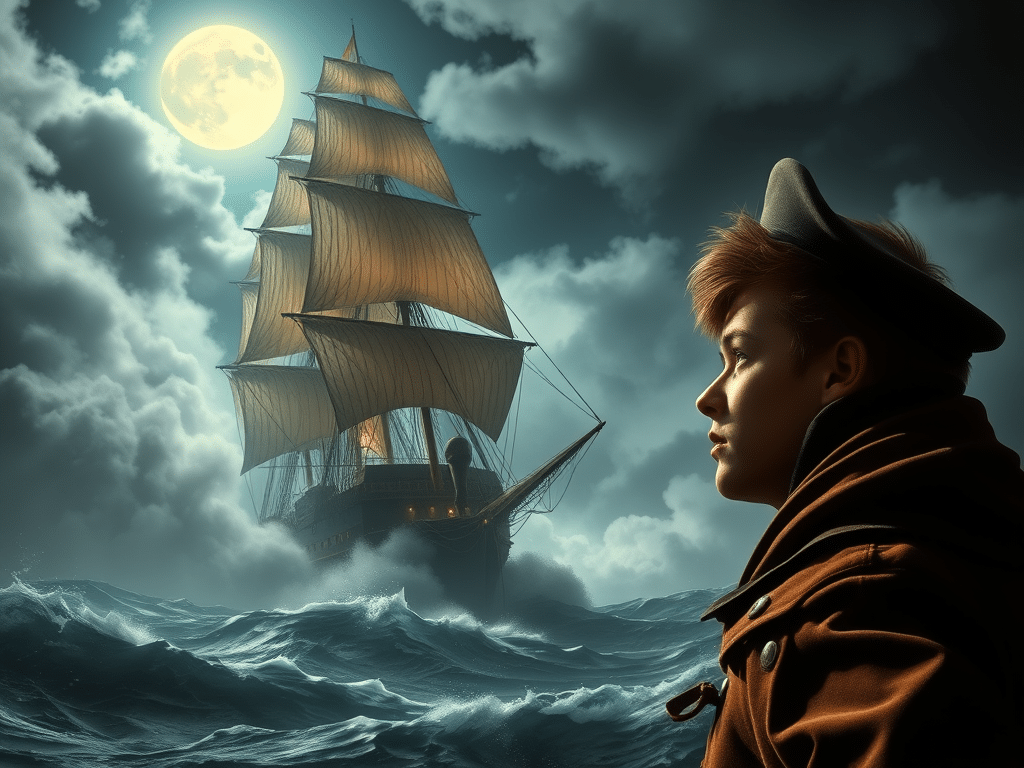
The Flying Dutchman is a legendary ghost ship doomed to sail forever, appearing as a glowing phantom that foretells disaster for those who see it.
-
Prince George, the future King George V, served in the Royal Navy from age twelve and later ruled Britain from 1910 to 1936.
-
On July 11, 1881, sixteen-year-old Prince George and twelve others aboard HMS Bacchante reportedly saw the phantom ship near the Cape of Good Hope.
-
Theories range from supernatural belief to mirages, misidentification, or the princes’ tutor’s embellishment of the diary entry.
-
The royal sighting gave the Flying Dutchman unprecedented credibility, especially after the lookout who first spotted it reportedly died that same day.
-
The encounter remains a fascinating blend of folklore and history that continues to captivate audiences over a century later.

Introduction
The Flying Dutchman is one of the most famous supernatural tales in seafaring history, told by sailors and storytellers for centuries. There have been many reports of seeing this ghost ship, but one stands out because it was seen by the future King George V of the United Kingdom. Prince George, a young midshipman in the Royal Navy, reportedly saw the ghostly ship in 1881. This event added a strange part to both folklore and history, and it still raises questions about how people see things, what they believe, and the mysteries of the sea.
Origins and Cultural Significance of the Flying Dutchman Legend
The story of the Flying Dutchman comes from maritime custom. It’s about a ghost ship that will never be able to dock because it will always be sailing the oceans. The most popular version of the story says that in the 1600s, a Dutch captain, whose name was often written as Van der Decken, tried to go around the Cape of Good Hope during a very bad storm. Depending on the story, the captain swore he would finish the crossing even if it took until the end of the world. He did this out of pride, blasphemy, or a deal with the devil. His promise was taken literally by supernatural forces, and he and his crew will have to sail forever as ghosts. People who say they have seen the Flying Dutchman say it looks like a ghost ship that sometimes glows with an eerie light and appears out of nowhere in fog or storms before disappearing just as strangely. According to the story, seeing the ghost ship is a bad sign that any ship that happens to see it will have bad things happen to it (Berry, 1960).
Many people have used the story of the Flying Dutchman as an allegory to talk about morality and the supernatural. In different versions of the story, the ship is used as a metaphor to warn people not to get too ambitious, which hits home strongly in seafaring communities. Because of this, it has fascinated people and led to stories that often show how people fight against nature (Metreveli, 2016).
In the Romantic age, works of literature, especially Wagner’s opera Der fliegende Holländer, made the ghost ship very popular. It is said that Wagner’s interest in the story came from his own rough sea voyages across the Baltic Sea, combining personal experience with national mythology (Millington, 2006; Collini, 2021). The story turned into a symbol of military and colonial adventures. It often showed the conflicts and hopes of colonial powers, especially between the Dutch and the British during the Age of Exploration (Andeweg, 2015).

Prince George and the 1881 Sighting
Prince George Frederick Ernest Albert was born on June 3, 1865. He was the second son of the Prince of Wales, who later became King Edward VII. This made it seem impossible at first that he would become king. As was the custom in his family, George joined the Royal Navy when he was twelve years old. This was the start of a job that would shape his personality and view of the world. For fifteen years, he was in the navy and did a lot of traveling. He became very close with sailors and the men who served under Britain’s military flag. Many believed that his older brother, Prince Albert Victor, would inherit the throne, but after Albert Victor’s death in 1892, George found himself in the direct line of succession. After his father died in 1910, George finally took the throne. He ruled during a rough time that included World War I and major social changes until his own death in 1936 (Cannadine, 2014).
It is said that the sighting happened on July 11, 1881, while Prince George, then sixteen, was serving on the ship HMS Bacchante in the water between Australia and South Africa, close to the Cape of Good Hope. The event was written about in the book The Cruise of HMS Bacchante, which was Prince George and his older brother Prince Albert Victor’s diary of their military training voyage from 1879 to 1882. The story goes that around 4:00 AM, during the middle watch, the lookout saw a weird red light that looked like the light of a ghost ship. The record says that thirteen people on the Bacchante, including the princes, saw the ghostly ship cross in front of them. The Flying Dutchman looked like a ghostly ship lit in a reddish light. According to reports, the HMS Tourmaline and the HMS Cleopatra, which were traveling with the Bacchante, also saw the ghost ship. However, the mystery ship disappeared just as quickly as it had shown up, leaving no sign (Petro & Anna, 2024).
Andeweg (2015) talks about how this story shows the tensions in history by seeing the ship as a ghostly representation of colonial memories and technological progress. King George was also a part of the story. He represented the complicated meanings of leadership and nautical practice in imperial settings. Because of the person involved, even a sighting of a ghost ship has more value than it should.
Explanations and Interpretations of the Sighting
Several ideas, ranging from the supernatural to the logical, have been put forward to explain this famous sighting. Some doubters say that the event might have been mistaken for something else, like the lights of another ship looking strange because of the weather or the fact that the sailors on night watch were tired and easy to fool. Some researchers talk about Fata Morgana, a complicated type of superior mirage that can make ships far away look like they float above the horizon or have distorted, otherworldly shapes. This happens a lot when the weather is near the Cape of Good Hope. Others doubt the accuracy of the diary entry itself, pointing out that the published account was heavily edited and may have been embellished by John Neale Dalton, the tutor who was traveling with the princes and may have added or dramatized the Flying Dutchman story to make the trip more interesting for readers. Some researchers think the diary entry is more likely to be made up than real historical evidence because it fits the standard story of the Flying Dutchman almost too well.
It’s impossible to overstate how important this royal sighting was to the Flying Dutchman legend. It gave the ghost ship story respect and attention that it might not have had otherwise. The Flying Dutchman story went from being a silly nautical myth to a story that learned people and regular people alike were interested in when the future king of England was present. The event has been talked about and written about a lot in maritime mystery books, articles, and conversations. It is often called the most famous and well-documented Flying Dutchman sighting in history. The story became even more tragic when the sailor on the Bacchante who first saw the ghost ship supposedly fell from the mast and died later that same day, fulfilling the legend’s warning that people who see the ghost ship will die. This accident, whether it was real or made up, only strengthened the legend’s hold on people’s minds and made sure it would be passed down from generation to generation.
Legacy and Modern Interpretations
The coronation of King George V was a show meant to bring the British Empire together and calm people down during a rough time. When he planned the ceremonies of being king, he often used nautical symbols, which fit with the stories people told about nobles and brave sailors (Dine, 1991). Making this point brings out the link between royal stories and bigger mythologies that shape British culture, like the Flying Dutchman story. King George V’s naval policies and celebrations helped strengthen the link between the monarchy and maritime customs, which shows how long the British Empire’s naval history goes back.
Scholars are still talking about the ship that sank. The ghost ship theme is used in Amiri Baraka’s play Dutchman, but the play is more about race relations and identity battles in America (Turki & Al-Douri, 2022; Jones et al., 2017). The way Clay and Lula engage in Baraka’s story is similar to how the Flying Dutchman is mysterious and hard to find. It shows a journey that includes both personal and social problems. It’s not just a ship that the characters are on; it’s also a metaphor for their existential problems, like the famous ship and its captain who was cursed to sail forever (Collini, 2021).
People from different cultures have different ideas about what The Flying Dutchman means. One idea is that it shows how people try to control nature but fail. In their 2024 paper, Kristianto et al. describe a larger maritime folklore tradition in Indonesia, focusing on how legends form cultural identity. In the same way, Anisimova and Makarova (2024) look at romantic depictions of ships in English writing and stress the symbolic depth of maritime imagery. Every way of looking at the Flying Dutchman story adds to its mythology, making it not only a story about how to navigate the seas but also a cultural view that can be used to look at bigger problems in society.
Conclusion
The meeting of Prince George and the Flying Dutchman is still an interesting mix of folklore, history, and the human desire to look for meaning in things we don’t fully understand. Whether the event was a real supernatural experience, a misunderstood natural event, or a work of fiction is irrelevant. It shows how powerful stories are, even affecting future world leaders. The story has been told for a long time because it touches on important themes in our lives, such as the vastness and uncertainty of the ocean, the thin line between what can be explained and what is mysterious, and our never-ending fascination with the idea that some things might not make sense. People are still interested in Prince George’s supposed meeting with the Flying Dutchman more than a hundred years later. This is how the legend and this part of its long history live on in maritime history and popular culture.
References
Andeweg, A. (2015). Manifestations of the Flying Dutchman: On materializing ghosts and (not) remembering the colonial past. Cultural History, 4(2), 187–205. https://doi.org/10.3366/cult.2015.0093
Anisimova, O., & Makarova, I. (2024). The image of Ship in English Romantic poetry: Reinterpreting Coleridge’s ‘Rime of the Ancient Mariner’ and Shelley’s ‘Vision of the Sea’. Litera, 11, 318–326. https://doi.org/10.25136/2409-8698.2024.11.72205
Berry, C. L. (1960). The Coronation Oath and the Church of England. The Journal of Ecclesiastical History, 11(1), 98–105. https://doi.org/10.1017/s0022046900063247
Cannadine, D. (2014). George V (Penguin Monarchs): The Unexpected King. Penguin UK.
Collini, P. (2021). L’Olandese Volante: Da Vasco da Gama a Wagner. In Proceedings of the Conference (pp. 277–282). https://doi.org/10.36253/978-88-5518-467-0.22
Dine, J. (1991). [Review of the book European Economic Interest Groupings, by D. van Gervan & C. A. V. Aalders]. International and Comparative Law Quarterly, 40(1), 254–255. https://doi.org/10.1093/iclqaj/40.1.254-a
Jones, R., Baraka, A., & Edward, J. (2017). Assessment of American mythic paradigm in the light of liberty, equality, fraternity and self-knowledge: A case of Le Roi Jones/Amiri Baraka, “Dutchman, 1964”. International Journal on Studies in English Language and Literature, 5(6), 58–62. https://doi.org/10.20431/2347-3134.0506009
Kristianto, A., Singgih, E., & Haryono, S. (2024). Nyi Roro Kidul and marine eco-pneumatology. International Journal of Asian Christianity, 7(1), 103–118. https://doi.org/10.1163/25424246-07010006
Metreveli, R. (2016). The Crusades and the Kingdom of Georgia. Crusader, 4(2), 63–80. https://doi.org/10.13187/crus.2016.4.63
Millington, B. (2006). Der fliegende Holländer. In The Operas of Richard Wagner (pp. 50–56). Oxford University Press. https://doi.org/10.1093/oso/9780195305883.003.0007
Petro, S., & Anna, K. (2024, May 27–29). Features of travels in the period of the modern history. In The XXI International Scientific and Practical Conference “Theoretical methods of research of the latest problems,” Prague, Czech Republic.
Turki, H., & Al-Douri, H. (2022). Tracing the Brechtian influence in Amiri Baraka’s Dutchman. JLS, 5(1), 1–14. https://doi.org/10.25130/jls.5.1.1



Leave a Reply