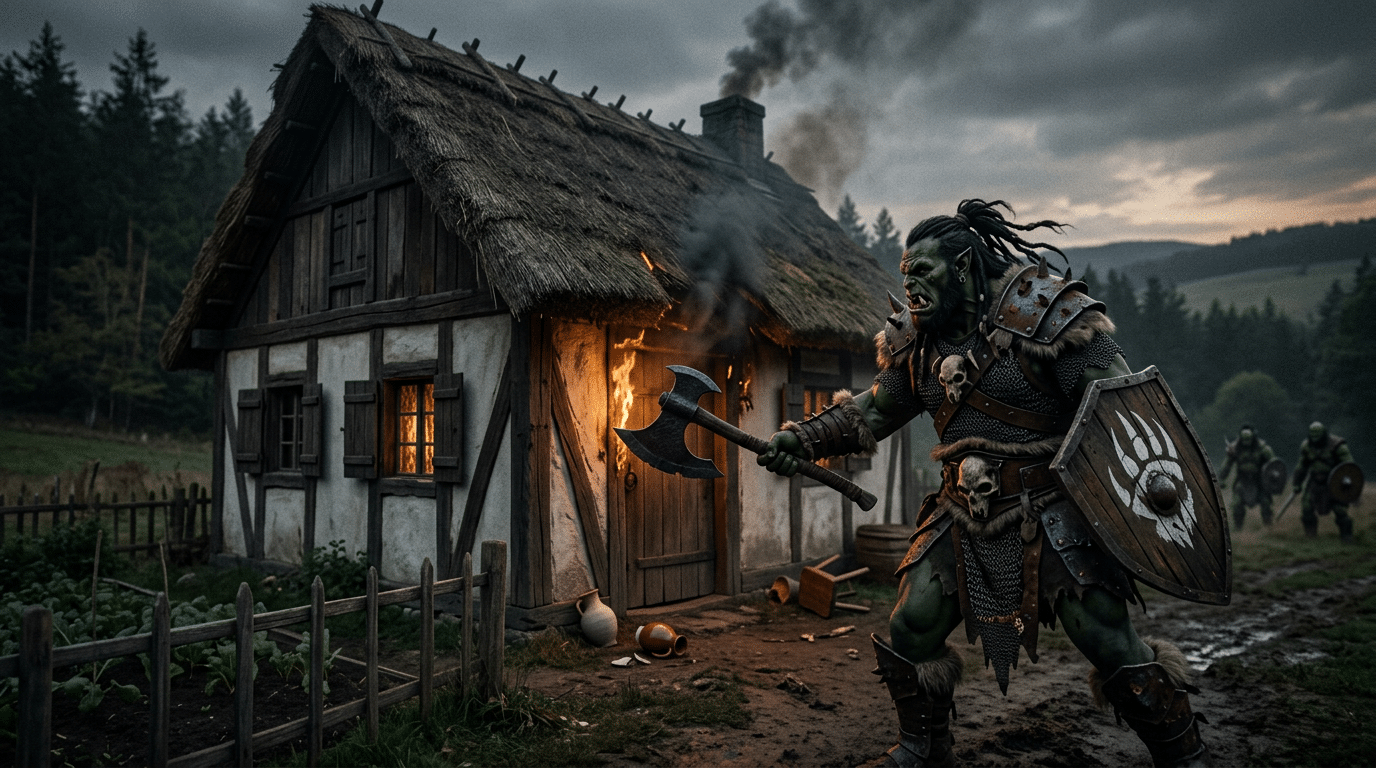
Orcs as Others: Key Points
-
Orcs serve as the archetypal “Other” in fantasy literature, representing threats to civilized order and embodying everything heroic protagonists are not.
-
Orcs are described with grotesque features like dark skin and twisted bodies that link their appearance to moral corruption, often drawing on racist and xenophobic imagery.
-
Orcs are portrayed as cruel and driven by base impulses, lacking genuine culture or compassion and existing in brutal hierarchies built on fear.
-
In Tolkien’s work, orcs are corrupted instruments of evil powers, lacking depictions of domestic life and given little dignity, even though their evil is imposed rather than inherent.
-
Scholars view orcs through postcolonial and critical race theory lenses, seeing them as reflections of colonial anxieties, racial prejudices, or symbols of industrialization’s dehumanizing effects.
-
The portrayal of inherently evil races raises ethical concerns about normalizing essentialist thinking, leading modern fantasy to give such races complexity or abandon the concept entirely.

Introduction
We can examine how societies build identity by defining what they are not, particularly through the concept of the “Other” in fantasy fiction. Fantasy stories depict some races or species as fundamentally different from the main characters. They are given traits that make them seem strange, dangerous, or morally lower. Orcs, maybe more than any other mythical animal, have come to reflect this process of “othering” in ways that show deep worries about society, wildness, and the limits of what it means to be human. Orcs symbolize cultural fears and stereotypes against people perceived as immoral in literature, especially in the works of J.R.R. Tolkien and other fantasy writers who came after him.
Theoretical Frameworks of Otherness in Fantasy Literature
The idea of the “Other” in fantasy fiction comes from philosophical and sociological studies that look at how groups define themselves by leaving others out and comparing themselves to others. Edward Said’s (1977) work on Orientalism shows how Western culture has always seen the East as strange, dangerous, and fundamentally different to defend its power and strengthen Western identity. For the same reason, in fantasy worlds, some races are called “Others” to set clear moral limits and make simple bad guys for heroic stories. In fantasy, the “Other” is usually someone who looks different, has cultural practices that seem cruel or hard to understand, and is thought to lack the qualities that make the main characters worthy of respect. This structure lets readers enjoy conflict stories without having to think about the moral issues that would come up if enemies were shown to have the same depth and humanity as heroes.
The orc has been used as a straightforward bad guy, but it has also been used to explore ideas of otherness, power, and moral ambiguity in fictional worlds for a long time. Some talks focus on how Tolkien shaped modern fantasy orc stereotypes, while other scholarly views stress how later writers changed or adapted this template to deal with modern issues of race, ethnicity, and colonialism. This large body of research is useful for looking at orcs as a way to think about the morality of magical worlds and the politics behind how creatures and enemies are made. For instance, studies of fantasy literature often show that orcs are part of a long history of racial and political symbols that goes beyond the works of a single author (Dehghan et al., 2024; Dehghan et al., 2024; Slusser, 2017; Loh et al., 2020).
Physical and Behavioral Dehumanization of Orcs
People usually describe orcs’ bodies in ways that make them look different from the idealized human or elf body, with traits that make them look gross, dangerous, and naturally less important. Tolkien’s orcs are twisted, evil versions of elves. They have dark skin, slanted eyes, fanged mouths, and hunched stances that make them look both physically and morally flawed. People often say that their bodies are both strong and disgusting, able to do a lot of damage but missing the grace and beauty of Middle-earth’s “good” races. These physical images come from a long history of racist and xenophobic imagery that says people who aren’t beautiful by European standards are less smart and moral. Focusing on their ugliness is a visual shorthand for the fact that they are enemies who don’t need to be understood or felt sorry for.
When it comes to behavior, orcs are portrayed as animals with base urges who lack the noble, caring, and cultural traits that define the heroic races. Orcs in Tolkien’s books or Dungeons & Dragons are portrayed as mean, weak, and dishonest, and they are unable to make anything good or beautiful. Instead, they can only copy and destroy what other people have made. Orcs use rude and harsh language, engage in cannibalism, torture one another, and display loyalty solely out of fear of stronger forces rather than love or respect for each other. Their society, such as it is, looks like a harsh order where the strong rule over the weak with no sense of fairness or compassion. This portrayal makes a clear contrast between the orcs, who can only destroy and despoil, and the civilized people, who build and form important communities. This viewpoint reinforces the idea that some beings are completely outside of the moral community.
As symbols of the Other, orcs reflect cultural fears of invasion, contamination, and the end of civilized order in the face of barbaric hordes. In fantasy stories, they often play the same part as historical fears of outsider groups that pose a threat to established societies, like Viking raiders, Mongol invaders, or colonized peoples fighting against European expansion. The orcish danger is usually considered existential, since they are the exact opposite of everything the main characters value, making it impossible for them to compromise or live together. Because orcs are seen as creatures that can’t be reasoned with, saved, or accepted into civilized society, this totalizing opposition lets fantasy stories create situations where violence against the Other is not only okay but also morally required. The role of orcs as Others takes away the moral problems that come up with war, so readers can enjoy stories of brave violence without feeling guilty about killing beings that they could relate to.

Cross-Cultural and Genre Perspectives on Orc Representation
As a flexible plot and symbol, orcs are used across fantasy genres to build worlds and ask questions about right and wrong. They show the conflict between being far away (the monster “other”) and being close (the moment in a story or movie when you meet the other). The strongest claims in the sources stress that orcs should be understood not only as enemies but also as cultural artifacts that show how people think about power, otherness, and morality in fantasy literature (Slusser, 2017; Loh et al., 2020; Lobo, 2024). Cross-media and cross-cultural similarities are also seen as useful from a methodological point of view. Researchers who look at orcs through different lenses—mythic heritage, postcolonial critique, genre theory, and reader reception—find more nuanced readings that show how fantasy’s moral imagination has both stayed the same and changed over time (Akifi, 2022).
Tolkien’s version of Middle-earth views orcs as the corrupt opposite of the free people who live there, seeing them mostly as tools of bad forces rather than people with free will or real problems. Tolkien thought that Morgoth and Sauron changed orcs from what they were originally like. This suggests that orcs’ evil nature is not natural but was put on them. However, this backstory doesn’t do much to give them dignity or depth in the story itself. Orcs are almost always shown in military settings, like as armies or raiding groups. They are rarely shown with families or doing anything other than serving dark lords. When Tolkien does give orcs lines to say, they are usually small-minded, mean, and scared, and the only time we feel sorry for them is when they complain about how badly their masters treat them (Rearick, 2004). This image makes beings who are both victims of corruption and fully responsible for their bad actions, which is said to have been a contradiction that Tolkien himself found annoying as he got older.
Some theories that help us understand orcs as Others come from studying postcolonial theory, critical race theory, and how fantasy fiction either reinforces or challenges power structures in the real world. Some experts say that Tolkien’s orcs, with their dark skin, slanted eyes, and connection to the East, show how racist and colonial Britain was in the early 1900s, even if Tolkien wasn’t aware of it. Others say that orcs represent a fear of invading forces in Europe in the Middle Ages or Early Modern Period, similar to how tales portrayed Vikings and Huns as horrible monsters. Some interpretations that are more sympathetic say that orcs represent how industrialization and dictatorship make people less human, and that Sauron’s reduction of them to tools of his will represents how people lose their humanity when they live in oppressive systems. Modern fantasy writers have been thinking a lot about how problematic it is to have always-evil humanoid races. Some have reimagined orcs as complex societies with their own valid points of view and cultures, while others have given up on the idea completely because it is so tied to racist ideology that it can’t be fixed.
The way orcs are portrayed as “Others” brings up important questions about the morality of creating fantasy worlds and how stories can either support or challenge prejudices in the real world. When fiction writers make races that are naturally bad, it’s easy to think about differences between people in essentialist terms, where moral worth is based on birth rather than choices or circumstances. This is especially upsetting when the way others’ dreams are described physically sounds a lot like racist stereotypes of real people, making the connections between fictional monsters and real people from disadvantaged groups feel uncomfortable. Having enemies who are completely bad may help the story by making action scenes more exciting and clear-cut, but it normalizes the idea that some beings are beyond moral concern. Modern fantasy writers are becoming more aware of this issue, and many of them either give traditional monster races more depth and humanity, or they don’t make whole species that are evil at all.
Other types of criticism look at the functions of the meta-genre: orcs can be used as screens to look at genre norms, such as the lines between fantasy and science fiction, as well as the changing ways that people are portrayed in global fantasy culture. For example, comparing fantasy and science fiction helps show how orc-like characters work in megatexts that span cultures and time periods, which leads to rethinking what we think we know about orcs’ evil and bravery (Lee, 2022; Rochelle, 2010; Frankel, 2024). The bigger argument in fantasy reviews about “what counts as fantasy” vs. “what counts as science fiction for young readers” can also affect how orcs are seen, especially in non-Western and young adult settings. Problematic category boundaries shed light on how orcs work in fantasy stories aimed at a certain age group or culture, sometimes challenging Western-centric readings and providing new ways to think about orc representation from a moral and aesthetic point of view (Lee, 2022).
Comparative studies look at how orcs show up in many different types of media, from classic literature to current game-like simulations and transmedia storytelling. They can be considered complex communities or as antagonists that have been broken down. This view fits with a larger trend in fantasy studies that sees orcs not as fixed monsters but as links in cultural meaning networks that can be used to criticize or shed light on how society works in the real world (Slusser, 2017; Loh et al., 2020; Lobo, 2024). Orcs could be any outgroup from today.
Conclusion
Orcs are the most basic type of monster. Others appear in fantasy fiction to represent fears about people who don’t fit in with society or morality. Because they are horrifying to look at, act wild, and pose an existential threat to brave societies, orcs make it easy for fantasy stories to show clear conflicts between good and evil without having to deal with complicated issues like moral ambiguity or empathy. But this story convenience comes with a lot of ideological baggage. Showing humanoid races as inherently evil can reinforce essentialist ideas and reenact historical patterns of dehumanization that were used to defend violence and oppression in the real world. As fantasy writing grows, so does the way orcs and other similar creatures are portrayed. Others is still a very important place for debates about the duties of creating worlds and how our creative works show and shape how we think about difference, belonging, and the limits of who should be treated as fully human.
References
Akifi, O. (2022). Uniqueness of the interpretation of Slavic mythological images in the work of A.F. Veltman. Culture and Text, (51), 150-156. https://doi.org/10.37386/2305-4077-2022-4-150-156
Frankel, V. (2024). Jewish Science Fiction and Fantasy of the 1960s and 70s. https://doi.org/10.5771/9781666941852
Lee, G. (2022). Past selves, future worlds: Folklore and futurisms in science fiction: Filipino fiction for young adults. Comparative Critical Studies, 19(3), 417-428. https://doi.org/10.3366/ccs.2022.0456
Lobo, F. (2024). The quest for the ukrainian “Araucana”. The case for the humanization of the Orc. Revista Electronica Iberoamericana, 18(2), 241-263. https://doi.org/10.20318/reib.2024.8828
Rearick, A. (2004). Why is the only good orc a dead orc? The dark face of racism examined in Tolkien’s world. MFS Modern Fiction Studies, 50(4), 861-874.
Rochelle, W. (2010). LeGuin, Ursula K. https://doi.org/10.1002/9781444337822.wbetcfv2l003
Said, E. W. (1977). Orientalism. The Georgia Review, 31(1), 162-206.
Slusser, G. (2017). Benford’s short fiction. https://doi.org/10.5406/illinois/9780252038228.003.0009


Leave a Reply