Wood Elves: Key Points
-
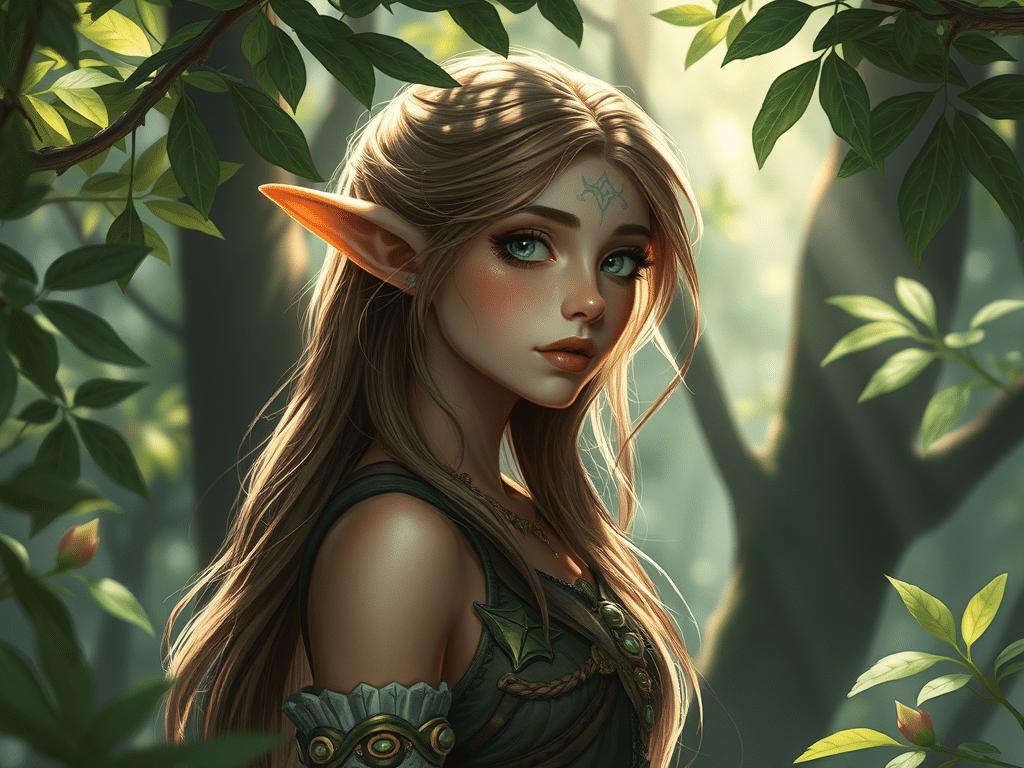
Wood elves have lithe frames, pointed ears, and earth-toned features that help them blend with forest environments.
-
They are fiercely independent and reclusive, preferring nature over civilization while practicing careful stewardship of their woodland domains.
-
Tolkien established the modern wood elf archetype, which contemporary authors have expanded to explore environmentalism and colonialism.
-
In D&D and video games, wood elves are characterized by stealth, agility, and unique cultural practices like nature-based religious covenants.
-
Scholars see wood elves as representing humanity’s desire for harmony with nature and the tension between civilization and wilderness.
-
Wood elves endure because they address our relationship with nature, serving as both nostalgic and hopeful environmental symbols.

Introduction
Wood elves are one of the most enduring and intriguing fantasy characters. They represent how people have always been interested in the deep depths of ancient forests. These otherworldly entities connect the civilized world to the wild, untamed world. They protect nature’s secrets and keep the wisdom of the ancient woods, serving as guardians of the ecosystem and symbols of the interconnectedness of all living things. Their presence in fantasy literature, games, and folklore has shaped our collective imagination of what it means to live in harmony with the natural world, while their portrayal has evolved to reflect changing attitudes toward environmentalism and the relationship between civilization and wilderness.
In Anglo-Saxon England, early records of elves show that there were many types of elves, such as wood-elves, field-elves, mountain-elves, and water-elves. People generally considered these beings to be women and linked them to certain types of landscapes, which suggests that elves and the natural world were linked early on. Stuart (1976) differentiates these specific categories from the broader Old English term “aelf,” which referred to a more gender-neutral classification. Glossators who tried to translate classical writings seem to have mixed up dryads with wood-elves, naiads with sea-elves, and muses with mountain-elves. This argument shows how Germanic and classical myths were visually and intellectually linked.
Shippey (2004) looks more closely at this language layering. He talks about the Old English word wudu-ælf, which means “wood-elf” and was probably made up to replace Latin words like “dryades.” Tolkien, a philologist who knew these traditions very well, would eventually use these kinds of differences to make his own Elvish hierarchies. Shippey contends that Tolkien established a canonical distinction among Light-elves, Dark-elves, and Wood-elves, thus organizing the “Elvish problem” derived from Germanic origins.

Physical Characteristics and Cultural Traits
The way wood elves look usually shows how closely they are connected to the forest they live in. Most of the time, they are shown as slender and graceful entities with flexible bodies that let them navigate through thick underbrush without making a sound or breaking a branch. Their faces are sharp and angular, with high cheekbones, pointed ears, and eyes that can be deep forest green, amber, or gold. Sometimes, they even show signs of the seasons changing year after year. Their skin typically looks like the ground, with natural patterns that help them fit in with their surroundings. For instance, their skin often resembles the pale cream of birch bark or the rich brown of oak. Wood elves’ hair hues often seem like the trees in the forest, with rich browns and blacks, fall reds, and sometimes the silvery green of branches covered in moss.
Wood elves are known for being quite independent and having a strong connection to the natural cycles of the forest. They are more private than their high elf cousins, and they would rather be with old trees and wild animals than deal with the politics and showiness of court life. Wood elves are generally shown as patient watchers who may stay still for hours while they watch for dangers to their houses or follow prey. However, they can also strike quickly when their habitats are in danger. Their civilizations usually work on the idea of giving and taking with nature, only taking what they need and giving back by being careful stewards, following rituals, and having a spiritual awareness of ecological balance. Many depictions of wood elves show them as having a wild side, with instincts honed by hundreds of years of living in places where a moment of inattention could be deadly. Their wild side has made them both skilled at making things in the woods and resistant to many civilized comforts.
In The Hobbit, Tolkien’s Wood-elves of Mirkwood show how some customs have stayed the same and how others have changed. They linger in twilight regions, love the stars, and live in huge forests. These are all things that remind us of old connections between elves and liminal natural areas (Honegger et al., 2024). However, their characterization is rather unclear. At first, they look like a group of people feasting who disappear when Bilbo gets close. Later, they turn into captors who lock the Dwarves up in the dungeons of their underground royal palace (Honegger et al., 2024; Post, 2014).
This paradox shows that they are “good people” who yet enforce territorial sovereignty (Post, 2014). King Thranduil rules the Woodland Realm, which is one of the remaining autonomous Elvish villages in Mirkwood (Harvey, 2003). The Wood-elves are said to be “more dangerous and less wise” than the High Elves of the West, who are shown as wiser and more exalted. This concept reinforces a hierarchy within Elvish identity (Shippey, 2004). The palace they live in is below the forest, which makes the line between court and nature less clear. Post (2014) contends that Tolkien intentionally subverts fairy-tale conventions: the enchanted forest is not only a chaotic wilderness but also a contested political arena where Elvish authority is perpetually undermined by spiders and goblins.
Honegger et al. (2024) also link Tolkien’s Woodland Realm to the Celtic sidhe, who are the “People of the Mounds” who live in the Otherworld below hills and barrows. The underground castle of Thranduil has both visual and mythological connections to Celtic traditions, which strengthens the idea that elves are beings who live in and outside of the human realm. It also firmly puts wood elves in the fairy world, suggesting that they possess magical qualities and a connection to nature that aligns with traditional fairy lore.
Tolkien’s distinction among Elvish civilizations mirrors his comprehensive depiction of Middle-earth’s societies, encompassing Hobbits, Men, Wizards, and several Elvish polities (Harvey, 2003). The Golden Wood of Galadriel, called Lothlórien, is situated between the Misty Mountains and the Anduin River. It is said to be the most beautiful of all the Elf-kingdoms. People are still suspicious of this world, though. Shippey (2004) observes that characters like Boromir and Éomer harbor fears about the Golden Wood, demonstrating that Elves can be perceived as perilous or eerie despite their esteemed moral and aesthetic standing. The Wood-elves’ duality—both alluring and menacing—mirrors a pervasive conflict in Tolkien’s works between grandeur and danger. They are not completely good or bad; they are sovereign entities whose goals are different from those of men and dwarves, often leading to misunderstandings and conflicts with these races due to their unique perspectives and priorities.

Literary and Gaming Representations
Wood elves have been in stories since the first fantasy books, but J.R.R. Tolkien’s work has had a big impact on how we think of them today. Tolkien’s Silvan Elves, especially the ones that lived in Mirkwood under King Thranduil, set the standard for how wood elves would be portrayed in later fantasy works. They were more rustic and secretive than the wise Eldar of Rivendell or Lothlórien. Later authors built on this idea. For example, Terry Brooks wrote about wood elves as the main elven race in his Shannara trilogy, making them the champions of nature against the spread of technology and industrialization. Contemporary fantasy literature has persistently examined wood elf cultures through various perspectives, with authors such as N.K. Jemisin and Andrea Stewart integrating wood elf-inspired societies into their narratives while subverting conventional fantasy tropes and addressing themes of colonialism, environmental degradation, and the complex relationship between diverse groups inhabiting disputed territories.
Wood elves have become a common character choice in the gaming world, but their portrayal varies a lot from one system or setting to another. Wood elves have been a playable race in Dungeons & Dragons since the first editions. They are usually known for having higher intelligence and dexterity scores, which indicate how well they can see and how quickly they can move, as well as their abilities to move faster and thrive in natural settings. In the fifth edition of D&D, wood elves are quick and stealthy, and they can hide even in light natural cover. This makes them ideal choices for rangers, druids, and rogues who want to be like the stereotype of the woods warrior or tracker. Wood elves have also been a big part of video games. For example, The Elder Scrolls shows the Bosmer as a separate wood elf culture with its customs, such as the Green Pact, a religious agreement that says they can’t harm plant life in their homeland of Valenwood. This means they have to eat meat and build their cities in living trees instead of cutting down trees.
The elves from Tolkien’s books have had an impact on digital fantasy realms in terms of their looks and culture. Poor (2012) notes that Tolkien makes a lot of different types of elves, such as wood-elves (elves that live in forests), high-elves (often depicted as noble and powerful), grey-elves (known for their wisdom), and “Elves of the Light” (associated with purity and goodness). However, later fantasy works tend to simplify these more detailed categories. For instance, in The Elder Scrolls series, the Bosmer (Wood Elves) are shown as naturalists who live in the woods and use bows, which shows how agile they are and how much they love nature (Poor, 2012). EverQuest II also shows Wood Elves as one of the basic varieties of elves: they are usually decent, love nature, and are adept at archery.
Yee (2009) changes the focus from representation to social architecture by looking at how the addition of races like wood elves in EverQuest affects how players interact with each other. Game mechanics, such as travel spells or binding to places, help players of different races work together and get along. In this setting, wood-elves are not just lovely figurines; they are also parts of social networks. The slow pace of gaming, which includes waiting and working together, is different from fast-paced action games and encourages communities that like to communicate with each other over time. So, the wood-elf goes from being a mythic woodland spirit to a philological creation, then from a Tolkienian ruler to a digital avatar. Despite these changes, several basic traits remain: closeness to nature, being on the edge of something, beauty with a hint of danger, and a sovereign claim to magical places.
Symbolic Significance and Contemporary Relevance
There are many different ideas on what wood elves mean to us and why they still interest us. Some scholars contend that wood elves epitomize a romanticized portrayal of pre-industrial societies, symbolizing an idealized state of harmony with nature that contemporary society has forfeited. However, this interpretation has faced criticism for potentially perpetuating noble savage stereotypes and oversimplifying the complex bonds that historical populations maintained with their environments. Environmental psychologists posit that the allure of wood elves is connected to the notion of biophilia, the intrinsic human inclination to forge connections with nature and other life forms. These characters embody wish-fulfillment figures who have attained the profound ecological integration that many individuals desire in an increasingly urbanized society. Other theorists have looked at wood elves as symbols of the “Other,” noting that they are shown as both attractive and dangerous, as well as civilized yet wild, which reflects deep cultural fears about the boundaries between culture and nature, ourselves and others, and the tempting idea of leaving behind societal rules for a more basic way of life.
Conclusion
Wood elves persist in fantasy due to their engagement with essential inquiries of humanity’s connection to the natural world and our role within it. These figures, whether they are noble guardians, ferocious warriors, or enigmatic people who live in the deep woods, make us think about what we could gain by living more in sync with natural cycles and what we could lose in the process. The wood elf archetype is changing as environmental issues become more important in the real world. It is no longer only an escape into fantasy; it is now a way for us to think about our responsibility as caretakers of the earth and the effects of our choices. We sense their longing for a wilder past and our hopes for a more sustainable future in their sharp ears and ancient eyes. Their existence means that wood elves will continue to haunt the shadows of fantasy forests for generations to come.
References
Brooks, T. (1977). The sword of Shannara. Random House.
Harvey, G. (2003). The origins of Tolkien’s Middle-earth for dummies. John Wiley & Sons.
Honegger, T., Velten, H. R., & Imorde, J. (2024). Beautiful and sublime—and never mind the pointed ears. Visualising the Elves throughout the centuries. In Fantasy aesthetics: Visualizing myth and Middle Ages, 1880–2020 (Vol. 4, p. 51).
Jemisin, N. K. (2015). The fifth season. Orbit Books.
Poor, N. (2012). Digital elves as a racial other in video games: Acknowledgment and avoidance. Games and Culture, 7(5), 375–396.
Post, M. R. S. (2014). Perilous wanderings through the enchanted forest: The influence of the fairy-tale tradition on Mirkwood in Tolkien’s The Hobbit. Mythlore.
Shippey, T. A. (2004). Light-elves, Dark-elves, and Others: Tolkien’s Elvish problem. Tolkien Studies, 1(1), 1–15.
Stewart, A. (2020). A song of wraiths and ruin. Delacorte Press.
Stuart, H. (1976). The Anglo-Saxon elf. Studia Neophilologica, 48(2), 313–320.
Tolkien, J. R. R. (1937). The hobbit. George Allen & Unwin.
Wizards of the Coast. (2014). Dungeons & Dragons Player’s Handbook (5th ed.). Wizards of the Coast.
Yee, N. (2009). Befriending ogres and wood-elves: Relationship formation and the social architecture of Norrath. Game Studies, (1).
ZeniMax Online Studios. (2014). The elder scrolls online [Video game]. Bethesda Softworks.


Leave a Reply