Deep Dragons: Key Points
-
Deep dragons are distinctive Underdark-dwelling dragons with iridescent purple-blue-gray scales who master psionics and mental manipulation rather than physical combat.
-
They hoard knowledge and mental essences instead of treasure, spending years in meditation within lair-libraries filled with crystalline memory devices.
-
Other dragon species view deep dragons with suspicion while deep dragons regard surface dragons as simplistic, resulting in mutual incomprehension and occasional conflicts.
-
As Underdark apex predators, deep dragons compete with mind flayers for psychic dominance while feeding on both physical sustenance and the thoughts of sentient beings.
-
Deep dragons maintain wary relationships with Underdark races including uneasy détentes with Drow and rivalries with mind flayers.
-
Their introduction represented Dungeons & Dragons‘ evolution toward sophisticated monster design and has impacted gameplay by encouraging non-combat solutions and psionic mechanics.

Introduction
Deep dragons are one of the most mysterious and conceptually complicated types of dragons in the Dungeons & Dragons universe. These Underdark monsters are a unique mix of dragon might and the strange way of thinking that exists in the underground worlds. They are different from their more well-known chromatic and metallic relatives. Deep dragons were first featured in the game’s extra materials and then improved upon in succeeding versions, showcasing their distinct characteristics and abilities that set them apart from traditional dragons, such as their affinity for the dark and their unique magical powers that reflect their underground habitat. They have become a unique part of the fantasy world since they question what most people think of as a dragon. Their existence brings up deep questions about how to adapt, how to be alone, and what it means to be a dragon.
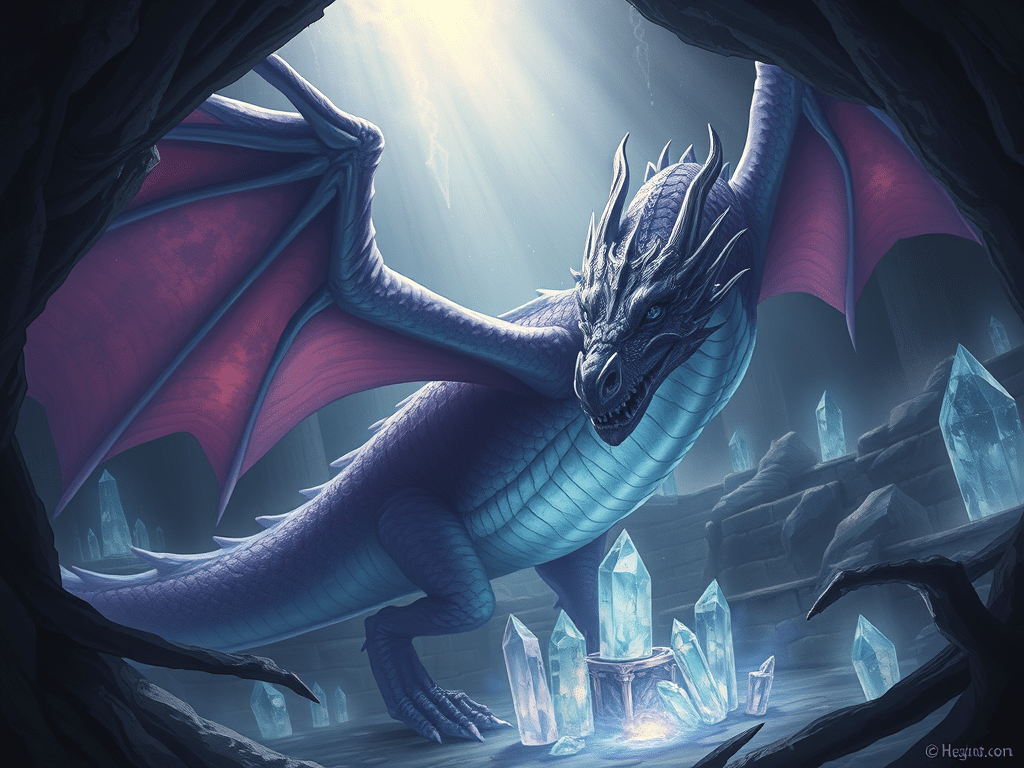
Deep dragons look different from surface-dwelling dragons right away. Their scales shine in a way that makes them look almost hypnotic, changing from purple to blue to gray. This helps them hide in the fluctuating magical lights of the Underdark and confuses their enemies. Deep dragons have developed a more muted color scheme that matches their surroundings. This coloration is different from the bright hues of chromatic dragons or the shiny metallic shine of their aristocratic cousins. Compared to other dragons, their bodies are sleek and a little flat. This trait helps them move around in the tight tunnels and caves of their underground home. People have said that their eyes have a strange nature, like they have swirling depths that seem to look right into the hearts of those who look at them.
Behavioral Patterns and Social Structure
The way deep dragons act and the way they live are very different from the way other dragons do things, as they prioritize introspection and philosophical contemplation over the more aggressive or social behaviors typically seen in other dragon species. These dragons are very thoughtful and philosophical. They spend long periods of time in deep meditation and self-reflection, which can endure for years or even decades. If you can call it a society, it’s very individualized. Each deep dragon devotes all its attention to its unique arcane studies and interests. Deep dragons are recognized for being proficient in psionics and mind control. They want to beat their foes by using their willpower instead of fighting them, often employing strategies that involve manipulation and psychological tactics to gain the upper hand. Instead of traditional treasure, they gather information by keeping scrolls, tomes, and the mental essence of creatures they’ve met. Their homes generally look more like libraries or meditation rooms than the usual dragon’s treasure vault, which is full of crystals that store memories and items that are psychically attuned.
Deep dragons and other dragons don’t get along and often clash. Chromatic dragons don’t trust or like deep dragons. They think that their intellectual interests are a sign of weakness and that their withdrawal from surface politics is a sign of cowardice. Metallic dragons are more open to philosophical pursuits, yet they are very upset by the moral ambiguity and psychic predation of deep dragons, which they perceive as a threat to the ethical standards they uphold in their own communities. Deep dragons think that surface dragons are simple and controlled by their basic impulses. They think that their evolution toward mental mastery is a better way for dragons to live. When deep dragons and surface dragons engage in combat, it typically ends quickly and clearly. This characteristic is because deep dragons would rather rapidly psychologically dominate their opponents or leave the fight altogether than fight for a long time. Deep dragons have usually worked with other species due to a common enemy, not because they were related.

Ecological Role in the Underdark
Deep dragons occupy the highest position in the intricate ecosystem of the Underdark. They are both feared and strangely stabilizing. These dragons keep the numbers of many of the more dangerous monsters that live in the dark depths in check. These include aboleths, mind flayers, and beholders, all of whom struggle with deep dragons for psychological dominance in the underground world. When deep dragons are around, they generally make areas calmer since smaller predators stay away from places that deep dragons own. This effect makes it easier for smaller species and even intelligent races to go around. Deep dragons eat a wide range of things, including both physical food and psychic energy. They feed on the thoughts and memories of living people in ways that can be as simple as watching them or as complex as completely absorbing them, which allows them to gain knowledge and power from their victims. Deep dragons don’t have as much of an effect on fungal forests and underground ecosystems as their surface cousins do. This distinction is because deep dragons have adapted to need less room and resources. The territorial limits set by deep dragons often cover whole areas of the Underdark. Their sphere of influence can be felt through psychic emanations that creatures that are sensitive to them can pick up from miles away, which allows deep dragons to monitor and exert control over their territory without direct confrontation.
There is a lot of complexity and wariness in the relationships between deep dragons and the different sentient races of the Underdark. Drow cities and deep dragons adjacent are in a tense peace, with neither side ready to start a war but both always pushing the limits and trying to get ahead through spying and manipulation. Mindflayers see deep dragons as both enemies and possible resources. They sometimes try to catch young deep dragons to use their brains or study their unique psionic powers, but these attempts almost always fail and lead to terrible reprisal. When they can, duergar and deep gnomes stay away from deep dragon areas because they see the dragons as unpredictable dangers whose philosophical thoughts don’t help with negotiations. Some people who live in the Underdark have been able to make deals with deep dragons, trading unusual knowledge or psychic experiences for safety or information. However, these deals are always risky. Deep dragons sometimes become interested in surface races that come into the Underdark because they see them as new sources of ideas and points of view. Such interest can lead to either enlightening conversations or terrifying encounters where adventurers have their minds harvested for interesting memories.
Impact on Game Design and Narrative
The several types of dragons in Dungeons & Dragons show how the game has changed from simple monster types to more intricate, detailed creatures with a lot of history. In the first versions of the game, dragons were mostly just enemies to fight with simple affiliations and skills. As the game grew up through new versions, dragons got more complex, with elaborate life cycles, complicated reasons for doing things, and complicated relationships with the world around them. The addition of specialist dragon varieties, such as deep dragons, was a step toward more variety in environments and themes. This trend was because dragons are so powerful and long-lived that they would naturally adapt to any ecological niche. This change was in line with larger trends in fantasy literature and game design that moved away from simple good vs. evil stories and toward more complex world-building. Each new type of dragon not only added a new level of difficulty to combat, but it also gave players a chance to learn more about the game’s civilizations, settings, and philosophical concerns.
Deep dragons have an effect on Dungeons & Dragons that goes beyond their immediate presence in campaign settings. They have changed how dungeon masters plan underground adventures by giving them a more complex option to the usual dangers that may be found in caves and tunnels. Deep dragons present players with challenges that surpass mere combat skills. They require negotiation, puzzle-solving, and creative thinking. Their focus on psionics and mental powers has helped make these game features more useful and popular, even though they aren’t used as much as they could be, particularly in scenarios that require strategic thinking and collaboration among players. Deep dragons are potent symbols of how being alone and in a certain environment can change even the most basic creatures. They make a statement about nature versus nurture and how identity can change, illustrating the idea that external influences and personal experiences shape one’s identity over time. They have inspired innumerable stories about ancient knowledge, prohibited mental talents, and the cost of seeking knowledge at the expense of connecting with people.
Conclusion
Deep dragons represent a prime example of the creative transformation of Dungeons & Dragons’ renowned monsters. They show how to change a well-known archetype by carefully considering the setting, characters’ actions, and beliefs to create something unique. Their presence adds richness and variety to dragon ecology and gives gamers and dungeon masters new story options. Deep dragons are a wonderful example of how thoughtful monster design that focuses on making each one distinctive and fitting with the story is more important than just changing the mechanics. Even in a world full of magic and wonder, the most intriguing creatures are the ones that make us question what we think we know and encourage us to look at familiar ideas from fresh angles.
References
Forgotten Realms Wiki. (n.d.). Deep dragon. https://forgottenrealms.fandom.com/wiki/Deep_dragon
Adult deep dragon. (n.d.). 5e.tools. https://5e.tools/bestiary/adult-deep-dragon-ftd.html
Deep dragon (5e). (2024, March 7). Dungeons and Dragons Wiki. https://dnd-wiki.org/wiki/Deep_Dragon_(5e)
Wyatt, J., Perkins, C., Mearls, M., Crawford, J., Schwalb, R., Lee, A., Thompson, R., & Decker, J. (2021). Fizban’s treasury of dragons. Wizards of the Coast.

Leave a Reply