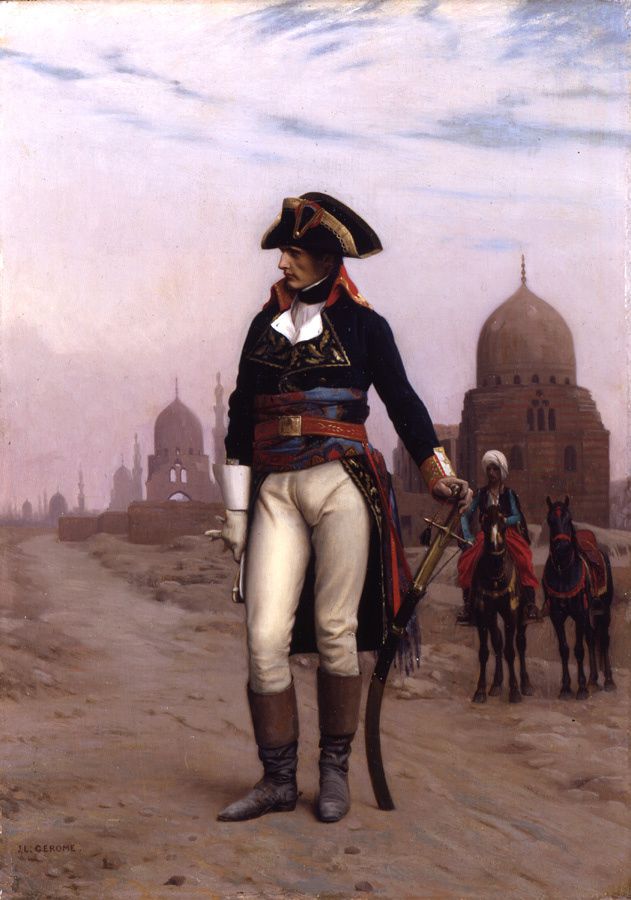
Numerous wild and false stories about Napoleon exist. Another story that is probably more fiction than fact is the one about Napoleon and the Sphinx.
One of the most important historical moments in French military history was Napoleon Bonaparte’s expedition into Egypt in the early 1800s. The famous Sphinx, which has captured people’s imaginations for millennia, was one of the numerous ancient wonders he came upon during this voyage. An intriguing narrative about Napoleon’s visit claims that he spent a night within the enormous stone edifice of the Sphinx, attempting to unravel its mysterious mysteries. This essay will give you an overview of Napoleon’s time in Egypt, explain the mystery surrounding the Sphinx, examine the reasons why this myth is probably not true, and then come to a decision about how true it is.
Egypt Campaign
Napoleon’s ambitious campaign in Egypt, spanning from 1798 to 1801, aimed to disrupt British trade lines and bolster French dominance in the region. Scientific expeditions, military conquests, and the study of ancient Egyptian civilization were the campaign’s defining features. Napoleon visited Egypt’s ancient sites, such as the well-known Giza Plateau, and it was clear that he was enthralled by the country’s rich historical and cultural legacy.
Napoleon had high hopes, but in the end, he was unable to accomplish his goals in Egypt. The discovery of the Rosetta Stone, which aided in the translation of ancient Egyptian hieroglyphs into modern languages, was one of the campaign’s high points.

Sphinx
An enduring representation of ancient Egypt, the Sphinx is a massive statue situated near the magnificent pyramids on the Giza Plateau. This magnificent image, with the body of a mighty lion and the mysterious face of a person, has fascinated travelers and academics for generations. Its actual function, exact construction date, and even original look remain a mystery to experts despite much investigation and study. Therefore, it is not surprising that an ethereal mist of myths and lore shrouds the Sphinx, making it the ultimate source of fascination and mystery.
Conflicting theories about the exact date of construction of this towering structure are adding fuel to these scholastic disagreements. While popular opinion holds that Khafre, the fourth dynasty’s pharaoh, ordered its construction to begin approximately 2500 BCE in conjunction with the construction of his pyramid complex, other theories advance this chronology by several centuries or even assign it to other monarchs. Such ambiguity simultaneously challenges accepted historical accounts and adds to the Sphinx’s mystique.
One myth that is undoubtedly untrue is the one about Napoleon shooting off the Sphinx’s nose. A plethora of YouTube videos and historical evidence have refuted this commonly held fallacy.
An odd story first surfaced in 1900. Southey and Coghlan included this previously unreported tale in Noble Nelson: The Story of the Four Great Victories by Which He Completely Frustrated Napoleon’s Plans. The writers also mentioned that this is a legend, which casts suspicion on the story right away.
The story goes that Napoleon chose to spend a night by himself inside the enormous stone structure of the Sphinx because he was fascinated by its mystery. There was something unsettling about the barely illuminated Sphinx, isolating him from outside noise. During the sleepless night, Napoleon’s sense of disquiet and curiosity grew as he claimed to have awakened to sounds beyond explanation. He returned from the Sphinx clearly shaken the following morning, only saying that he had seen something that was incomprehensible to humans and declining to provide any other specifics of his encounter. According to reports, he claimed he saw something inside the Sphinx that was not intended for human view and that he was unable to discuss it.

Analysis
There are several reasons to question the veracity of Napoleon’s encounter with the Sphinx, despite its fascinating narrative. Firstly, the lack of primary evidence or eyewitness reports from reliable historical records raises doubts about the incident. Given the size of Napoleon’s campaign and the abundance of chroniclers, it seems odd that there is no reliable evidence.
Second, Napoleon was a reasonable and practical military commander. It is inconceivable that he would engage in a risky and superstitious endeavor that could jeopardize both his personal safety and the success of his military campaign. His priorities in Egypt were not indulging in superstitious activities but rather achieving political and strategic goals.
Thirdly, the narrative aligns with the common practice of spinning exaggerated stories about historical personalities to evoke a sense of mystery and intrigue. Rather than being based on fact, these kinds of stories usually succeed because of their capacity to capture the public’s imagination.
Ultimately, the writers of the book that contains the story concluded that it was probably a hoax and made a note of it.
Conclusion
The legend of Napoleon learning the mysteries of the Sphinx by spending a night within it is probably a fabrication or an embellishment of mythology. The mystery surrounding the Sphinx and Napoleon’s haughty demeanor captivate the story, but the lack of reliable historical documentation, Napoleon’s practical attitude, and the tendency toward exaggerated stories call into question its authenticity. However, the legend endures, demonstrating the attraction of tales that straddle the boundaries between fact and mythology, as well as the ongoing fascination with the mysterious Sphinx.
References
Lehner, M. (1992). Reconstructing the Sphinx. Cambridge Archaeological Journal, 2(1), 3-26.
Lippert, S. J. (2022). Egypt and Napoléon Displaced. Iconocrazia, 2(22), 149-169.
Regier, W. G. (2004). Book of the Sphinx. U of Nebraska Press.
Southey, R., & Coghlan, C. H. (1880). Noble Nelson: The Story of the Four Great Victories by which He Completely Frustrated Napoleon’s Plans for the Invasion of England. Hansard.
Zivie-Coche, C. (2004). Sphinx: history of a monument. Cornell University Press.



Leave a Reply