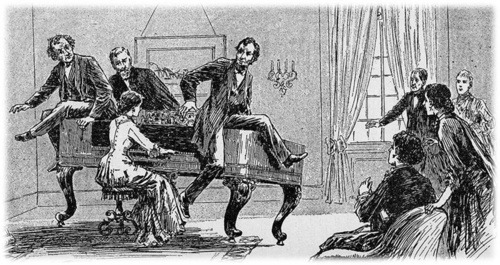
Lincoln Séances: Six Key Points
-
The spiritualism movement, centered on communicating with the dead through mediums, gained massive popularity in the mid-to-late nineteenth century, attracting over eight million believers by 1897.
-
The Civil War’s unprecedented death toll of 750,000 Americans created ideal conditions for spiritualism’s growth, as many families couldn’t recover bodies or perform traditional mourning rituals.
-
On February 20, 1862, eleven-year-old Willie Lincoln died from typhoid fever in the White House, devastating both parents but especially leaving Mary Todd Lincoln bedridden with grief.
-
Mary Todd Lincoln hosted up to eight séances in the White House Red Room, where mediums helped her connect with Willie and her other deceased son, Eddie.
-
Mrs. Lincoln’s spiritualism was controversial, forcing her to step back publicly, while after the president’s assassination, stories of Lincoln’s ghost haunting the White House became enduring American mythology.
-
The Lincolns’ spiritualism reflected how the Civil War changed American attitudes toward death and mourning, offering a historical example of how grief drives cultural innovation during national crises.

Introduction
The American Civil War changed not only the politics of the United States but also how Americans thought about and dealt with death. During this time of unprecedented national tragedy, spiritualism became a strong cultural force that gave families who were grieving hope of being able to talk to their dead loved ones again. When their son Willie died in 1862, President Abraham Lincoln and First Lady Mary Todd Lincoln became the leaders of this movement. The Lincolns’ interest in spiritualism and séances in the White House was part of a larger trend in the country during the Civil War, showing how deep loss could lead even the most famous people to believe that the line between the living and the dead could be crossed. Their experience with spiritualism not only affected how they dealt with their grief, but it also had a lasting effect on American cultural history and the stories that have grown up around the Lincoln presidency.
Spiritualism in 19th-Century America
The spiritualism movement that took over America in the 1800s was based on the idea that the living could talk to the spirits of the dead with the help of special people known as mediums. In 1848, two young sisters from Hydesville, New York, named Maggie and Katie Fox, said they could talk to spirits by making strange rapping sounds in their home. This religious and philosophical movement really took off after that (Chapin, 2000). Historian Alexandra Kommel says that “spiritualism, a belief system based on a doctrine that the dead can talk to the living, existed long before the Civil War, but it didn’t become popular until the middle to late nineteenth century” (White House Historical Association, 2019). By 1897, spiritualism had garnered over eight million adherents in the United States and Europe, predominantly from the middle and upper classes, who were in search of novel perspectives on mortality and the afterlife. The movement provided an alternative to conventional religious practices, promising direct interaction with deceased souls instead of depending solely on belief in an abstract paradise (Nartonis, 2010).
The Civil War created the perfect environment for spiritualism to grow quickly throughout American society. This was because the war’s enormous death toll left hundreds of thousands of families desperately investigating how to connect with their lost loved ones. The war killed about 750,000 Americans, which is almost the same number as the total number of Americans who died in the Revolutionary War, the War of 1812, the Mexican-American War, the Spanish-American War, World War I, World War II, and the Korean War. Many soldiers died far from home on battlefields that were far away, and their families couldn’t mourn in the usual ways because their bodies were often left unrecovered and unidentified. Historian Drew Gilpin Faust noted that “the specific circumstances of the Civil War frequently obstructed mourning, making it challenging, if not impossible, for numerous grieving Americans to navigate the stages of grief” as survivors were “both literally and figuratively unable to ‘see clearly what… has been lost.’” (White House Historical Association, 2019). Traditional religion had a difficult time giving people comfort when so many people died for no beneficial reason. These events created a spiritual void that spiritualism quickly filled. During this time, séances became very popular. They usually started with everyone sitting in a circle, holding hands, and saying prayers. Then the medium would go into a trance-like state and supposedly help people talk to the dead through rapping sounds, automatic writing, or spoken messages from beyond the veil.
Lincoln Séances
The Lincoln family began to feel deep sadness on February 20, 1862, when their eleven-year-old son, William Wallace Lincoln, who they called Willie, died in the White House after fighting typhoid fever for several weeks. A newspaper article that came out the day after Willie’s death said, “His sickness, an intermittent fever that took on a typhoid-like character, has caused his family and friends to worry and be alarmed for a week now…” “The President has been by his side most of the time, hardly resting for ten days” (White House Historical Association, 2019). Willie’s death happened during the Civil War’s darkest time, when it seemed like the country itself was dying. The combination of personal and national tragedy was too much for both Abraham and Mary Todd Lincoln to handle. Mary Todd Lincoln, on the other hand, was especially affected by her grief. After Willie’s death, she spent weeks in bed and was unable to attend his funeral. The first lady was even more upset because she had already lost her son Edward Baker Lincoln, who died at age four in 1850. Willie’s death was the second child she had buried, and she was scared for the safety of her two living sons, Robert and Thomas (Martinez, 2009).
Mary Todd Lincoln turned to spiritualism and started holding séances in the White House, especially in the Red Room, in her desperate search for comfort and connection with Willie. After Willie’s death, Mrs. Lincoln met the Lauries, a well-known group of mediums in Georgetown. She found so much comfort in their séances that she started holding similar ones at the executive mansion. Using surviving documents, historian David Herbert Donald figured out that the first lady may have held as many as eight séances in the White House. There is also evidence that President Lincoln himself went to at least some of these sessions. In December 1862, Mary Todd Lincoln hosted the medium Nettie Colburn in the Red Room for a séance that was said to have included the president. The occasion was one of the most famous séances. Colburn later said that while she was in a trance-like state, she channeled spirits who “urged the president to issue the Emancipation Proclamation, which they predicted would ‘be the crowning event of his administration and his life.’” (National Geographic, 2024; Wills, 1992). President Lincoln may or may not have believed in these spiritual messages, but his wife found comfort in the idea that she could still talk to her dead son (Monaghan, 1941).
Mary Todd Lincoln found that the séances helped her cope with her grief so well that she came to believe that Willie’s spirit visited her often and was still a part of her life. She informed her half-sister, Emilie Todd Helm, “Willie is alive.” Each night, he appears before me and stands at the foot of the bed, wearing the same gentle, charming smile he has always maintained. He doesn’t always come by himself. “Little Eddie [her son who died at age four] is sometimes with him” (White House Historical Association, 2019). Mrs. Lincoln found comfort in the belief that her sons’ spirits were still with her, which traditional religious comfort could not provide during her darkest times. She also dreamed about Willie and felt his presence all over the White House. These experiences made her believe even more in the basic ideas of spiritualism. Mary Todd Lincoln found a way to cope with her grief through these spiritual experiences, whether they were real or not. This helped her return back to her duties as first lady, even though she never fully got over the trauma of losing Willie.
Contemporary Reactions
People today have mixed feelings about Mary Todd Lincoln’s interest in spiritualism. This is due to societal tensions over the legitimacy of such practices. Many Americans felt sorry for the first lady and were interested in spiritualism, but others thought her séances were proof that she was mentally unstable or acting inappropriately for someone in her position. Even when spiritualism was at its most popular, it was still controversial. Skeptics called mediums frauds and charlatans who took advantage of grieving, weak people to make money. Mrs. Lincoln knew about these criticisms and eventually stopped being publicly involved with spiritualism after a few months. However, she never fully gave up her belief that it was possible to talk to the dead. Spiritualism was present in the White House during Lincoln’s presidency, which showed how far the movement had spread in American society. However, it also showed the social risks of openly accepting such unusual religious practices.

Impact
The Lincolns’ involvement with spiritualism had effects that went far beyond their grief and added to the myths that still surround Abraham Lincoln and the White House. Almost immediately after President Lincoln’s death on April 14, 1865, reports of his ghost began to circulate. Stories of Lincoln’s spirit haunting the White House have continued into the twenty-first century. Many famous people, such as First Lady Grace Coolidge and Queen Wilhelmina of the Netherlands, have said they saw Lincoln’s ghost in different rooms of the White House, especially the Lincoln Bedroom and the Yellow Oval Room. The fact that people wanted to believe in Lincoln’s ghost showed a deeper cultural need to stay connected to the president who died for the Union and freed the slaves.
Mary Todd Lincoln’s ongoing engagement with spiritualism following her husband’s assassination illustrated the enduring influence of these beliefs on her existence and perspective. In 1870, the former first lady went to see William H. Mumler, a self-proclaimed spirit photographer who had been accused of fraud, and asked to have her picture taken with the ghost of her dead husband. The picture quickly spread and became one of the most famous examples of spirit photography from the 1800s, claiming to show President Lincoln’s spirit standing behind his widow with his hands on her shoulders. Kimberly N. Kutz, a historian, says that “Prints, photographs, and literary depictions of Lincoln as a spirit were plentiful in the months and years after his assassination, documenting his journey into the afterlife from the moment the Angel of Death appeared above his bed” (White House Historical Association, 2019). These pictures served two purposes: they made Mary Todd Lincoln feel better and they made a sad country that really wanted to believe its fallen leader was at peace and still watching over the country he had saved feel better.
The Lincolns’ involvement with spiritualism has a bigger cultural meaning because it shows how Americans dealt with the enormous trauma and loss of the Civil War. The movement gave people who were grieving a way to locate peace and meaning in deaths that traditional religious systems had a difficult time explaining or comforting. For Mary Todd Lincoln and many other Americans who lost loved ones in the war, spiritualism gave them hope that death was not the end, but rather a temporary barrier that could be crossed with the help of talented mediums. During and after the Civil War, séances became very popular. This episode showed that Americans’ views on death, mourning, and the possibility of an afterlife that kept relationships going changed in a big way. As the country tried to cope with the enormous amount of death and destruction caused by the war, spiritualism gave people a way to understand loss that focused on keeping connections rather than breaking them.
The decline of spiritualism in the twentieth century and the transformation of White House séances into mere historical curiosities exemplify the changing American attitudes toward death, mourning, and the supernatural. By World War II, spiritualism had lost the dedicated followers it had during the Civil War. The decline was because advances in medicine made people live longer, better systems for recovering soldiers from the battlefield made it easier to identify and return fallen soldiers home, and changes in religious and cultural practices gave people new ways to confront grief. The Civil War’s mass deaths became less common in American life, and the spiritualism movement’s need for spiritual connection with the dead slowly faded. People still talked about séances held by Mary Todd Lincoln in the Red Room and President Lincoln’s ghost walking around the White House, but they were seen more and more as intriguing historical oddities than proof of real supernatural events. Contemporary Americans, existing in a time when death is less apparent and more medicalized than in the nineteenth century, find it challenging to fully grasp the desperation and sincerity that compelled individuals such as Mary Todd Lincoln to wholly adopt spiritualism (Hamilton, 2014).
Conclusion
The Lincolns’ engagement with spiritualism and séances offers important lessons about the convergence of personal sorrow, public leadership, and cultural transformation during a traumatic era in American history. Mary Todd Lincoln’s reliance on mediums and spirit communication was not indicative of weakness or instability; rather, it was a logical reaction to profound loss during a time when conventional sources of solace appeared insufficient to cope with the magnitude of mortality surrounding her. Her séances in the White House Red Room were both a very personal way for her to stay in touch with her son Willie and a way for her to be part of a larger cultural movement that helped millions of Americans confront the Civil War’s death and destruction. President Lincoln’s potential participation in certain séances, whether driven by personal curiosity, spousal encouragement, or authentic receptiveness to spiritual phenomena, illustrated that even the nation’s foremost leaders were susceptible to the sorrow and ambiguity that afflicted American society during this somber era. The spiritualism movement that thrived during the Civil War era, as demonstrated by the Lincolns’ involvement, illustrates how profoundly war and mass mortality can transform cultural practices, religious convictions, and societal perceptions of the demarcation between life and death. The legacy of these séances endures in American culture through ongoing ghost stories and a lasting interest in the Lincoln family’s personal tragedies, serving as a reminder that grief is egalitarian and the human desire for connection transcends death.
References
Chapin, D. (2000). The Fox Sisters and the performance of mystery. New York History, 81(2), 157.
Hamilton, M. L. (2014). “I Would Still Be Drowned in Tears”: Spiritualism in Abraham Lincoln’s White House. Savas Publishing.
Martinez, S. B. (2009). The Psychic Life of Abraham Lincoln. Red Wheel/Weiser.
Monaghan, J. (1941). Was Abraham Lincoln Really a Spiritualist?. Journal of the Illinois State Historical Society (1908-1984), 209-232.
Nartonis, D. K. (2010). The rise of 19th‐century American spiritualism, 1854–1873. Journal for the Scientific Study of Religion, 49(2), 361-373.
National Geographic. (2024, April 24). Séances at the White House? Why these first ladies turned to the occult. https://www.nationalgeographic.com/history/article/seances-at-the-white-house
White House Historical Association. (2019, April 24). Seances in the Red Room. https://www.whitehousehistory.org/seances-in-the-red-room
Wills, G. (1992). Lincoln at Gettysburg: The words that remade America. Simon and Schuster.


Leave a Reply