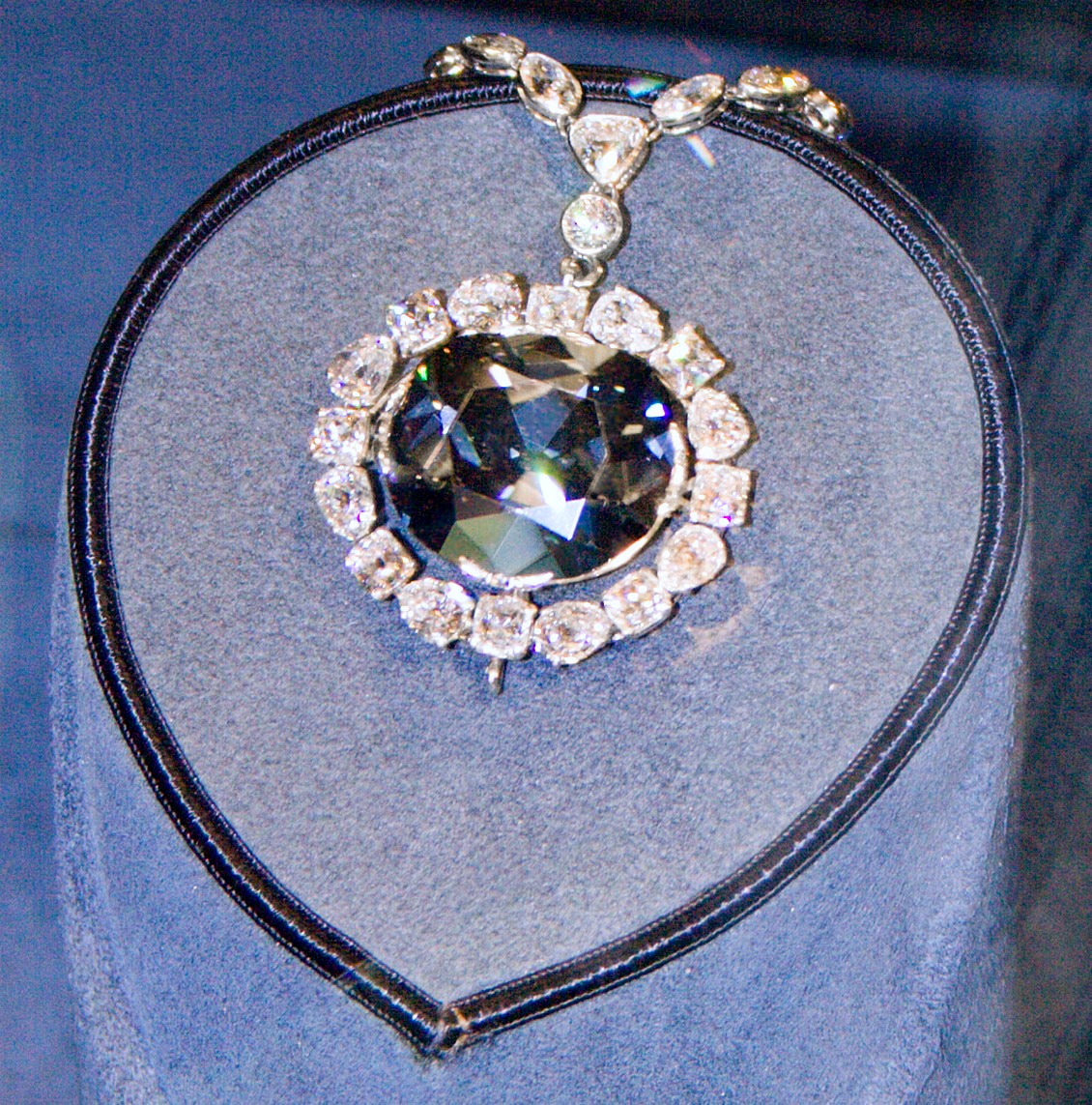
Curse of the Hope Diamond: Key Points
- The Hope Diamond is a 45.52-carat blue diamond, famous for its deep blue color and eerie red glow under ultraviolet light, and it currently resides at the Smithsonian Institution in Washington, D.C.
- Its recorded history begins in 17th-century India, where French merchant Jean-Baptiste Tavernier purchased it before selling it to King Louis XIV of France, after which it became part of the French crown jewels.
- The diamond disappeared during the French Revolution and resurfaced in London around 1812, eventually being purchased by Henry Philip Hope, whose name it permanently took on.
- The curse claims that the diamond was stolen from a Hindu goddess and brings misfortune to its owners, with supposed victims including Louis XVI; Marie Antoinette; and members of the McLean family, who owned it in the early 20th century.
- Many historians believe jeweler Pierre Cartier invented or exaggerated the curse to make the diamond more desirable and to drive up its sale price, and several of the curse’s dramatic claims fall apart under historical scrutiny.
- The most likely explanation for the curse’s persistence is a combination of confirmation bias and human psychology, as people naturally remember the tragedies connected to the diamond while forgetting the uneventful lives of many of its owners.

Introduction
Few objects in human history have caught the imagination quite like the Hope Diamond, a diamond that has inspired awe, curiosity, and dread for ages. Legends about the stone say that it is cursed with a tremendous curse that can bring calamity, madness, and death to anybody who dares to acquire or wear it. The narrative of the Hope Diamond is one of the most dramatic and gripping stories ever recounted about a single object, whether you believe in the supernatural or not. It weaves together history, tragedy, and mythology in a way that continues to fascinate people to this day.
The Hope Diamond is one of the largest and most famous blue diamonds in the world. It weighs 45.52 carats. It takes on an incredibly deep blue color due to minuscule levels of boron absorbed into the crystal structure as it was produced deep within the earth billions of years ago. The stone is about the size of a walnut, and when exposed to UV light, it phosphoresces with an eerie red glow, only adding to its mysterious reputation. It is now a permanent fixture in the Smithsonian Institution’s National Museum of Natural History in Washington, D.C. Each year, millions of tourists come to witness its legendary beauty up close and personal.
The Diamond’s Physical and Scientific Characteristics
Any meaningful discussion of the Hope Diamond must begin with what is known about the gem itself. Post and Farges (2014) place the diamond in the broader context of rare gemology, accentuating its exceptional deep blue color with an authoritative scientific explanation. Pointon (2017) explains the physical reason for this colorization. The unusual electric conductivity of the gem is due to the presence of boron in the crystal structure, a quality that makes it different from almost all other diamonds. These physical features have contributed to the mystery of the diamond, adding scientific dimension to what is otherwise a legend-dominated story.
Historical Ownership and Provenance
The Hope Diamond’s recorded history starts in India in the mid-17th century when the French jeweler Jean-Baptiste Tavernier bought a huge, irregularly triangular blue diamond from the Kollur mine in the Golconda region around 1666. The original stone was much larger than the diamond we see now, weighing about 112 carats in the rough, and Tavernier sold it to Louis XIV of France in 1668, along with a number of other precious stones. Louis XIV then had the diamond recut into a heart-like form weighing about 67 carats and he wore it on a long ribbon around his neck, nicknaming it the “Blue Diamond of the Crown.” It traveled through the French royal family and finally into the crown jewels, where it hung around the necks of Louis XVI and his queen, Marie Antoinette, for a time.
The diamond’s troubled travels took an abrupt turn during the French Revolution, when the crown jewels were seized from the royal storage in September 1792. The stone disappeared from the record for almost twenty years, which was precisely the period allowed by French law for the prosecution of the theft of stolen goods. It resurfaced in London about 1812, in the hands of a diamond trader, and was bought by a rich banking family. The stone was acquired by Henry Philip Hope probably about 1839, and it was his name that became forever associated with the jewel, converting it from a nameless blue diamond into the famed Hope Diamond the world knows today.
In the ensuing decades, the stone passed through several more hands, often embroiled in financial struggle and legal disputes before landing in America. In 1901, the diamond was sold to pay off debts and finally ended up in the hands of legendary jeweler Pierre Cartier, who took it to the United States. In 1911 Cartier sold the diamond to Evalyn Walsh McLean, a wealthy American socialite, and McLean wore it regularly, even attaching it to the collar of her Great Dane. In 1947, jeweler Harry Winston purchased her entire jewelry collection. Then, in a grand gesture of philanthropy, Winston donated the Hope Diamond to the Smithsonian Institution in 1958, mailing it in a plain brown paper package by registered mail with an insurance value of one million dollars.
The identification of the diamond’s provenance has been the work of several researchers, each adding detail to a convoluted path of ownership. Tolansky (1961) offers one of the first scholarly treatments postulating that the Hope Diamond was recut from the Tavernier Blue, a large blue diamond originally acquired in India by the French merchant and explorer Jean-Baptiste Tavernier in the mid-seventeenth century and stolen from the French Regalia in 1792. Patch (1976) traces a more complete path, following the diamond from India in 1642 through its life as the French Blue diamond to its eventual presentation to the Smithsonian Institution in 1958. Pointon (2017) adds extra detail to this history, recording the gem’s arrival in the hands of a London trader in 1812 and its purchase by Henry Philip Hope in 1839, the individual from whom the diamond derives its contemporary name. Kurin (2017), a decade into her cultural anthropological investigation, collates much of this historical record and interrogates the reliability of the ownership narratives that have come to characterize the diamond’s biography.

The Curse: Legend, Origins, and Cultural Mythology
The notion of a curse linked to the Hope Diamond seems to have developed and changed over time rather than originating from one ancient source. The most popular version of the curse is that the diamond was originally stolen from the eye of a statue of the Hindu goddess Sita and that she inflicted a horrible curse on anybody who dared to acquire the stolen stone. The curse story has Tavernier being torn to bits by wild wolves in Russia immediately after having sold the diamond to Louis XIV; Louis XVI and Marie Antoinette being killed during the Revolution; and a long line of owners after them suffering madness, financial ruin, accidents, and death. The curse stories ratcheted up around the McLean family, as Evalyn Walsh McLean’s young son perished in a vehicle accident, her daughter died of an overdose, and her husband was institutionalized following a mental breakdown.
The Hope Diamond’s curse is crucial to its cultural life, and researchers have expended enormous efforts exploring the origins and development of this tale. As traced by Newsome (2017), the curse’s reported origin is that a Hindu priest cursed the gem because Jean-Baptiste Tavernier had removed the stone from India. In this version of events, the curse passed through subsequent owners, with Newsome (2017) designating King Louis XIV as the first “confirmed victim,” alluding to the upheaval that followed the French monarchy’s possession of the stone. Kennedy (1999) adds to this story strand, reporting that Louis XVI and Marie Antoinette were carried to the guillotine after the diamond had come into royal hands, a detail that has long cemented the curse legend in popular imagination.
The intricacies of the curse have been a subject of controversy among historians, gemologists, and skeptics for generations, and a few intriguing hypotheses have evolved as to what the curse actually is and where it came from. One of the most plausible theories among historians is that Pierre Cartier himself fabricated or inflated the curse myth in order to make the diamond more attractive and justify his price when he sold it to Evalyn Walsh McLean. Reports say McLean herself indicated that Cartier told her the stone was cursed before she bought it and she seemed to embrace the notoriety of owning such a renowned and hazardous gem, wearing it to parties as a social statement. The notion is borne out by the fact that many of the most spectacular stories of the curse do not stand up to historical investigation. Tavernier, for example, died of natural causes in Moscow in his seventies, not mauled by dogs.
Scholarly Interpretations and Skeptical Analysis
A frequent subject in the literature has been the degree to which the curse myth was actively constructed and marketed for commercial ends. Post and Farges (2014) make this argument explicit, noting that stories of the diamond being cursed or bringing bad luck were relatively recent inventions, likely fabricated or greatly exaggerated by jeweler Pierre Cartier to persuade Evalyn Walsh McLean to buy the stone in the early twentieth century. Ocker elaborates on this line of analysis by explaining how the curse story was commodified by jewelers and prior owners to increase the diamond’s market price and desirability (2020). In this understanding, the curse was not a spontaneous folk belief but an intentional marketing ploy, a narrative device to enhance the gem’s appeal and explain its fabulous price.
Finlay (2007) takes a broader view of the diamond from the standpoint of gem history and places it in the context of a wider world of famous stones whose stories are a blend of adventure, geology, power, and fortune. Her story is an example of how reputations for gems develop through a combination of actual occurrences and flights of fancy. The Hope Diamond is a particularly excellent example. Similarly, Patch (1976) builds her study in three parts: what is known, what is speculated, and an appraisal of the tale, a methodological tactic that mimics the sort of critical sifting required to disentangle historical fact from accreted mythology.
There is a growing scholarly consensus that these genesis legends are not historically true. Kurin (2017) contends that the alleged ancient curse is a recent myth, originating in urban centers such as New York, London, Paris, and Washington. Kurin (2017) instead approaches the curse as the contemporary folklore of the twentieth century, a type of cultural commentary on social interactions and worries rather than a supernatural mystery. This reframing is important, since it moves the analytical attention away from the question of whether the curse is “real” or not to the question of why it was compelling and necessary for people to believe in it.
Another popular view is that the curse is mostly a product of confirmation bias, that very human habit of remembering information that confirms what we already think and ignoring or forgetting information that contradicts it. The Hope Diamond has had a long list of owners over the ages, and with so many people having owned the diamond, it would be statistically strange if none of them had ever had to endure adversity, sorrow, or disaster in their lives. When horrible things happen to diamond owners, people link them to the curse, but when good things happen, or when an owner lives a long and successful life, those facts are quietly forgotten or left unmentioned. Some historians also note that many of the alleged victims of the curse, like Marie Antoinette, were in very perilous political positions for reasons that had nothing to do with a gemstone and that blaming their misfortunes on a diamond is an easy but inaccurate simplification.
A third line of thought takes a more cultural and psychological approach to the curse, arguing that the myth endures not because it is real, but because it satisfies a very human desire for story and meaning. For centuries audiences have been drawn to stories that suggest that powerful, beautiful gods have moral weight; that greed and the acquisition of enormous wealth have consequences; and that the cosmos punishes those who steal what is not theirs. The Hope Diamond is an ideal vehicle for that kind of story, with its royal pedigree, its terrible history in the French Revolution and its journey over continents and centuries. In this way, the curse isn’t really about the diamond, but rather what humans put on it. A magnificent gem becomes a mirror for our fears about destiny, luck, and fairness.
Perhaps the most analytically rigorous strand in this literature is the skeptical tradition, which considers the evidential basis for the curse deficient. Kennedy (1999) is one of the most forthright in this regard, stating that belief in what he terms the “Hope Diamond jinx” is supported by selective data. Kennedy (1999) notes that a close study of the diamond’s ownership history suggests that for at least half of all owners, no misfortune whatsoever seemed to have been experienced. He says the press promotes the myth by only reporting the negative events and omitting the incidents that contradict the cursed narrative. Kennedy (1999) also points out that the Smithsonian Institution’s purchase of the diamond in 1958 is somewhat of an argument against the curse, with the institution not suffering any reported misfortune in the decades afterward.
Post and Farges (2014) provide a contrasting view with a touch of dry wit, arguing that the Hope Diamond has turned out to be a source of “wonderfully beneficial luck” in view of its profoundly positive influence on the expansion of and public interest in the United States National Gem Collection. This observation lends support to the wider scholarly thesis that the meaning of the curse is not set but rather built by individuals who tell and retell the story, adapting it to their own goals. The public’s reaction to the donation itself, with members of the public writing to the institution expressing concern about the diamond’s supposed reputation and some even offering to relieve the museum of the “cursed diamond,” shows how deeply the manufactured legend had permeated popular consciousness by mid-century (Post & Farges, 2014).
Conclusion
The story of the Hope Diamond and its reputed curse tells us just as much about human nature as it does about the stone. The diamond is undoubtedly a wonderful one, a geological wonder with a history traced across three and a half centuries of royal courts, revolutions, robberies, and fortunes. The curse, whether true or false, contrived or simply a result of selective memory and creative storytelling, has bestowed upon the Hope Diamond a cultural power that far exceeds its physical beauty. The stone sits silently in its Smithsonian case, visited by millions of curious eyes, continuing to do exactly what it has always done: captivate, mystify, and remind us that sometimes the most powerful force surrounding an object is not any supernatural energy it might contain but the stories we tell about it.
References
Finlay, V. (2007). Jewels: A secret history. Random House Trade Paperbacks.
Kennedy, R. F. (1999). Curses: Foiled again. Skeptical Inquirer, 23(1), 7.
Kurin, R. (2017). Hope Diamond: The legendary history of a cursed gem. Smithsonian Institution.
Newsome, J. (2017). The Hope Diamond, cursed objects, and unexplained artifacts. Cavendish Square Publishing.
Ocker, J. W. (2020). Cursed objects: Strange but true stories of the world’s most infamous items. Andrews McMeel Publishing.
Patch, S. S. (1976). Blue mystery: The story of the Hope Diamond. Smithsonian Institution Press.
Pointon, M. (2017). Rocks, ice and dirty stones: Diamond histories. Reaktion Books.
Post, J. E., & Farges, F. (2014). The Hope diamond: Rare gem, historic jewel. Rocks & Minerals, 89(1), 16–26.
Tolansky, S. (1961). Some folklore and history of diamond. Journal of the Royal Society of Arts, 109(5062), 743–763.



Leave a Reply