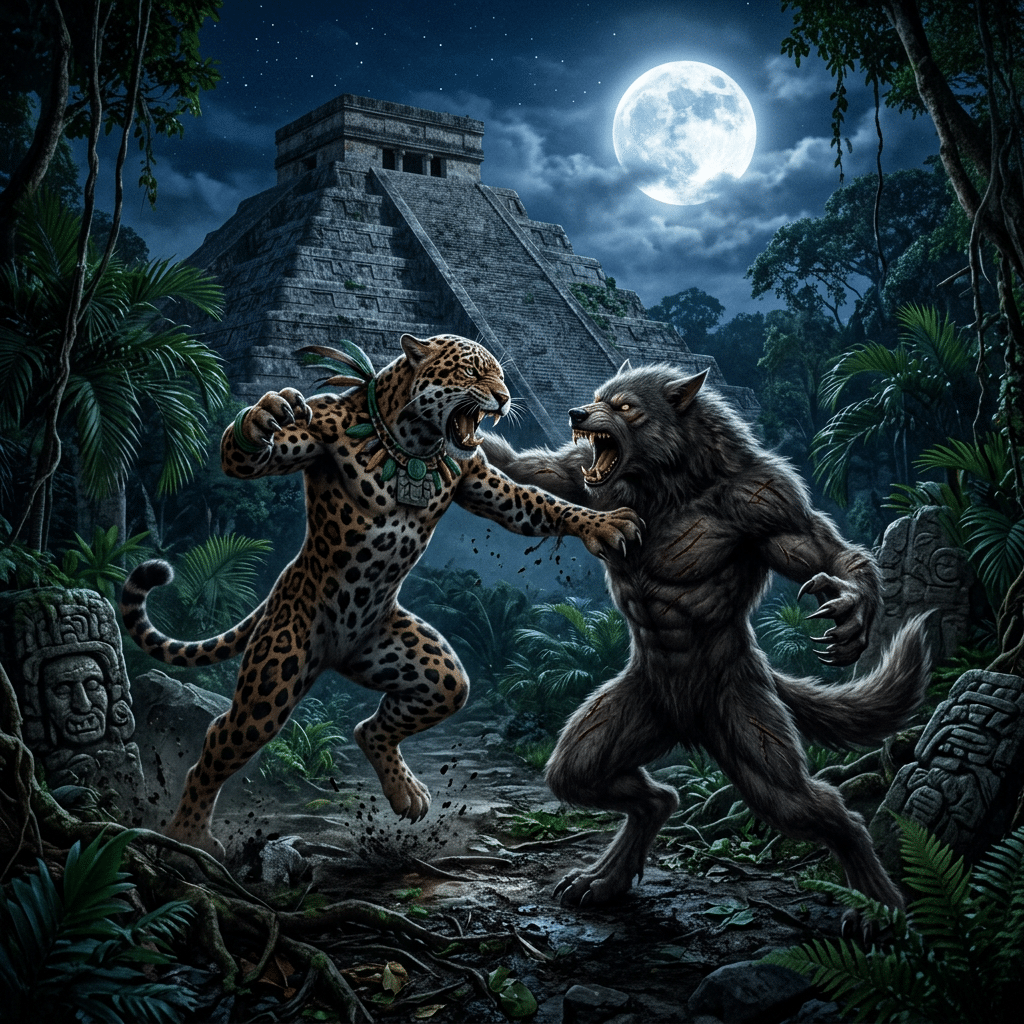
Werewolf vs. Werejaguar: Key Points
- Werewolves originate from European folklore as cursed humans who transform into wolf-human hybrids, often against their will, while werejaguars come from Mesoamerican civilizations like the Olmec and Maya, where they were sacred, divine figures associated with power and spiritual authority.
- Physically, werewolves are depicted as tall, bipedal, and monstrous in transformation, whereas werejaguars are portrayed with a more intentional, integrated hybrid appearance reflecting the compact power of the jaguar.
- Behaviorally, werewolves lose all control and memory during transformation, becoming indiscriminate killers, while werejaguars retain their minds and use their animal connections deliberately and purposefully.
- Spiritually, the werewolf was associated with demonic corruption and a fall from grace in Christian-influenced Europe, while the werejaguar held a sacred role as a bridge between the human world and divine or underworld realms.
- The differences likely stem from the cultural roles of each animal, with wolves inspiring fear and association with wilderness and disorder in Europe, while jaguars commanded reverence as apex predators tied to fertility, rain, and the cosmos in the Americas.
- Together, the two figures reflect opposing mythological worldviews, with the werewolf representing humanity’s fear of losing itself to animalistic chaos, and the werejaguar representing the aspiration to transcend human limits through sacred animal communion.

Introduction
For generations and in civilizations throughout the world, storytellers, shamans, and scholars have been captivated by the myth of the person who turns into a mighty animal. If the werewolf is the prototypical shapeshifter in Western popular culture, then the werejaguar is no less dominant in the mythology of the Mesoamerican and South American civilizations. The two figures make a fascinating study in contrast, though they are geographically and culturally apart. They illustrate not only different notions of change but also fundamentally different interactions between humanity, the animal world, and the supernatural.
The Werewolf in European Mythology
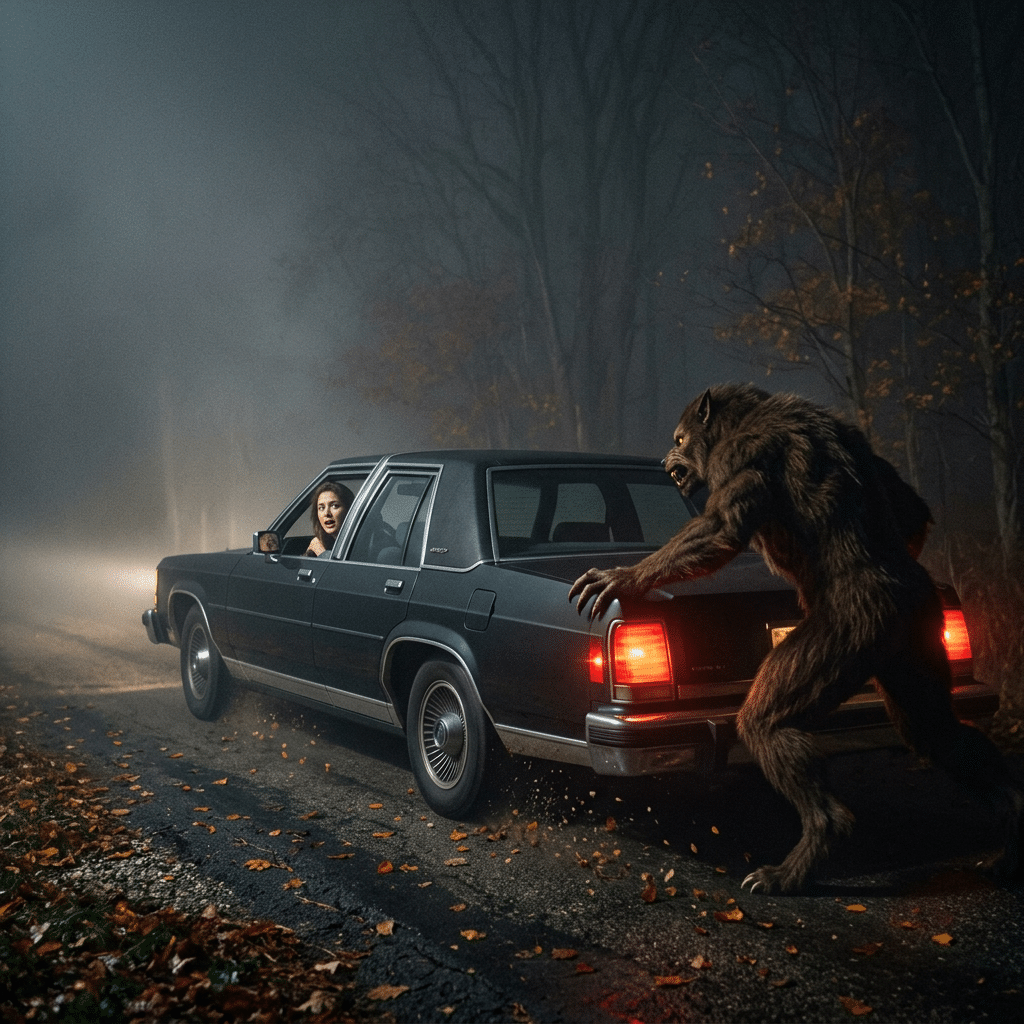
The werewolf, as it has come to be understood in European mythology and modern popular culture, is a human who turns into a wolf or a hybrid wolf-human form, usually involuntarily. The myth of the werewolf is ancient, stemming from ancient Greece and Rome, with individuals like Lycaon, the king who was cursed by Zeus to turn into a wolf after serving human flesh at a holy feast. In medieval Europe, the werewolf was often linked to demonic possession, witchcraft, or a curse passed on by a bite, causing one to be dreaded and loathed. The werewolf was a metaphor of lost humanity, a beast who gave up reason and society for primordial, carnivorous instinct.
The motif of nights associated with the moon that become the reverse is common in European and Indigenous North American traditions. Some sources explicitly associate the transformation with the timing of the moon, while others describe a more general change that is uncontrollable during certain times (Henderson, 2020; Podruchny, 2004). This theme is also reflected in contemporary synopses of lycanthropy in folklore and clinical description, where the moon motif is a continued locus of public understanding, even as different explanations are foregrounded in research (Henderson, 2020; Guessoum et al., 2021). In many folklore stories, werewolves often prey on humans or cattle and engage in harmful conduct. Werewolves are portrayed as perpetrators of violent crimes and threats that endanger social order in anthropological and literary discourse. Occasionally they are a moral or existential threat and not only a physical one (George, 2019; Behrmann, 2012; Sartin, 2019).
The Werejaguar in Mesoamerican Mythology
The werejaguar, however, has its roots in a very different mythological tradition, one that is largely associated with the cultures of the Olmec, Maya, and Aztec civilizations of Mesoamerica. In these cultures the jaguar was not a symbol of cursed ugliness but a revered being, a symbol of power, fertility, the underworld, and rain. The werejaguar was usually shown as divine or semi-divine, a monarch, shaman, or deity who could assume jaguar features as a symbol of spiritual authority, not spiritual degradation. However, several academics have claimed that the Olmec rain god was a werejaguar, a hybrid child with feline traits that symbolized the union of human and jaguar as a basic element of the cosmos.
The most frequent references to were-jaguar imagery are from Olmec sculpture and iconography, in which human creatures with jaguar characteristics appear in contexts implying dominance, metamorphosis, or predation. The literature explicitly describes jaguars tearing human beings as a motif associated with coercive or dangerous power, which some scholars connect to the nahual (nagual) concept—related to a shapeshifting spirit or animal companion—presented in Olmec nobility and mythic imagery (Sandstrom & Sandstrom, 2020; González, 2020; Mazariegos, 2020; Milbrath & Baquedano, 2023).
Morphological, Behavioral, and Spiritual Distinctions
You can see the morphological distinctions between these two beings and these differences reflect the animals that inspire them. When transformed, the werewolf tends to get taller and bigger. Its fur is coarse; its claws are lengthy; its snout is large with strong fangs; and the ears go to the top of the skull. The monster produced is commonly described as bipedal, retaining a generally humanoid shape but taking on an unmistakable wolfish aspect and being capable of immense speed and deadly power. But the werejaguar is generally described as more comfortable in its hybrid form: spotted feline fur, a broad flat nose, and the compact, muscular strength of a jaguar, rather than the gaunt, rangy aspect of a wolf. The werejaguar in many artistic representations from ancient Mesoamerican sources has a more consciously crafted look, implying artistry and divine intent rather than a violent, uncontrolled mutation.
Behaviorally, the two figures diverge considerably, especially in how metamorphosis affects the intellect and moral character of the individual. The traditional depiction of the werewolf is that of a creature that is completely out of control once it transforms, a ruthless predator that kills cattle and humans alike without a care, often with no recollection of its actions by morning. This loss of agency is the tragedy of the werewolf myth, wherein the afflicted individual is simultaneously victim and monster, helpless to stop the damage done in the course of the lunar transition. But the werejaguar is not normally connected with senseless violence or a loss of self. In Mesoamerican traditions, the act of becoming or interacting with the jaguar was a show of mastery and control, something that was consciously performed by a trained shaman or powerful ruler to defend their people, speak to supernatural forces, or exert authority.
The spiritual elements of each character mirror the greater religious worldviews they emanate from. The werewolf was commonly considered, in European Christian-influenced culture, to be a soul in league with or in thrall to dark forces, a being whose transformation symbolized a loss of grace and a regression to animal depravity. In many traditions, the cure for lycanthropy was religious intervention, either exorcism or the employment of sacred symbols or death, which may free the soul from its misery. But the werejaguar had a sacred, not profane, spiritual function, connecting the earthly and divine realms. In Mesoamerican cosmology, the jaguar was a being of the underworld and the night sky. The werejaguar shaman was a channel between the human world and those deeper strata of reality, a role respected and even venerated within the community.
The idea of changing into wolves or wolf-like creatures is ancient and usually embedded in a religious or moral story of sin, magic, or punishment. In medieval and early modern Europe, werewolves were often incorporated into law and ecclesiastical discourse and could be prosecuted on the basis of diabolical or demonic agency; this writing is well documented in the historical literature that considers lycanthropy both a medical/psychological curiosity and a confession of monstrous acts in a religious courtroom culture (Fahy, 1989; Metzger, 2013).

Cultural Functions and Literary Representations
Despite the common theme of metamorphosis between human and animal, the two mythologies diverged quite a bit. There are several hypotheses as to why. One common anthropological theory is that the particular animal featured in each myth corresponds to the top predator in the local ecosystem. Wolves and jaguars fill very different niches and elicit very different cultural reactions, so the mythologies developed differently. Another explanation involves social function. The werewolf myth is seen to have externalized fears of violence, pestilence, and social disorder in medieval Europe, while the werejaguar myth is thought to have legitimated governmental and religious power in hierarchical Mesoamerican civilizations. Some scholars also mention the role of hallucinogenic rituals in Mesoamerican shamanic culture, arguing that real trance experiences in which practitioners felt they were merging with jaguar spirits provided a more experiential and thus more dignified basis for the werejaguar myth than the mostly externally imposed curse story of the werewolf.
In medieval and later literary representations of lycanthropy, the werewolf figure is incorporated into larger issues of humanity, animality, and social order. Guillaume de Palerne, for example, utilizes the werewolf as a direct way of probing the human/animal boundary and the social logic of family and power: an “anthropological machine” that emphasizes the borderwork between skin and self (Behrmann, 2012). In later literary and scholarly discussions, werewolf characters continue to be employed to interrogate gender, transgression, and the politics of body alteration (Kooistra, 2018; Klein, 2019).
The were-jaguar notion is primarily situated in the Olmec culture, with overt references to jaguar-transformer iconography and nahual power in elite settings. Later scholarship has followed these themes into the Classic Maya, where jaguar imagery and shapeshifting are placed into the context of political authority, ritual practice, and legendary storytelling. Maya contexts directly link jaguar transformation to broader issues related to sorcery, ceremonial authority, and the intersection of kingship and magical activity (Stuart, 2020; Knab, 2020; Chévez, 2020).
Discussions focus on the relationship between sorcery, political authority, and ritual specialists as depicted in Classic Maya literature and iconography. Jaguar imagery as a potent emblem of agency, danger, and social regulation in the setting of the urban polity. These debates parallel broader Mesoamerican debates about whether elite authority was primarily constructed and legitimized through ritual-sorcerous power or through more overt dynastic governance, a theme that runs through several chapters in the volumes cited (González, 2020; Mazariegos, 2020).
Conclusion
In the end, the werewolf and the werejaguar are two completely unique responses to one of humanity’s oldest questions: what does it mean to cross the line between human and animal? The werewolf offers a story of loss, of contamination, and of the ever-present threat of the beast within, whereas the werejaguar tells a story of power, of holy knowledge, and of the possibility of becoming more than human by accepting the animal world on its terms. When we look at these characters together, we obtain a better picture of how mythology acts as a mirror for cultural ideals, reflecting not just what a society fears, but also what it aspires to and what it deems sacred.
References
Behrmann, B. (2012). “Quel beste ceste piax acuevre”: Idyll and the Animal in Guillaume de Palerne‘s Family Romance. Cahiers De Recherches Médiévales Et Humanistes, 24, 331–346. https://doi.org/10.4000/crm.12940
Chévez, L. G. (2020). Witchcraft in a Mixtec and Tlapanec Municipality of the Costa Chica of Guerrero: A Sociocultural Epidemiology. 114–134. https://doi.org/10.5876/9781607329541.c004
Fahy, T. (1989). Lycanthropy: A Review. Journal of the Royal Society of Medicine, 82(1), 37–39. https://doi.org/10.1177/014107688908200115
George, S. (2019). Wolves in the Wolds: Late Capitalism, the English Eerie, and the Weird Case of ‘Old Stinker’ the Hull Werewolf. Gothic Studies, 21(1), 68–84. https://doi.org/10.3366/gothic.2019.0008
González, R. M. (2020). Nahualli ihuan tlamacazqui: Witches, Sorcerers, and Priests in Ancient Mexico. 381–397. https://doi.org/10.5876/9781607329541.c013
Guessoum, S. B., Benoit, L., Minassian, S., Mallet, J., & Moro, M. R. (2021). Clinical Lycanthropy, Neurobiology, Culture: A Systematic Review. Frontiers in Psychiatry, 12. https://doi.org/10.3389/fpsyt.2021.718101
Henderson, L. (2020). Anthropophagy of the Werewolf. Exchanges the Interdisciplinary Research Journal, 7(2), 58–75. https://doi.org/10.31273/eirj.v7i2.402
Klein, I. (2019). When Good Girls Go Bad (Or Do They?): Nymphomania and Lycanthropy in Verga’s “La Lupa.” MLN, 134(S), S-272-S-285. https://doi.org/10.1353/mln.2019.0072
Knab, T. J. (2020). The Jaguar’s Line: Witchcraft and Sorcery in Mesoamerica. 167–178. https://doi.org/10.5876/9781607329541.c006
Kooistra, L. J. (2018). Clemence Housman’s The Were-Wolf: Querying Transgression, Seeking Trans/Formation. Victorian Review, 44(1), 55–67. https://doi.org/10.1353/vcr.2018.0009
Mazariegos, O. C. (2020). Where Children Are Born: Centipedes and Feminine Sexuality in Ancient Mesoamerica. 206–235. https://doi.org/10.5876/9781607329541.c008
Metzger, N. (2013). Battling demons with medical authority: werewolves, physicians and rationalization. History of Psychiatry, 24(3), 341–355. https://doi.org/10.1177/0957154×13482835
Micha, A. (Ed.). (1990). Guillaume de Palerne: Roman du XIIIe siècle. Droz.
Milbrath, S., & Baquedano, E. (2023). Introduction. 3–22. https://doi.org/10.5876/9781646424610.c001
Podruchny, C. (2004). Werewolves and Windigos: Narratives of Cannibal Monsters in French-Canadian Voyageur Oral Tradition. Ethnohistory, 51(4), 677–700. https://doi.org/10.1215/00141801-51-4-677
Sandstrom, A. R., & Sandstrom, P. E. (2020). Sorcery and Counter-Sorcery among the Nahua of Northern Veracruz, Mexico. 69–113. https://doi.org/10.5876/9781607329541.c003
Sartin, J. S. (2019). Contagious Horror: Infectious Themes in Fiction and Film. Clinical Medicine & Research, 17(1–2), 41–46. https://doi.org/10.3121/cmr.2019.1432
Stuart, D. (2020). The Wahys of Witchcraft: Sorcery and Political Power among the Classic Maya. 179–205. https://doi.org/10.5876/9781607329541.c007
Leave a Reply