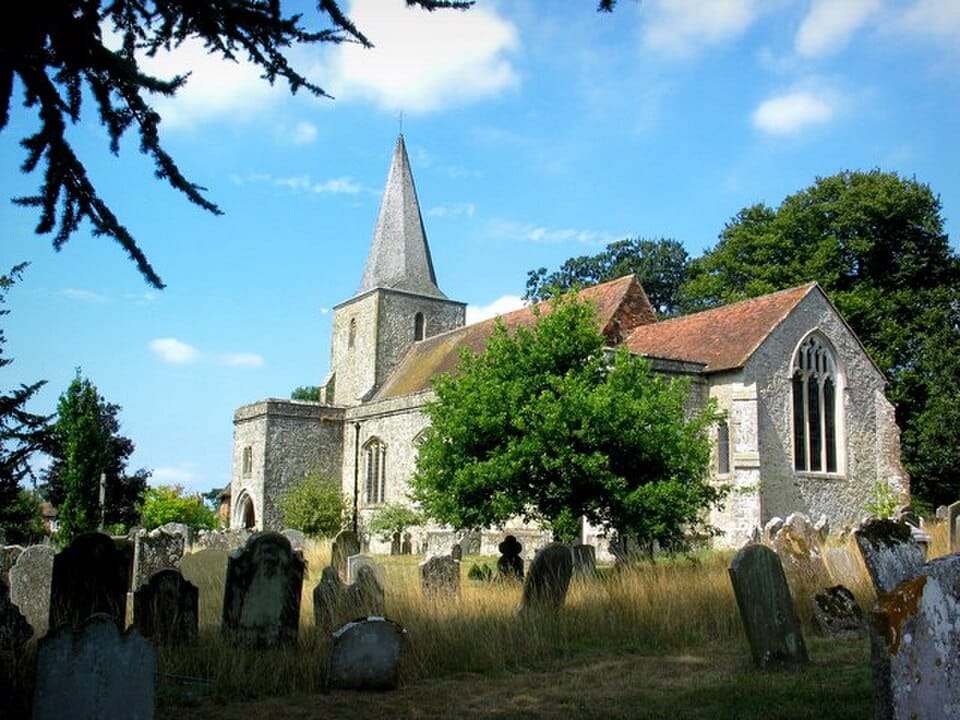
The Paranormal Legacy of St. Nicholas’ Church, Pluckley: Key Points
- St. Nicholas’ Church sits at the heart of Pluckley, widely recognised as England’s most haunted village and central to its paranormal reputation.
- The White Lady is believed to be a ghost connected to the aristocratic Dering family, said to drift silently among the graves at dusk or dawn.
- The Red Lady is thought to be a grieving mother whose infant was denied consecrated burial, doomed to haunt the churchyard searching for her lost child.
- Phantom horses are also reported in the churchyard’s lore, described as invisible hooves or fleeting dark shapes, possibly linked to the historic Dering estate.
- Paranormal investigators have repeatedly visited the site, and while findings remain inconclusive, reports of cold spots and unexplained sounds continue to accumulate.
- The legends endure because they reflect genuine historical grief and the deeply human belief that love and loss can outlast death.

Introduction
The village of Pluckley, located in the undulating Kent countryside, has for decades had a unique and spooky reputation. Pluckley has been called the most haunted village in England at various times, and it has an astonishing concentration of purported ghostly activity. At the core of this ghost tale lies the old church of St. Nicholas, whose churchyard and surroundings have become the very definition of hauntings. The church isn’t just located in a haunted village; it perhaps defines it, attracting paranormal investigators, curious visitors, and dubious journalists to its mossy graves and aged stone walls.
The Cult of St. Nicholas: Iconography and Sacred Space
St. Nicholas is a pan-European patron saint, and his cult has affected the layout of church space, its iconography, and devotional practice. The fact that the saint was a patron of merchants and sailors also helped to anchor the programs and altarpieces of the urban church in medieval and late medieval Europe. St. Nicholas churches and altarpieces incorporated urban identity and patronage networks (for example, in Lübeck, Tallinn, and Bari) linking saints to trade, travel, and urban life (Tillery, 2020). The larger hagiographic and cultic lineages of Nicholas, from Asia Minor to Norman Bari, show how communities used the saint’s identity to justify sacred sites and their social purposes (Hayes, 2016). Iconographic and devotional forms, particularly local depictions of St. Nicholas in monastic contexts, further indicate how distinct communities deployed St. Nicholas to express piety, patronage, and local belonging (Bome, 2006).

The Spectral Ladies of Pluckley
The most commonly reported apparitions associated with St. Nicholas’ Church are the so-called Red Lady and White Lady (Pluckley.net, n.d.). The names may be different, but the stories behind them are full of tragedy and local folklore. It is thought the White Lady is the spirit of a woman from the Dering family, one of the most important aristocratic families involved with the history of Pluckley and the church itself. Local tradition says she was buried in the church grounds in a series of lead coffins, one inside the other, in an attempt to preserve her remains by her loyal relatives. She is supposed to glide noiselessly around the churchyard, a pale, mournful figure most often spotted in the early morning hours, or at nightfall, when the sun is retreating and the shadows are lengthening across the gravestones. She makes a dramatic appearance occasionally. What witnesses report is little more than a faint glowing shape passing between the tombs, then vanishing completely, only the sensation of discomfort remaining.
The Red Lady has a distinct, perhaps more emotive, story to tell. It is claimed to be the ghost of a lady who lost a child through still birth or infant death and was denied the right to have her baby buried on consecrated ground. This was not uncommon in former centuries when the church had rigorous laws for the burial customs of the unbaptized. It is thought that she haunts the churchyard, looking for her lost child, consumed by grief and never at peace (Blosslyne, 2013). Some tales imply that she wears a red rose, from which her name is derived, but others claim that the redness refers to the hue of her robe. She is one of the more emotionally compelling of Pluckley’s many ghosts, a representation not only of a restless soul but also of a mother’s anguish that has somehow survived death itself (Albertsen, 2026).
Phantom Horses, Church Architecture, and the Atmosphere of the Past
Besides these two protagonists, stories of ghost horses (Tyrrell, 2019) have also been linked to St. Nicholas’ Church and its surroundings. Such ethereal beings are usually described as the sound of hooves on hard ground while no living horse is present or as fugitive visual impressions of dark equine shapes moving through the mist. Horses have, of course, been vital to rural English life for ages, and it is unsurprising that they should stay in the landscape alongside human apparitions. Some researchers of Pluckley’s supernatural legacy have suggested that the phantom horses may be related to the Dering family’s estate, as the family had extensive holdings in the area, and horses would have been an important part of their everyday lives. Others have said the apparitions are residual hauntings, in essence mental imprints of energy left behind by creatures whose lives were so attached to a particular spot that some trace of them is said to linger.
The church architecture itself, dating from the thirteenth century with important later expansions, contributes immensely to the atmosphere that has given rise to these legends. The churchyard, with its ancient yew trees, its uneven ground, and the accumulated weight of centuries of burial, has about it a quality that even the most determined rationalist may find affecting. The Dering family chapel adds another dimension of historical gravitas to the cathedral, reminding visitors that the individuals in these ghost stories were once real people with real anguish, real love, and real deaths. Whether you believe in ghosts or not, there is something undeniably powerful about standing in a place that has seen so much human passing across so many years.
Folklore, Paranormal Investigation, and the Persistence of Ghost Legends
In the local memory, we have a vocabulary for haunted churches from the studies of folklore and tradition. Works on “living legends” and “playing with fear” reveal the circulation of traditions of saints, village churches, and spectral presences in popular memory, often transforming modest churches into sites of intersection of folklore, historical memory, and terror. These sources demonstrate how hauntings originate from the communal memory of sacred spaces and the folk stories that surround them and provide a paradigm for conceptualizing the imagined haunted St. Nicholas’ Church in Pluckley as a vernacular ghost culture (McNeill, 2018; Bird, 2018). The broader Gothic-literary frame, in which saints, relics, and cathedrals become sites of haunting, provides a parallel interpretive mechanism to the mortmain logic (Winter, 2018; McNeill, 2018; Bird, 2018).
Over the years, paranormal investigators have come and gone from St. Nicholas’ Church, armed with electromagnetic field detectors, thermal cameras, and audio recorders. The results have been unsurprisingly inconclusive in any scientific sense, but anecdotal stories of anomalous readings and unexplained cold spots and disembodied sounds continue to mount. Pluckley has been the subject of several television documentaries on the supernatural and St. Nicholas’ Church is typically one of the centers of attention. Such media attention has no doubt inflated the legends; the difference between real local folklore and the sort of ghost story that is polished and expanded with each retelling becomes indistinct.
It is only fair to admit that skepticism is very justified here. The village of Pluckley has benefited commercially from its haunted reputation, and the ghost stories, however old some of them are, are hard to untangle from tourism and local identity. It is not so much any actual paranormal activity that allows the Red Lady and White Lady to survive, but rather the human need for stories, especially stories of pain, loss, and the dead not staying quietly dead. To dismiss the stories out of hand is to overlook something crucial about their enduring appeal. They are rooted in genuine historical experience, in real people buried in real dirt and in real emotions about how communities commemorate and memorialize the dead.
Conclusion
St. Nicholas’ Church, Pluckley, nevertheless remains one of the most interesting places in England for anyone interested in the convergence of history, folklore, and the paranormal. Maybe the Red Lady still haunts the graves in search of her child, the White Lady still floats in the predawn silence, and phantom horses still resound through the churchyard, but in any case, these tales have taken on a life of their own beyond the question of their literal validity. The church is a monument to the persistent human urge to believe that the dead linger, that love and grief are potent enough to cross the line between the living and the lost, and that certain locations hold onto the past more fiercely than others. The belief in Pluckley seems less like superstition and more like something genuinely and persistently human at the foot of an ancient church, whose stones have absorbed the anguish and prayers of generations.
References
Albertsen, M. (April 16,2026). Haunted village. Ancient Origins. https://www.ancient-origins.net/news-history-archaeology/haunted-village-00102684
Bird, S. E. (2018). Playing with Fear. 112–128. https://doi.org/10.7330/9781607328087.c005
Blosslyne. (2013, June 13). The haunting church of Pluckley in Kent. WordPress. https://blosslynspage.wordpress.com/2013/06/13/the-haunting-church-of-pluckley-in-kent/
Bome, H. (2006). Sacred Image as a Local Patron? The Icon of St Nicholas of Mozhaisk in the Petseri Monastery in Setu Folklore. Folklore Electronic Journal of Folklore, 34, 73–86. https://doi.org/10.7592/fejf2006.34.bome
Hayes, D. M. (2016). The Cult of St Nicholas of Myra in Norman Bari, c. 1071–c. 1111. The Journal of Ecclesiastical History, 67(3), 492–512. https://doi.org/10.1017/s0022046915003371
McNeill, L. S. (2018). Living Legends. 207–210. https://doi.org/10.7330/9781607328087.c010
Pluckley.net. (n.d.). Ghosts. Pluckley Village. https://pluckley.net/village-life/history/ghosts/
Tillery, L. (2020). Hanse Cultural Geography and Communal Identity in Late-Medieval City Views of Lübeck. Journal of Urban History, 47(6), 1251–1274. https://doi.org/10.1177/0096144220917933
Tyrrell, C. (2019, June 2). A tiny angel keeping watch in the most haunted Village in Britain (allegedly) – a visit to St Nicholas, Pluckley. Shadows Fly Away. https://shadowsflyaway.blog/2019/06/02/a-tiny-angel-keeping-watch-in-the-most-haunted-village-in-britain-allegedly-a-visit-to-st-nicholas-pluckley/
Winter, C. (2018). “Some Fatal Secret”: Mortmain in Horace Walpole’s The Castle of Otranto. Lumen Selected Proceedings From the Canadian Society for Eighteenth-Century Studies, 37, 123. https://doi.org/10.7202/1042227ar
Leave a Reply