Herne the Hunter: Key Points
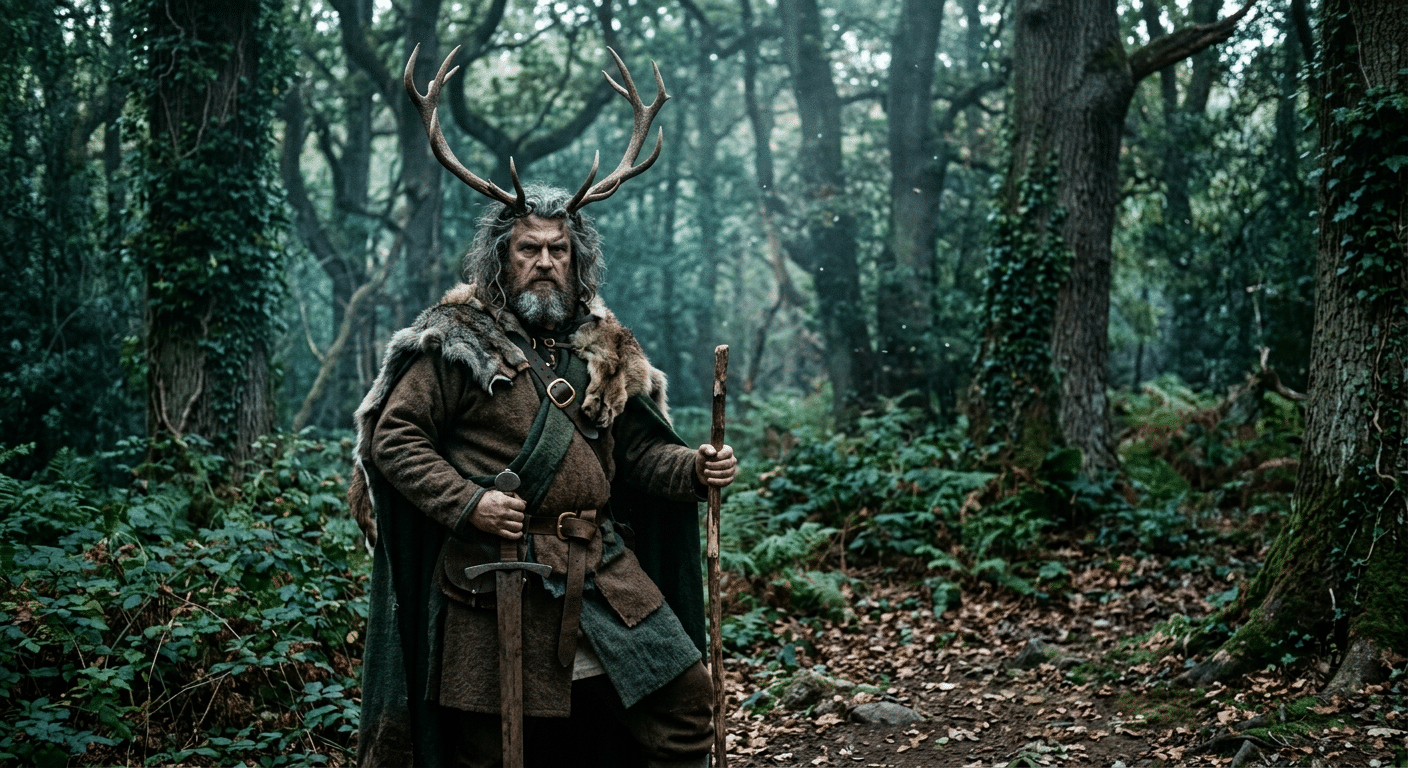
- Herne the Hunter is an antlered phantom said to haunt Windsor Forest, rattling a chain, blighting oaks, and leading a spectral hunt with unseen hounds.
- Legend casts him as Richard II’s huntsman, gored saving the king, revived with the stag’s antlers bound to his head, then driven to hang himself after jealous rivals had him dismissed (Krensky, 2008).
- The written record is thin, starting with a brief mention in Shakespeare’s The Merry Wives of Windsor, with the stag and wizard added by Ainsworth’s 1843 novel Windsor Castle.
- Sightings are almost all modern, from spectral hounds in 1926 to wartime encounters, feeding a belief that Herne warns of disaster or a monarch’s death.
- Theories hold that he was a real keeper or poacher, a pagan survival linked to Cernunnos and the Wild Hunt, or simply a literary invention.
- He endures for his themes of betrayed loyalty and the blurred line between human and animal, court and wilderness.

Introduction
A figure that has startled travelers for the past four hundred years walks deep in the royal woodland of Berkshire, where the trees of the old Windsor Forest still line the boundaries of the Great Park. He sports the antlers of a stag on a human’s head. He jingles a chain, curses the woods he passes and leads a ghostly chase whose hounds are heard but never seen. His name is Herne the Hunter and his legend is one of the oddest in English folklore, not least because it mixes a tragic human tragedy with something far older and wilder. Herne is a ghost, a warning, a forgotten divinity, perhaps. To comprehend his endurance, it is beneficial to begin by looking at the story itself.
The Legend of the Royal Huntsman
The most usual version of the narrative sets Herne in the time of Richard II, toward the end of the fourteenth century. Herne was a royal huntsman, which means he was the man who organized and conducted hunting trips for the monarch (Krensky, 2008). One day, while hunting in the forest, the royal group encountered a wounded deer that charged and attacked the king. the forest, the royal group While hunting game through the forest, a wounded deer charged the royal group and turned to attack the king. A wounded deer turned and charged at the king. Krensky (2008) describes how Herne placed himself in the way of the animal and was met with the force of its horn, mortally wounded but protecting his master. The next step takes the story out of mere history and into magic. Beside the dying man, a magician came and told the king that Herne could be saved, on one condition. The stag’s antlers must be cut off and tied to the huntsman’s head. Richard did as he was told and Herne lived (Krensky, 2008).
As is often the case with such remedies, the price was always a factor. Herne recovered and became one of the king’s favorite huntsmen, showered with accolades and, in some versions, a gold chain and a silver hunting horn. There was jealousy. His position was disliked by the other huntsmen at court, who sought to poison the king’s mind against him, in some versions by making up claims that he had taken the king’s deer. At last they succeeded in convincing Richard to terminate his employment. Ruined and discredited, Herne wandered into the forest, located a large tree, and hanged himself from its branches (Krensky, 2008). Since then he has haunted Windsor Forest. The oak, or rather a succession of trees claiming to be its successor, became known as Herne’s Oak, a title currently held by one of the trees planted in 1906.

Names, Sources, and the Documentary Trail
Herne’s name connects to earlier words meaning a “hunter” or hunting figure in medieval and early modern usage. The horned hunter is linked with the fae and the iconography of the stag in a traditional motif that appears in wider European folklore, and scholarly studies have explored the antecedents of stag-deity symbolism and its subsequent vernacular manifestations. Academic studies of history and folklore have examined the etymology and development of Herne as a hunting figure. Such work has drawn attention to connections proposed by antiquaries and folklorists with older iconography of horned deities and with medieval and modern references to huntsmen and forest law. These strands provide a context in which to explain the development of Herne the Hunter as a figure of English folklore and local legend (Peake, 1922; Stevenson, 1926).
The paper trail behind this narrative is not as long as most people think. The first reference to Herne is in the comedy of Shakespeare in The Merry Wives of Windsor (c. 1597). Mistress Page tells an old story of a former keeper of Windsor Forest who travels around an oak at midnight in winter with enormous ragged horns, blasting the tree, snatching the livestock, and rattling a chain. That’s about all there is to it. There is no suicide, no Richard II, no wizard, and no stag. The basic core is the antlers, the chain, and the blighted oak. Everything else developed outward from the original story during the subsequent generations. Even a pirated version of the play from 1602 has a character suggesting that the ghost story was devised to frighten youngsters into obedience—a stunning early indicator that people then perceived the tale as fear fiction (1926) rather than sober reality. Most of the dramatic elements familiar to readers today, the goring by the stag and the supernatural rescue, were popularized in William Harrison Ainsworth’s best-selling 1843 novel Windsor Castle, where the rescuer is not a kindly wizard but the Devil himself, who spares Herne on the condition that he wear the antlers forever.
Modern Sightings and Recurring Motifs
Almost all modern experiences with Herne date from the twentieth century or later. In 1926 the wife and daughter of a local justice of the peace reported hearing the deep baying of phantom hounds twice at midnight and the newspaper description explicitly linked the sound to Herne. He was seen or heard during both world wars and was supposed to have been seen around the time of the death of King George VI in 1952. Park keepers, troops nearby, and nighttime walkers have reported seeing a tall, antlered figure standing still in the trees; a phosphorescent glow moving through the foliage; or the abrupt sound of a hunting horn where no hunt could be. Others tell of a magnificent stag that comes at dusk and disappears without a trace. Herne also fits into a wider pattern of royal hauntings, since Henry VIII, his daughter Elizabeth I, Charles I, and George III are reported to walk Windsor Castle itself (Krensky, 2008). The sightings are nationally significant because they are based on a concept that emerged in the twentieth century. Herne is supposed to come just before tragedies and right before rulers die; thus, a local ghost is like an alarm bell for the whole realm.
Common visual and narrative elements linked with Herne are a hunter, most often portrayed as dressed in green or forest-like clothing, at times with horned or stag-related images, and frequently associated with Windsor Forest. Here the huntsman The huntsman appears in the act of pursuit or as a revenant-like presence, perceived or observed by travelers, foresters, and hunters. In certain versions, the motif of the pursued stag or the seasonality of the chase appears, connecting Herne to the forest’s vitality and to the ceremonial aspects of medieval and subsequent hunting culture. The literature around Herne stresses the woodland space as a moral and magical site where human action, nobility, and nature converge, where the figure engages in a ritualized, albeit spectral, presence within the landscape (Peake, 1922; Stevenson, 1926).
Competing Theories and Enduring Meaning
Theories as to what Herne really is fall into three basic categories. The first takes him for a genuine person, possibly a goalkeeper at Windsor, or the yeoman Richard Horne, who was arrested poaching in the woodland during the reign of Henry the Eighth. The earliest surviving text of Shakespeare’s play spells the name Horne, lending some weight to this hypothesis. The second camp considers him a survivor of paganism. Jacob Grimm was immensely important. He was the first to suggest that Herne had previously commanded the Wild Hunt, that thundering cavalcade of dead riders found across northern Europe. Further, R. Lowe Thompson suggested in 1929 that Herne is a linguistic cousin of the Gaulish horned god Cernunnos. That is, if the Latin cornu becomes horn, then Cerne might become Herne. Margaret Murray reaffirmed the association in 1933, and many modern pagans have bought into it, integrating Herne into a wider horned god alongside Pan. But the proof is scant. Cernunnos is attested on the mainland of Europe rather than in Britain; Herne appears nowhere except in Berkshire and the reach of the old Windsor Forest, and the name may be a simpler derivation from the Old English “hyrne,” meaning “horn” or “corner.” The third camp, strongly supported by folklorists like Jeremy Harte, is that Herne is mostly a creative invention, a bit of local color added by Shakespeare to a play that later authors, poets, and ghost hunters blew up into a comprehensive mythology.
That’s the point of the story, the uncertainty. Herne is a case study in the way folklore really works, building up layer upon layer as each generation adds the features it finds most meaningful. It is also a story of betrayed loyalty, which lends it its emotional power. A man sacrifices his body to his king, receives a horrific gift, and is ruined not by the stag but by his colleagues’ envy. That’s a complaint any listener can relate to. His antlers symbolize the boundary between human and animal, as well as between organized court and untamed wood, and this symbolism has allowed him to easily transition into modern novels, operas, television, and games. To the royal family he is an uneasy guardian, a reminder that even palaces are built on older, darker ground.
Herne the Hunter became a potent figure in the Victorian and English literary imagination, a figure of haunting woodlands and nostalgic, sometimes sad, medievality. Antiquarian and folkloristic talks since the 18th and 19th centuries have situated Herne within a wider inventory of English forest mythology, frequently mixing historical data with mythical embroidery. In other versions, Herne’s reputation is deployed to critique monarchy, land usage, and the cultural memory of hunting as a noble practice associated with aristocratic identity and the environment. The figure, therefore, lies at the junction of folklore, local tradition, and literary invention, with many authors and collectors seeing him as a living memory of England’s woods heritage (Edman, 2019; Peake, 1922; Stevenson, 1926).
Conclusion
Herne the Hunter has survived by not letting himself be tied down. He could have been a huntsman who died with a broken heart, a poacher whose fame outlived his crime, an echo of a horned deity worshiped before Britain had monarchs, or a creation of a dramatist that took on a life of its own. He is probably all these, one on top of the other, each one taking authority from the one before. What is known is that the story still functions. The oaks were black against the sky, and there was a sound far off in the distance, perhaps dogs or the wind. It was a winter midnight in Windsor Great Park, and the legend didn’t have to be real. A winter midnight in Windsor Great Park enveloped the scene, where the legend’s presence lingered, regardless of its authenticity. That is the genuine haunting, and it shows no signs of letting up.
References
Ainsworth, W. H. (1843). Windsor castle: An historical romance. Henry Colburn.
Edman, T. B. (2019). A comparative study of King Arthur’s radial journey: Back to the beginnings. Elektronik Sosyal Bilimler Dergisi, 18(70), 600–615. https://doi.org/10.17755/esosder.420826
Krensky, S. (2008). Ghosts. Lerner Publications.
Peake, H. (1922). 17. Horned deities. Man, 22, 27. https://doi.org/10.2307/2840222
Shakespeare, W. (1602). The merry wives of Windsor. T. Creede.
Stevenson, J. H. (1926). Note on three metal matrices of seals (of apparently the thirteenth century or thereby) in the National Museum of Antiquities, which bear the emblem of the stag-head cabossed. Proceedings of the Society of Antiquaries of Scotland, 60, 218–226. https://doi.org/10.9750/psas.060.218.226

Leave a Reply