Magic during the Battle of Britain: Key Points
- In the summer of 1940 Britain faced a genuine invasion threat, and alongside the conventional defense a small number of astrologers, ceremonial magicians and witches believed they were fighting a parallel occult campaign.
- The Battle of Britain was decided by the integrated Dowding system of radar and sector control, unsustainable German losses and naval weakness, leading Hitler to postpone Operation Sealion indefinitely on 17 September 1940.
- Allied occult activity took three forms: cynical official use of astrologers such as Louis de Wohl for intelligence and propaganda, Dion Fortune’s weekly meditation network from 1939, and outright ritual magic.
- In 1940 a Hampshire coven performed a ritual at the Rufus Stone in the New Forest, using chanting and dancing to block the invaders, and Gerald Gardner described a great cone of power directed at Hitler with the command “you cannot cross the sea,” with seventeen witches present and five dying soon afterwards (FitzGerald, 2021).
- Stories of Crowley burning a Nazi dummy in Ashdown Forest in 1941 to lure Hess, and of a 1943 rite at Men an Tol, are almost certainly inventions, being contradictory, unclaimed by Fleming or Crowley, and unmentioned before the 1990s (FitzGerald, 2021).
- Explanations range from literal magical efficacy to morale building, myth making for the revived craft, hindsight bias and weak sourcing, and the episode matters as cultural history rather than as military history.

Introduction
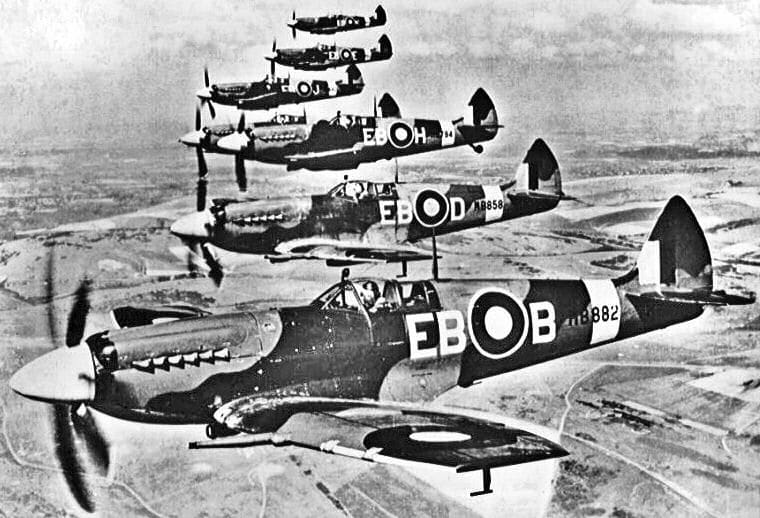
Britain faced the most severe threat of invasion it had encountered since the Napoleonic wars in the summer of 1940. France had fallen, the British Expeditionary Force had fled from Dunkirk without most of their equipment, and the Luftwaffe was massing on conquered airfields in northern France. The struggle that followed was fought by the youthful pilots of the Spitfires and Hurricanes and by the radar operators, plotters, mechanics, and gun crews who supported them. But at the same time, astrologers, ceremonial magicians, and a tiny coven of witches in Hampshire were said to be conducting a second, stranger campaign in wooded clearings and suburban drawing rooms. The essay looks at this occult activity, compares it to the military reality of the Battle of Britain, describes what has come to be called the Magical Battle of Britain from a British perspective and considers the competing explanations for why such rituals were performed and why they are still remembered.
Occultism, Intelligence, and the Historiography
The literature speaks of the World War Two wartime imagination of psychic warfare and occult knowledge within the larger discourse of espionage and intelligence. Krasztev’s analysis of “ESP wars” and the circulation of ideas about psychic espionage in Soviet state contexts contextualizes occult or occult-adjacent claims in the history of intelligence culture, where ideas of “psychic” or “borderline” science intersect with real state security issues and propaganda narratives during the wartime and early Cold War periods (Krasztev, 2019). There are also more general observations in the literature on the relationship between secret societies, occult groups, esoteric networks, and governments, propaganda, and state power. While not all sources identify this connection as a core empirical finding for WWII, they illuminate the cultural resonance of occult organisms in security discourse and the public imagination around state espionage, secrecy, and power (Krasztev, 2019; Hagemeister & Menzel, 2012; Gearon, 2021).
The Military Reality of 1940
The Battle of Britain is often timed from July to October 1940. On 16 July, Hitler’s Directive 16 approved preparations for Operation Sealion, an amphibious landing on the south coast of England. But the operation was based on a condition that was never met: air superiority over the Channel and southern England. The Luftwaffe initially targeted coastal convoys and ports, then in August shifted its focus to Fighter Command’s airfields, radar stations, and aircraft manufacturers and, from 7 September, concentrated its full efforts on London. That move was a grave mistake. Fighter Command used the Dowding system, which included radar, reports from the Observer Corps, filter rooms, and sector controllers, to protect its squadrons and effectively respond to attacks. Both sides suffered enormous losses, but the Germans’ were irreplaceble. The Kriegsmarine’s worries about transporting an army over the Channel in requisitioned river barges were never allayed. On 17 September Hitler indefinitely postponed Sealion. His planners were already gazing east by then. But the invasion never happened. The fact that the invasion never happened is the heart of everything that follows.

Occult Activity on the Allied Side
There were various different kinds of occult and pseudo-occult activity on the Allied side and it is worth distinguishing them. Some of this activity was official, licensed, and thoroughly cynical. British intelligence used the astrologer Louis de Wohl both to speculate about the guidance Hitler might be getting and as a propaganda asset in the United States. Black propaganda units created false astrological materials aimed at German troops. Part of it was private, devotional. From late 1939, Dion Fortune, head of the Fraternity of the Inner Light, circulated weekly letters to a scattered network of correspondents who meditated at an agreed hour each Sunday, visualizing guardian figures, a protective sea of light around the island, and the archetypes of Arthur, Merlin, and the Christ. Participants saw themselves as safeguarding the group’s thought of the nation against a hostile group mind. And some of it was just ritual magic, of a kind that would have been known three hundred years ago.
The best-known episode belongs to the last category. In 1940, another occult group got involved in magical workings in an attempt to repel the imminent threat of a German invasion. At the time, a coven of witches in Hampshire decided to perform a ritual at the Rufus Stone in the New Forest and its members tried to block the German invaders through a mixture of chanting and dancing (FitzGerald, 2021). Among those present was Gerald Gardner, a retired colonial civil servant who was eventually to be significantly responsible for the rebirth of witchcraft in Britain. He claimed that the great cone of power was raised and slowly pointed in the general direction of Hitler and the command was given, “You cannot cross the sea, you cannot cross the sea, you cannot come, you cannot come,” just as was done to Napoleon and the Spanish Armada (FitzGerald, 2021). There were seventeen witches present at this ceremony; five of them died shortly afterward (FitzGerald, 2021). Since then the rite has gained the pretend military codename “Operation Cone of Power” and is generally located at Lammas, on or about 1 August 1940. The reported deaths are most likely due to the group’s practice of working naked in the open air, where exposure and pneumonia (rather than the expenditure of life force) are more likely culprits among senior individuals. The rites, like the magical workings of Fortune, were likely to have raised morale among individuals in the esoteric community (FitzGerald, 2021).
Aleister Crowley has been linked to the same tradition of storytelling on much weaker evidence. He is said to have been involved in two magical ceremonies, the first dreamt up by Ian Fleming with the purpose of luring Rudolf Hess into defecting to Britain, and allegedly, soldiers went to Ashdown Forest in Sussex in 1941, where Crowley burned a dummy in Nazi uniform to the accompaniment of ritual chanting (FitzGerald, 2021). There are a lot of distinct versions of this narrative, all contradicting as to time, place, amount of persons engaged and even the nature of the rite (FitzGerald, 2021). The narrative was never addressed until the 1990s and neither Fleming nor Crowley ever claimed to have organized or even carried out such an event, which makes later creation the most economical explanation and casts further doubt on the story’s veracity (FitzGerald, 2021). Fleming was indeed involved in schemes to attract Hess to Britain through some kind of intentional occult misinformation, but it is quite unlikely that Crowley was a participant in these activities (FitzGerald, 2021). The same applies to another ceremony that Crowley is alleged to have carried out in 1943 at the Men-an-Tol megalithic site in Cornwall, said to have impacted the Battle of the Atlantic and the Philadelphia Experiment; there is no evidence for any such activity, Crowley never mentioned any such rituals, and the story did not emerge before the 1990s, so once more it seems an invention rather than sober fact (FitzGerald, 2021).
Competing Explanations and Scholarly Debate
There are several competing hypotheses about this stuff. The first is the participants’ own belief that consciousness can act at a distance, that Sealion was abandoned because the German leadership had been miraculously dissuaded, and that the war had a genuine inner dimension. This hypothesis is unfalsifiable and historically unnecessary, as the extant German records explain the postponement in terms of unbroken British air defense, naval inadequacy, and the mounting attraction of the future campaign in Russia. The second theory is the psychological one. Ritual offered frightened people something to do at a moment of severe helplessness, and on this reading the cone of power belongs next to the sandbag, the Anderson shelter, and the parish prayer meeting. The third explanation takes the episode as folklore in the making. Gardner wanted a lineage for the reborn craft, and a myth of hereditary witches saving the nation at the cost of their lives supplied antiquity and patriotism combined, while recalling ancient traditions like Drake and the Armada. A fourth theory is based on hindsight, as an invasion that never occurred means that any earlier ceremony can be considered successful. A fifth, especially pertinent to the Crowley accounts, is straightforward source criticism: late, uncorroborated, mutually inconsistent testimony tells us about the decade in which it was written, not about 1941. A last reading is comparative, noting that Allied occult traditions were created in the shadow of a magnified popular belief in Nazi occultism, for a magical foe seems to require a magical response.
Thus, scholars widely recognize a complex and debated link between occultism and WWII-era politics across the corpus. Other studies (especially Kurlander) argue for a nuanced interpretation that does not equate Nazi occultism with a monolithic “occult state,” pointing out that high-level regimes sometimes suppressed occult currents while allowing or using them opportunistically at other levels (Kurlander, 2015). Other academics stress the resilience and semi-autonomous continuation of occult concepts inside broader cultural and intellectual networks, even under official secular state mandates (Krasztev, 2019; Hagemeister & Menzel, 2012). This disparity highlights the value of precise claims about specific organizations, periods, and types of occult practice, rather than broad generalizations.
Conclusion
The Magical Battle of Britain can thus best be interpreted in two ways at once. As military history, it is insignificant. It was radar, radio, aircraft production, sound tactical control, and the endurance of Fighter Command’s pilots that beat the Luftwaffe, not the chanting in the New Forest. It is illuminating as cultural history and really touching. A few people without airplanes, guns, or influence did what they thought they could do. One individual helped create a pagan religion partly inspired by this memory. Later Crowley legends illustrate how quickly such occurrences gather narrative once they enter popular literature and how carefully one must weigh the evidence. Britain’s occult war is a worthy subject for serious study, as it serves as a prism to examine morale, myth construction, and the concerns of 1940, rather than offering an alternative explanation for these issues or for why Hitler never crossed the sea.
References
FitzGerald, M. (2021). The Nazis and the supernatural: The occult secrets of Hitler’s evil empire. Sirius.
Gearon, L. (2021). Editorial: Literature and Security. Text Matters, (11), 17–34. https://doi.org/10.18778/2083-2931.11.02
Hagemeister, M., & Menzel, B. (2012). The New Age of Russia. Occult and Esoteric Dimensions. https://doi.org/10.3726/b12474
Krasztev, P. (2019). In the Twilight of Ideologies: Power and Esotericism in Soviet State Socialism. Colloquia Humanistica, (8), 37–56. https://doi.org/10.11649/ch.2019.004
Kurlander, E. (2015). The Nazi Magicians’ Controversy: Enlightenment, “Border Science,” and Occultism in the Third Reich. Central European History, 48(4), 498–522. https://doi.org/10.1017/s0008938915000898


Leave a Reply