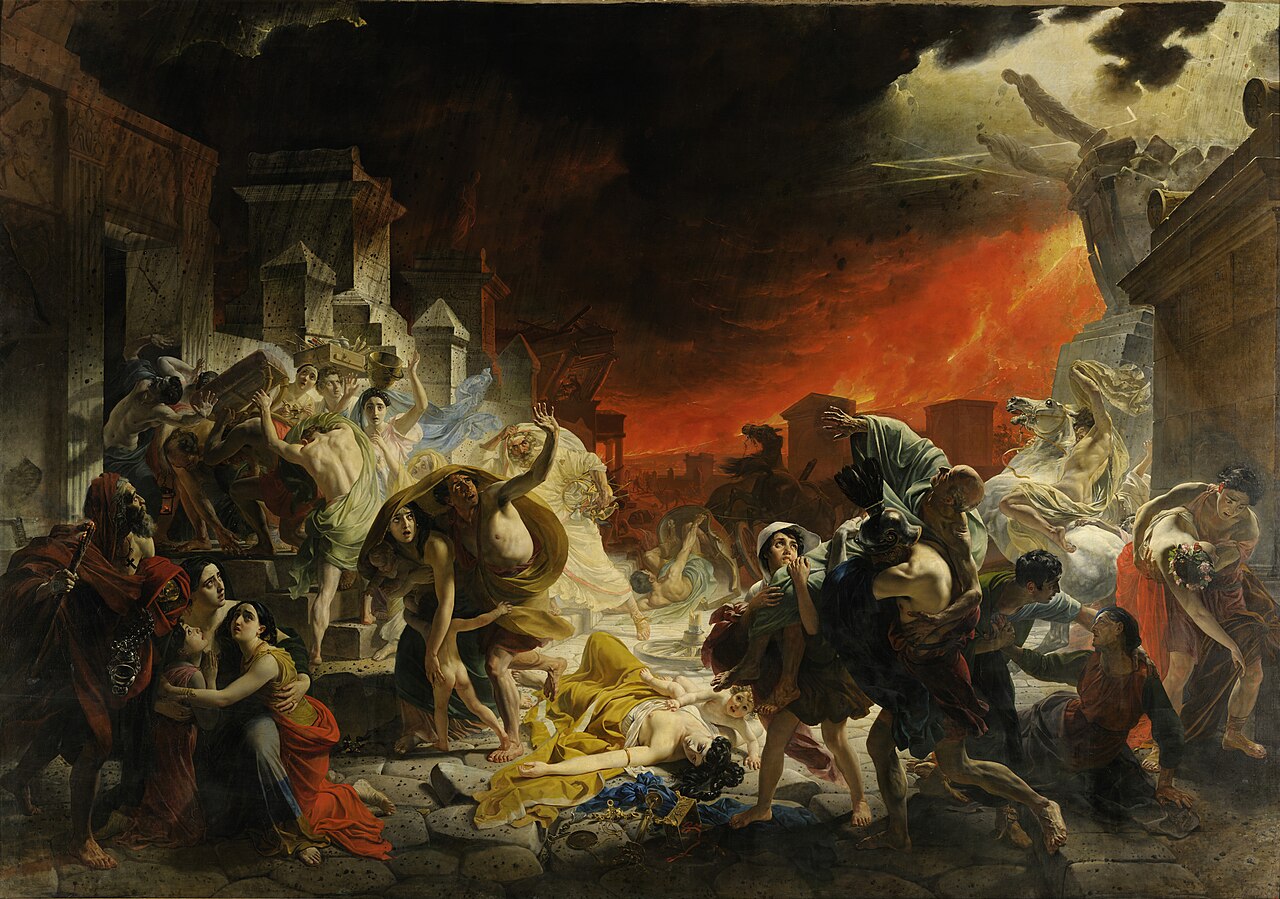
Pompeii Hauntings: Key Points
- In AD 79 Vesuvius erupted above a town that did not know it was a volcano, burying Pompeii and killing thousands in seconds. Pliny the Younger’s letters and the plaster casts preserve the moment.
- Romans divided the dead into honored ancestors and lemures, the restless dead who died violently or without burial rites. Households expelled them each May at the Lemuria with black beans and bronze.
- Pompeii fits that template perfectly: sudden deaths, unrecovered bodies, no rites, no surviving descendants. Cassius Dio even reports giant figures seen during and after the disaster.
- Modern visitors report footsteps, voices near the Forum, cold spots, and crushing grief at the Garden of the Fugitives. Over a hundred tourists have mailed back stolen fragments, blaming them for misfortune.
- One theory claims the eruption opened a supernatural portal, drawing on the region’s ancient reputation as a gateway to the underworld. The disaster destroyed both the people and the rituals that would have contained them.
- Scholars reject portals but note the site meets every Roman criterion for haunting, and that excavation disturbed the dead without rites. A street of people frozen mid gesture simply leaves no vocabulary but ghosts.

Introduction
The ruins of Pompeii are among the most visited archeological sites on earth and, at least in the imagination of the people who walk them, among the most constantly haunted. Two millennia after Mount Vesuvius buried the city, visitors still describe footsteps in empty hallways and voices in the Forum after closing time. It felt horrible, and it seemed like someone was watching from the empty entrances. Some of these experiences are the mind’s reactions to an abnormal location, a town deserted of all but the tourists, the bread still in the ovens, and the dead still lying where they fell. But the ghost stories of Pompeii are more than just atmosphere; they lie at the intersection of three very different traditions: the ancient Roman conception of what happens to the improperly buried dead, the eyewitness and near-contemporary accounts of the disaster itself, and a modern occult notion that the eruption tore open something in the earth that was never closed again. To understand why Pompeii seems haunted, it’s best to start by understanding what really happened.
AD 79: The Eruption of Vesuvius
The eruption of Mount Vesuvius in AD 79 is one of the best-documented historical volcanic occurrences, and Pompeii is a classic example of how pyroclastic activity and its associated processes devastated a Roman city. The sources agree on the order of tephra fallout, then subsequent PDCs, building collapses, and patterns of death and preservation, all of which together produced the archeological record of Pompeii (Biancardo et al., 2020; Borgia et al., 2005; Dellino et al., 2021; Giacomelli et al., 2003; Migoń & Pijet-Migoń, 2018; Vogel et al., 2016). The event is supported by contemporary eyewitness narratives from Pliny the Younger, which provide a time context for linking stratigraphy to human consequences (Giacomelli et al., 2003; Retief & Cilliers, 2010).
By late summer or autumn AD 79 Pompeii was a thriving provincial town of ten to twenty thousand inhabitants on the Bay of Naples, boasting its baths and bakeries, brothels, theater and amphitheater, and its painted mansions owned by affluent merchants and freedmen. Green and terraced vineyards spread below, and Vesuvius towered above, a volcano hardly anyone thought of as such. For generations it had been peaceful. The town experienced a major earthquake in AD 62 that destroyed it, and the restoration was still in progress when the mountain finally erupted. Earth tremors in the days leading up to it caused little anxiety, for as Pliny the Younger would later write, earth tremors were regular in Campania. Then the summit blew wide. A column of gas, ash, and pumice shot more than twenty miles into the sky, and Pliny, looking from Misenum across the bay, likened it to a pine tree with a towering trunk and spreading branches. His uncle, Pliny the Elder, sailed to the rescue to see it and perished on the shore at Stabiae. For hours pumice rained down on Pompeii, piling up deep enough to buckle roofs and plug doors. Many people ran away. Many more stayed indoors and waited, which was sensible and deadly. The next morning the eruption column collapsed, and pyroclastic surges—avalanches of superheated gas and ash traveling faster than a person can run—roared down the mountain and through the city. Death was instant, hot enough in some cases to vaporize soft tissue and, in one remarkable find at Herculaneum, to vitrify a victim’s brain. When the ash settled, Pompeii was buried under four to six meters of volcanic rubble. Some survivors burrowed their way back in to pillage their homes. Then the town disappeared, its name remaining as a curiosity on maps, until the seventeenth century, when systematic excavation began and workers found caverns in the hardened ash. The holes were filled with plaster and made the renowned casts: a dog straining on its leash, a man protecting his face, and families cowering under a staircase.
The AD 79 event was not an isolated occurrence but rather interacted with a broader history of Vesuvius activity and surrounding geomorphology. Stratigraphic sequence and landscape evolution studies suggest that Pompeii is part of a wider pattern of episodic tephra fall and debris flows in the Sarno Plain, with deposits from multiple earlier eruptions (e.g., Avellino, Mercato) in a continuous Plinian-debris-flow sequence that built the urban and agricultural hinterlands around Pompeii for millennia (Borgia et al., 2005; Doronzo et al., 2023; Vogel et al., 2016). The importance of the eruption reaches beyond immediate destruction: the preservation of Pompeii as a city buried by ash and pumice in a volcano-tectonic environment near a caldera has produced an enduring archeological record that has contributed to current geoarchaeology, disaster archeology, and geotourism. The location provides a place to research the linkages between volcanic hazards, urban design, risk perception, and cultural memory spanning millennia (Migoń and Pijet-Migoń, 2018; Senatore et al., 2013; Vogel et al., 2016).

Roman Ideas of the Restless Dead
What is important here is that the Romans themselves developed a complex and concerned conception of ghosts. Roman religion did not have the dead gone. Buried right and remembered right, the deceased became the di manes, ancestral spirits who could be venerated and fed and who stayed, more or less, where they belonged. The Parentalia was in the month of February when families visited tombs. The festival culminated on the twenty-first with the Feralia, during which families ate with their ancestors and renewed their commitments to the living. But there were two kinds of people. The lemures, or larvae, were the restless dead: those who died violently, or before their time, or with a sense of something horrible about them, or without offspring, or, above all, without funeral rites. Such souls were unable to settle into the afterlife and could not be absorbed by the family. Instead, they drifted back to the houses they knew, interrupting sleep, souring luck, and terrifying children. Roman families observed the Lemuria on the ninth, eleventh, and thirteenth of May each year. Ovid explains the ritual in the Fasti. At midnight the master of the home got up, walked barefoot through the house and hurled black beans over his shoulder; he repeated nine times a formula requesting the shades to leave, hammering bronze to scare them away. Ovid linked the event with the vengeful ghost of Remus, who had died prematurely at the hands of his brother. by his brother and so died before his time. The reasoning is simple enough. A horrible death made a bad spirit and a bad ghost had to be dealt with. Even educated Romans told ghost stories for fun and for argument. In Mostellaria, Plautus crafted an entire play about a servant who convinces his master that an unburied murder victim haunts their family residence. by an unburied murder victim. In a famous letter to Licinius Sura, Pliny the Younger describes a haunted house in Athens, haunted by an emaciated spirit in chains, whose bones were later found buried in the courtyard and whose disquiet subsided when they received appropriate burial. That narrative is not some fringe belief. An urban senator presents the orthodox Roman view: the dead are silent if the ceremonies are performed and not otherwise.
The Roman belief in ghosts and the afterlife is typically connected with a broader Roman religion and the underworld (the world of the dead). The ideas of shade, soul, and the afterlife are found in ancient sources, in debates about Roman religious practice and philosophy, and in literary depictions of the afterlife. Several works address the permanence of ancestral and divine presences in Roman philosophy and ritual and how succeeding writers interpreted or repurposed Roman concepts about the dead. These broader concerns are echoed in studies on Roman religion, the afterlife, and the representation of ghosts and dead ancestors in classical and late antique contexts (Fratantuo, 2016; Pollard, 2020; Scherer, 2019; Westwood, 2024).
Haunted Landscape: Pompeii, Ancient and Modern
That belief is fundamentally different from what occurred at Pompeii, which closely resembles a worst-case scenario by Roman standards. Thousands died abruptly, viciously. Most were not saved. They all lacked the washing, the lamentation, the procession, the cremation or burial, the nine days of mourning, and the annual offerings that were required by Roman practice. The survivors scattered around Campania, and following generations forgot even the site of the town. The ancient sources tell us that even at the time there was a sense of something horrible in the incident. Cassius Dio says that more than a hundred years afterward, before and during the catastrophe, figures like giants were seen moving over the earth and through the air by day and by night on the mountain, in the surrounding country, and in the cities, and that afterward they were said to appear again. Modern readers may easily account for the phenomenon as ash clouds forming human shapes or literary license invoking the tale of the giants imprisoned beneath the Campanian soil. But Dio is not talking about a metaphor. He is describing apparitions, and his readers perceived the locale as a place where these things happened.
Modern reports are in the same vein, except they come from tour guides rather than historians. Custodians and night personnel have long been attributed with accounts of footprints on the basalt paving after the gates close, of voices speaking something like Latin near the Forum and the Basilica, and of the sound of a crowd in the deserted amphitheater. The Villa of the Mysteries, with its mysterious initiation frescoes, has been the site of accounts of cold spots and figures seen in doorways. The most-cited hot area by far is the Garden of the Fugitives, where a group of thirteen victims died together and where their castings still stand. Visitors describe grief arriving as a tangible weight, as well as the impression of a kid standing right behind them. Photographs purporting to depict transparent beings accompanying the casts circulate on the internet, and as with almost all of these images, they cannot be duplicated or authenticated. They spoke about dogs that won’t go into specific houses and the feral cats on the site acting suspiciously at dusk. Running alongside these stories is the well-documented phenomenon of the Pompeii curse, which is not strictly a ghost story but belongs to the same emotional family. Over the years more than a hundred tourists have mailed back stolen tiles, mosaic fragments, and pieces of pottery, frequently with letters of remorse blaming their thefts for illness, sorrow, and financial ruin. One Canadian lady who returned tiles in 2020 stated that she had taken a piece of history with terrible energy tied to it, that people had died horribly and she would rather not carry the curse to her children. Whatever one thinks of the process, the belief is true and it is surprisingly close to ancient Roman thought about offended dead and the items that belong to them.
The most dramatic recent assertion goes further and suggests the eruption didn’t just kill individuals but opened something. Vesuvius is not a volcano but a door, and in AD 79 the door came off its hinges in this version. The concept is mostly based on really ancient geography. The Bay of Naples The eruption simultaneously obliterated all the ceremonial equipment at the thinnest point on the world’s floor for both Greeks and Romans alike. Virgil led Aeneas down through a cave beside Lake Avernus in the Phlegraean Fields, a short distance west of Pompeii, where the eruption simultaneously obliterated all the ceremonial equipment thought to be a real entrance to the underworld; birds were known to perish flying over it, poisoned by the odors, with the Cumaean Sibyl as his guide. At Baiae the hot springs steamed, at Solfatara the ground smoked, and the whole country The eruption simultaneously obliterated all the ceremonial equipment called burning. Vesuvius itself was worshiped as a divine power and was represented as a snake in the domestic shrines at Pompeii. The fire of the mountain could readily be connected with Vulcan and his underground forge. Occult and paranormal writers have extensively discussed the traditional dating of the eruption to the twenty-fourth of August, the day after the Vulcanalia festival dedicated to the fire god, suggesting that the mountain reacted to its rites with catastrophe; however, current evidence indicates a later date in the autumn, which eliminates this coincidence. Then the portal theory provides us a causal chain of its own. The eruption broke the boundaries between the world of the living and the world of the dead, liberating not just the victims of Pompeii but older and colder entities. At the same time, the eruption destroyed all the ceremonial equipment that typically is used to honor the dead. The eruption simultaneously obliterated all the ceremonial equipment typically used to honor the dead. to honor the dead. used to honor the dead. No family left to beat bronze and sow beans. In February, no tomb received an offering. The Lares of each household were buried in the houses they guarded. The hauntings in this reading are severe, not because the deaths were particularly horrific, but because a spiritual quarantine failed at the moment of the wound.
Roman Belief and Pompeian Haunting: Academic Perspectives
Roman religion specialists do not endorse portals, but numerous have remarked how well Pompeii follows the ancient pattern, and it is here that more serious theories tying Roman faith to the Pompeian haunting develop. The first is a structural remark. The victims of Vesuvius meet all the criteria through which the Romans defined a lemur: violent death, premature death, absent burial, interrupted grieving, and the demise of the family line that would have perpetuated the cult of the dead. If you had asked a Roman of the first century to build a place that was bound to be plagued, it would look like Pompeii. The second observation is on the excavations. Archeology in the seventeenth and nineteenth centuries did what the ancients would have considered appalling: broke into graves without ceremonies, moved bones, and then displayed the dead in glass exhibits for paying visitors. In this context, the plaster castings invented by Giuseppe Fiorelli in the 1860s are particularly odd things. Masks of the dying forever. Not tombs, nor bodies, but pictures of the moment of death. The Latin word for a malevolent spirit, “larva,” also meant “mask.” The final point is psychological rather than religious. Every culture has stories about trauma, and Pompeii’s dead are not abstract. They have names and addresses, debts, election graffiti and insults scribbled on walls, and grocery lists. Some researchers have proposed materialist explanations for the tales, such as a stone tape effect in the mineral-rich ash or anomalous electromagnetic circumstances in volcanic earth impacting the temporal lobe; however, neither theory has relevant data to back it up. The simpler answer is more likely. On a street where an entire populace perished mid-gesture, the human mind reaches for the lexicon of ghosts because no other vocabulary will do. The Romans reached for the same terms and for the same purpose.
The ancient Roman belief in ghosts that comes across in the texts given is a strong, yet complicated aspect of Roman religion and literary culture. Ghostly and underworld imagery are central to ritual memory (through Varro’s antiquarian project) and epic imagination (through Vergilian underworld scenes), while reception histories (Josephus’ engagement with Roman religion) show how later readers created and challenged these beliefs in a larger Mediterranean context. The intersection of antiquarian, literary, and reception studies in these works calls for a view of Roman beliefs in ghosts as a layered tradition, rooted in ritual and scholarly memory, dramatized in epic narrative, and ever reinterpreted in the light of later intellectual and religious developments (Fratantuo, 2016; Pollard, 2020; Rolle, 2022; Scherer, 2019).
Conclusion
So Pompeii is doubly haunted, and the two hauntings are not of the same nature. There is the old haunting, in which a Roman would have seen a city of lemures, thousands of shades adrift between the world and the underworld since no one cleansed their bodies, said their names, or flung black beans at midnight to send them on their journey. And then there is the current haunting, with visitors snapping pictures of oddities, guides talking about the whispers in the Forum, and worried foreigners mailing back stolen mosaic tiles to Italy with apologies to the dead. The concept of a dark gateway created by the eruption serves as a connection between the two hauntings, attempting to explain in supernatural terms the site’s unique significance: a catastrophe that obliterated both a people and the entire ceremonial system that would have allowed for their proper burial. The larger point remains, whether or not anything wanders the Via dell’Abbondanza after dark. Rome’s ghosts were the result of negligence, not malice, and Pompeii is the largest act of unintended neglect in the ancient world. The ruins remain a place where the line between remembering and being remembered seems unusually blurred. That, more than any snapshot or cold spot, is why the ghosts of Pompeii refuse to leave.
References
Biancardo, S. A., Veropalumbo, R., Vorobjovas, V., & Dell’Acqua, G. (2020). Modeling Roman Pavements Using Heritage-BIM: A Case Study in Pompeii. The Baltic Journal of Road and Bridge Engineering, 15(3), 34–46. https://doi.org/10.7250/bjrbe.2020-15.482
Borgia, A., Tizzani, P., Solaro, G., Manzo, M., Casu, F., Luongo, G., Pepe, A., Berardino, P., Fornaro, G., Sansosti, E., Ricciardi, G. P., Fusi, N., Donna, G. D., & Lanari, R. (2005). Volcanic spreading of Vesuvius, a new paradigm for interpreting its volcanic activity. Geophysical Research Letters, 32(3). https://doi.org/10.1029/2004gl022155
Dellino, P., Dioguardi, F., Isaia, R., Sulpizio, R., & Mele, D. (2021). The impact of pyroclastic density currents duration on humans: the case of the AD 79 eruption of Vesuvius. Scientific Reports, 11(1). https://doi.org/10.1038/s41598-021-84456-7
Doronzo, D. M., Trasatti, E., Arienzo, I., Balcone‐Boissard, H., Barra, D., Aiello, G., Amato, V., & Vito, M. A. D. (2023). Magma reservoir growth and ground deformation preceding the 79 CE Plinian eruption of Vesuvius. Communications Earth & Environment, 4(1). https://doi.org/10.1038/s43247-023-00880-9
Fratantuo, L. (2016). Vimque deum infernam: Virgil’s God of the underworld. Graeco-Latina Brunensia, (1), 59–72. https://doi.org/10.5817/glb2016-1-4
Giacomelli, L., Perrotta, A., Scandone, R., & Scarpati, C. (2003). The eruption of Vesuvius of 79 AD and its impact on human environment in Pompeii. Episodes, 26(3), 235–238. https://doi.org/10.18814/epiiugs/2003/v26i3/014
Migoń, P., & Pijet-Migoń, E. (2018). Natural Disasters, Geotourism, and Geo-interpretation. Geoheritage, 11(2), 629–640. https://doi.org/10.1007/s12371-018-0316-x
Ovid. (2004). Fasti (A. J. Boyle & R. D. Woodard, Trans.). Penguin Books. (Original work published ca. 8 CE)
Plautus. (2011). Mostellaria (W. de Melo, Trans.). Harvard University Press. (Original work published ca. 195 BCE)
Pollard, R. M. (2020). Imagining the Medieval Afterlife. https://doi.org/10.1017/9781316823255
Retief, F., & Cilliers, L. (2010). The eruption of Vesuvius in AD 79 and the death of Gaius Plinius Secundus. Acta Theologica, 26(2). https://doi.org/10.4314/actat.v26i2.52566
Rolle, A. (2022). Coming Home: Varro’s Antiquitates rerum divinarum and the Canonisation of Roman Religion. 263–284. https://doi.org/10.1163/9789004520264_011
Scherer, M. (2019). Resurrecting antiquity: Memories of Medea in the Caribbean. Memory Studies, 15(2), 480–500. https://doi.org/10.1177/1750698019882053
Senatore, M. R., Ciarallo, A., & Stanley, J. (2013). Pompeii Damaged by Volcaniclastic Debris Flows Triggered Centuries Prior to the 79 A.D. Vesuvius Eruption. Geoarchaeology, 29(1), 1–15. https://doi.org/10.1002/gea.21458
Vogel, S., Maerker, M., Rellini, I., Hoelzmann, P., Wulf, S., Robinson, M., Steinhübel, L., Maio, G. D., Imperatore, C., Kastenmeier, P., Liebmann, L., Esposito, D., & Seiler, F. (2016). From a stratigraphic sequence to a landscape evolution model: Late Pleistocene and Holocene volcanism, soil formation and land use in the shade of Mount Vesuvius (Italy). Quaternary International, 394, 155–179. https://doi.org/10.1016/j.quaint.2015.02.033
Westwood, U. (2024). Free Speech and Moses’ Laws: The Limits of παρρησία in Josephus’ Works. 145–166. https://doi.org/10.1163/9789004693296_007


Leave a Reply