Nale Ba: Key Points
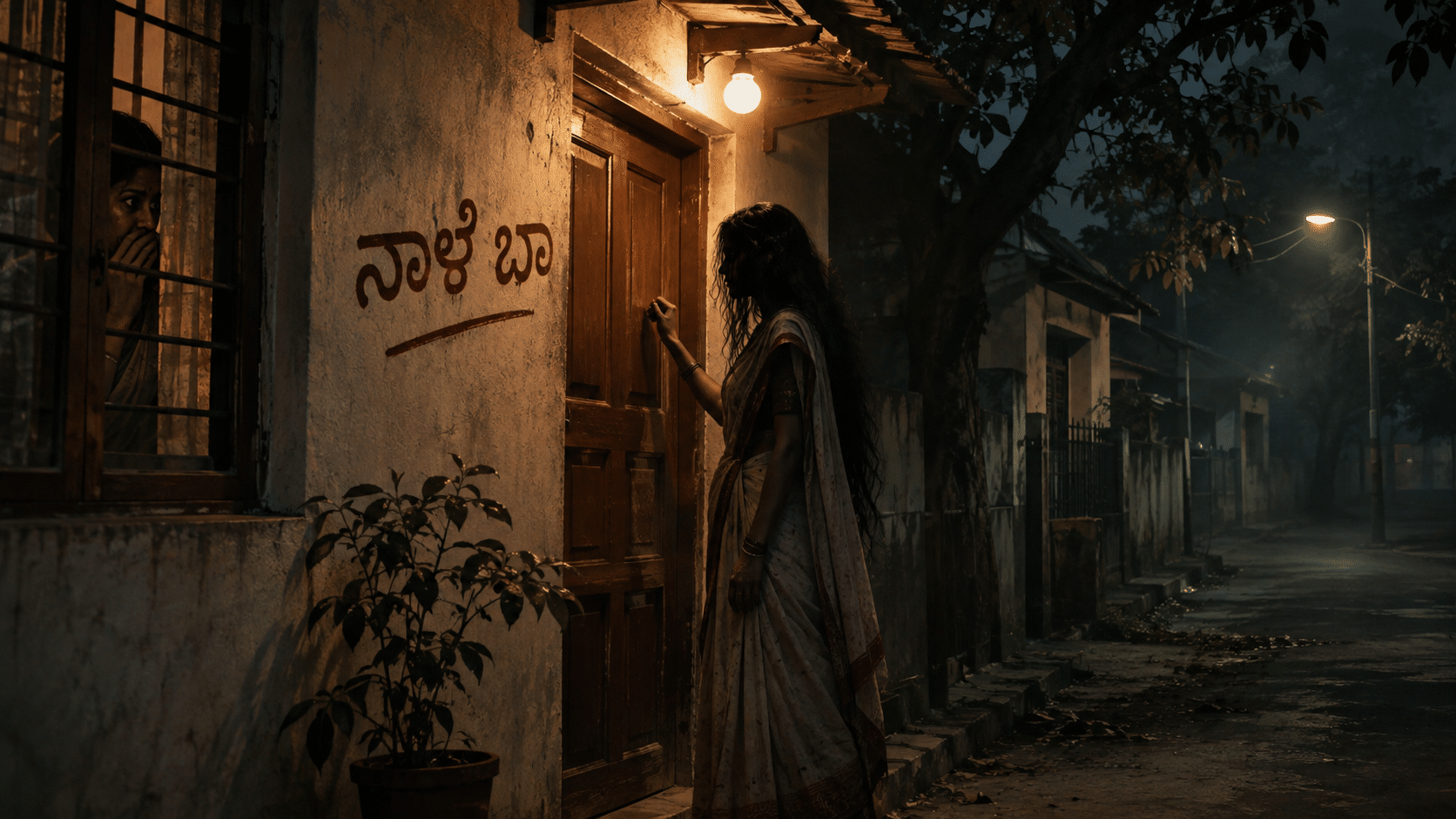
- Nale Ba is a Karnataka urban legend about a dangerous female spirit who wanders neighborhoods at night, knocking on doors and calling to residents.
- The ghost supposedly imitates the voice of a family member or friend, tricking people into opening the door before killing or abducting them.
- Residents protected themselves by writing “Nale Ba,” meaning “Come tomorrow,” on their doors or walls, causing the spirit to leave and return the next night.
- The legend fits into India’s long tradition of ghost stories involving dangerous female spirits, supernatural deception, and rules that humans can use for protection.
- Theories suggest Nale Ba developed from urban rumors, fears about nighttime strangers, older Indian ghost traditions, and a community’s desire to control an unexplained threat.
- The legend gained a much larger audience through the 2018 Hindi horror comedy Stree, which adapted the “come tomorrow” idea and used it to explore fear, gender, and personal safety.

Introduction
One of the most intriguing current ghost stories in India is the legend of Nale Ba because its strength stems from a remarkably basic notion. In the nighttime, a ghostly visitor comes to a residence, but two words on the door are said to be enough to halt her. In Kannada, Nale Ba, alternatively spelled Naale Baa, means “come tomorrow.” Particularly in the 1990s, the mythology grew to be connected with Bengaluru and nearby districts of Karnataka, when tales emerged of a violent female spirit roaming residential neighborhoods after dark. The statement was written on doors and walls by residents, as it was thought that the ghost would read the instruction and postpone her visit until the next night (Ghosh, 2018; Raman, 2018). There’s no evidence that a supernatural monster actually attacked humans, but the story became a memorable piece of urban folklore. Nale Ba is particularly fascinating since it mixes older Indian notions of deadly spirits with the concerns and rumor networks of a modern city.
The Nale Ba Legend and Its Protection
The primary story is scary since it is located at the entrance to the residence. Most popular is the one about a mysterious female spirit or witch who goes through the neighborhoods at night and knocks on doors. She doesn’t necessarily declare herself in a tone that is blatantly supernatural. Rather, she is described as imitating the voice of a relative, a friend, or other familiar person. If a mother, sister, husband, or friend calls from outside and awakens you, it is normal to open the door. Legend has it that such a call puts the resident in dire danger. Some stories say that the victim dies, often within 24 hours, while others describe individuals merely disappearing (Ghosh, 2018; Raman, 2018).
That ability to emulate a trusted person is what gives the fable most of its psychological impact. A monster who claims to be a monster can easily be avoided. Nale Ba strikes by apparently playing on familiarity. So the disturbing question is not only what may be outside, but also whether one can trust one’s own senses. Even the recognition of the voice does not ensure safety. The regular nocturnal knock becomes a menace. It is in this aspect that Nale Ba is part of a much bigger tradition of supernatural tales where ghosts trick people into thinking they look or sound familiar.
The individuals the spirit threatens, however, have an almost comically easy defense. The residents write “Nale Ba” on the outside of the house. The spirit arrives, she receives the note urging her to come tomorrow, and she goes. The next night she returns, receives the same command, and leaves again. For Nale Ba, tomorrow never comes. The supernatural aggressor is therefore caught in a cycle of unending repetition established by language rather than annihilated by an exorcism, religious ceremony, or physical encounter. Legend has it that the words were scrawled on walls and doors by people as the news moved across Bengaluru (Ghosh, 2018; Raman, 2018).
This weird solution differentiates Nale Ba from many ghost stories. The spirit is dangerous enough to kill or take humans yet she is also constrained by a rule. She can read. More importantly, she seems compelled to conform to what she reads. The person within the house doesn’t beat the supernatural world; they work the rules of the supernatural world. Supernatural creatures are often restricted in this way by folklore. A ghost might be attached to a particular place, a vampire might need an invitation, or a particular object or ritual might be able to banish a spirit. In Nale Ba, the protecting object is the written language itself.

Ghosts and Spirits in Indian Folklore
It is talked about as a live, transmitted medium that carries ghost stories in its repertoire. Anthropology and folklore literature indicate that oral narratives, including stories of spirits, ghosts, and the supernatural, are transmitted from generation to generation and function in communities as part of a living oral tradition. This practice is in keeping with Indian contexts where oral narration keeps local hauntings, spirits, and sea or forest ghosts alive in the memory of the community. The general tension between “folklore” as a discipline and its empirical manifestations across cultures makes a case for treating Indian ghost narratives as traditional material as well as ongoing creativity (Ben-Amos, 2021; Upadhyay, 2016; Ilyefalvi, 2018; Chiranjeevi & Dhumal, 2025; Kumar, 2022; Soni, 2020).
Indian folklore is rich in ghost stories, which are varied and numerous. India has diverse languages, faiths, ethnic traditions, and regional storytelling cultures; hence, there is no uniform Indian idea of a ghost. For instance, the term “bhut” or “bhoot,” which is used in general to refer to numerous kinds of spirits, is associated with death and the supernatural. Wayne McClintock (1990) recognized many sorts of ghosts and demons in Indian folk religion and the significance these beings could have in explanations of illness, misfortune, and odd happenings. Likewise, more modern study refers to bhuta-preta traditions as having different regional manifestations, including creatures known by names such as chudail, jinn, daiva, and bhoota (Prakash, 2026).
The deadly female spirit is a frequent character of Indian ghost traditions. The best recognized example is possibly the chudail or churel. Such individuals are frequently related to unnatural or sad deaths and may be a menace to live men. Older reports of northern Indian tradition describe the churel as a peculiar female ghost, including the renowned feature of backward-facing feet (Crooke, 1894). Nale Ba should not be simply labeled as a churel, as the legend has its own regional history and peculiarities. Nevertheless, the frequency of legends about menacing female spirits formed a cultural backdrop in which the idea of a female supernatural night guest would have been familiar.
Theories Behind the Legend
Several probable reasons exist for the rise of the Nale Ba tale. The simplest explanation is that it was an urban legend that grew through hearsay. Its popularity was constantly highest in Karnataka in the 1990s, notably in and around Bengaluru (Ghosh, 2018; Raman, 2018). One individual hearing about a mysterious woman knocking on a neighbor’s door would inform another household, who might connect the rumor to an unexplained illness, death, weird sound, or visitor in the night. Each time a rumor is shared, it may include one additional detail. Even if they don’t believe the tale 100 percent, individuals will eventually take measures. The cost of writing two words on a wall is almost negligible, so the rationale is simple: why take a chance?
You may also see the exercise as a collaborative anxiety control tool. Fear is simpler to manage when people feel they can do something concrete to defend themselves. The scary part about the invisible threat is that it’s difficult to control. Writing “Nale Ba” addresses the ambiguity and presents it as a solvable issue. So a resident might see the phrases on the door and feel like something’s been done. When neighbors start to do the same thing, the behavior becomes self-reinforcing. The writing is also clear proof that other individuals have heard the narrative. In this view, the protective message can at the same time relieve the individual worry and serve to propagate the tale.
Another approach emphasizes the social significance of doors and midnight guests. There is a door between the interior of the residence and the exterior. The fable of Nale Ba serves as a cautionary tale about the dangers of crossing boundaries based solely on someone’s seemingly trustworthy demeanor. Tales like these might serve as informal cautions against strangers, criminality, and danger at night. The familiar voice adds another dimension to the warning: appearances and sounds can be deceptive. It’s common sense not to open a door to an unknown nocturnal visitor, even if there’s no witch involved. So folklore may have converted a mundane safety guideline into an unforgettable spooky tale.
The spirit’s female identity has also invited sociological interpretations. Indian magical lore is full of tales of female spirits that get angry and violent after being mistreated, betrayed, dying prematurely, or having frustrated relationships. This pattern does not show a particular origin for Nale Ba, especially as urban legends vary quickly and often lack a traceable first form. But it does help explain why listeners could comprehend the character right away. The wandering magical woman was already a familiar figure in Indian storytelling. Nale Ba put her figure in a modern context and gave her an especially memorable frailty.
Nale Ba in Popular Culture
The mythology finally left the communities where it had been circulating and reached Indian popular culture. Its most notable spin-off is Amar Kaushik’s 2018 Hindi horror-comedy Stree. The film relocates the supernatural threat to Chanderi, Madhya Pradesh, where a female ghost is abducting men. Residents protect themselves with the Hindi slogan “O Stree, kal aana,” which means “Come tomorrow, woman.” The filmmakers, Kaushik said, drew on Nale Ba and supernatural beliefs from elsewhere in India, not just replicating a single mythology from Karnataka (Hajee, 2018). The film’s Central Board of Film Certification listing also mentions that Stree is based on the Nale Ba urban legend, which was popular in Karnataka in the 1990s (Central Board of Film Certification, 2018).
Stree also offered a fresh social dimension to the old story. The film subverts common anxieties regarding gender and safety at night; the female ghost is not simply a terrible monster. Men become the ones who are told to not walk alone at night and to beware of a menacing stranger. Kaushik has responded directly to this reversal, drawing parallels between the warnings sent to the male characters and the precautions women are constantly advised to take so that they can be safe (Singh, 2018). The adaptation shows how folklore is altered as it is absorbed into popular society. A scary myth from 1990s Bengaluru was the basis for comedy, horror, and criticism of gender.
Ghost stories in India are expected to be regionally diverse, reflecting local belief systems and responding to changing media settings. This corresponds to the broader folkloristic perception of ghost stories as being rooted in region-specific mythologies, ritual practices, and social contexts (e.g., local spirits, ancestral hauntings, forest and coastal hauntings) (Ben‐Amos, 2021; Upadhyay, 2016; Bálint, 2021; Kumar, 2022; Soni, 2020). Ethnographically, the interest in local knowledge systems indicates that Indian ghost stories must be analyzed considering community-specific meanings, performative contexts (night gatherings, storytelling sessions, ritual sites), and changing forms (oral storytelling to digital narratives on social media) (Bálint, 2021; Kumar, 2022; Prasad, 2020).
So the greatest impact of Nale Ba may not be that it is evidence of anything paranormal, but that the myth itself survived. The mythology reveals how rapidly societies may come up with explanations and rituals when they don’t know what is happening. It also shows that urban folklore does not need to have an old origin. By the time the Nale Ba tales became popular, Bengaluru was already a big metropolitan area. Telephones, media, education, and urban expansion did not put an end to supernatural rumors. In some ways, the tale might have moved faster in a heavily connected city.
Conclusion
Nale Ba is notable for the folklore that couples an ancient form of fear with an almost amusing remedy. A ghost approaches after dark, imitates someone the victim loves, and waits outside the protection of the threshold. But apparently she can be put off by a written request to come back another day. There is no credible proof that a supernatural woman actually haunted Bengaluru, and the narrative is best understood as modern folklore, not as documented paranormal history. However, the narrative held significant meaning for those who shared it and inscribed protective words on their homes. Its subsequent adaptation into Stree introduced the mythology to audiences far beyond Karnataka. Nale Ba lives because “come tomorrow” is more than a brilliant defense against a ghost. It’s one of the oldest tricks in folklore for dealing with fear: put a rule on the unknown, and suddenly it feels manageable.
References
Bálint, Z. (2021). About the authors. Ethnographica et Folkloristica Carpathica, 23, 196–199. https://doi.org/10.47516/ethnographica/23/2021/10147
Ben-Amos, D. (2021). Introduction to the special issue “The Challenge of Folklore to the Humanities.” Humanities, 10(1), 18. https://doi.org/10.3390/h10010018
Central Board of Film Certification. (2018). Stree. CBFC Watch. https://cbfc.watch/film/stree-2018
Chiranjeevi, M., & Dhumal, S. N. (2025). Mapping the landscape of scholarly impact of folk literature: A bibliometric analysis of global and local research dynamics in folk literature from 2020-2024. https://doi.org/10.21203/rs.3.rs-5845925/v1
Crooke, W. (1894). The popular religion and folk-lore of Northern India (Vol. 1). Archibald Constable & Co.
Ghosh, S. (2018, June 6). Nale Ba: The scary urban legend Rajkummar-Shraddha’s Stree is based on. India Today. https://www.indiatoday.in/movies/bollywood/story/nale-ba-the-scary-urban-legend-rajkummar-shraddha-s-stree-is-based-on-1252289-2018-06-06
Hajee, K. (2018, August 6). What is the “ridiculously true” story behind Stree? The Quint. https://www.thequint.com/entertainment/bollywood/urban-legend-story-behind-stree-nale-ba-rajkummar-rao-shraddha-kapoor
Ilyefalvi, E. (2018). The theoretical, methodological and technical issues of digital folklore databases and computational folkloristics. Acta Ethnographica Hungarica, 63(1), 209–258. https://doi.org/10.1556/022.2018.63.1.11
Kumar, S. (2022). Imagined ethnography and cultural strategies: A study of Easterine Kire’s Sky Is My Father and Don’t Run, My Love. Rupkatha Journal on Interdisciplinary Studies in Humanities, 14(2). https://doi.org/10.21659/rupkatha.v14n2.ne29
McClintock, W. (1990). Demons and ghosts in Indian folklore. Missiology: An International Review, 18(1), 37–52. https://doi.org/10.1177/009182969001800104
Prakash, B. (2026). Ghost of justice: Bhuta-preta as the figures of performative justice in India and South Asia. Performance Research, 29(7), 56–66. https://doi.org/10.1080/13528165.2024.2569227
Prasad, L. (2020). Introduction: “That acre of ground.” In Gender and storytelling in India (pp. 1–15). https://doi.org/10.1515/9781501752285-003
Raman, S. G. (2018, August 9). Equal parts horror and comedy: Shraddha Kapoor and director Amar Kaushik on Stree. Scroll.in. https://scroll.in/reel/889524/equal-parts-horror-and-comedy-shraddha-kapoor-and-director-amar-kaushik-on-stree
Singh, S. (2018, September 9). She walks in beauty, men run in terror. The Indian Express. https://indianexpress.com/article/express-sunday-eye/stree-movie-she-walks-in-beauty-men-run-in-terror-5344495/
Soni, R. K. (2020). Folklore as tradition, heritage and profession. Smart Moves Journal IJELLH, 8(1), 8. https://doi.org/10.24113/ijellh.v8i1.10334
Upadhyay, P. (2016). Anthropological perspectives on folklore: Underpinnings on some Nepali folklore. Tribhuvan University Journal, 29(1), 149–160. https://doi.org/10.3126/tuj.v29i1.25966


Leave a Reply