The Haunted Inn at Aberdeen: Key Points
- The Inn at Aberdeen in Valparaiso, Indiana, was an 1850s farmhouse converted into a bed-and-breakfast in 1995. Its rooms and staircase became known for ghost sightings.
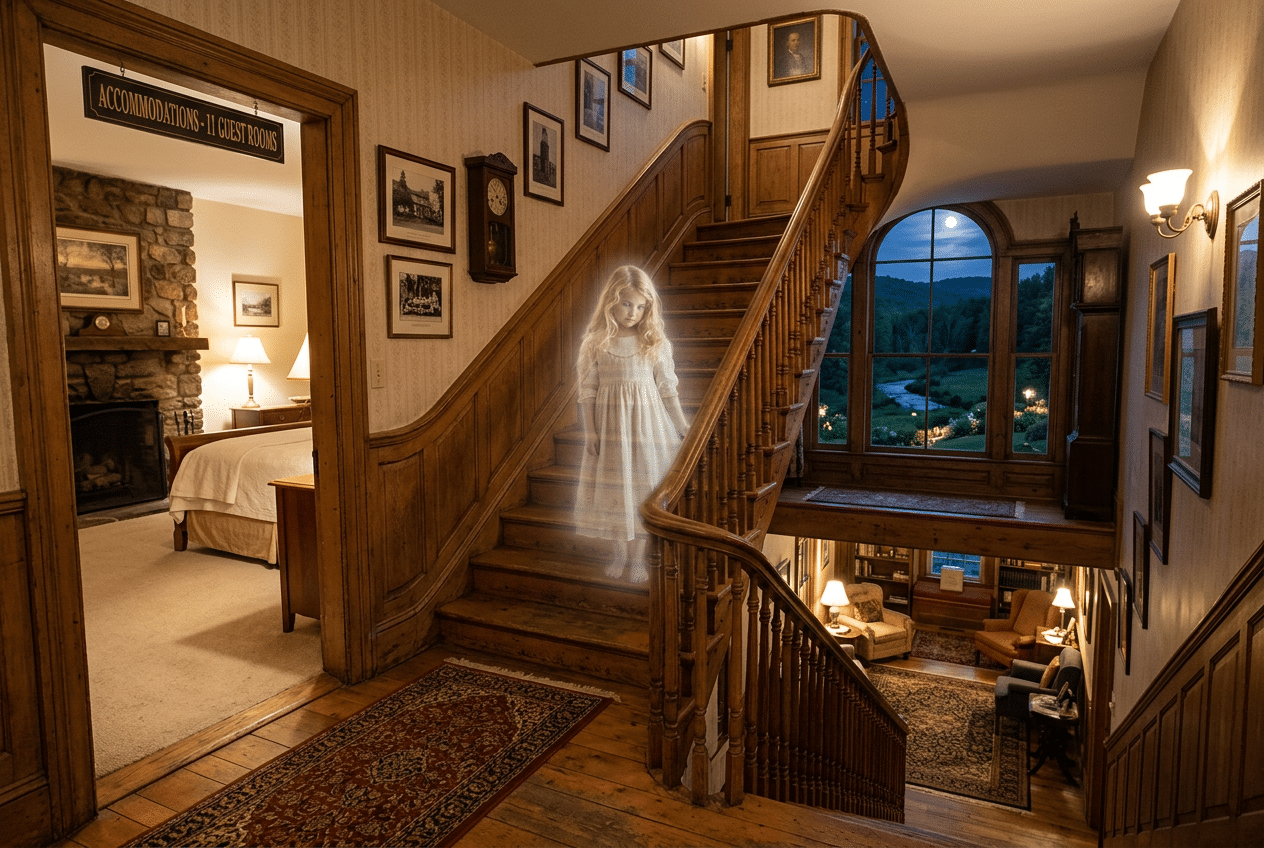
- Grace Ritter died at age four, and some believe her spirit remains as Angel, a playful ghost seen on the staircase.
- Angel reportedly moves belongings, interferes with televisions, and talks to children. One guest claimed her missing jewelry mysteriously reappeared.
- Other hauntings include a scarred Civil War-era ghost and three visitors who mysteriously vanished. A hidden trapdoor may connect the farmhouse to the Underground Railroad.
- The inn appeared on Ghost Hunters in 2016. Investigators reported unusual activity, although some disturbances had ordinary explanations.
- The inn closed in 2018, but its ghost stories remain part of local folklore. No scientific evidence confirms the hauntings.

Introduction
The Inn at Aberdeen in Valparaiso, Indiana, holds a curious place in the ghost lore of the American Midwest. The inn had gained its reputation as a haunted place when it was a working bed-and-breakfast, not like abandoned hospitals or estates fallen into disrepair. The lovely rooms and serene settings brought visitors, yet there were tales of unexplained footsteps, of possessions missing, and of eerie apparitions. The most renowned was a young girl named Angel, who some believe to be the ghost of a kid who died in the nineteenth century. Other reports included a scarred Civil War-era apparition, unexplained disappearances of visitors, and basement disturbances. These reports grabbed the attention of paranormal enthusiasts, journalists, and television investigators. The inn’s reputation is a wonderful example of how history, tradition, and personal encounters can turn an ordinary building into a famous haunted spot.
History of the Inn at Aberdeen
The property is located at 3158 South State Road 2, close to the Aberdeen residential subdivision and golf course. The old home dates back to the 1850s and is surrounded by rolling hills, woodlands, and little streams. With its historic architecture and planted gardens, it feels inviting. The inn had eleven guest rooms, many with fireplaces, jacuzzi tubs, and private balconies or patios, during its bed-and-breakfast years. It had a 19th-century charm with a winding staircase, library, solarium, and comfy communal spaces. The exquisite surroundings contrasted sharply with the stories of supernatural activity associated with the building (Ammeson, 2017; The Traveler’s Way, 2013; Webster, 2016).
The house has a history that predates its reputation for ghosts. Records indicate that a farmhouse existed on the property as early as 1856, when it belonged to Samuel Collins and was known as Timberlake Farm, according to paranormal researcher Mitch Goth (2022). The Ritters, John and Sarah, bought the farm in 1878. Ritter came to Porter County with his family in 1845, going from Erie County, New York. After his father died, his mother had to raise seven children on her own. Later Ritter went west, fought in military engagements with Colonel Kit Carson, and barely escaped a critical bullet wound in a confrontation with Native American warriors. After his recovery he moved to Indiana and became a farmer (Ammeson, 2017).
Ritter married Sarah J. Hesser in 1871, and they had five children, named Merritt, Hattie, William, Ollie, and Grace. The family has experienced many tragedies. Grace died at about four years of age, and Sarah died in 1884. Two years later, Ritter remarried but lost more people dear to him. In 1900 his son William, aged twenty-one, was kicked by a horse and killed. These deaths proved relevant to the later haunting traditions of the inn, including the identification of the strange girl seen on the stairs as Grace Ritter. There is no evidence that her spirit still resides in the house, but the family’s documented tragedies gave a historical framework for the ghost stories (Ammeson, 2017).
The farmhouse changed hands several times before John and Linda Johnson bought it in 1995. John Johnson, a physician in Schererville, Indiana, was drawn to the property’s historic appeal and picturesque country setting. The couple renovated the place and opened it up as a high-end bed-and-breakfast. The strange occurrences began roughly a year after the organization was created, Johnson said. Guests reported missing things, strange noises, and odd activities in their rooms. Over time, the Inn at Aberdeen developed a reputation that drew tourists intrigued by both its lodgings and its alleged supernatural inhabitants (Ammeson, 2017).
One of the most intriguing historical claims to the land is its connection to the Underground Railroad. Johnson felt the farmhouse was a haven for those fleeing slavery in the nineteenth century. He showed us a trapdoor in a closet in a front corridor that led into the basement where freedom seekers might reportedly hide. Johnson urged the passengers to go on through Hebron and Westville to Michigan City and finally to Canada. Ammeson (2017) mentions Michigan City’s known involvement in the Underground Railroad and the operations of Daniel Low, who is claimed to have assisted roughly 150 people escape through the area. But there is no independent verification that the Aberdeen farmhouse itself was a station. The trapdoor and the local history make the custom intriguing, but the property’s exact role has not been verified.

Angel and the Other Reported Hauntings
The inn’s most renowned apparition is a young girl named Angel. They say employees and guests observed her seated on the main staircase or walking through the building before vanishing. The first Johnson heard of the apparition was from an employee who reported seeing a youngster on the stairs. Johnson took her for a visitor, but the staff said the youngster looked much like a child in a sepia portrait of the Ritter family, which hung not far away. The discovery was made that Angel was in reality Grace Ritter, who had perished in childhood. The connection gave the spirit a name and a tragic family history, turning an anonymous ghost story into a recognizable local legend (Ammeson, 2017; Goth, 2022).
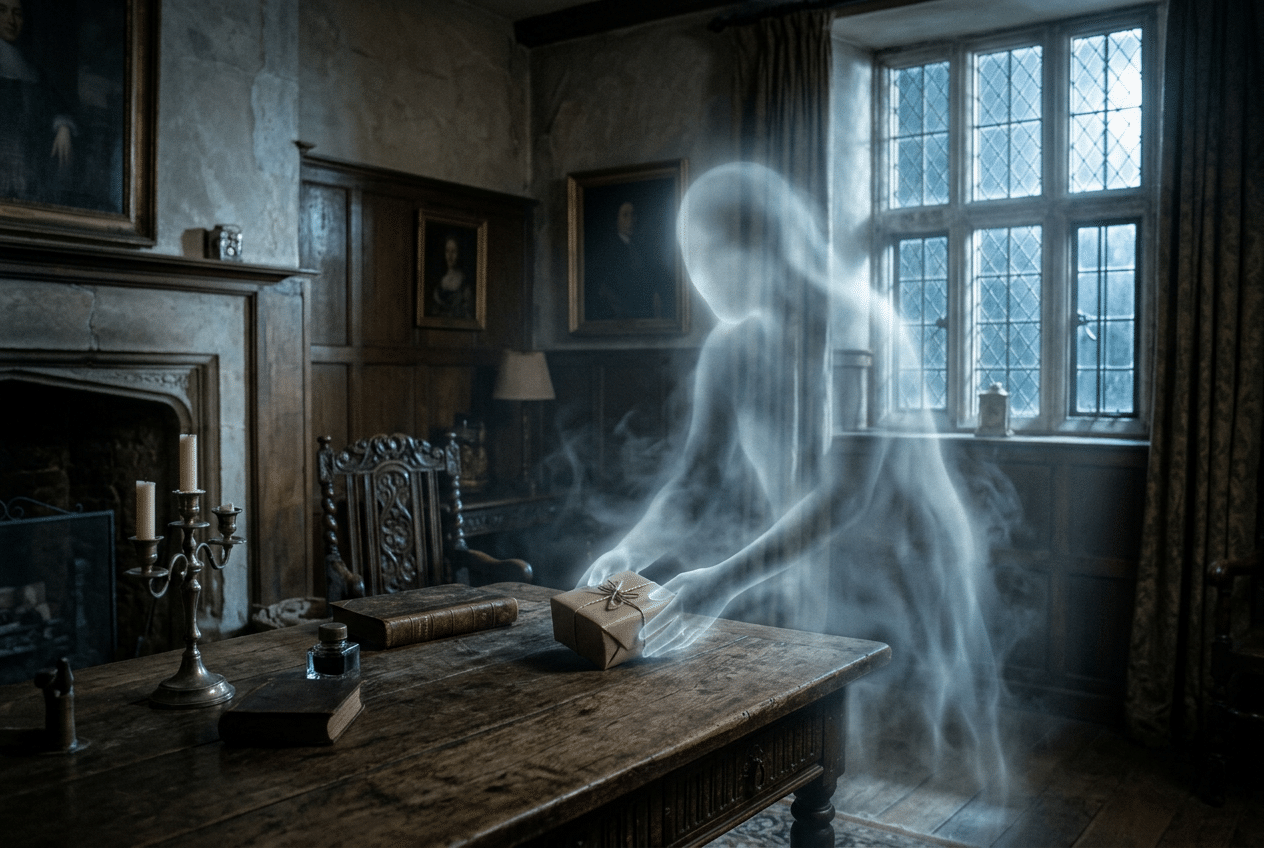
Angel’s demeanor is described more often as mischievous than terrifying. Guests have noticed items disappearing and reappearing, televisions switching on and off and doors moving by themselves. Indiana Haunted Houses (n.d.) tells of an incidence where lipstick was reported to have been found inside a shoe of a guest. In The Traveler’s Way (2013) a TV is shown switching on and off continuously while a guest is staying. Such instances added to Angel’s reputation as a lively spirit who delighted in meddling with conventional routines. What she does is in the vein of old poltergeist stories, where unseen powers shift things around and make a fuss, without necessarily hurting anyone.
There was one very weird report of a woman who was staying in a locked guest room. Johnson said the woman spread her makeup and jewelry on a writing desk before she went into the bathroom. When she returned, things were missing or had been moved about. She glanced at the door and saw it was still locked. She went back to the bathroom for a moment, then came back to find everything back in place. In the end the guest decided that a ghost was playing tricks on her. Johnson said that the incident was one of the first instances to help build the haunted reputation of the inn (Ammeson, 2017).
Angel also apparently had contact with children. Johnson remembered a four-year-old youngster who sat on the stairs and seemed to speak to someone invisible to the grownups around him. When his grandma asked who he was talking to, the youngster said he was talking to a small girl. People thought Angel liked being around kids because of stories like that. Such narratives echo older supernatural traditions in which children are thought to be especially sensitive to spirits. However, creative play and imaginary friends are conventional explanations for some of the experiences. The event is part of the legend of the inn, a memorable encounter rather than evidence of an actual ghost (Ammeson, 2017).
Another wonderful story was about three visitors who just seemed to disappear for no reason. Johnson told of an old woman who came into the inn during a severe thunderstorm with two children, a boy about six and a girl about seven. The grandmother spoke to the manager as though she knew the house previously. The manager thought another family member could be parking a car and stepped into an adjoining room for a moment. When he returned, all three visitors were gone. Despite the rain, it was said there was no water on the floor and no car was seen outside. Johnson thought the situation was unusual because the visitors looked to have disappeared too rapidly to leave normally (Ammeson, 2017).
This tale seems like a classic ghost story of human-like apparitions that evaporate without a trace. Such individuals can sometimes be seen in the costume of an earlier age or showing a strange affinity with old places. The guests were suspected of being former residents, given the grandmother’s obvious knowledge of the home. Their plain clothing and abrupt exit only deepened the mystery. Still, the story lives on as a secondhand account without independent corroboration. This detail is important because it enhances the inn’s supernatural reputation by including mystery guests who appear to be connected to its past.
Another alleged apparition was said to haunt the basement. Paranormal investigators reported a peaceful masculine presence with facial scarring that seemed to date back to the Civil War era. Johnson attributed the amount to the Underground Railroad history of the property. This spirit, unlike Angel, supposedly liked to be alone and shunned contact with guests. Other reports included strange footsteps, chilly areas, loud noises, and shadowy figures around the structure. The scarred man’s identity is unknown, and the connection to the Underground Railroad is based on paranormal interpretation, not historical fact (Ammeson, 2017; Goth, 2022).
Reports continued to fly among the guests and employees. A reviewer of Indiana Haunted Houses said in September 2021 that she was sleeping in the Aberdeen Suite and her towel moved on its own while she was in the shower. She also said a room key had gone missing and there were odd noises at night. One former employee said he left a bottle of Febreze upstairs and found it downstairs—that’s according to a Reddit thread concerning hauntings in Porter County. Another employee jokingly blamed Angel for the event (Indiana Haunted Houses, n.d.; Reddit, 2023). Such reports cannot prove supernatural activity, but they do show how the same stories of shifted artifacts continued to circulate among various visitors and personnel.
Paranormal Investigations and Witness Accounts
The inn received national notice in its eleventh season when it was examined by the television series Ghost Hunters. The episode was titled “Angel of Death” and aired in September 2016. The Atlantic Paranormal Society investigators looked into allegations regarding the young girl, including reports of shifting items, odd sounds, and unusual activity at the fireplace. They set up cameras, used thermal imaging equipment, and tried to record any conceivable electronic voice phenomena. The inquiry connected the haunting allegations to the Ritter family and the claimed history of the site with the Underground Railroad (SYFY, 2016).
The study yielded some intriguing records but also pointed to mundane explanations for other events. SYFY (2016) reported authorities found that the most likely cause of a fireplace turning on unexpectedly was a faulty switch. They looked at audio recordings of voices that some people said they couldn’t explain. But the background noise, electronic interference, and human expectations can make vague noises appear as speech. The inquiry didn’t prove spirits resided at the property, but it added to the inn’s legend. The most significant consequence was that it brought the stories to a national television audience.
The local press was more dubious. In a report published by the Chicago Tribune, innkeeper Bill Simon confessed he heard strange noises and occasionally saw shadows (Webster, 2016). Still, he said, drafts, passing cars, and the usual sounds of an old structure may account for many encounters. The article also recounted the story of investigators Al and Cathy Taylor, who observed some strange sensor readings and captured a sound like a sigh. Their results were intriguing to paranormalists but did not prove a supernatural cause.
Even John Johnson himself was afraid of the hauntings. He confessed he had never actually seen a ghost, shadowy apparition, or inexplicable orb, despite being the owner of an allegedly haunted restaurant. Investigators showed him pictures with brilliant orbs they described as spiritual energy but he remained doubtful. Johnson was a doctor, a man of evidence, and he stated he had not been able to obtain persuasive evidence of paranormal activity. But he liked the stories and the attention they brought. His experience shows how a haunted reputation can grow through guest experiences and local lore, even when the owner of a home does not believe in ghosts (Ammeson, 2017).
Folklore, Explanations, and Cultural Impact
The ghost stories from The Inn at Aberdeen are like many older European and American folk tales. Angel’s antics are reminiscent of the household spirits, brownies and kobolds, who shuffle things around, make noise, and interfere with the daily round. Her behaviors also resonate with the poltergeist’s history of unexplained bodily disruptions. The scarred basement ghost, on the other hand, talks about spirits that stay in places where there is pain or unfinished business. The enigmatic grandma and children follow a common pattern of seemingly ordinary tourists who abruptly disappear. Such commonalities indicate that the Aberdeen legends relate to a far older history of explaining strange encounters through supernatural stories.
Paranormal believers sometimes make a distinction between residual and intelligent hauntings. A residual haunting is the repetition of perceptions of past events without conscious interaction, whereas an intelligent haunting is one in which ghosts respond to live people. Angel’s supposed talks with children and manipulation of objects have lent themselves to explanations involving an intelligent spirit. But the unexplained visitations are like stories of apparitions repeating scenes of the past. There is no scientific evidence for either theory. Both offer paradigms for believers to comprehend the strange happenings in the inn (Ammeson, 2017; Goth, 2022).
Psychological explanations provide an alternative. A visitor who knows a building is considered haunted may be more attentive to unexpected sounds, movements, and shadows. Some of the observed faces, figures, and voices may be explained by pareidolia, which is the tendency to perceive a familiar pattern where none actually exists in ambiguous material. Suggestion and memory in the interpretation of experiences can also affect the experience itself. Once guests learn about Angel, things like lost items or broken appliances take on a spiritual significance. This phenomenon does not mean witnesses are dishonest. People can see strange things and be passionate about them but be wrong about why they occurred.
Environmental elements are also worth mentioning. Older buildings creak. Wood structures expand and compress with changes in temperature and humidity. Heating systems, plumbing, ventilation, and electrical equipment might produce strange noises or motions. Drafts can cause doors to move and electrical failures can interfere with televisions and fireplaces. Cold areas might be the result of poor insulation or air circulation. The inn’s combination of nineteenth-century farmhouse architecture and later expansions may have resulted in varying acoustic and environmental conditions. Such explanations do not cover every experienced report but are testable alternatives to supernatural explanations.
The link to the Underground Railroad adds a significant historical and ethical aspect. American ghost stories usually tie the supernatural to slavery, battle, and human misery. Such traditions might lead to an interest in lost history, but they can also convert real tragedy into amusement. The frightening story was centered around the trapdoor and supposed escape route at the Inn at Aberdeen. But who the people that may have passed over the property are remains unknown. Stronger evidence for the farmhouse’s likely involvement in the Underground Railroad would come from archival records, property documents, and local history. The scarred male ghost should also be considered a paranormal claim and not evidence that a specific historical individual haunts the area.
The inn’s reputation demonstrates how ghost stories influence the identity of a region and attract tourists. In 2002, Wanda Lou Willis included the property in her Haunted Hoosier Trails: A Guide to Indiana’s Famous Folklore Spooky Sites, placing it in the company of Indiana’s known haunted sites (Goth, 2022). Travel stories introduced them to guests looking for offbeat stays, while Ghost Hunters took them to a national audience. After the inn was closed, reports continued to circulate on websites and in online chats. Every new story confirmed the old stories. The more they heard, the more they tried to fit what they saw into the myths about Angel and the other spirits.
The Inn at Aberdeen closed as a bed & breakfast in January 2018, allegedly because the owner retired and not because of paranormal activity (InnsForSale.com, n.d.). But the closing did not kill its ghostly reputation. The stories preserved elements of local history, including the growth of a nineteenth-century farm, the tragedies faced by the Ritter family, and the property’s metamorphosis into a modern hospitality institution. Angel was particularly noteworthy because she was a mix of childish innocence and mysterious conduct. The property was darkened by the scarred basement spirit and the disappearing visitors, hinting that multiple generations of the property’s past might be somehow present.
Conclusion
The Inn at Aberdeen exhibits the intricate ways in which history, tradition, personal testimony, and popular entertainment intersect to produce a lasting haunted reputation. Its 19th-century beginnings, the tragedies of the Ritter family, and its questionable Underground Railroad link are the background for tales of a playful child, a damaged man, and enigmatic visitors who vanish. Paranormal studies and reports from guests have kept these legends alive, but there’s no scientific proof to definitively determine whether supernatural creatures reside on the property. If Angel was a true ghost, a misinterpretation of human experience, or a contemporary version of previous household-spirit legends, her narrative has become part of the cultural memory of Valparaiso. Even after the inn stopped accepting visitors, its ghosts helped keep the old farmhouse alive in Indiana’s ghostly lore.
References
Ammeson, J. S. (2017). Hauntings of the Underground Railroad. Quarry Books. https://www.perlego.com/book/569101
Goth, M. (2022). Aberdeen Inn’s friendly ghost stories grab visitors. HauntedUS. https://hauntedus.com/indiana/aberdeen-inn/
Indiana Haunted Houses. (n.d.). Inn at Aberdeen. https://www.indianahauntedhouses.com/real-haunt/inn-at-aberdeen.html
InnsForSale.com. (n.d.). Inn at Aberdeen in Valparaiso for sale. https://www.innsforsale.com/USA/Indiana/valparaiso/inn-at-aberdeen-in
Reddit. (2023, September 28). Porter County hauntings? [Online discussion]. r/Indiana. https://www.reddit.com/r/Indiana/comments/16u0tzr/
SYFY. (2016, September 7). Angel of death [TV series episode]. In Ghost Hunters (Season 11, Episode 8). https://www.syfy.com/ghost-hunters/photos/angel-of-death-season-11-episode-8
The Traveler’s Way. (2013, January 4). The Inn at Aberdeen: A hauntingly fun weekend. https://thetravelersway.com/the-inn-at-aberdeen-a-hauntingly-fun-weekend/
Webster, N. C. (2016, October 28). Inn at Aberdeen has ghostly history. Chicago Tribune. https://www.chicagotribune.com/2016/10/28/inn-at-aberdeen-has-ghostly-history/
Willis, W. L. (2002). Haunted Hoosier trails: A guide to Indiana’s famous folklore spooky sites. Emmis Books.


Leave a Reply