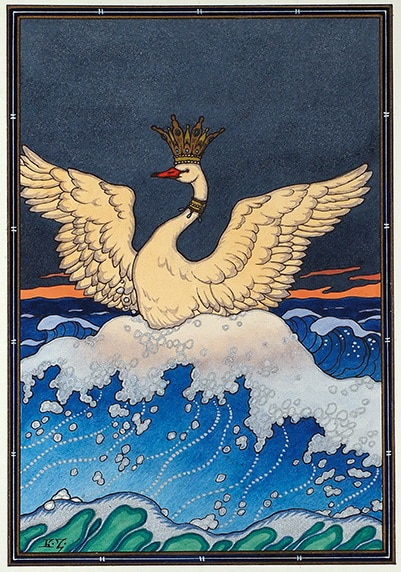
Swan Maidens: Key Points
- Swan maidens are supernatural women who transform into swans by wearing magical feather garments. They are typically described as exceptionally beautiful, graceful women who inhabit secluded natural places.
- In traditional folklore, a man steals a swan maiden’s feather robe while she bathes, preventing her from transforming and forcing her to become his wife. When she eventually recovers the garment, she often returns to her original form and flies away.
- Swan maiden legends appear throughout Europe and Asia, with related traditions found in Africa and the Americas. Similar supernatural brides include Japanese crane wives, celestial maidens, Norse valkyries, and Scottish selkies.
- Folklorists suggest that swan maiden stories may have originated from ancient animal worship, spiritual beliefs about nature, or traditions involving supernatural marriages.
- Swan maiden legends explore themes of love, freedom, captivity, identity, and the relationship between humanity and nature. Modern interpretations often view the stolen feather garment as a symbol of lost independence.
- Swan maidens have influenced literature, mythology, ballet, and modern fantasy, particularly through stories involving enchanted women and magical transformations.

Introduction
For generations, and throughout continents, storytellers have written about fascinating ladies who dwell between the human world and the natural world and who can transform themselves into graceful birds and disappear into the sky. One of the most persistent mystical creatures is the swan maiden, a beautiful woman who can turn into a swan by donning a magical feather dress. Her stories appear in European fairy tales, Asian mythology, and cognate traditions around the world. Swan maidens are typically shown as beautiful brides, but their tales are also filled with deception, imprisonment, forbidden knowledge, and the fight for liberation. Typically, a human man snatches a swan maiden’s feather robe, keeping her from returning to her normal form and forcing her to become his wife. Eventually she retrieves the garment back and has to decide whether to stay with her human family or return to the world she knew. These traditions have captivated folklorists because they layer the supernatural metamorphosis onto marriage, identity, human-animal connections, and the limits of society and nature (DeMello, 2024; Sax, 1998).
The swan maiden motif involves a woman, originally met in animal (often swan) form, who may be transformed into a human being. The tale typically includes ceremonial or forbidden questioning, marital suasion, and ultimate revelations or transformations. The overall typology and cross-cultural presence of the swan maiden motif are discussed in synthesizing work on folktale types and their metamorphosis imagery (Hatto, 1961; Kovalchuk, 2018). The motif is a frequent theme in the studies of comparative folklore. The structural technique of metamorphosis in fairy tales often includes swan imagery (Kovalchuk, 2018).
Appearance and Behavior
Swan maidens are often depicted as lovely young women whose look mirrors the elegance and grace of the birds they turn into. Generally they are tall and willowy with long, flowing hair, delicate features, and, in human form, an almost miraculous loveliness. They could be wearing elegant outfits, dazzling materials, or clothes made of white feathers. Some traditions link them to glowing skin and a beauty that is unearthly and sets them apart from other women. Usually they appear as a giant white swan, although in certain local tales they are cranes, geese, or other birds. The white swan is particularly suitable for these legends because its long neck, graceful motions, and brilliant plumage have long made it a symbol of beauty and purity in European art and literature. Unlike harpies and other creatures who have a mixture of human and bird anatomy, swan maidens normally have two forms. Without their feather clothes, they look entirely human, while with their feather clothes, they look entirely avian. The robe of magic is the tool of transformation, enabling the maiden to pass between worlds that everyday humans cannot (DeMello, 2024; Sax, 1998).
Swan maidens’ behavior is a mirror of their odd existence between humans and the supernatural. They often come in packs, sometimes three, six, or seven sisters, who descend from the sky to bathe in quiet lakes, rivers, or pools in the forest. They shed their feather clothes and for a time, became human ladies before entering the ocean. These bathing scenes are some of the most recognizable motifs in the swan maiden folklore. The women are generally depicted as playful and careless, not knowing that a hunter or traveler is observing them from a hidden spot. When anyone steals one of their feathered robes, they behave very differently. A swan maiden cannot return to her bird shape without the clothing and may implore the thief to grant her freedom. In some legends she is portrayed as sorrowful and resigned to her lot, while in others she gradually comes to love her human husband. And even in her phase as a devoted wife and mother, there is her link to the supernatural world. Once her feathers are restored, she almost always finds the urge or the capacity to return to that world irresistible (Jacobs, 1916; Miller, 1987).
Swan Maiden Folklore Across Cultures
One of the most famous European instances appears in Joseph Jacobs’s Europa’s Fairy Book (1916). A hunter meets seven lovely women who have come down to a lake in feathered robes in the story The Swan Maidens. The sisters remove their cloths and enter the water to bathe. The hunter is especially drawn to the youngest maiden and stealthily snatches her feather dress as she bathes. When the sisters are ready to go, six get their clothes and turn to swans, but the youngest cannot find hers. As dawn comes, her sisters desert her and fly away. Then the hunter comes out of hiding, holding the stolen robe. The maiden pleads with him to return it, but he refuses, knowing she will leave. Instead, he lends her his cloak and convinces her to marry him. The couple finally has two children, a son and a girl, and the maiden becomes a devoted mother. But her seeming domestic bliss is contingent upon the ongoing concealment of her magical garments (Jacobs, 1916).
The story is different when the concealed garment of the swan maiden is finally found. When she gets her feathers back, she can return to her true form and depart the human world. In many versions of this legend, a youngster stumbles upon the hidden robe and presents it to the mother without comprehension of its significance. The maiden recognized the robe at once and knew that she could now cease to be a prisoner. Her leaving brings a severe dilemma, for she may really love her children and perhaps her husband, but she also belongs to another existence. In other tales, she flies away forever, and the husband mourns the woman lost to him. Others have the husband going on an arduous supernatural trip to retrieve his wife or show himself worthy of reunion. These diverse endings hint that the traditional storytellers were concerned with more than just a mythical animal bride. The question was whether relationships formed on deception might continue once the supernatural partner was free to choose (DeMello, 2024; Miller, 1987).
There are many analogous stories in Scandinavian folklore, illustrating the cultural importance of swans and other waterbirds in northern Europe. Swedish variants collected from the nineteenth-century folklore tradition occasionally highlight the anguish of the maiden’s departure and the failure of her human spouse to reclaim her. In these myths, the swan maiden can be associated with distant lakes, woodlands, and locations believed to connect the everyday world to magical entities. The scenery is itself conducive to mystery. A silent lake bordered by dark forests is the perfect location for a chance meeting with women who come down from the sky and disappear before dawn. Swedish swan maiden tales relate to a broader, northern European tradition. Magical women are given powers that regular men strive to master by obtaining a supernatural thing. This stolen clothing is particularly important since it reflects the identity, mobility, and freedom of the maiden (Hofberg, 1880/1980; Sax, 1998).
There are also parallels between swan maidens and the valkyries of Norse mythology. (Valkyries are supernatural female beings associated with Odin who choose killed warriors and escort the chosen ones to the afterlife.) Some Old Norse heroic tales include women who are somewhat like the valkyries and who wear swan robes that allow them to fly, albeit their main function is not the same as that of the swan maiden. There is a poem in the Poetic Edda, called the Völundarkviða, where three magical women, in swan costumes, are wives of three brothers. The ladies live with the males for several years, then leave and go back to their magical doings. It’s as if they are playing out the basic conflict of the swan maiden myth, but without the usual pattern of the hunter seizing the feather robe and forcing marriage. This relationship shows that bird transformation, supernatural marriage, and the temporary union of human males with heavenly women were recurring patterns in folklore, rather than proven themes in northern European folklore (Larrington, 2014; Sax, 1998).
Other traditions exist in other parts of Europe. Romanian mythology tells about charmed birds, brides with supernatural powers, and transformations between human and animal form. An example of the larger tradition of birds with human features or exceptional relationships with people is Moses Gaster’s Rumanian Bird and Beast Stories. These stories are part of a larger set of European tales involving animal husbands, magical transformations, and transgressions of supernatural law. The selkie of Scottish and North Atlantic tradition is particularly close to the swan maiden. Selkies are seals that can take off their skins and become human. In several Selkie legends, a man snatches a female Selkie’s sealskin so that she cannot return to the ocean and must become his wife. When she recovers the skin at last, she returns to the sea, perhaps abandoning a husband and children. The likeness is uncanny. Both tales include an animal lady whose freedom hinges on the presence of her original covering, and both often end with the supernatural wife returning to the environment from which she came (DeMello, 2024; Gaster, 1915; Sax, 1998).
Asian legend also has equally notable examples of magical bird women and weddings between humans and celestial beings. Japanese folklore has a story called “The Crane Wife,” in which a man rescues a wounded crane. Then a gorgeous woman appears and she becomes his wife. She offers to spin cloth of immense value to sell for the sustenance of their home but asks that her husband never witness her work. In her room of weaving, she secretly turns into a crane and utilizes feathers from her own body to weave the wonderful cloth. Her husband finally breaks the taboo and finds out her true identity. But because he has seen what she wanted to hide, she leaves him and returns to her life as a bird. The crane wife differs from the usual swan maiden because her husband does not steal her feathers first, but in both myths magical ladies are married on the condition that their animal identities be kept secret. The Japanese story emphasizes trust, sacrifice, and the dangers of being curious (DeMello, 2024; Miller, 1987).
The Hagoromo mythology, another Japanese tradition, is closer to the familiar European swan maiden story. Here is an extract from a story: A fisherman finds a magnificent robe of feathers hanging on a pine tree by the beach. Her clothes were those of a Tenny, a celestial girl descended from the realm above. The fisherman’s taking of the garment prevents the girl from returning to heaven. She asks him to fix it but he says no at first. In the classical Noh play Hagoromo, the fisherman finally concedes to the maiden’s demand to return the garment after she vows to dance a heavenly dance. She retrieves her robe and dances and goes up to the sky. The story has the fundamental features of the swan maiden tradition: the supernatural woman, the feather clothing, the human man who steals it, and the woman’s ability to return to her original realm is restored. Unlike many European versions, the Noh theater stresses the beauty of the maiden’s celestial dance and the awe of her departure (Miller, 1987; Tyler, 1992).
Chinese legend also tells of celestial maidens who travel down to earth, bathe in lakes, and become entangled with mortal men. One particularly fitting instance is the story of the Cowherd and the Weaver; however, its most famous renditions describe celestial lovers separated by the Milky Way, not a bird woman whose feathers are taken. Other Chinese tales of celestial maidens and stolen garments are closer to the swan maiden pattern. In these myths, removing or hiding the supernatural woman’s clothing might prevent her from returning to heaven, and she might marry a mortal. Finally, the partnership is threatened by the re-establishment of her heavenly identity or by interference from supernatural authority. These parallels have been used by folklorists to look for probable historical links between stories from Europe and Asia. But the fact that related stories are found throughout wide geographical areas does not mean that all versions are derived from one source (Miller, 1987).
There are also parallels in South Asian mythology and folklore for the swan maiden ritual. In Hindu holy literature they are described as beautiful celestial women involved with heavenly courts, water, dance, and supernatural ties with human beings. The narrative of Urvashi and King Pururavas is particularly significant since it is the story of a celestial woman who becomes involved with a human under certain conditions. If those conditions are violated, she leaves him. Urvashi is not normally shown as a swan maiden in the famous European sense, but the story does contain the themes of the supernatural marriage, the violated rules, and the challenge of establishing a stable partnership between a mortal and a heavenly entity. Thus, Indian traditions have caught the attention of scholars considering the likely development and diffusion of supernatural bride legends. Some have suggested that parts of the swan maiden narrative came westward from Asia; others that similar motifs may have arisen independently or moved via a number of other cultural paths (Miller, 1987; Sax, 1998).
Related animal-bride traditions have been reported in Africa and the Americas as well, though their magical women do not necessarily become swans. In places where there are no swans, or where they are less important traditionally, other animals may play similar roles. In folktales, bird women, animal partners, magical skins, and transformations are found in many societies. Typically the particular animal signifies the local environment and the critters the storytellers are most familiar with. That versatility also accounts for why comparable tales may depict swans in northern Europe, cranes in East Asia, and other birds elsewhere. However, academics need to distinguish between a genuine swan maiden story and a more general story about a supernatural animal wife. The key characteristic of the swan maiden legend is frequently the loss and recovery of a garment or covering that enables the woman to return to her former shape (DeMello, 2024; Miller, 1987).

Folklore Classification and Interpretations
Within the international system of folktale types, folklorists classify the swan maiden story as type ATU 400, “The Man on a Quest for His Lost Wife.” This narrative pattern describes a man who marries a supernatural woman but then loses her and must undertake an extraordinary quest to retrieve her back. The stolen feather garment is a common feature in many stories. The classification covers different types of supernatural wives. The method was created by Antti Aarne, Stith Thompson, and Hans-Jörg Uther, who compared folktales from different locations and classified them by repeating story structures. This classification enables investigators to compare stories that vary in characters, place, and cultural aspects but have similar narratives. It also indicates that the swan maiden tale is part of a much bigger corpus of folklore about marriages between human beings and otherworldly companions (Uther, 2004).
The literature explicitly connects the swan figure to broader symbolisms of beauty, purity, and danger, as well as the ethical-political dimensions of gendered beauty in fairy tale discourse (e.g., “beauty” as a culturally loaded category and its representation in mythic form) (Leavy, 1994; Sax, 1998). The motif frequently has a dual gendered dynamic: the swan bride and the human husband, with interpretive readings ranging from agency and liberty to coercion and modification of social roles.
One explanation of the swan maiden tradition is that it derived from ancient views about relationships between animals and humans. Boria Sax (1998) claims in The Serpent and the Swan: The Animal Bride in Folklore and Literature that animal-bride stories contain vestiges of prior interactions between human communities and the natural world. He links these traditions to totemism, animal symbolism, and religious beliefs in which animals hold spiritual significance or have a mysterious relationship with humans. In this case, the supernatural bride represents the connection between man and nature that has been slowly fading in human society. Her marriage to a mortal fixes the relationship temporarily, but her final leaving demonstrates its fragility. The husband tries to gain dominion over the natural world by snatching the garment, but the animal bride cannot give up her identity forever. Her retreat to the woods is a symbolic refusal of man’s dominance over nature.
Sax (1998) also suggests similarities between animal-bride rituals and ancient Mediterranean serpent beliefs. In some old myths the magical bride is a snake or has a concealed snake-like nature. Similar myths arose in northern European cultures when birds such as swans became major supernatural manifestations. One explanation of this is that other animals may occupy the same symbolic role as the stories passed from one civilization to another. The serpent might symbolize fertility, mystery, or secret supernatural knowledge, while the swan could symbolize beauty, change, and the mystical journey between earth and sky. It is, however, an interpretation of reoccurring patterns in folklore, rather than a proved historical chronology. There is not enough evidence of transfer from specific traditions to prove that swan maiden tales are direct descendants of old snake religions.
Another reading is concerned with marriage, gender, and the domination of women. Many swan maiden myths begin with a man who spies on women bathing and then steals a thing vital for one woman’s liberation. The girl cannot go back home and is forced into marriage since the man controls her escape. From a contemporary perspective, the arrangement presents clear problems concerning consent and compulsion. The partnership starts with a lie even in the sympathetic portrayal of the husband. The maiden’s retrieval of her feathers, then, can be read as an act of resistance to captivity. By choosing to fly away, she attains the independence that was robbed from her. In other versions, the virgin’s genuine love for her husband and children complicates this reading, creating a struggle between her commitments to her family and her desire for liberty. These paradoxes provide the stories relevant for assessing historical expectations of marriage, obedience, motherhood, and female autonomy (Miller, 1987; Sax, 1998).
The prominence of the supernatural bride can also be explained by religious perspectives. Alan L. Miller (1987) has analyzed the theological implications of divine-wife folktales, especially in Japanese cultures, and has claimed that such narratives might depict the problematic interaction between human beings and supernatural powers. The unearthly woman offers beauty, affluence, or amazing powers to the human home, but her presence comes with a condition. Human curiosity, possessiveness, or a broken restriction breaks down the supernatural bond. The bride’s loss can consequently be a sign of the repercussions of trying to control what is sacred, which cannot be controlled by normal human authority. In the Japanese tales, the feather robe can symbolize the heavenly maiden’s divinity, and its return reestablishes the distance between the mortal and celestial realms. This view explains the repetition of similar stories in both religious traditions and secular fairy tales.
Psychological readings focus on metamorphosis, desire, and the struggle between personal identity and social expectation. The swan maiden has two forms, corresponding to two separate existences. Her human form allows marriage, motherhood, and participation in society, while her bird form represents freedom, movement, and an identity that existed before her union with her mortal husband. The stolen garb could signify the suppression of one’s natural self, and its retrieval, the recovery of independence. The husband’s fear of the maiden leaving him implies the anxiety of abandonment and lack of control over another’s wants. The reoccurring motif of the hidden clothing is also analogous to broader fairy-tale patterns in which secret knowledge or prohibited objects dictate the fate of a relationship. However, these psychological readings are modern interpretations of traditional narratives and should not be immediately accepted as the objectives of the original storytellers (Miller, 1987; Sax, 1998).
A more historical approach looks at how stories move through trade, marriage, migration, and cultural contact. Folktales accompanied merchants, soldiers, religious communities, and families and adapted to new linguistic and cultural surroundings. The story of a bird woman with supernatural powers might be altered to use the species most familiar to local audiences. Still, other storytellers could have woven in pieces of older animal-bride tales with local beliefs in spirits, celestial creatures, and enchanted lakes. The vast dispersion of swan maiden legends is compatible with such procedures, but it does not support a single site of origin. Such stories may also develop independently. Human civilizations face similar experiences again and again, such as marrying outside of one’s society, the death of loved ones, and the enigmatic seasonal patterns of migratory birds. Folklorists therefore consider historical transmission and likelihood of autonomous development when comparing various traditions (Miller, 1987; Uther, 2004).
Their natural behavior might have led to swans’ reputation for being otherworldly. Swans are large visually striking birds that generally couple for life and have elaborate courtship displays. Their glides over water are so beautiful they can seem almost ceremonial, and their ability to take to the air creates a stark contrast between apparent tranquility and rapid departure. Migratory swans, also, vanish from familiar scenes and reappear with the turning of the seasons, a pattern that could spawn legends of passage through visible and unseen realms. Their white feathers may have reinforced connections with purity, beauty, and supernatural femininity. Such features help explain why swans were revered as symbols in European folklore but cannot explain the precise elements of the stolen-feather myth. The legends were presumably born by human observations of animal behavior within the framework of pre-existing religious beliefs and narrative traditions (Sax, 1998).
Cultural Influence and Paranormal Connections
Swan maidens have inspired literature, music, dance, and visual art, particularly in light of the wider link of swans with magical women. A prominent example is the ballet Swan Lake by the composer Pyotr Ilyich Tchaikovsky, originally performed in Moscow in 1877. The evil sorcerer has put a curse on the main character, Princess Odette, and she has to live as a swan. She can take human shape again, but only for a short time, and her fate is bound up in love and the lifting of the curse. The ballet does not retell the original stolen-feather myth but is inspired by related European themes like swan women, miraculous transformation, and the terrible separation of lovers. The picture of a lovely woman, existing between the human and bird forms, became one of the most recognizable images in classical dance. Swan Lake established the swan woman as a lasting emblem of beauty, vulnerability, and mystery in modern popular culture (Tchaikovsky, 1877; Sax, 1998).
Beyond ballet, the swan maiden legend has a far wider effect, appearing in fantasy literature, modern retellings of fairy tales, and contemporary studies of mythology. Writers are still adapting stories about women who turn into birds, highlighting different parts of the ancient tales. Some versions retain the romance between a human man and a magical bride, while others emphasize the maiden’s capture and escape. Fantasy fiction also explores identity and belonging through magic feather clothing, charmed skins, and bird transformations. The connection between swan maidens and selkies is particularly noteworthy since both traditions pose problems about the possibility of love when one spouse limits the freedom of the other. Modern renditions often give the magical woman more independence and let her perspective dictate the plot. These themes are still prevalent and the emotional tensions behind the ancient tales are still recognizable even when the supernatural settings are different.
Swan maiden stories also help in the study of comparative mythology since they show how similar supernatural notions can arise in different societies without being the same. Europeans may focus on hunting, stolen garments, marriage, and eventual escape. Japanese customs tend to emphasize more the beauty of the celestial, artistic performance, sacrifice, or breaking of a prohibition. Other Asian myths link magical women to heavenly places and the gap between mankind and divine entities. Common features are the crossing of barriers between worlds, the temporary union of human and supernatural spouses, and the challenge of maintaining that connection, despite these differences. Such parallels provide useful material for probing cultural trade, religious symbolism, and the manner in which storytellers modify inherited myths to local contexts. They also show why the swan maiden cannot be reduced to a single fixed creature with the same qualities in each tradition (Miller, 1987; Uther, 2004).
Swan maidens occupy an intriguing position between shapeshifting creatures, nature spirits, and supernatural beings associated with particular places from a paranormal perspective. Their transformations are like those of werewolves, selkies, and other beings who can change between human and animal form. But the swan maidens are usually not represented as frightening predators. Their supernatural talents are often flight, beauty, transformation, and access to a world beyond normal human experience. They could be understood as fairylike beings, visitors from the heavens, or women whose animal identities connect them to secret spiritual energies. While modern cryptids are generally portrayed as biological entities that remain unnamed, swan maidens are more closely connected to traditional stories and religious symbolism. There is no scientific evidence that people can become swans or that magic feather clothing has supernatural powers. They are important because of the ideas, myths, and cultural meanings that have been associated with them for generations (DeMello, 2024; Sax, 1998).
Conclusion
The swan maiden remains one of the most intriguing supernatural heroines of mythology, her stories combining otherworldly beauty with all-too-human trials. She can come down from the skies, become a beautiful bird, and enter the home of a common man, but she cannot easily give up the identity that makes her magical. In European and Asian cultures, the stolen feather gown symbolizes the delicate balance between possession and freedom, while the maiden’s eventual flight prompts inquiries into love, devotion, and the right to shape one’s own destiny. These stories have been analyzed by scholars in terms of religion, psychology, gender relations, ancient animal symbolism, and the historical movements of folklore between cultures. Their legacy lives on in literature, ballet, and contemporary fantasy. The most persistent element of the Swan Maiden is the picture of a woman who seems to be of the human world but whose true home is elsewhere, beyond it. The narrative informs its viewers that even the most beautiful supernatural visitor cannot always be convinced to stay when she finally gets her feathers back and flies up to the sky.
References
DeMello, M. (2024). Bigfoot to Mothman: A global encyclopedia of legendary beasts and monsters. Bloomsbury Academic. https://www.perlego.com/book/4279696
Gaster, M. (1915). Rumanian bird and beast stories. Sidgwick & Jackson.
Hatto, A. T. (1961). The swan maiden: A folk-tale of North Eurasian origin? Bulletin of the School of Oriental and African Studies, 24(2), 326–352.
Hofberg, H. (1980). Swedish fairy tales (W. H. Myers, Trans.). Belford-Clarke Company. (Original work published 1880)
Jacobs, J. (1916). Europa’s fairy book. G. P. Putnam’s Sons.
Kovalchuk, L. (2018). Conceptual integration of swan maiden image in Russian and English fairytales. In I. V. Denisova (Ed.), Word, utterance, text: Cognitive, pragmatic and cultural aspects (European Proceedings of Social and Behavioural Sciences, Vol. 39, pp. 68–74). Future Academy. https://doi.org/10.15405/epsbs.2018.04.02.10
Larrington, C. (Trans.). (2014). The poetic Edda (Rev. ed.). Oxford University Press.
Leavy, B. F. (1994). In search of the swan maiden: A narrative on folklore and gender. New York University Press. https://www.jstor.org/stable/j.ctt9qg995
Miller, A. L. (1987). The swan-maiden revisited: Religious significance of “divine-wife” folktales with special reference to Japan. Asian Folklore Studies, 46(1), 55–86. https://doi.org/10.2307/1177885
Sax, B. (1998). The serpent and the swan: The animal bride in folklore and literature. University of Tennessee Press.
Tchaikovsky, P. I. (1877). Swan Lake [Ballet]. Bolshoi Theatre.
Tyler, R. (Ed. & Trans.). (1992). Japanese Nō dramas. Penguin Books.
Uther, H.-J. (2004). The types of international folktales: A classification and bibliography (Parts 1–3). Suomalainen Tiedeakatemia

Leave a Reply