Milk Hares: Key Points
- Milk hares were supernatural creatures in Scandinavian folklore believed to steal milk from neighboring cows and return it to witches. They appeared as ordinary hares or magically created animals made from household materials.
- Milk hares supposedly entered barns, drank cows’ milk, and returned home to regurgitate it into containers. Their activities explained mysterious declines in milk production and suspicious prosperity among neighbors.
- European folklore frequently described witches transforming into hares to steal, deceive, or escape detection. When hunters injured these animals, women sometimes appeared with matching wounds, supposedly revealing their supernatural identities.
- Milk hare legends shared themes with other paranormal rabbit traditions, including the Easter Hare, Moon Rabbit, and supernatural trickster stories. Rabbits and hares were associated with fertility, mystery, cunning, and magical transformation.
- Theories explaining milk hare beliefs include agricultural uncertainty, fear of witchcraft, suspicion toward independent women, and the hare’s elusive natural behavior. These stories offered supernatural explanations for ordinary misfortunes and reinforced existing social prejudices.
- Milk hare folklore influenced Scandinavian storytelling, religious imagery, and European witchcraft beliefs. Although no scientific evidence supports their existence, the legends reveal how supernatural fears could shape community relationships and contribute to accusations and persecution.

Introduction
For centuries, in European mythology, hares have occupied a precarious space between the natural and the supernatural. They were mysterious creatures on account of their incredible speed, their nocturnal habits, and their ability to flee into the countryside, and they had a particularly disturbing reputation on account of their links with fertility, witchcraft, and transformation. One of the stranger examples is the milk hare, a supernatural creature that steals milk from adjacent farms and delivers it to a witch. Such creatures were a common theme in stories throughout Scandinavia, with many parallels to British and Irish beliefs of witches who turned themselves into hares. The milk hare may at first appear a humorous manifestation of rural superstition, but its history points to serious issues of agricultural survival, female independence, magical theft, and the supposed ability of witches to transgress the barriers between human and animal. The folklore also shows how regular animals could be suspected in places where bad luck without an explanation was often blamed on supernatural powers (DeMello, 2024; Kvideland & Sehmsdorf, 1988).
The idea of witches transforming into hares to steal milk or butter from cows is well-attested in folklore and in the trial record tradition in Ireland and Britain. Irish tradition holds that witches become hares and take milk from cows. The witch is found by wounds or other magic when hunters or farmers come after the animal. Scholarly treatments emphasize how these legends frame the witch as a domestic and economic threat rather than purely a demonic force; the animal form (hare) is central to the narrative, with the milk theft linked to the dairy economy rather than to ritual murder or maleficium alone (Nuttall, 1998; Sneddon & Fulton, 2018; Henderson, 2008; Parish, 2019).
The Milk Hare in Scandinavian Folklore
The milk hare, frequently identified with the Scandinavian troll cat, was usually thought of as a harelike being with supernatural powers. It appeared in a somewhat variable way, depending on the region and the particular story. In other versions, the creature was a normal hare, with long ears, strong hind legs, a short tail, and a body covered in brown or gray hair. This natural aspect was important to its success, for it allowed the animal to pass through fields and farmyards without instantly arousing suspicion. Milk hares were also said, in other traditions, to be artificial creatures, made by witches out of such domestic things as rags, sticks, knitting needles, and other objects. These animals were created through magic and sent out to steal milk for their makers. The milk hare was an abnormal, magically formed creature, and it might not have a biological body. It had supernatural life and a specific purpose from a witch (DeMello, 2024; Lindow, 1978).
The most remarkable conduct of the milk hare was to steal milk from the cows of other families. According to Scandinavian legend, the creature entered the nearby farm, walked up to a cow, and drank its milk directly from the udder. Then it flew home to its owner, where it vomited the stolen milk into a bowl, bucket, or kettle. There were tales of milk hares that haunted the same fields over and again, leaving cows curiously dry, while they looked healthy enough. The robbery was to the witch’s advantage by furnishing her with lucrative dairy products, which she would otherwise have had to raise enough cows to produce herself. And this supernatural arrangement turned milk production into a sort of mystical rivalry between households. For instance, if a farmer’s milk supply inexplicably diminished, he would assume a witch from the neighborhood has sent a milk hare to collect the missing milk (Kvideland & Sehmsdorf, 1988).
The significance of this conduct becomes evident when we consider the economic situation of rural northern Europe. Milk was an important household resource that could be consumed directly or converted into butter, cheese, and other preserved delicacies. Dairy production helped to ensure household nutrition and economic security, especially in communities where agriculture relied on a small number of domestically raised animals. A cow that suddenly gave demonic-looking milk was a real concern. In the past, when sophisticated veterinary treatment was rare and the scientific reasons for changes in milk production were not understood, people believed that supernatural forces stealing the milk explained this baffling phenomenon. The milk hare fable thus linked common agricultural troubles with anxieties about evil neighbors and secret magical activities (Kvideland & Sehmsdorf, 1988).
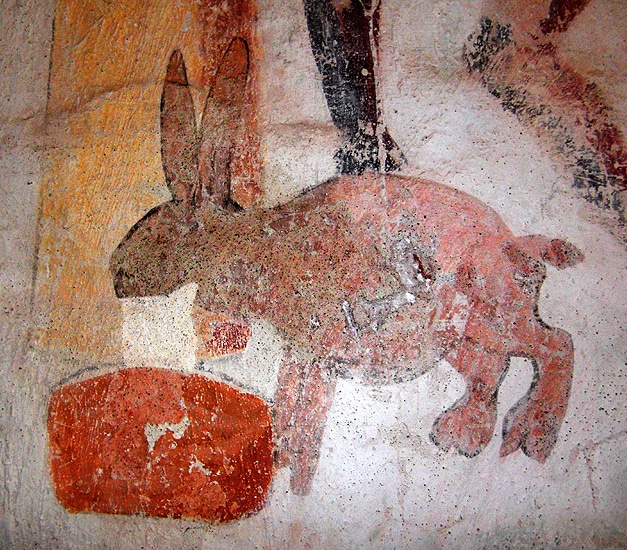
The tradition may be traced back at least as far as the fifteenth century. A remarkable illustration is a medieval mural in Uppsala, Sweden, that shows a magical milk-stealing creature returning its ill-gotten supplies. The picture shows how thoroughly the idea had permeated the Scandinavian religious and public consciousness. These depictions also show that milk theft by witchcraft was familiar enough to audiences for artists to convey it visually. The milk hare was a striking illustration of illicit supernatural activity in a society where religious instruction commonly employed imagery to communicate moral messages. Its connection to witches situated the creature within a broader Christian perspective on magic as a perilous transgression of legitimate religious and social behavior (DeMello, 2024).
Descriptions of milk hares and their making are particularly rich in Swedish folklore. In a book translated by John Lindow, in the story “Milking Others’ Cows,” there is a story about a woman called Magnus Tilda’s mother who was said to have had two milk hares, one big and one small. The neighbors believed that she had created the creatures using knitting needles, wood, and rags. Each animal would visit a nearby farm, steal some milk, and return to deposit it in a kettle kept in her barn. It was said that the kettle was always full in the morning and that the woman could obtain plenty of milk without generating it through the usual agricultural effort. The tale highlighted the link between supernatural thievery and charges of ill-gotten wealth. Someone who seemed to have more food or wealth than was appropriate to her status became a focus of suspicion (Lindow, 1978).
The milk hare was also one of a larger family of Scandinavian mythological creatures associated with witches and stolen dairy. Swedish folklore claimed witches could produce or control creatures known as bjära or vomit and send them to steal milk or other supplies. In adjacent Nordic traditions came related beings, sometimes more like cats, balls of yarn, or other odd things than hares. This supernatural economy of the family was notably connected with the troll cat. These beings had the power to transfer precious resources from one home to another, using magic. The different appearances are indicative of the milk hare being a regional variant of the widespread belief in witchcraft as a means of acquiring wealth at the expense of others (Kvideland & Sehmsdorf, 1988).
The link between milk hares and witches who physically changed into animals is quite essential. In some traditions the milk hare was an artificial slave of the witch. In others the hare was the witch herself, who took the guise of an animal for a time to work mischief. The two ideas may have overlapped, but they are not the same. The magically created being may have its volition but is under the direction of its creator. The witch who converted herself had firsthand knowledge of the risks of traveling in an animal body. Both hypotheses implied that the supernatural could pass the border between human beings and animals. This idea was especially alarming, given the ordinary appearance of the hare, as a seemingly innocuous species found in a field might in fact conceal a harmful human intelligence (DeMello, 2024).

Witchcraft and Shapeshifting Across Europe
Early modern English demonology and witchcraft books expand on the animal familiar and the use of shapeshifting as fundamental aspects of witches’ power. The familiar (often an animal, such as a hare or a cat) was a chasm of a deal with the Devil, which allowed the witch to fly and to do harm at a distance. In these accounts, the milk/butter theft motif was often found alongside “bewitched butter” or “blood in milk” narratives, which resulted from the witch’s transformations or the assistance of the Devil, highlighting a common European repertoire of magical economy concerning dairy products and shapeshifting into hares (Armstrong-Jones, 1929; Kirsch, 1978; Parish, 2019).
In Irish folklore there are several stories that exemplify this connection. In “The Old Woman as Hare,” a neighbor farmer finds that his cows no longer give milk, and this is replicated by the other farmers who live near the old woman who lives in a hut by herself. Eventually, a neighbor sees a hare coming out of the woman’s home, and he suspects her. He shoots the animal, hitting it in the shoulder. The next morning he goes to the cottage with a similar shoulder injury covered in bloody cloth and finds the elderly woman. The implication is inescapable. The hare and woman were the same creature, and the wound that was inflicted in the shape of an animal stayed even after the change was complete. This motif reappears in European witchcraft traditions and serves as a useful storytelling device for revealing an otherwise hidden witch (DeMello, 2024).
Another Irish classic, “The Coming of Oscar,” also features a similar metamorphosis motif but flips the more recognized relationship between female witches and cows. Here a hare is hunted and loses its tail in the chase. The beast is transformed into a man whose wounded back reveals his magical identity. This narrative is noteworthy in that the knitting needles, wood, and ale show that her transformation was not a strictly female domain. But the most similar stories from Europe talked of female witches who turned into hares. The emphasismorning andarm also shows that the human body was not entirely separated from its animal look by transformation. Damaging one type could reveal the identification of the other (DeMello, 2024).
Equally distressing examples are to be found in German folklore. In such myths as “Witch as Hare” and “Girl Who Transformed Herself into a Hare,” hunters come across hares that seem to resist regular gunshot. Their failure to kill the creatures leads them to assume otherworldly meddling. At last one hunter succeeds in loading his gun with sacred powder and, with this weapon, overcomes the supernatural defense of the hare. But instead of a dead animal, he finds a lady, mortally wounded. The myth draws upon a number of long-standing European superstitions: that witches could change themselves into animals, that magical creatures could not be injured by ordinary weapons, and that religiously charged artifacts might defeat supernatural beings. The hunter becomes an unintentional investigator of witchcraft, claiming that the animal’s seeming invulnerability is proof that something unusual is afoot (DeMello, 2024).
‘The Shot Hare’ is a similar tale from Welsh mythology where a witch constantly turns herself into a hare and outwits a poacher trying to shoot her. Unable to account for his repeated failures, the man seeks a doctor, who prescribes him mountain ash, vervain, and a written charm. These artifacts are said to undermine the creature’s mystical protection. At their next meeting, the poacher shoots the hare’s legs off. He finds an injured woman in a house nearby, validating his suspicions that the animal was in fact a witch. The myth is especially intriguing in that it mixes Christian style defensive magic with earlier folk practices in plants considered to have supernatural characteristics. In northern European mythology, mountain ash or rowan was popularly believed to ward off evil magic (DeMello, 2024; Kvideland & Sehmsdorf, 1988).
Similar stories were perpetuated in English traditions. In “A Witch-Hare at Sedgefield,” a hare escapes from a hunting group into a house through a small aperture. But before it can escape, the animal is caught by a dog and injured in the leg. When the hunters burst into the house, they discover an old woman with a broken leg instead of the animal they were expecting. The parallels of the physical condition of the injured hare and the woman are put out as the story’s evidence of witchcraft. In similar stories it is shown repeatedly that the hunters are witnesses to the revelation of hidden magical identities. Their stories also point to the conflict between typical rural activities such as hunting and the possibility that a normal interaction with wildlife could involve deadly magical energies (DeMello, 2024).
The concept that witches may occasionally turn themselves into hares had ramifications beyond the realm of story-telling. In the European witch trials, claims of turning into an animal could help lead to suspicion of certain people. DeMello (2024) analyzes the English case of Julian Coxe, who was killed in 1663 on witchcraft charges involving allegations of metamorphosis into a hare, and shows how witness accounts contributed to this outcome. Occurrences of metamorphosis could be used as firsthand evidence of a system that was already vulnerable to claims of mystical evil. But milk-hare mythology and historical witch prosecutions are not to be taken as the same kind of thing. One was Scandinavian tales of animals that stole milk by sorcery; another was English court cases involving supposed animal metamorphosis, part of a broader history of witchcraft allegations. They had similarities suggesting common beliefs, yet they were in different legal and cultural contexts.
Hares in Other Supernatural Traditions
The connection between witches and hares was also linked to wider European folklore about rabbits. Hares were often associated with fertility because of their breeding habits, and their seasonal activity made them significant symbols of spring and rebirth. They were considered very elusive animals, owing to their speed, vigilance, and capacity to evade hunters. At the same time, hares were sometimes depicted in European tradition as sly, sexually profligate, or connected to mystical forces. These features made the animal a good metaphor for stories about witches, who were often accused of breaking religious rules and societal bounds. In one context the hare could symbolize natural abundance; in another, hazardous magical trickery (DeMello, 2024).
The hare (and other animals) as a desirable type of magic occurs periodically in European witchcraft legends as a liminal figure able to cross human-animal barriers and therefore to destabilize moral and social order. The motif of witches becoming hares to steal milk is well-attested in Irish folklore, Scottish and Gaelic contexts, and English demonology, with regional variants but a coherent structural logic (Nuttall, 1998; Sneddon & Fulton, 2018; Armstrong-Jones, 1929; Parish, 2019).
One of the more intriguing analogies is the Easter Hare, which evolved into the present Easter Bunny. The Easter hare originated with German-speaking European settlers who had a tradition of bringing or hiding eggs for children. The devil creature became linked with springtime festivals, fertility, and rebirth, eventually becoming a fixture in American popular culture. There is no historical proof that the Easter Bunny descended straight from the milk hare. Both legends, however, show how European communities believed the hare to possess remarkable powers. The Easter Hare was a pleasant supernatural visitor who brought gifts, whereas the milk hare was a frightening visitor who stole. The diverse roles show the versatility of the rabbit symbolism in many cultural contexts (DeMello, 2024; Kvideland & Sehmsdorf, 1988).
Other supernatural rabbit traditions stretch well beyond Europe. The Moon Rabbit is a mythical creature, a hare said to live on the moon, and is frequently represented as using a mortar and pestle to pound ingredients. In Chinese tradition the rabbit is often associated with the creation of an elixir of immortality. In Japanese interpretations, the Moon Rabbit is often associated with the activity of preparing rice cakes. These myths are much different from European legends of the milk hare, but they do share the idea that rabbits possess special powers and engage in actions beyond the capability of regular animals. The Moon Rabbit is usually a revered or benign creature, and the milk hare is linked to witchcraft and stealing crops. Their study shows how animals that were very similar might acquire extremely diverse supernatural meanings according to local religious and cultural traditions (Eberhard, 1986).
The milk hare also recalls the trickster rabbit traditions in African and African American folklore. The stories of Br’er Rabbit were influenced by African American oral traditions and were popularized in collections released. Br’er Rabbit frequently relies on his cunning, deception, and manipulation of more powerful adversaries to survive. Br’er Rabbit isn’t often thought of as a witch or magical thief of dairy products, like the milk hare. But both make use of their diminutive stature and presumably innocuous appearance to attain goals beyond the reach of larger or more powerful beings. The resemblance is thematic, not evidence of a common origin. It shows the continuing utility of rabbits as characters who can upset ordinary preconceptions about power, wisdom, and vulnerability (Harris, 1881).
Explanations and Cultural Impact
There are several possible reasons for the great popular folk lore of hare folklore in northern Europe. One explanation is the economic significance of dairy production. Farmers are trained to know why a cow produces less milk than expected. Illness or malnutrition, stress, seasonal change, and other natural circumstances could all cause diminished milk production, and not all such weapons were readily understood. It was an explanation for which there was some logic. It explained what was wrong and who might have done it. This is the idea of witches who stole milk. A nearby woman with an exceptionally large amount of milk would start to suspect, especially if she was already unpopular or socially awkward. Thus, the milk hare was a supernatural explanation of economic misery and perceived inequity (Kvideland & Sehmsdorf, 1988).
A second theory focuses on gender and the historical link of women with animals and domestic production. In many rural villages in Europe women were significant in milking cows, processing dairy products, and caring for smaller household animals such as rabbits. Their experience with these acts may have played a role in the association of women with the stealing of magical milk. At the same time, European witchcraft charges were often aimed at women in weak social positions, such as elderly widows, destitute women, and those who lived alone. The milk hare stories are about older women who live alone and are said to put their neighbors in danger with their magical activities. Such depictions may reflect social fears about women who resided outside typical family patterns or who appeared to possess wealth they had not gained via approved means (DeMello, 2024).
A third reason is the normal behavior of the hare. European hares are swift, wary animals that are most active at dawn, twilight, and at night. They may hide in the plants and zip away when startled, making it seem as though they can appear and disappear into thin air. They possess elongated ears and a distinctive mode of locomotion that is enjoyable to observe. So an animal that appeared unexpectedly near a farm or field could seem strange to someone who was already worried about witchcraft. It was difficult to shoot or catch hares, and their elusiveness supported stories of magical protection. Missing a shot could be considered proof of supernatural invincibility rather than just a garden-variety hunting failure. The animal’s true traits contributed to the plausibility of incredible stories about it.
Another perspective is psychological and social explanations. Folklore frequently provides a concrete form to fears that are otherwise difficult to locate or control. The milk hare turned an invisible problem, the mysterious loss of milk, into a visible enemy that could be reportedly tracked, wounded, or slain. It also promoted the understanding of coincidences as meaningful links among societies. A hunter who wounded a hare and then found a woman with a wound could connect the two occurrences through a belief in transformation. Such logic could fuel suspicions even in the absence of solid proof. Once a community had accepted the notion of witch-hares, it could interpret ordinary observations as confirming their presence.
What is especially illuminating is the constant motif of physical wounds in Sedgefield’s “transformations.” A witch that turns into a hare frequently eludes normal detection until someone strikes the creature. Then the matching harm on the human body reveals the lie. This narrative approach answers the main challenge of leg instead of transformation: how can a human establish that an animal is actually human? In doing so, storytellers developed a readily identifiable means of identification, as injuries traveled across forms. The motif also provided a moral finale, in which the witch’s transgression was discovered and punished. Unfortunately, such stories could cause people to think that physical injuries or strange events were proof of witchcraft, putting those already suspected in danger (DeMello, 2024).
Thus, the cultural impact of the milk hare was more important than its strange appearance might imply. These stories helped communities make sense of agricultural losses, reinforced existing ideas about witchcraft, and provided memorable cautions about theft and deception. They also mirrored conflicts between neighbors, particularly when one household seemed more fortunate than another. In cultures where reputation was important, an allegation of supernatural milk theft might destroy social bonds and deepen enmity toward an individual. The larger legacy of animal metamorphosis created a cultural climate in which accusations of witchcraft may be deadly. Even when the stories were recounted mainly to entertain, they kept alive notions about gender, morality, and divine power that had once guided daily life.
The legend also had an impact on Scandinavian storytelling and visual culture. A recognizable supernatural being in medieval reprEuropeanons, ortrials,es and subsequent folklore collections, was the milk hare. Its odd blend of people, transformation, magical fabrication, and agricultural plunder distinguishes it from more typical European monsters. The image of a hare vomiting stolen milk into a witch’s kettle may seem weird or funny to modern readers, but the creature’s original meaning was grounded in practical concerns around food, animals, and household survival. These tales have been preserved in folklore collections, such as Scandinavian Folk Belief and Legend, which have allowed historians and sorceryists to study how rural societies saw disaster and supernatural meddling (Kvideland & Sehmsdorf, 1988).
In modern conceptions of the paranormal, milk hares are frequently considered shapeshifters, witch familiars, or magically animated creatures. In this respect, the stories are comparable to other legends in which supernatural beings take on animal shapes to pass unnoticed among humans. The milk hare can also be compared to legends of witches’ familiars, which were thought to assist their owners by completing chores or injuring adversaries. But there is no convincing scientific evidence that witches could turn into hares, create living animals through magic, or employ supernatural creatures to steal milk. The evidence supports the beliefs and stories, not the creatures’ physical existence. Their significance is in what they tell us about people’s past experiences, their concerns, and their explanations of situations that they could not otherwise illustrate.
Conclusion
The milk hare remains one of the more weird supernatural creatures of Europe, for its fearsome reputation grew from a mundane agricultural problem. A shortage of milk might be proof of witchcraft, a hare in a field could be a witch, and a hurt lady might be accused of being an animal in disguise. These ideas tied Scandinavian customs into a wider European mythology of witches, rabbits, transformations, and other supernatural trickery. Comparisons with the Easter hare, moon rabbit, and trickster rabbit also indicate how frequently human societies have conceived of the wonderful talents of these common creatures. Modern explanations of milk loss and animal behavior do little to justify the acceptance of the milk hare as a literal species, but the mythology nonetheless has historical value. It shows how legend could explain economic suffering, voice fear of outsiders, and sometimes lead to actual persecution. It was not some weird rabbit who stole milk; it was the milk hare. It was the concern that the unseen supernatural power of a neighbor could endanger the security of the whole household.
References
Armstrong-Jones, R. (1929). Superstition. Journal of the Royal Society of Medicine, 23(2), 135–141. https://doi.org/10.1177/003591572902300236
DeMello, M. (2024). Bigfoot to Mothman: A global encyclopedia of legendary beasts and monsters. Bloomsbury Academic. https://www.perlego.com/book/4279696
Eberhard, W. (1986). A dictionary of Chinese symbols: Hidden symbols in Chinese life and thought (G. L. Campbell, Trans.). Routledge & Kegan Paul.
Harris, J. C. (1881). Uncle Remus: His songs and his sayings: The folk-lore of the old plantation. D. Appleton and Company.
Henderson, L. (2008). Witch-hunting and witch belief in the Gàidhealtachd. 95–118. https://doi.org/10.1057/9780230591400_5
Kirsch, I. (1978). Demonology and the rise of science: An example of the misperception of historical data. Journal of the History of the Behavioral Sciences, 14(2), 149–157. https://doi.org/10.1002/1520-6696(197804)14:2<149::aid-jhbs2300140208>3.0.co;2-d
Kvideland, R., & Sehmsdorf, H. K. (Eds.). (1988). Scandinavian folk belief and legend. University of Minnesota Press.
Lindow, J. (1978). Swedish legends and folktales. University of California Press.
Nuttall, D. (1998). Witch and priest juxtaposed: Two figures from Irish traditional. Folklore: Electronic Journal of Folklore, 9, 34–40. https://doi.org/10.7592/fejf1998.09.witch
Parish, H. L. (2019). “Paltrie Vermin, Cats, Mise, Toads, and Weasils”: Witches, familiars, and human-animal interactions in the English witch trials. Religions, 10(2), 134. https://doi.org/10.3390/rel10020134
Sneddon, A., & Fulton, J. F. (2018). Witchcraft, the press, and crime in Ireland, 1822–1922. The Historical Journal, 62(3), 741–764. https://doi.org/10.1017/s0018246x18000365

Leave a Reply