The Magdeburg Unicorn: Key Points
- In 1663, mysterious fossil bones discovered near Quedlinburg, Germany, were interpreted as remains of a unicorn, creating one of history’s strangest fossil reconstructions.
- Medieval Europeans widely believed in unicorns because of religious symbolism, classical writings, and supposed unicorn horns, often actually narwhal tusks, sold for their alleged magical and medicinal properties.
- The reconstructed creature featured an enormous horn, oversized skull, short body, and two legs, with bones possibly belonging to Ice Age animals such as mammoths and woolly rhinoceroses.
- Although Otto von Guericke is traditionally credited with assembling the skeleton, historical research indicates that the famous illustration developed through the work of several scholars, including Gottfried Wilhelm Leibniz.
- Modern scientists consider the unicorn a mistaken interpretation of prehistoric remains, illustrating how established beliefs influenced early fossil studies before comparative anatomy and paleontology developed.
- A modern replica displayed at the Museum of Natural History in Magdeburg preserves the bizarre creature, which has become a popular symbol of scientific mistakes and the influence of mythology on natural history.

Introduction
One of the oddest fossil reconstructions in the history of science comes from a set of ancient bones discovered in the hills near Quedlinburg, Germany, in 1663. The monster, later called the Magdeburg Unicorn, had a giant horn, a big cranium, and a curiously formed body and legs that, by careful study of the anatomy, looked incapable of bearing its weight. It was nothing like the graceful white unicorns of medieval painting. But the reconstruction came from a time when European researchers were just beginning to study fossils in a scientific way but still accepted many traditional descriptions of strange animals. The reconstruction was associated with the renowned inventor and natural philosopher Otto von Guericke; later the philosopher Gottfried Wilhelm Leibniz worked to preserve the image for future generations. The Magdeburg Unicorn demonstrates how pre-existing assumptions can color the understanding of physical data. It also represents an important stage in the history of paleontology, when the finding of old bones led to problems for which scholars did not have scientific means to provide confident answers (Abel, 1939; Leibniz, 1749).
The Discovery and Reconstruction of the Unicorn
The story started in the Seweckenberge hills near Quedlinburg, in the Harz region of today’s Saxony-Anhalt, Germany. The seventeenth century saw this location coming to prominence because of the strange bones found in its geological strata. In 1663, fossil remnants unearthed in a limestone quarry were considered proof of a big, unknown animal. It is impossible to recreate the exact circumstances of the excavation, since the surviving narratives were written or published at different times and the original specimens are lost. Nevertheless, the discovery came to be identified with Otto von Guericke, who lived from 1602 to 1686 and served as mayor of Magdeburg. Guericke was already known for his research with air pressure and vacuum technology, particularly his famous experiment with the Magdeburg hemispheres. His interest in the fossil remains reflected the wide-ranging curiosity of seventeenth-century natural philosophers, whose interests ranged from astronomy and physics to geology and strange animals (Leibniz, 1749; Wootton, 2015).
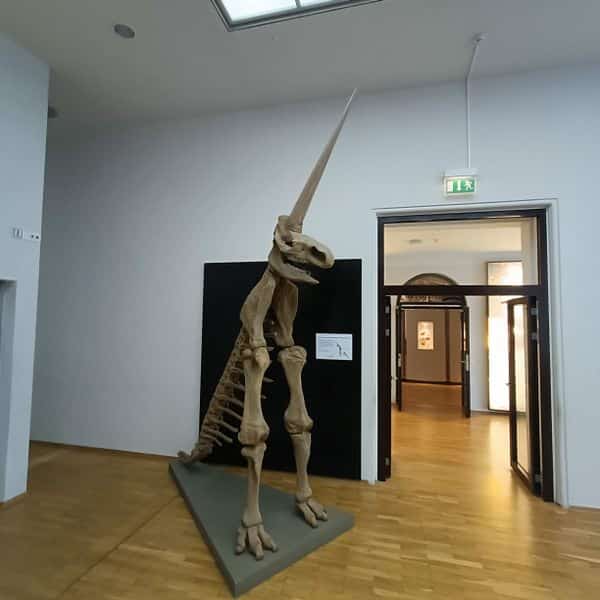
The popular story is that, by carefully studying the anatomy, Guericke took the bones to be from a unicorn and either reconstructed or described a reconstruction of the beast. The creature that resulted was a sight to behold. The horn was long and slender, projecting from the front of its head, and its cranium looked too big for the rest of its body. The torso was short and oddly formed, and the reconstruction had two prominent legs instead of the four generally associated with a horse or a rhinoceros. The creature looked as though multiple unrelated creatures had been fused into one skeleton. Modern accounts usually identify the skull as that of a wooly rhinoceros and other bones as prehistoric mammals, including mammoths. Some common accounts identify the horn as a narwhal tusk but the historical material that survives does not conclusively support that identification. So the reconstruction has to be considered an interpretation of the fossil material as a whole, with no assurance about the specific anatomical position of any part (Abel, 1939; Leibniz, 1749).
One must distinguish between the initial discovery, Guericke’s interpretation, and the familiar depiction replicated today. The extant evidence does not indicate that Guericke himself collected each bone in the exact physical configuration seen in later depictions. Much of what people know as the Magdeburg Unicorn derives from an etching related to Gottfried Wilhelm Leibniz’s Protogaea, a treatise on the history of the Earth published posthumously in 1749. Leibniz had been active in the Harz and had an interest in its geological history. His narrative preserved the story of the remarkable skeleton, but the art should not be taken as a photographically precise depiction of a physical reconstruction completed in 1663. It is an interpretation that has been handed down through seventeenth- and eighteenth-century study. This distinction is important since the fame of the Magdeburg Unicorn depends largely on the appearance of an image whose link to the actual fossils is disputed (Leibniz, 1749).

Medieval Unicorn Beliefs and Early Natural History
But seen against the backdrop of European belief in unicorns, it is simpler to understand why this strange creature was accepted. Unicorns enjoyed a respectable role in religion, natural history, medicine, and popular imagination in the Middle Ages. Medieval Europeans did not necessarily consider unicorns as imaginary in the contemporary sense. Many thought them to be actual animals that lived in faraway parts of the world that Europeans did not often visit. Classical authors gave the unicorn what seemed to be a historical basis, and this idea was repeated by medieval writers. For instance, Pliny the Elder described a savage, one-horned beast in India, and subsequent natural history traditions retold and altered stories of similar animals. These accounts continued for centuries, frequently without actual sight of the species they described (Pliny the Elder, 1940; Shepard, 1930).
The cultural value of the unicorn was only bolstered by Christian ideas. The unicorn was a formidable beast that could only be trapped in the company of a virgin, according to medieval bestiaries. In this tradition the beast would come to a maiden, put its head in her lap and be susceptible to hunters. Christian scholars read the narrative as an allegory of the Incarnation, with Christ as the unicorn and Mary as the virgin. The imagery is in texts, tapestries, sculpture, and religious art. The unicorn was thus a creature that straddled the worlds of natural history and spiritual significance. Its existence looked convincing, partly because it had been recounted by competent authority, and partly because its symbolic importance had become firmly established in Christian society (Hassig, 1995; Shepard, 1930).
There were also actual things that were thought to be unicorn horns, which further reinforced belief in unicorns. In northern waters, Arctic peoples hunted narwhals. Their products circulated in commercial networks. European merchants imported narwhal tusks. These long, twisting tusks were similar to the horns in images of unicorns and were often offered as genuine unicorn remains. Wealthy collectors, monarchs, and religious institutions cherished them. Some claimed powdered unicorn horn could neutralize poison, prevent disease, or even detect tainted food and drink. Unicorn horn was sometimes sold by apothecaries, and royal collections exhibited ornate tusks as precious natural curiosities. The items supplied what looked like physical evidence that unicorns were real. Even one who has never seen a living unicorn could see a wonderful horn, which was allegedly plucked from a unicorn (Shepard, 1930).
These ideas were particularly powerful because of the authority of classical and medieval literature. Naturalists operated within a tradition where the information provided by authoritative authors held significant weight, even if the initial findings were questionable. Aristotle, Pliny, medieval encyclopedists, and Renaissance scholars contributed to a body of work that regarded strange animals as worthy objects of natural history. It was difficult to verify accounts of faraway creatures, because travel was expensive, communication was delayed, and there were few credible zoological collections. The line between an unknown genuine animal and a mythological beast was therefore often blurred. For example, rhinoceroses were real animals that many Europeans knew mostly via written accounts and pictures. Their large horns would lend some credence to the unicorn stories, but the animals themselves were much different from the horse-like creatures of European art (Hassig, 1995; Shepard, 1930).
By 1663, however, European ideas regarding unicorns were changing. Renaissance naturalists. They started to compare reports, examine specimens, and ask whether the objects recognized as unicorn horns really were from the animals of classic literature. But it was the Danish scholar Ole Worm (1588-1654) who played a significant role in creating the link between alleged unicorn horns and narwhal tusks. But such findings were a challenge to prior ideas and didn’t immediately dislodge belief in unicorns. Scientific change was slow. Some scholars may learn that some of the horns had been misidentified but still be willing to believe that there were other kinds of unicorns. Hence the Magdeburg reconstruction emerged in this period of transition, when inherited traditions and emergent modes of empirical study often coexisted (Daston & Park, 1998; Shepard, 1930).
The finding of large fossil bones presented another issue for seventeenth-century researchers. The current idea of extinction was not generally embraced and the immense antiquity of the Earth was scarcely comprehended. People often explained bones much larger than those of familiar European animals in terms of existing classifications. Others thought the remains were of giants, dragons, or monsters from old religious and historical literature. Others identified them with elephants carried by the troops of Rome or with creatures killed in the Flood of the Bible. Given the limited comparable material available, these explanations were sometimes realistic. Investigators struggled to identify isolated bones and determine whether they belonged to the same animal without solid tools for recreating extinct species (Rudwick, 2005).
Referring to the Quedlinburg fossils as unicorn bones offered a culturally recognizable explanation for what would otherwise be mysterious objects. The rationale may have gone from a presumption that unicorns existed to an interpretation of the bones that appeared to confirm that notion. A large skull implied a remarkable beast, and a big horn provided its signature feature. Other bones could then be built around this fundamental idea. Modern scientists would say that this strategy is subject to confirmation bias, the tendency to interpret facts in a way that confirms an existing belief. But we should be careful to apply this phrase in retrospect. Guericke and his contemporaries labored without the advantages of contemporary comparative anatomy, radiometric dating, evolutionary biology, or accepted protocols for identifying extinct mammals. Their interpretations were a reflection of the intellectual resources at their disposal (Daston & Park, 1998; Rudwick, 2005).
The recreated skeleton is intriguing to look at, in itself, because its anatomy is so improbable. The horn juts forward from the skull at such an angle that it makes the creature look less like a graceful legendary horse and more like an animal bearing a gigantic spear. The head is the overall structure. Its body is small, not possessing the proportions that would be expected of a huge quadruped, and the bipedal posture at once raises problems of balance and locomotion. The creature’s stance suggests it could hardly have walked, let alone run. Even the link between the skull, vertebrae, and supporting limbs is anatomically incorrect. These oddities are what have made the Magdeburg Unicorn a beloved example of the fossil reconstruction gone wrong. The drawing is notable because the creature looks so impossible.
Historical Reactions and the Reconstruction Debate
Responses to reconstruction varied widely through time. To seventeenth-century onlookers, the discovery gave a probable explanation for previously unknown fossil remnants and seemed to provide physical confirmation for a species already detailed in reputable literature. Guericke’s own standing as a skilled natural philosopher may have added to the persuasiveness of his narrative. In the following years, Leibniz dealt with the discovery, which brought the story further scholarly attention. But extant materials do not provide an indication of the extent to which the original reconstruction was accepted or the degree of consensus among contemporary scientists as to its anatomical accuracy. It would be dishonest to imply that all seventeenth-century scientists accepted the creature as real. The learned world was already split over the credibility of natural history in its traditional sense and the interpretation of strange specimens (Krafft, 2015; Leibniz, 1749).
The story also involves a substantial historical misinterpretation. Popular tales usually say that Guericke himself dug up the bones and made the odd two-legged skeleton in 1663. The remaining documents were, however, reviewed by the historian Fritz Krafft (2015), who found that the renowned reconstruction was not put together originally either by Guericke or by Leibniz. However, the first report and depiction were attributed to Johannes Meyer, an astronomer and official at Quedlinburg. Guericke mentioned the discovery in his Experimenta nova (ut vocantur) Magdeburgica de vacuo spatio of 1672 but did not include the famous drawing of the skeleton. Later Leibniz got material associated with Meyer’s narrative. Protogaea. The picture was updated and finalized by Leibniz and engraver Nicholas Seeländer sometime around 1716. The renowned image is consequently the consequence of a chain of interpretations and artistic changes, not a unique reconstruction by Guericke.
This finding makes the popular story a whole lot more complicated. The Magdeburg Unicorn was not just the result of one scientist making an anatomical blunder. It was all the communication of observations, descriptions, sketches, and academic interpretations. At each step, there was room for misunderstanding or embellishment. The attribution of the reconstruction to Guericke was popularized by the paleontologist Othenio Abel in the early twentieth century and reiterated by later writers. According to Krafft (2015), the popular myth of Guericke personally digging up and reconstructing the unicorn has no historical basis. The narrative around the fossil is thus an illustration of how mistakes in history can become facts by repetition, even in scientific literature.
Later scientists had a quite different reaction to the alleged unicorn. With the development of comparative anatomy in the seventeenth and nineteenth centuries, naturalists were increasingly able to identify ancient bones by comparison with the skeletons of live animals. Georges Cuvier was a scientist whose work helped found vertebrate paleontology. He showed that by careful study of the anatomy it was possible to assign fossil remnants to extinct species. This method makes it much easier to spot anatomical inconsistencies in the Magdeburg Unicorn. The odd proportions no longer suggested a remarkable animal. Instead, they proposed that bones from several animals had been confused for portions of one. The reconstruction became a historical curiosity of the problems experienced by early fossil searchers (Rudwick, 2005).
One interpretation of the initial fossil material is that it consisted of the remains of numerous large Ice Age mammals buried in the same approximate location. During the Pleistocene, mammoths and wooly rhinoceroses roamed Europe, and their fossilized bones have been uncovered at various European locations. Both animals had anatomical characteristics that may lead investigators unfamiliar with their skeletons astray. For example, mammoth tusks might be viewed as the horns of giant animals, especially if found without the skull. Wooly rhinoceros remains have posed comparable issues. Such fossils in combination might supply enough evidence for someone trying to reconstruct an unfamiliar animal. This would be especially the case if the investigator already anticipated the creature having a conspicuous horn (Rudwick, 2005).
The horn itself is a very intriguing problem. It is popularly known as a narwhal tusk, referring to the longstanding connection between narwhal ivory and the European unicorn myth. But the Magdeburg Museum of Natural History concedes the original horn’s identity is questionable. The object represented in the historical reconstruction could have been a mammoth tusk or another fossil fragment regarded as a horn. The original specimens are now lost; therefore, modern researchers cannot go back and inspect the specimen to figure out its origin. The museum also points out that the bones probably came from different animals, maybe even different species. Thus, the famous description of a wooly rhinoceros skull, mammoth legs, and a narwhal tusk should be viewed as a popular reconstruction of the reconstruction, not a completely authenticated inventory of the genuine fossils (Museum für Naturkunde Magdeburg, n.d.).
Another idea is based on the geological conditions that caused the bones to be found together. The Seweckenberge area includes deposits relating to prehistoric settings where large mammals lived and perished, leaving behind skeletal remains. Bones from different species can be collected by natural processes like erosion, sediment transport, scavenging, and repetitive deposition over extended periods. These procedures can concentrate fossils that are not from a single individual. Modern research has also considered the Pleistocene fossil deposits of the area in terms of carnivore activity and prehistoric animal populations. These geological explanations provide a more probable source of the mixed remains than a hitherto unknown two-legged unicorn. They also demonstrate the importance of knowing where and in what context fossils were found when interpreting an ancient find.
Scientific Explanations and Lasting Impact
The psychological explanation is to look at the power of expectations. The bones were found at a time when unicorns already held a known place in European thought. The presence of a visible horn may have persuaded viewers to consider the remaining bones to be from the same legendary animal. With that identification accepted, anatomical inconsistencies would have seemed less troublesome, as the creature was believed to be uncommon. This reading does not presuppose intentional deception. It is possible for people to seriously mistake evidence if they lack the knowledge to analyze it themselves. The Magdeburg Unicorn is also a useful case study for the possible effect of cultural preconceptions on scientific explanations, particularly where physical evidence is lacking.
The reconstruction also brings up questions regarding the link between mythology and paleontology. Some scholars have claimed that early finds of huge fossils helped give rise to myths of giants, dragons, griffins, and other fantastic beasts. For example, Adrienne Mayor (2000) has written about probable links between fossil finds and classical myths, proposing that prehistoric relics were occasionally interpreted by ancient people in terms of the mythical traditions available to them. There is historical documentation of a related surviving method in the Magdeburg Unicorn. A fossil does not necessarily create a new myth, but an established myth affects the interpretation of a fossil. The interaction was reciprocal: conventional stories provided the framework for understanding natural objects, and those items appeared to offer evidence that validated the stories.
The effect of the Magdeburg Unicorn was felt beyond the initial scientific controversy. Its inclusion in Leibniz’s Protogaea tied the creature to an early attempt to explain the geological history of the Earth in terms of natural processes. Leibniz was interested in the making of mountains, the genesis of fossils and the changing conditions of the globe. His willingness to offer the unicorn as well as other geological observations indicates the ambiguous boundaries of early natural science. The investigators were trying to come up with explanations for the physical world, but occasionally they carried preconceptions from older traditions. The narrative of the unicorn is particularly illuminating, for it brings a seemingly legendary animal into a work devoted to the natural history of the Earth (Leibniz, 1749).
During the twentieth century the beast earned a new notoriety as one of the most uncomfortable and anatomically impossible fossil restorations ever depicted. It was a favorite subject for the history of paleontology, with its odd anatomy and enormous horn. The image became an example of scientific inaccuracy and was often humorously cited as proof of how badly early naturalists could get fossils wrong. But this reputation has challenges of its own. Modern tendencies to mock the reconstruction might conceal the historical challenges to identify prehistoric species before the emergence of modern paleontology. It can also contribute to the misattribution of the illustration to Guericke. The history of the creature is more interesting when viewed as a mixture of fragmentary data, traditional belief, scholarly interpretation, and the progressive development of scientific methodology (Krafft, 2015).
The original bones and the seventeenth-century arrangement have not survived, but the Magdeburg Unicorn can still be seen in a modern reconstruction in the Museum für Naturkunde Magdeburg. It’s a 2.5 m tall sculpture that replicates the stunning appearance from old images. Thanks to current replicas of the reconstruction created by the workshop of Swiss taxidermist Urs Oberli, museum visitors can encounter the creature as a three-dimensional item. The Magdeburg display has become a popular attraction and the museum’s symbol. Visitors are confronted with an animal that is at once prehistoric and surreal, with its long horn, huge head, truncated body, and strange supporting legs (Krafft, 2015; Museum für Naturkunde Magdeburg, n.d.).
The museum’s presentation urges visitors to reassess the relationship between observation and interpretation. Its formal description admits that the bones were presumably from separate species and stresses that the historical paintings show a creature unlike any real terrestrial vertebrate. The museum also raises the question of why educated onlookers, who knew the skeletons of domestic animals and hunted wildlife, accepted such a strange arrangement of anatomy. The reconstruction is sometimes a surprise and a topic of conversation among tourists. In this context, the unicorn is no longer evidence of the existence of mythical beings. It is an instructional object that enables visitors to consider how past generations made sense of the natural environment (Museum für Naturkunde Magdeburg, no date).
What makes the present response especially remarkable is that the reconstruction has become more famous as a mistake than it ever was as a scientific finding. Pictures are shared in conversations on odd fossils, historical misconceptions, and the birth of paleontology. Some viewers laugh at the creature’s unrealistic morphology, while others are intrigued at the notion that ancient fossils contributed to unicorn mythology. The recreation also will be of interest to those who research cryptozoology and mythological animals. For these audiences it is a documented instance when physical remnants were perceived as belonging to a creature associated with legend. But the historical significance of the unicorn is not proof that unicorns ever existed. The surviving record shows that some old bones were found and misidentified, not that there was a previously unknown horned species.
The Magdeburg Unicorn also emphasizes the value of conserving original scientific evidence. Without the bones, researchers are forced to go back on historical descriptions, pictures, and subsequent interpretations. This makes it difficult to know for sure which species were represented, how the bones were initially arranged and what the first spectators truly observed. Meyer’s reported sketch, later illustrations, and current copies differ, showing how representations can acquire an authority independent of the objects they are meant to represent. If the original fossils had survived with adequate documentation, modern paleontologists could have been able to reproduce the discovery more accurately. Their absence has allowed ambiguity and speculation to thrive for millennia (Krafft, 2015).
Conclusion
The Magdeburg Unicorn may teach its most lasting lesson about the link between belief and evidence. The medieval unicorn traditions were reinforced by revered books, religious symbolism, economic products, and centuries of artistic portrayal. These factors made the animal believable to anyone who had never seen one alive. That cultural context gave an explanation waiting to be used when strange fossils were found at Quedlinburg in 1663. This reconstruction was retained and changed in successive scholarly publications and finally became a notorious example of wrong anatomical interpretation. But its history also shows how scientific knowledge is developed through correction. Gradually researchers found out how to identify extinct mammals, how to tell the difference between unrelated skeletal remains and how to investigate the historical roots of notable finds. The Magdeburg Unicorn remains today a remarkable reminder that fossils don’t explain themselves. They mean different things depending on what questions investigators ask, what evidence they maintain, and what assumptions they bring to their job.
References
Abel, O. (1939). Vorzeitliche Tierreste im deutschen Mythus, Brauchtum und Volksglauben. Gustav Fischer.
Daston, L., & Park, K. (1998). Wonders and the order of nature, 1150–1750. Zone Books.
Guericke, O. von. (1672). Experimenta nova (ut vocantur) Magdeburgica de vacuo spatio. Jansson-Waesberge.
Hassig, D. (1995). Medieval bestiaries: Text, image, ideology. Cambridge University Press.
Krafft, F. (2015). Gottfried Wilhelm Leibniz oder Otto von Guericke? Protogaea oder Experimenta nova Magdeburgica? Die Rekonstruktion des vermeintlichen Einhorns von Quedlinburg. Sudhoffs Archiv, 99(2), 166–208. https://pubmed.ncbi.nlm.nih.gov/26790196/
Leibniz, G. W. (1749). Protogaea, sive de prima facie telluris et antiquissimae historiae vestigiis in ipsis naturae monumentis dissertatio. Johann Wilhelm Schmidt.
Mayor, A. (2000). The first fossil hunters: Paleontology in Greek and Roman times. Princeton University Press.
Museum für Naturkunde Magdeburg. (n.d.). Unicorn skeleton. https://www.naturkundemuseum-magdeburg.de/en/dauerausstellung/einhorn-skelett/
Pliny the Elder. (1940). Natural history (H. Rackham, Trans., Vol. 3). Harvard University Press.
Rudwick, M. J. S. (2005). Bursting the limits of time: The reconstruction of geohistory in the age of revolution. University of Chicago Press.
Shepard, O. (1930). The lore of the unicorn. George Allen & Unwin.
Wootton, D. (2015). The invention of science: A new history of the scientific revolution. Harper.


Leave a Reply