The Hammersmith Ghost Murder: Key Points
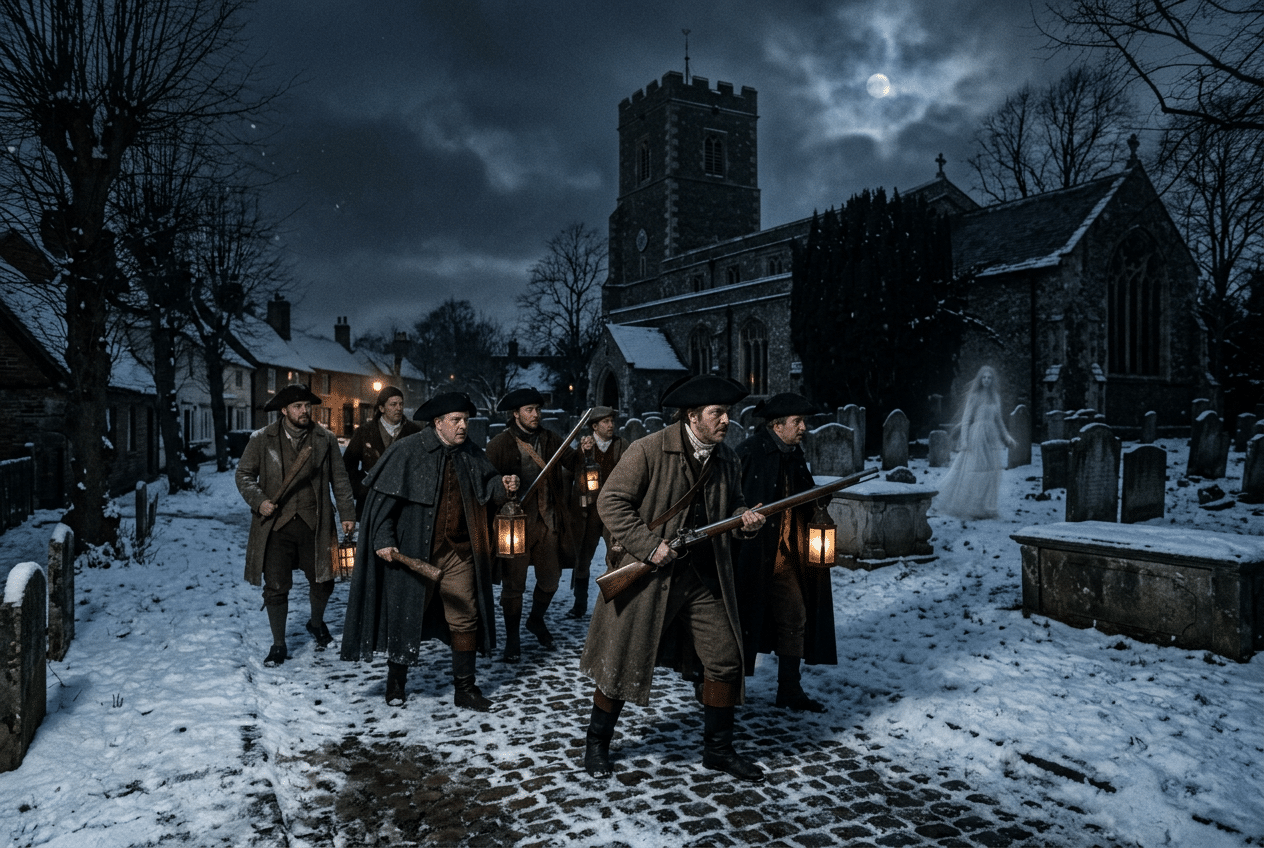
- During the winter of 1803 to 1804, people in Hammersmith reported a pale figure in the churchyard and lanes, and armed residents began patrolling at night to catch it.
- On January 3, 1804, excise officer Francis Smith shot and killed Thomas Millwood on Black Lion Lane. Millwood was a bricklayer wearing the white linen trousers, flannel waistcoat, and apron of his trade.
- At the Old Bailey, Smith was convicted of murder after the court refused to accept a manslaughter verdict, though his death sentence was later reduced to a year of hard labor.
- Witness accounts show the patrols were hunting a “pretended ghost,” meaning a living person, and white cloth was the only consistent sign they had. That made Millwood, who had been mistaken for the ghost once before, dangerously easy to misidentify.
- An engraving dated 1804 already named John Graham as the Hammersmith Ghost, and later retellings describe him as a shoemaker who confessed to wearing a sheet to frighten his apprentices.
- The engraving shows Graham was linked to the ghost early, but the sightings varied too much to prove he caused all of them. In the end, a ghost story turned white cloth into a warning sign, and an innocent worker happened to be wearing it.

Introduction
There are few figures more curious wearing a white sheet than a horned figure dressed in the history of English law, like the Hammersmith Ghost. In the winter of 1803-4, villagers in Hammersmith, to the west of London, spoke of a pale figure seen strolling around the churchyard and roads after dark. They went out at night to catch it, armed. On January 3, 1804, Thomas Millwood, a bricklayer, was shot and killed by one of them while heading home in his trade’s white attire. The story is often presented as a cautionary tale about superstition, but one detail warrants closer examination: wearing a white sheet is not the same as being a horned figure dressed in a white sheet, as is commonly believed. The detail is white. The story of a phantom becomes a story about clothes and evidence and the desire for a neat ending, tracing it from the initial sightings to the fatal shot and then to an engraving that claims a different man as the ghost.
The Legend and Its Setting
The ghost story is set in a London neighborhood (the Hammersmith district) during the late 19th to early 20th century, a time of rapid urbanization, packed streets, and a thick social mix. The visual culture of urban specters that Victorian audiences expected in popular imagination (Spence, 2022; Krisjanous & Carruthers, 2018) feeds the environment that makes ghostly rumors traverse neighborhoods, markets, and tenement rows in a hurry. This mood fuses the chills of a ghostly visitation with the anxieties of modern city life and the dangers surrounding marginal urban populations in a changing empire (Spence, 2022; Krisjanous & Carruthers, 2018).
The Shooting and Trial of Francis Smith
The killing itself is the best documented element of the story. William Girdler, a night watchman, said that he saw Francis Smith, an excise officer, who was out with a rifle in hopes of finding the ghost, about half past ten that night (Old Bailey Proceedings Online, 1804). Girdler named the hour and the two men agreed to meet again. Just after eleven, Smith encountered a white figure on Black Lion Lane. Anne Millwood, the victim’s sister, had just witnessed her brother walk out of their parents’ house. She said that she heard a voice say, “Damn you; who are you and what are you?” Damn you, I’ll shoot you,” and then a shot” (Old Bailey Proceedings Online, 1804). Millwood died from a gunshot wound to the left lower-jaw area. Smith was upset thereafter and was taken into custody. His phrasing was instructive when he spoke to Girdler, saying he had shot a man “who he believed to be the pretended ghost of Hammersmith” (Old Bailey Proceedings Online, 1804). That month Smith went on trial in the Old Bailey. They were trying to get a manslaughter verdict. The judge told them the evidence only allowed for murder or acquittal. He was found guilty of murder and sentenced to death, but the sentence was reduced to a year at hard labor (‘Hammersmith Ghost Murder Case,’ 2025).
The question of what Millwood had on him arose immediately at the trial. A witness described him as wearing white linen trousers, ‘a waistcoat of flannel, evidently new, extremely white, and an apron, which he wore round him’ (Old Bailey Proceedings Online, 1804). None of this was a masquerade. It was a typical outfit for a man in the building trade. A relative, Mrs. Fulbrooke, testified that she had advised him to wear a greatcoat over his whites, since he had been mistaken for the ghost before (Old Bailey Proceedings Online, 1804). So the threat was anticipated. That winter in Hammersmith, the folks around Millwood knew that a guy in white was no longer just a man in white.

Sightings, Interpretations, and Evidence
We go back to the ghost quest and why White had such weight becomes evident. R. S. Kirby’s early printed account, “The Hammersmith Ghosts,” collects testimony from the panic and places Black Lion Lane into its geography (Kirby, 1804). According to local myth, the ghost was the spirit of a man who had committed suicide and been buried in the churchyard. Descriptions were diverse. The apparition was supposed to emerge “in a white sheet, and sometimes in a calf-skin dress, with horns on its head, and glass eyes” (The London Archives, 2026). There were some dramatic reports. Thomas Groom, a brewer’s servant, said that something got up behind a tombstone and took him by the throat. He pushed back and “felt something soft, like a wonderful coat” (Old Bailey Proceedings Online, 1804). On December 29, Girdler claimed he chased the figure near Beavor Lane until it dropped its shroud and ran away (“Hammersmith Ghost Murder Case,” 2025).
Together these tales disclose something that is easy to miss. Long before the shooting, the people searching for the ghost had abandoned the idea of it being solely otherworldly. A shroud that could be shed and a body like a greatcoat are both signs of a live person. This idea is confirmed by Smith’s phrase “pretended ghost.” The patrols were not tracking a spirit. They were pursuing a man who pretended to be one, and the only sure sign they had was a pale form in the dark. The ghost was a constant part of the sheet. It was also the one quality an innocent workman would have in common. Millwood’s spotless linen trousers and fresh apron and flannel waistcoat were practically identical. His working clothing in a dark alley between the bushes answered the description of a shroud.
The ghost is described through ambient and sensory cues: cold drafts, the sudden extinguishing of lamps, faint whispers, or tremors in the environment, all suggesting a supernatural intrusion rather than a conventional incident. These tactics coincide with the esthetics of Victorian ghost stories and phantasmagoric traditions that connect visual interest with emotional excitation (Spence, 2022; McCorristine, 2006). The story will likely offer conflicting interpretations—ghost, hoax, misconception—and tantalize the reader with ambiguity. This phenomenon corresponds to the long-standing ambivalence toward paranormal events that scholars of parapsychology and spectral culture have investigated across the Victorian and modern periods (Hanks, 2016; Kloosterman, 2012). The Hammersmith Ghost story reflects the wider Gothic, spiritualist, and sensational practices of its time, such as spirit photography, phantasmagoria, and the period’s obsession with ‘deadly’ or haunting presences in the city. These links locate the story within a tradition of paranormal imagination in Victorian Britain (Spence, 2022; Ioan, 2023; McCorristine, 2006).
Sources have their boundaries too and they must be explicitly mentioned. In his thesis, Keane (2019) reconstructs the incident and highlights gaps in the coverage before Millwood’s death. That’s important because most of what we know about the sightings comes from testimony and printed accounts collected after the killing, when the tale already had a terrible focus. The sightings are reported. The shooting is a matter of history. These are several types of evidence. The women who are reported to have died of fright and the horned figure in a calf skin may be the result of true experiences, exaggeration, or hearsay that expanded in the telling. The rest of the record does not permit us to separate one from the other with confidence.
John Graham and the Engraving
The most fascinating thing happens after the trial. An 1804 engraving shows John Graham as the Hammersmith Ghost (John Graham, the Hammersmith Ghost, 1804). This type of engraving is also associated with Kirby’s 1804 volume, situating it in the same publishing moment as the early printed narrative (Kirby, 1804). Commercial image archives label it as an 1804 etching and engraving of “John Graham, known as the Hammersmith Ghost” (Granger, n.d.). The National Galleries of Scotland has a stipple and line engraving in its collection entitled John Graham, d. 1804. Hammersmith Ghost, but the date is given as unknown (National Galleries of Scotland, n.d.). This difference is important. This implies that more than one impression or state of the image persists and that collections are not entirely in agreement as to how firmly to date it.
But the old artifact does answer one question. By 1804 the ghost had been publicly connected to Graham’s name. Later versions do even more. Graham was sometimes described as an old shoemaker who confessed to dressing up in a sheet to scare several apprentices who had been scaring his children with ghost stories (“Hammersmith Ghost Murder Case,” 2025). In certain popular tales his confession is the neat conclusion of the affair. That’s why the sheet is there. It explains the churchyard. It makes a frightening season into a single prank that got out of hand.
This engraving wearing a white sheet is not the same as a horned figure dressed and shows that Graham was connected to the ghost early on. That doesn’t show he was behind every sighting recorded. The descriptions in the record do not follow an internal logic. A man wearing a white sheet is not the same as a horned figure dressed in a white sheet. A horned figure in a calf hide with glass eyes is not a white sheet. It is difficult to explain an assault in the churchyard or a chase along Beavor Lane by a shoemaker hoaxing his apprentices. Once a village believes in a ghost, every pale shape is evidence. Millwood demonstrates how it works, as he himself was mistaken for the ghost at least once before being killed. Some of the sightings may have been Graham. Others might have been copycats, common individuals in white clothes, or stories that improved with the retelling. It can’t exclude any of these from the record.
Conclusion
The Hammersmith Ghost is regarded as a story about believing in the supernatural, yet the evidence points to something more conventional and more troubling. The white clothes were the string that connected the case together. It was a pall to the affrighted spectators. For the armed patrols it was a “pretended ghost.” To Thomas Millwood it meant a day’s labor. It cost him his life. The trial record is noteworthy for its precise account of his death and what he wore, compared to the earlier sightings, which remain mostly as statements gathered after the fact. The 1804 engraving of John Graham demonstrates how fast the public demanded a culprit with a name and a face. It indicates that Graham quickly established contact with the spirit. That doesn’t mean one man on one sheet accounts for everything people say they saw. The honest conclusion is messier than the folklore. A ghost story made a sign. The sign was white fabric. An innocent bricklayer wore it by accident.
References
Granger. (n.d.). England: Ghost, 1804 [Image record No. 0017261]. https://www.granger.com/media/0017261
Hammersmith Ghost murder case. (2025, December 1). In Wikipedia. https://en.wikipedia.org/wiki/Hammersmith_Ghost_murder_case
Hanks, M. (2016). Between Electricity and Spirit: Paranormal Investigation and the Creation of Doubt in England. American Anthropologist, 118(4), 811–823. https://doi.org/10.1111/aman.12684
Ioan, D. (2023). Spectral Bodies and Superimposition in Photography and Film. Studia Universitatis Babeş-Bolyai Dramatica, 68(1), 43–70. https://doi.org/10.24193/subbdrama.2023.1.02
John Graham, the Hammersmith ghost [Engraving]. (1804). Orleans House Gallery, London Borough of Richmond upon Thames. https://orleanshousegallery.org/
Keane, G. (2019). [Thesis title] [Bachelor of Philosophy thesis, University of Pittsburgh]. D-Scholarship@Pitt. https://d-scholarship.pitt.edu/
Kirby, R. S. (1804). The Hammersmith ghosts. In Kirby’s wonderful and scientific museum (Vol. 2). R. S. Kirby. University of Illinois Library digitized collection. https://brittlebooks.library.illinois.edu/
Kloosterman, I. (2012). Psychical research and parapsychology interpreted. History of the Human Sciences, 25(2), 2–22. https://doi.org/10.1177/0952695111421580
Krisjanous, J., & Carruthers, J. (2018). Walking on the light side. Qualitative Market Research an International Journal, 21(2), 232–252. https://doi.org/10.1108/qmr-12-2016-0123
McCorristine, S. (2006). “Dreaming While Awake”: The Evolution of the Concept of Hallucination in the Nineteenth Century. Forum University of Edinburgh Postgraduate Journal of Culture & the Arts. https://doi.org/10.2218/forum.0.564
National Galleries of Scotland. (n.d.). John Graham, d. 1804. Hammersmith ghost [Stipple and line engraving, Accession No. EP V 740.1]. https://www.nationalgalleries.org/art-and-artists/30886/john-graham-d-1804-hammersmith-ghost
Old Bailey Proceedings Online. (1804, January 11). Trial of Francis Smith (t18040111-79). https://www.oldbaileyonline.org/browse.jsp?div=t18040111-79
Spence, C. J. (2022). The phantasmagoria: From ghostly apparitions to multisensory fairground entertainment. Frontiers in Communication, 7. https://doi.org/10.3389/fcomm.2022.894078
The London Archives. (2026, October 25). The Hammersmith ghost. https://www.thelondonarchives.org/blog/the-hammersmith-ghost

Leave a Reply