Who Were the Dero? Key Points
- The Shaver Mystery began in March 1945 when Amazing Stories published Richard S. Shaver’s “I Remember Lemuria!” Editor Raymond A. Palmer rewrote the manuscript and promoted it as an account of a hidden civilization.
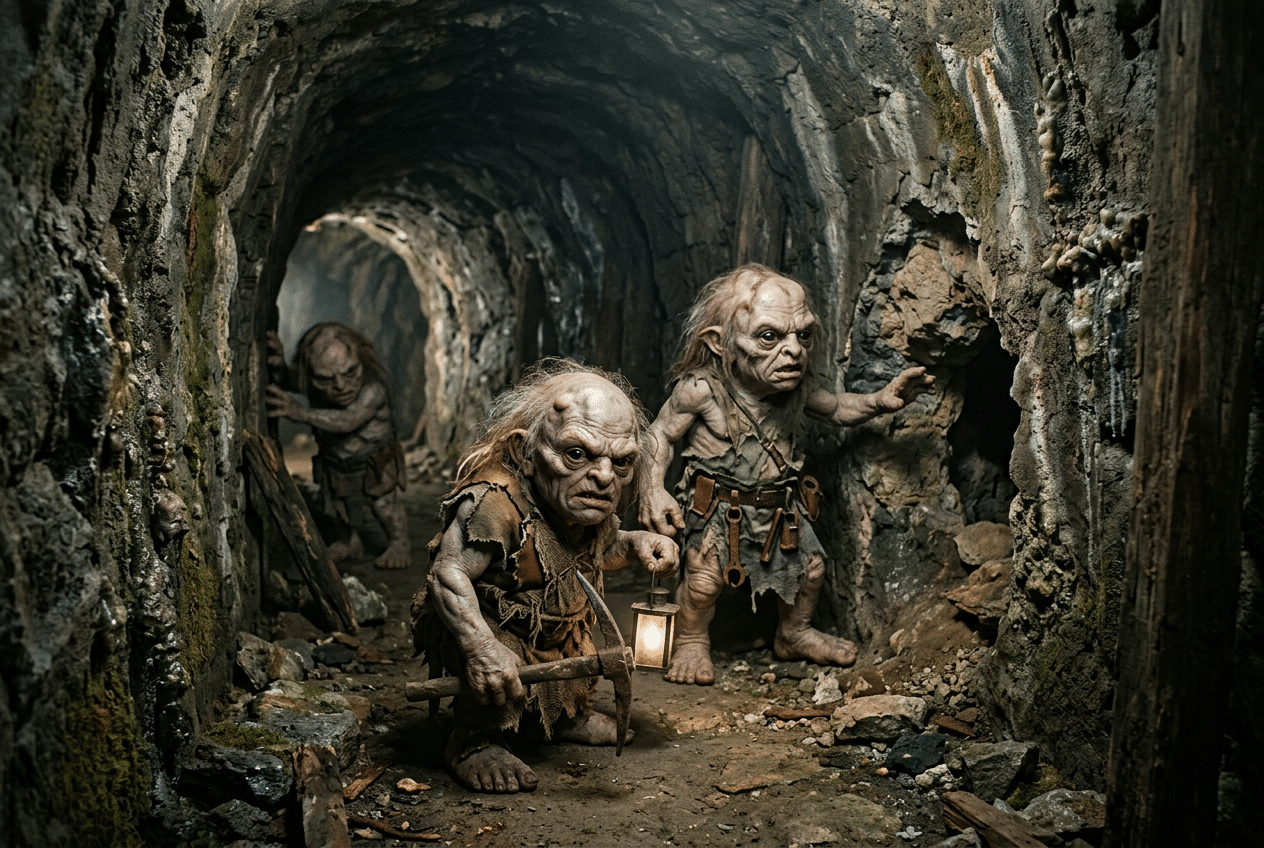
- The dero were small, dwarfish humanoids descended from an ancient people who had lived beneath the Earth. Shaver portrayed them as twisted by harmful energies, while other cave dwellers called Tero tried to protect humanity.
- The dero supposedly used ancient machines to transmit voices, inflict pain, and cause accidents aboveground. They could torment people who had never set foot in their caverns.
- Shaver believed the dero were real and interpreted voices he heard while welding as underground communications. Some readers sent letters describing similar experiences, but no physical evidence verified the dero’s existence.
- The stories drew on lost-continent legends and tales of underground peoples. Shaver’s reported experiences help explain his conviction, and Palmer’s promotion also helps explain how the claims reached so many readers.
- The mystery boosted magazine sales and divided science fiction fans over whether the stories belonged in a fiction magazine. Palmer later linked the dero to flying saucers, giving the legend a place in early UFO lore.

Introduction
The March 1945 issue of Amazing Stories featured a science fiction story that encouraged its readers to take its monsters seriously. Richard S. Shaver’s “I Remember Lemuria!” describes a prehistorical society whose descendants now live in giant caverns beneath the Earth. These included the dero, evil creatures who exploited the machinery they had inherited to torture the inhabitants of the surface. Editor Raymond A. Palmer edited Shaver’s manuscript extensively and sold it as the story of a secret world. The Shaver Mystery transformed a pulp adventure into a public debate about whether a magazine could uncover a secret history or just convince its readers to discover one in their lives (Menzel & Boyd, 1963).
Shaver spoke of a large underground world of caves inhabited by malevolent beings called ‘dero’ who used advanced technology to torture people on the surface (McKee, 2020). Beggan identifies the two subterranean civilizations as the Deros and Teros (Beggan, 2025). Shaver (Halperin, 2020) writes that people blamed them for disasters, disappearances, and mental and physical ailments.
The Underground World and Physical Appearance of the Dero
At the heart of Shaver’s underground realm were ancient beings who possessed technology far beyond anything that current humans had. In the legends, the most advanced inhabitants finally left Earth due to dangerous radiation from the sun. Their descendants lived in the underground cities. Some of them kept the old devices running. The Dero were of the unfriendly branch of this race. Other cave dwellers, named Tero, strove to protect surface people and to warn them of danger. This split enabled a conspiracy and a resistance to fit into Shaver’s reality. A voice from the caves may be a tormentor bothering someone or a friend trying to convey a warning across (Menzel & Boyd, 1963).
The dero are generally regarded as diminutive, dwarfish humanoids, physically shrunken descendants of the old inhabitants. Their look is an expression of a premise of the tales: damaging forces were said to have deformed their bodies and distorted their minds. It is typically broadened to stand for “detrimental robots,” but the word robot has a special connotation in the magazine. An editorial note on “Thought Records of Lemuria” derives from deleterious robotism, a state of skewed thinking that constantly turns a person toward evil deeds. The dero were living things whose minds had been taken over by a desire to destroy. Their machines were separate, and those devices made them much more dangerous than their size suggested (“Dero,” n.d.; Shaver, 1945).
Much of the terror was what the Dero were alleged to be able to do at a distance. Shaver blamed their device for conveying voices and thoughts, which caused agony and produced mishaps on the surface. In the catacombs the dead might torture prisoners themselves. One could become a target above ground, without ever seeing a cave mouth. Shaver further stated that the dero were obstructing scientists whose discoveries could threaten their control. The theory offered a common cause for wandering voices, abrupt agony, and seemingly random tragedies. It also made the claim difficult to contest on its terms, as an unseen enemy could always be said to have hidden its work (Menzel & Boyd, 1963; Shaver, 1945).
The Shaver Mystery and Raymond Palmer
Shaver’s letter was included in the January 1944 issue of Amazing Stories, and publisher Ray Palmer advertized his articles as “The Shaver Mystery” for some five years. It dominated the magazine and improved circulation, but it also triggered a strong backlash from science fiction fandom (Halperin, 2020; Lagrange, 2016). Palmer is shown as a “dark mentor” who might have profited from Shaver commercially (Beggan, 2025). One publication describes it as a calculated, provocative deception sponsored by Palmer to boost sales (Menadue, 2018).
Shaver spent numerous years in mental facilities before he began his writing career and said the stories were factual (McKee, 2020). Scholars read the dero as an “influencing machine,” a delusional belief that external forces were controlling one’s thinking, and as a theodicy that explained personal trauma like the loss of his brother (McKee, 2020; Halperin, 2020). The material was published in The Shaver Mystery Magazine and the anthology The Hidden World (Halperin, 2020). Shaver then moved into visual work, including “rock books,” and was regarded as an outsider artist after his death (Beggan, 2025).

Belief in the Dero and Explanations of the Mystery
Shaver claimed the caverns and their occupants were real. He said he heard voices over the loudness of the welding equipment, and he assumed they were communications from underground. His account, the magazine first said, was the retrieval of ancient recollections. By June 1945, Palmer’s editorial introduction presented Shaver as having personally seen the underground cities, while a notice with the account allowed readers to consider it fiction. Letters came in from readers who described situations they believed lent validity to Shaver’s statements. These letters tell us how people understood their experiences once they encountered the stories. There was never any independently confirmed physical evidence produced to prove that the dero or their machines existed (Menzel & Boyd, 1963; Shaver, 1945).
Different sections of the puzzle have several explanations. A literary interpretation puts the stories against older tales of subterranean peoples, legends of lost continents and pulp adventures of forgotten civilizations. Shaver took these old ideas and made them technical. Where a folktale would give a spirit an uncanny voice, he envisioned apparatus that might convey speech into someone’s consciousness. Biographical interpretation begins with the experiences that Shaver recounted and questions how he came to interpret these encounters as evidence of outside involvement. His conviction tells us something about the hold the narrative had on him, but the surviving record provides room for uncertainty about what he experienced and why. It’s easier to document a publishing explanation. Palmer wrote the initial book, gave it an audience, and continually asked readers to determine how much of it to trust. The editor’s competence at keeping disputes alive is better demonstrated than the depth of his belief (Menzel & Boyd, 1963), as Nadis’s (2013) biography of Palmer shows.
Cultural Impact and Influence on UFO Folklore
The debate sold publications and split the science fiction fandom. The circulation soared, and the June 1947 edition of Amazing Stories was devoted to Shaver material. Some fans were annoyed at the amount of space a fiction magazine had given to the claims of an actual underground civilization. Others continued to debate the issue in specialist periodicals, and Palmer returned to the theme in The Hidden World in 1961. The Shaver Mystery also bled into early flying saucer culture, when Palmer publicly connected the two topics. The dero appeared in circulation before the most renowned saucer sightings of 1947. They provided a convenient explanation for advanced technologies and secret beings that have been in proximity to humanity for millennia (Clute et al., 2025; Menzel & Boyd, 1963; Nadis, 2013).
Conclusion
The book lives on as an American legend because Shaver and Palmer gave their readers a method to turn private fears into a story they could all tell. Two that appeared together in the same magazine would seem to link a weird voice or an unexplainable accident to someone else’s narrative. The deer’s appearance is less important than the actions Shaver attributed to the cave’s small figures. Supposedly they could enter wherever. The history of the notion, from pulp literature to reader testimony to flying saucer mythology, demonstrates how far it proceeded without presenting independently verifiable evidence of the beings at its center.
References
Beggan. (2025). False prophet and profit. https://doi.org/10.26736/hs.2025.02.01
Clute, J., Nicholls, P., & Widden, L. (2025, January 13). Shaver, Richard S. In The encyclopedia of science fiction. https://sf-encyclopedia.com/entry/shaver_richard_s
Dero. (n.d.). In Encyclopedia of occultism and parapsychology. Encyclopedia.com. https://www.encyclopedia.com/science/encyclopedias-almanacs-transcripts-and-maps/dero
Halperin. (2020). Shaver mystery. In Intimate alien. https://doi.org/10.1515/9781503612129-009
Lagrange. (2016). Ray Palmer: The Shaver Mystery. https://doi.org/10.58079/126xx
McKee. (2020). Reality – Is it a horror? https://doi.org/10.58997/jgm.v1i1.1
Menadue. (2018). Hubbard bubble, Dianetics trouble. https://doi.org/10.1177/2158244018807572
Menzel, D. H., & Boyd, L. G. (1963). The world of flying saucers: A scientific examination of a major myth of the space age. Doubleday & Company. https://www.gutenberg.org/files/66639/66639-h/66639-h.htm
Nadis, F. (2013). The man from Mars: Ray Palmer’s amazing pulp journey. Tarcher.
Palmer, R. A. (Ed.). (1945). Amazing Stories [Magazine]. Ziff-Davis Publishing Company.
Palmer, R. A. (Ed.). (1961). The hidden world [Anthology].
Shaver, R. S. (1945, March). I remember Lemuria! Amazing Stories.
Shaver, R. S. (1945, June). Thought records of Lemuria. Amazing Stories, 19(2).
The Shaver Mystery Magazine. (n.d.). [Magazine].



Leave a Reply