Rollright Stones and Carnac: Key Points
- Communities living beside the ancient stone monuments of Western Europe made up legends to explain them. At both Rollright in England and Carnac in Brittany, people said the stones were once men.
- Rollright has three parts: a circle, a lone stone, and a small cluster. That layout gave storytellers a ready-made cast. A witch turned an ambitious king into the King Stone, his army into the circle, and his plotting knights into the Whispering Knights.
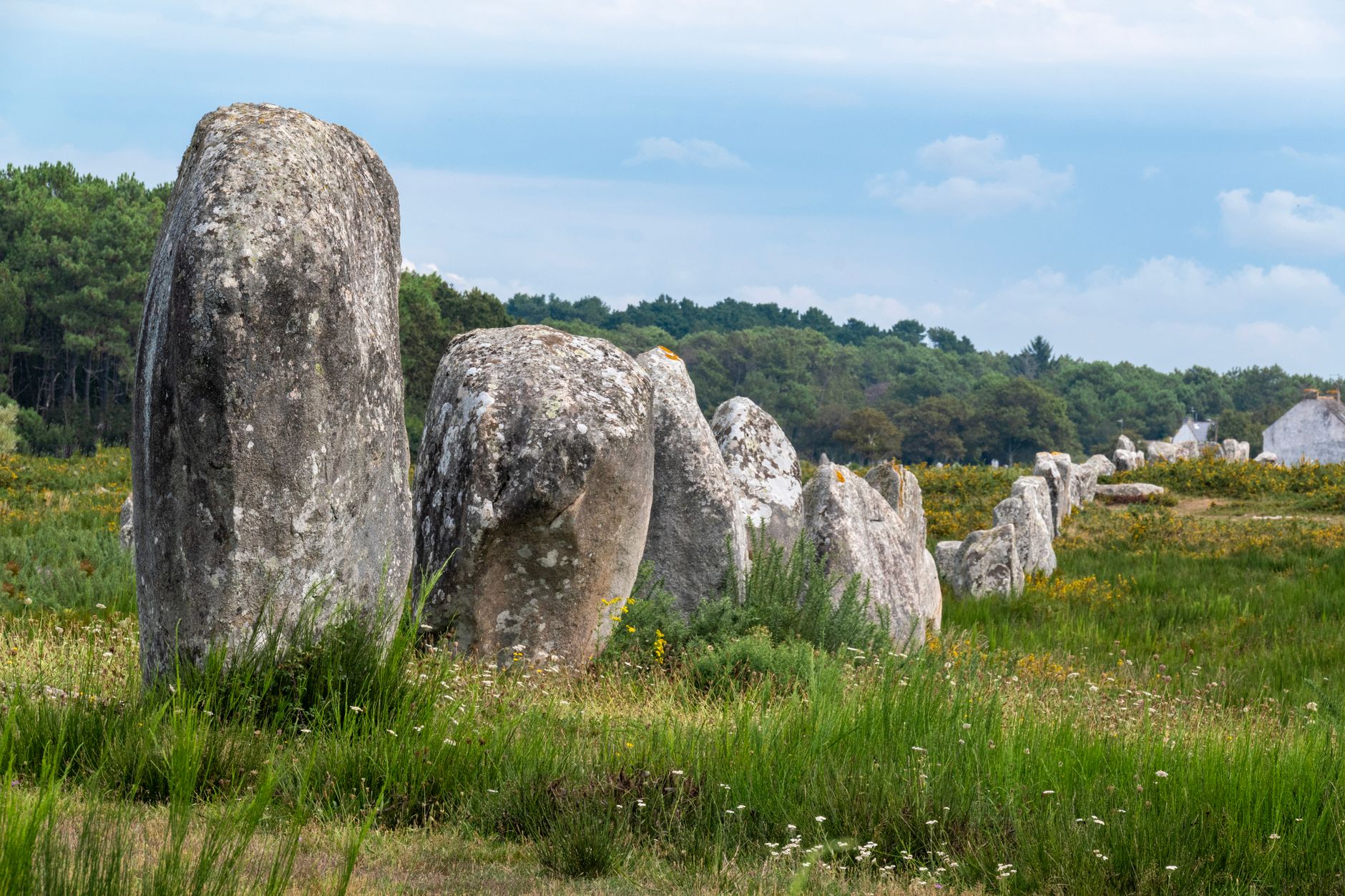
- Carnac’s long, parallel rows of more than 3,000 menhirs look like soldiers in formation. Local legend says Saint Cornély turned a pursuing Roman army into these stones.
- Because Rollright’s layout varies, its story features individual characters with their own motives. Carnac’s repetitive rows produced a story with one hero facing a faceless mass of enemies.
- Both legends work the same way. They explain puzzling stones through a single magical transformation that freezes people mid-movement. In both places, the stones are also said to come alive at certain times to drink from the nearby water.
- The moral framing differs. The witch’s curse is a rough, local justice that keeps the story’s politics earthly. The saint’s miracle turns a pagan landscape into evidence of Christian triumph.

Introduction
The magnificent stone monuments of western Europe have outlived the people who erected them. They have also survived the memories of their purpose. Later communities continued to live near these quiet formations and sought to understand what the stones were and why they existed. Two of the most popular answers are that the stones were men once. The Rollright Stones on the Oxfordshire-Warwickshire boundary were the scene of a witch turning a conquering king and his men to stone. Saint Cornély is claimed to have turned an army of pursuing Romans into the long rows of menhirs that stretch across the landscape at Carnac, in Brittany. In both cases the physical layout of the monument acts almost like a script, providing the storyteller with a ready-made cast of characters. A pagan curse and a Christian miracle have quite different moral frames, but they explain remarkably comparable sights in shockingly similar ways.
Modern Pagan Practice and the Rollright Stones
Today, megalithic landscapes are often seen by witches and neo-pagan communities not only as heritage objects but also as “living” sites with ongoing spiritual potential. Butler argues that neo-pagans in Ireland see sacred sites such as Newgrange, the Hill of Tara, stone circles, and other megalithic monuments as places of ritual and gathering, as a link to previous religious practices, and as living spiritual meanings in the landscape (Butler, 2011). From this perspective, megaliths are not static artifacts but active sites of contemporary practice. The anthropological literature in this area also documents a wider pattern, where modern Pagans develop intimate associations with ancient landscapes and invoke a sense of lineage and continuity with “earlier religions of Europe” in their use of sacred landscapes as centers for ritual activity (Butler, 2011). This is echoed in ethnographic writings on neo-pagan veneration of Celtic mythic personages as real presences in the land.
At Rollright, the monument itself suggests a multifaceted narrative, as it consists of three distinct structures rather than a single edifice. The King’s Men is a ring of weathered stones, the King Stone is a single towering stone across the road, and the Whispering Knights is a group of upright slabs some way to the east. These are now known by archeologists to be from different times. The Whispering Knights are the ruins of an early Neolithic chambered tomb; the circle is later and the King Stone is later still. To the villager gazing on, however, the layout reads easily as a social hierarchy. A mob stands together, a leader stands alone and a small group huddles to one side as if plotting. Arthur Evans collected the local legend in detail and recorded the story that explained this arrangement. Evans (1895) reports that a king was crossing the ridge when he met a witch who gave him this rhyme: “Seven long strides shalt thou take, / And if Long Compton thou canst see, / King of England thou shalt be” (p. 19). The king advanced, but a mound of earth arose to hinder his view and the witch said, “Thou and thy men hoar stones shall be, / And I myself an elder tree” (Evans, 1895, p. 20). Thus, the king became known as the lone King Stone, his army was referred to as the circle, and the knights who had stepped aside to conspire against him were called the Whispering Knights.
The match between monument and story is surprisingly tight. Each part of the site is given a role. The isolation of the King Stone is the isolation of a man who outran his supporters in ambition. The circle forms a body of soldiers who didn’t receive the order to advance. Even that little elevation of ground between the King Stone and the valley is utilized, because the plot needs something to keep Long Compton out of sight. Grinsell (1976) notes that British megalithic sites commonly have traditions of petrified persons, which are often connected with dancers, wedding guests, or Sabbath breakers. What makes Rollright’s story so interesting is the three-part structure; it allows for a more intricate drama than just a story of retribution. The stones are more than humans. They stand for a political situation, a ruler-to-be, his army, and traitors in the ranks.

Saint Cornély and the Carnac Alignments
Carnac is a different shape, hence a different casting. The alignments at Le Ménec, Kermario, and Kerlescan are not a circle with outliers but long, parallel rows of standing stones stretching for kilometers over the terrain. Over 3,000 menhirs are put out in “symmetrical, evenly spaced columns that disappear into the distance” (Tucker, 2022) along roughly four kilometers of the Breton shore. No one in their midst could miss the visual coherence of their stance. They appear as rankings. They seem like an army drawn up in formation, and the legend takes that literally. The local story is that Cornély was a pope in Rome and was chased out of the city by soldiers who sought to assassinate him. He fled to Brittany with a couple of oxen and eventually he found himself stranded with the sea at his back (Office de Tourisme de Carnac, n.d.). One popular version of the story is that he hid in the ear of one of his calves and called on heaven as the troops approached, turning them all to granite (Office de Tourisme de Carnac, n.d.; Tucker, 2022).
The difference in layout creates a difference in the type of tale that is delivered. The motley assembly of Rollright requires individuals with agendas of their own: the power-hungry monarch and the plotting knights. Carnac’s lines are so repetitious that there is little room for different characters. A row of stones, almost identical, indicates a collective, a legion without a face marching in step, and the Cornély legend is pleased to provide us with just that. The warriors are faceless; they have no inner life. They exist only as the danger the saint must flee from. There are no real people in the Carnac narrative, except for Cornély himself and, appropriately, his oxen. This links to his later function as patron saint of horned cattle in southern Brittany, a role still honored locally (Tucker, 2022). The story contains numerous protagonists, like the monument, which has several places of interest at Rollright. The stones at Carnac make one overwhelming pattern; thus, the story has one hero and a mass of antagonists.
Petrification, Curses, and Miracles
Still, the work of the witch’s curse and the saint’s miracle is quite alike. Both myths take a truly bewildering truth, the existence of stones as big as men laid out with clear aim, and explain it by one supernatural act of metamorphosis. Both see the stones as individuals frozen in the middle of a movement. The king is in mid-stride, and the legion is in mid-march. Both reports also hint that the petrification is not quite complete. Evans (1895) recorded a belief that the Rollright stones descend to a nearby spring to drink on certain occasions. At Carnac the stone soldiers are said to come alive once a year on Christmas night to drink from the neighboring streams, crushing anyone foolish enough to stand in their way (Office de Tourisme de Carnac, n.d.). This common detail is telling. Both societies envisioned the stones as creatures half awake, keeping the monuments alive with a feeling of danger and presence long after their makers were forgotten.
But the moral framework turns in an intriguing direction. The agent of change at Rollright is a witch, a character generally associated with hazardous and unsanctioned power. Yet her curse is a form of brutal justice, curbing the pride of a man who would steal the crown of England. She even turns herself into an elder tree next to her victims, anchoring herself in the landscape as a permanent guardian. At Carnac, the agent is a saint; the miracle is heavenly protection for a beleaguered believer against pagan aggressors. The petrification is justified, not ambiguous. Thus, the Christian myth appropriates a pre-Christian monument and assigns it a meaning appropriate to the church’s own history of martyrdom. Tucker (2022) observes the irony that the stones are at least 3,000 years older than the Roman Empire, which means the Roman troops of the mythology could never have been there. The Breton story still does something that the Rollright one does not attempt. It makes a pagan environment into evidence of Christian victory. The English story, however, stays magical in the hands of a local, unofficial character and keeps the politics grounded.
Megaliths in Folklore and Contemporary Ritual
Several references associating megaliths with shamanic and folklore imaginaries provide a good comparative perspective for the megalith-witch nexus. Malim examines shamanism in Wales, drawing on ethnographic and archeological evidence; the analysis of shamanic-like practices at megalithic sites helps to account for why contemporary witches may ground ritual experiences in perceived shamanic or spiritual energies that are thought to radiate from or connect to ancient monuments (Malim, 2025). Other sources focus on the integration of megaliths into folklore (e.g., trials for witchcraft, fairy connections, and legendary actions associated with stones), highlighting how these stones act as carriers of cultural memory, which endures and transforms through time. This mythical continuity may be the reason that witches may intentionally seek megalithic places for ritual work, storytelling, and experiential practices linking past and present spiritualities (Goodall, 2016; Gillings & Pollard, 2016).
The megalithic environment is imagined in contemporary witch and neo-pagan contexts as interwoven with legendary narratives (e.g., Druids, fairy associations, and pre-Christian rites). Goodall’s investigation of the megalithic sites of Guernsey and their links with local myths (e.g., Le Creux ès Faïes, Le Trepied) shows how stones are invested with symbolic values that contribute to the contemporary narrative and ritual imagination, illustrating the role of megaliths in public memory and spiritual experience beyond archeology (Goodall, 2016).
The wider scholarly discussion of megaliths suggests their contribution to the production of cosmologies at the scale of the landscape. Studies of passage tombs and their symbolic architectural organization illustrate how prehistoric structures are interpreted for their symbolic and cosmological value, often reinterpreted through a contemporary perspective by current practitioners. This synthesis may help explain why witches and neo-pagans may orient ritual activity to alignments, sacred horizons, or site-specific numerologies and narratives (supported by research on Irish and British megalithic landscapes) (Robin, 2010).
Conclusion
The witches of Rollright and Saint Cornély of Carnac originate from different theological cultures yet their stories are sustained by the same human urge. People confronted with old stones that look uncannily like congregations of people will read them as humans and invent stories to fit the shapes in front of them. The circle, solitary stone, and clustered group at Rollright created a narrative of ambition and betrayal, featuring distinct roles for a king, an army, and knights. Endless ranks at Carnac told a tale of a single holy man versus a uniform army. In theology, a curse and a miracle are antithetical, but both do the same work in the story: each petrifies a moment of motion into stone forever and converts a primordial enigma into a compelling story. Together they reveal how the landscape itself influences folklore and how, in different areas, storytellers, inspired by what they observed, arrived at startlingly similar explanations for monuments whose original purpose had long been forgotten.
References
Butler, J. (2011). An ethnographic study of Irish Neo-Pagan culture. The Boolean, (2011), 16–20. https://doi.org/10.33178/boolean.2011.4
Evans, A. J. (1895). The Rollright Stones and their folk-lore. Folklore, 6(1), 6–51. https://doi.org/10.1080/0015587X.1895.9720276
Gillings, M., & Pollard, J. (2016). Making megaliths: Shifting and unstable stones in the Neolithic of the Avebury landscape. Cambridge Archaeological Journal, 26(4), 537–559. https://doi.org/10.1017/s0959774316000330
Goodall, P. (2016). Revealing Guernsey’s ancient history in fact and fiction. Shima, 10(2). https://doi.org/10.21463/shima.10.2.12
Grinsell, L. V. (1976). Folklore of prehistoric sites in Britain. David & Charles.
Malim, R. H. M. (2025). Shamanism in Wales: A historical approach through ethnography, folklore and archaeology. The Antiquaries Journal, 105, 218–245. https://doi.org/10.1017/s0003581525100516
Office de Tourisme de Carnac. (n.d.). Les légendes de Carnac. Retrieved November 24, 2026, from https://www.ot-carnac.fr/megalithes/comprendre-megalithisme/legendes-carnac/
Robin, G. (2010). Spatial structures and symbolic systems in Irish and British passage tombs: The organization of architectural elements, parietal carved signs and funerary deposits. Cambridge Archaeological Journal, 20(3), 373–418. https://doi.org/10.1017/s0959774310000478
Tucker, H. (2022, September 15). The mystery of France’s “Stonehenge.” BBC Travel. https://www.bbc.com/travel/article/20220914-carnac-alignments-brittanys-mysterious-standing-stones
Leave a Reply