The Skvader of Sweden: Key Points
- The skvader is a fictional Swedish creature combining the head and legs of a European hare with the wings, back, and tail of a wood grouse. Its unusual appearance represents an impossible biological hybrid.
- The legend began when hunter Håkan Dahlmark claimed to have shot the creature in 1874. In 1907, his housekeeper gave him a painting depicting the animal, turning his exaggerated hunting story into a recognizable image.
- In 1918, taxidermist Rudolf Granberg completed a mounted skvader using real animal parts. The specimen became a popular attraction at the Norra Berget Museum in Sundsvall, Sweden.
- The skvader resembles other fictional animal hybrids, including the American jackalope, Bavarian wolpertinger, and German rasselbock. These creatures demonstrate how imaginative storytelling and fabricated taxidermy can create convincing animal hoaxes.
- Theories explaining the skvader’s popularity include exaggerated hunting stories, fascination with hybrid animals, and the apparent credibility of museum specimens. Its fictional scientific name further contributed to the illusion of authenticity.
- The skvader became an unofficial symbol of Sundsvall and influenced Swedish language, transportation nicknames, tourism, and commercial products. Its history demonstrates how a humorous hoax can become a lasting part of regional folklore.

Introduction
The skvader, a European hare with the wings, back, and tail of a wood grouse, is one of Sweden’s most odd legendary creatures. It resembles an animal that might inhabit the forests of Northern Europe, but the skvader is a completely fictitious species, whose beginnings are found in an embellished hunting tale, an imaginative picture, and a well-produced taxidermy specimen. Conversely, the skvader boasts a proven history of human invention, unlike those elusive species, which are still the topic of purported eyewitness accounts. However, it has become part of Swedish regional folklore as an important element and has inspired museum displays, public monuments, commercial products, and even terms in the Swedish language. Its history is a diverting example of how an invented creature may acquire cultural legitimacy and become a beloved local emblem. The skvader also belongs to a larger tradition of paranormal hoaxes of improbable animal hybrids, such as the American jackalope and the Bavarian wolpertinger (DeMello, 2024; Thaning, 1982).
One piece of literature describes the skvader as a kind of winged hare, which in optical or perceptual terms can be mistaken for a duck. The source specifically defines it as a hypothetical or illustrative example of “ambiguous” or “redundant” labeling contrasting a recognized category (duck) and a less familiar, mythological category (skvader) (Rubinov, 2023). This explicit representation supports the main assumption that Skvader is a fictional species used to address challenges of perception and model benchmarking rather than a true biological being.
The Skvader’s Appearance and Imagined Behavior
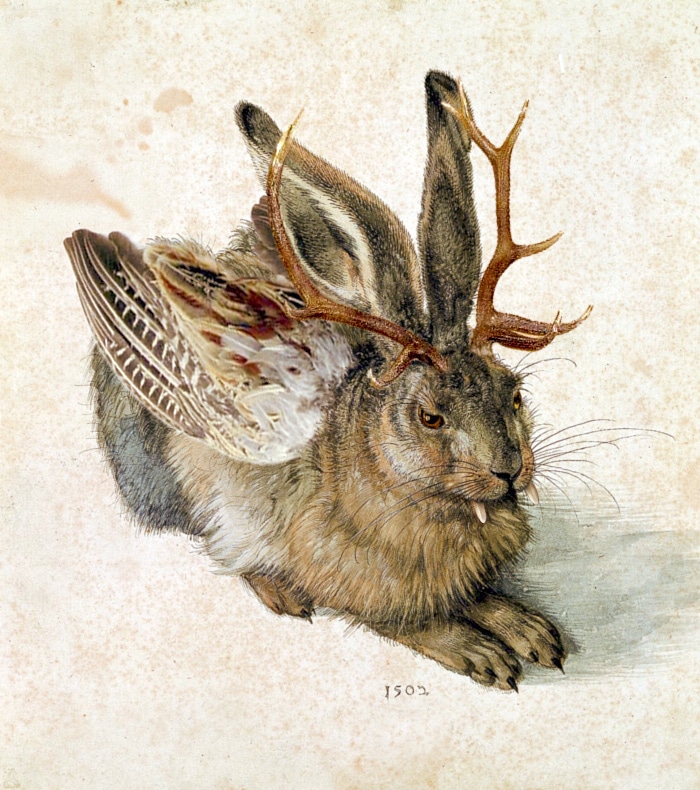
The skvader has the head, forequarters, and hind legs of a European hare (Lepus europaeus) coupled with the feathered back, wings, and tail of a female western capercaillie, often known as a wood grouse (Tetrao urogallus). It has the big ears, large eyes, whiskers, and thin muzzle of a hare. The front of its body is clothed with regular mammalian fur, but the upper back exhibits the brown and gray feathers of a female grouse. It has two large wings growing from its shoulders and a fan-shaped feathered tail instead of the small tail of a hare. The rear legs of the creature are still those of a robust terrestrial mammal, meaning an animal as well adapted to sprinting as it is to leaping. Biologically the combination is impossible, but visually the combo is convincing since the separate elements are taken from real animals. The skvader was eventually given the tongue-in-cheek scientific name Tetrao lepus pseudo-hybridus rarissimus, a deliberately ludicrous name indicating an extraordinarily uncommon hybrid between a grouse and a hare (Sveriges Radio, 2018).
The name itself comes from the animal’s odd composition. The Svenska Akademiens ordbok, the historical dictionary of the Swedish Academy, explains that the word skvader is composed of parts related to skvattra, meaning to babble, quack, or chirp, and tjäder, the Swedish word for wood grouse (Svenska Akademien, n.d.). The name that results implies an animal that belongs half to the world of birds and partially to that of mammals. The word came to mean more than the fabled creature throughout time. In Swedish, “svader” can mean an odd mixture of contradicting or ill-fitting parts. So the statement became a language expression for the precise trait that makes the animal memorable: two things that typically do not belong together, linked together.
As the skvader is a mythical creature, any description of its behavior must obviously be speculative. It has hare-like legs and probably runs, hops, and makes quick leaps through the bushes to evade predators. The wings might possibly aid in brief bursts of movement or extra lift when jumping, but the anatomy of the animal would make true flying quite unlikely. Its food may be similar to that of a hare and consist of grasses, herbs, bark, and delicate shoots, or include the leaves, buds, and berries used by grouse. The mix of mammalian and avian traits also makes for funny questions concerning reproduction, nesting, and communication. Would it build a nest or den in the grass? Would it sound like a bird, or would it be rather silent like a hare? Such possibilities belong only to the realm of speculative folklore. There are no authenticated sightings to confirm that a living skvader ever existed.
Origins of the Legend and the Taxidermy Specimen
The legend usually starts with Håkan Dahlmark, a Swedish hunter who said he shot the remarkable creature in 1874 while out hunting in the woods north of Sundsvall. The story goes that the allegation originated in a dinner conversation in a restaurant in Sundsvall around the turn of the twentieth century. Dahlmark amused his company by describing an impossible creature—a combination of a hare and a bird. The other visitors seemed to have accepted the story as a funny hunting exaggeration, but the specifics were uncommon enough to be recalled. Hunting stories have been a way to tell tales, compete, and make jokes for a long time, especially when hunters discuss animals they claim to have seen in the far wilderness. Dahlmark’s narrative was of this tradition; however, a far more comprehensive history was later given to it (Thaning, 1982).
In 1907 the legend made a giant step toward becoming a recognizable cultural phenomenon. On his birthday, Dahlmark’s housekeeper gave him a painting of the creature he had described. It was a picture made by her nephew and intended as a hilarious gift. The artist merged the known head and legs of a hare with the feathered wings, back, and tail of a grouse, creating the look that would become associated with the skvader. Dahlmark reportedly liked the painting enough to keep it. He donated the painting to a local museum before his death in 1912. The painting turned the oral hunting story into a permanent visual form. The imaginary being could now gain a stable identity that could be communicated to those who had not heard Dahlmark’s original story (Thaning, 1982).
In 1916 a museum official encountered the Swedish taxidermist Rudolf Granberg at an exhibition in Örnsköldsvik. The representative told the account of Dahlmark’s hunt and there was interest in having the creature rebuilt from the image. Granberg stepped up to the plate and began building a physical specimen from actual animal parts. By 1918 he had finished the mounted skvader, a composite artificial animal made by mixing the body parts of a European hare and a female wood grouse. The specimen, once completed, was shown at the museum in Norra Berget in Sundsvall, where it became a popular attraction. The original painting was maintained as well, so visitors could see both the idea for the piece of art and the final taxidermy product. The difference between the 1916 commission and the 1918 completion is essential since the latter is the time when the real building of the iconic equestrian animal took place (Thaning, 1982).
Granberg’s work shows the persuasive effectiveness of taxidermy in the making of animal frauds. Museum-goers used to seeing specimens mounted often think of them as “real” wildlife, especially if the displays look like scientific exhibits. A fake animal made of real anatomical pieces might exploit that expectation, because its hair, feathers, eyes, and other observable traits look natural. Skvader’s body was physically real, but the species it was meant to symbolize was fictional. This difference is reminiscent of the issues encountered by paranormal researchers when dealing with so-called monster remnants, preserved bodies of aliens, and other such phenomenal objects. An object may be real without validating the interpretation we give it. The skvader is particularly instructive because its artificial fabrication is recorded, eliminating the doubt that typically accompanies allegedly enigmatic specimens.
The fictional scientific name of the skvader adds another layer to its past as a fun parody of natural history. The term “Tetrao lepus pseudo-hybridus rarissimus L.” is said to have been used by Swedish writer and journalist Olof Högberg. The name influenced the design of the creature in reference manuals. The name followed the Latin style of zoologists, providing the illusion that the creature was a recognized species. Högberg also recalled the meeting of the peculiar animal in the forests of Medelpad, according to a 2018 article by Sveriges Radio. The joke classification helped turn the skivader from a local hunting jest into something akin to a scientific discussion. In 2018, when the mounted creature celebrated its hundredth anniversary, the event gained notice in Sundsvall and proved the continued devotion surrounding the innovation (Sveriges Radio, 2018).

Animal Hybrids, Folklore, and Scientific Credibility
The idea of a rabbit-bird hybrid is even older than the Swedish skvader. The first-century CE work, Pliny the Elder’s Natural History, includes accounts of strange animals reported from far-off lands, including an animal classically identified as a cross between a rabbit and a bird that lived in the Alps. The claimed animal has the body of a bird and the head of a rabbit, much like the skvader. When it came to learning about unknown animals, ancient naturalists typically relied on travelers, merchants, hunters, and previous authors. Their accounts were therefore occasionally a mixture of accurate facts and misunderstandings, exaggerations, and mythological beasts. The similarity between Pliny’s described animal and the skvader does not provide a historical link between the two accounts. But it indicates that the concept of mixing rabbits and birds has been alive in European cultures for ages (DeMello, 2024; Pliny the Elder, ca. 77–79 CE/1940).
The skvader also belongs to a broader European history of fictional animal hybrids. The Bavarian wolpertinger is typically shown as a rabbit or other small creature with antlers, wings, fangs, or other physical traits. In Austria there is the Raurakal, and in the Thuringian Forest the Rasselbock. The Elwedritsche is another comparable creature. It is part of the folklore of the Palatinate region of Germany and is usually characterized as a weird birdlike creature with bizarre mammalian features. These contraptions often occur in hilarious hunting lore, local storytelling, and contrived taxidermy exhibits. They seem slightly different, but the premise is the same: familiar creatures can be mixed to create apparently unusual species. These species inspire audiences to think that wildlife unknown to conventional biology exists in isolated jungles (DeMello, 2024; Wikipedia contributors, 2025).
A particularly useful example is the American jackalope. In the twentieth century, the jackalope, usually represented as a jackrabbit with deer or antelope antlers, emerged as a symbol of Wyoming and the American West. Mounted specimens were displayed in tourist outlets, souvenir shops, and private collections, usually accompanied by exaggerated tales of the creature’s speed, temperament, or strange habits. Like the skvader, the jackalope achieved recognition through artificial taxidermy rather than biological proof. Both beasts show how the physical form of an impossible species may buttress a fictional heritage. Their popularity also indicates a crucial contrast between a hilarious invention and a harmful deception. These creatures are liked by a lot of people because they get the joke and admire the creativity that goes into making them (DeMello, 2024).
There are several reasons why the skateboard continues to be popular. One stresses the social purpose of inflated hunting stories. For a long time hunters have been telling their friends about perilous encounters, huge creatures, and amazing finds. Dahlmark’s narrative took the same structure, turning an impossible animal into a funny conversational coup. Another explanation involves the human love affair with hybrids. Griffins, centaurs, mermaids, and other mythical creatures show how often the imagination blends common animals or human elements into strange forms. The skvader is part of this tradition, but it seems more funny than scary. Its face looks hair-like and, hence, therefore, approachable. But the grouse wings are a visual contradiction and unexpected.
Another explanation has to do with the authority of scientific institutions. Museums are repositories of real specimens, collections, and knowledge about the natural world. Visitors may consequently infer that an animal on a mount is a species that formerly lived. The skvader makes use of this assumption through a body that is painstakingly constructed to mimic an actual taxidermy specimen. The made-up Latin name adds a further air of scientific respectability. Such characteristics demonstrate how exceptional statements can be made to look credible by using familiar means of presenting. Similar approaches have been employed in hoaxes involving paranormal monsters, alien remains, and other artifacts claimed to be evidence of mysterious beings. The skvader is a particularly good example here, since the invention of the skvader is documented, and it is publicly admitted to be fictional.
Biologically the skvader cannot exist as the hybrid that it is seen in its mounted form. European hares are mammals, wood grouse are birds, and the two groups belong to evolutionary lineages separated by hundreds of millions of years. Their reproductive organs and genetic differences mean they cannot produce hybrid offspring. The claimed capacity of the creature to fly is also a severe anatomical problem. Birds feature specific skeletal architecture, powerful flight muscles, and respiratory adaptations that facilitate flight. You wouldn’t obtain these features by sticking wings on a rabbit. Even if the animal had movable wings, it would not fly well because it did not have the anatomy to coordinate movements. Thus, the skvader is better viewed as an artistic creation rather than as an unknown species or an exceptional biological mutation.
The Skvader’s Cultural Legacy in Sweden
The skivader’s effect extends well beyond the museum that is home to Granberg’s specimen. It became an unofficial symbol of Sundsvall and has a strong relationship to the adjacent region of Medelpad. In 1987, when citizens were asked to choose an official provincial animal, many supported the skvader. Finally, they settled on the mountain hare, which is a real animal that serves as a humorous compromise, as it resembles the mammalian half of the imaginary beast. The episode showed how deeply the skvader had permeated local identity. “The cultural importance of the skvader was further acknowledged in 1994 with a statue erected in Sundsvall, and a novelty road sign near the museum warns drivers of skvaders crossing the road. The public displays of the creature shift it from a museum oddity to a recognizable part of the region’s cultural legacy (Wikipedia authors, 2025).
The word “skvader” also made its way into the daily Swedish language to describe something made up of mismatched components. During the 1950s and 1960s, the word was used as a nickname for a special combination bus and truck in northern Sweden. The front end of these vehicles was the passenger compartment with an open area in the rear for goods. They worked on minor routes in Norrland, bringing both passengers and cargo, such as milk from farms to local dairies. The skvader term was particularly fitting for their strange mix of transportation responsibilities. The vehicle was like the mythical creature that was a mixture of a hare and a grouse, combining two different modes of transport into one machine. The language development is an example of how a fictitious creature can be used as a practical metaphor for real objects (Svenska Akademien, n.d.; Wikipedia contributors, 2025).
The skivader has even entered Swedish business culture. The monks made a herbal liqueur, Skvaderns, based on ingredients from Lunde Skog—the forest in the classic hunting narrative. The launch of the product was inspired by an old hunting story, as told in a 2013 article in Allt om Whiskey. The drink’s name and its geographical ties united a popular commercial product with a well-known piece of local folklore. Such usage implies the economic and promotional worth of a created monster. The image and narrative of the Skvader have become well known enough to sustain tourism, souvenirs, public events, and regional branding (Allt om Whiskey, 2013).
Perhaps the most interesting aspect of the history of the skvader is the changing meaning of the word itself. The original narrative appears to have been a humorous exaggeration for a small audience. The painting gave the creature a familiar look, and Granberg’s taxidermy specimen rendered it a physical reality. Museum exhibitions and local storytelling brought the animal to new generations. Eventually, the skvader became a local icon, and its cultural value no longer depended on anyone believing it truly existed. This evolution is analogous to that of other fictional beings, which, through repeated artistic productions and public traditions, gain enduring identities. But the skateboarder has a peculiar claim to fame. Its origins are unusually well documented, enabling investigators to watch a created species enter the world of accepted tradition.
The Skvader also offers a great case study for analyzing claims of the paranormal and supposed cryptozoological finds. Its history reveals why physical evidence needs to be looked at in connection to its origins, construction, and recording. A displayed specimen might look impressive, but it may not be a true species, and a scientific-sounding name does not make it biologically legitimate. But to dismiss the skvader as just a false animal would be to neglect its historical value. Its story shows how humor, craftiness, and local pride can keep an innovation alive across centuries. The creature is not real in the biological sense, but it has a cultural reality that cannot be dismissed.
The skvader is one of the most hilarious examples of Swedish folklore, arising as it does from an unmistakable human invention. Its blend of hare and grouse anatomy, its origins in Håkan Dahlmark’s amazing hunting narrative and its manufacture by Rudolf Granberg in 1918 show how a hilarious tale may take a physical shape and achieve an enduring public identity. The comparison to the jackalope, Wolpertinger, and other invented hybrids places the creature in a larger tradition of animal hoaxes, and its effect on Swedish language, transport terminology, regional iconography, and commercial products illustrates its remarkable cultural reach. The skvader never existed as a species, but it became something just as lasting: a familiar icon of Swedish humor and inventiveness. Its history is a reminder that a created beast can become a real part of cultural legacy, even when everyone knows the animal itself is impossible.
References
Allt om Whisky. (2013, August 28). Jägarskröna bakom lansering av svensk örtlikör. https://www.alltomwhisky.se/2013/08/jagarskrona-bakom-lansering-av-svensk-ortlikor/
DeMello, M. (2024). Bigfoot to Mothman: A global encyclopedia of legendary beasts and monsters. Bloomsbury Academic. https://www.perlego.com/book/4279696
Pliny the Elder. (1940). Natural history (H. Rackham, Trans., Vol. 3). Harvard University Press. (Original work published ca. 77–79 CE).
Rubinov, M. (2023). Circular and unified analysis in network neuroscience. Elife, 12. https://doi.org/10.7554/elife.79559
Svenska Akademien. (n.d.). Skvader. In Svenska Akademiens ordbok. https://www.saob.se/artikel/?seek=skvader&pz=1
Sveriges Radio. (2018, June 5). Skvadern fyller 100 år. https://sverigesradio.se/artikel/6969118
Thaning, O. (1982). Sverigeboken. Det Bästa.
Wikipedia contributors. (2025, May 1). Skvader. In Wikipedia. https://en.wikipedia.org/w/index.php?title=Skvader&oldid=1288179454

Leave a Reply