The Tikbalang: Key Points
- The tikbalang is a supernatural creature from Philippine folklore with the head and hooves of a horse and a tall, humanoid body. It inhabits forests, mountains, and isolated roads.
- Known for its mischievous behavior, the tikbalang confuses travelers, causes them to wander in circles, and creates supernatural illusions. Turning clothing inside out is traditionally believed to break its enchantment.
- Tikbalangs are sometimes considered guardians of forests rather than evil monsters. Some legends claim that stealing a magical hair or spike from their mane allows humans to control them.
- The tikbalang may have originated from ancient Philippine spirit traditions influenced by Indian mythology. Its horse-headed appearance resembles Hayagriva, a divine figure associated with Hinduism and Buddhism.
- The tikbalang’s horse-like features may have developed after Spanish colonizers introduced horses to the Philippines in the sixteenth century. Earlier accounts describe supernatural beings without mentioning equine characteristics.
- The tikbalang remains an important figure in Philippine folklore, literature, comics, and modern entertainment. Its legend reflects indigenous spiritual beliefs, colonial influences, and humanity’s fascination with mysterious wilderness creatures.

Introduction
Folklore tells about a weird monster deep in the forests and mountains of the Philippines that has the traits of a human and a horse. Known as the tikbalang, this mysterious beast has terrified visitors and puzzled locals and roamed distant woods for centuries. The tikbalang is unlike the centaur we know from Greek mythology. The centaur has the upper body of a human and the bottom body of a horse, whereas the tikbalang is the reverse. It stands on two legs and has the head and hooves of a horse linked to a tall, humanoid torso. The creature is also called a werehorse and is notably known for luring visitors astray, causing them to walk in circles along forest and mountain roads. The tikbalang is a wonderful example of how supernatural beliefs alter when cultures encounter new creatures, religions, and ideas. Its enduring presence in Philippine narratives reflects the extensive heritage of indigenous spiritual practices, colonial history, and the human tendency to conceive of unusual entities inhabiting the natural world (DeMello, 2024; Eugenio, 2007).
The tikbalang is a monster from Philippine folklore that is said to have the body of a person but the head of a horse (typically shown with horse-like features and disproportionate limbs). In traditional legend, Tikbalang are also said to have trickster-like behavior, the ability to shapeshift, and a tendency to mislead visitors or lure people into woodlands or mazes. These fundamental descriptions situate the tikbalang within the extensive Southeast Asian folklore traditions of shape-shifting forest beings and tricksters prevalent in diverse cultures (Hunt, 2026). Several scholarships on Philippine myth and folklore openly incorporate tikbalang within debates of ritual, narrative function, and intertextual linkages to modern media and literature (Basada & Moyano, 2021; Sugue & Reyes, 2022).
Physical Appearance of the Tikbalang
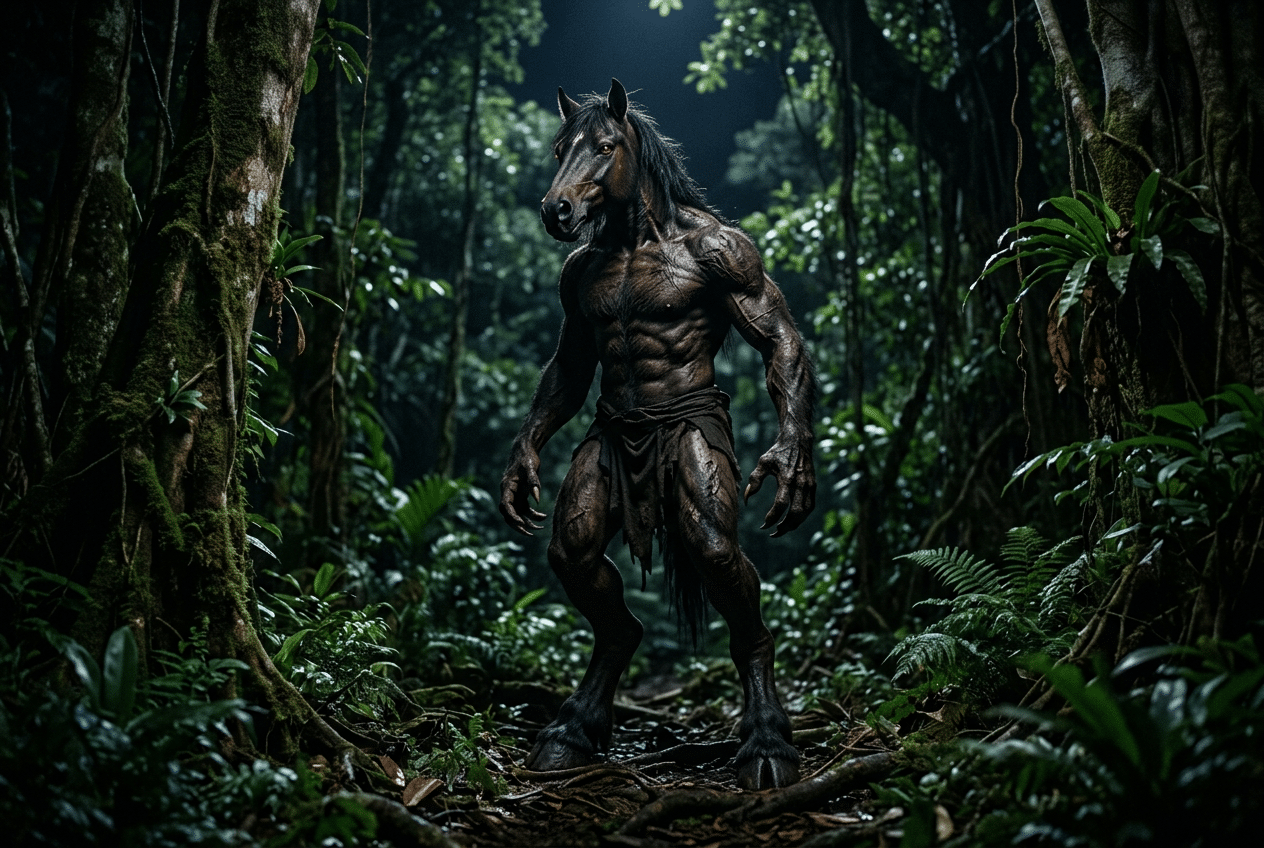
The tikbalang is a bit of a more uncommon human-animal hybrid within folklore. The tikbalang is usually depicted as having a very tall, thin body that is out of proportion, with long limbs and legs that contribute to its creepy appearance. Its head is horse-like with a long snout, pointed ears, big nostrils, and strong jaws. Dark eyes gaze out from under a high forehead, and a mane of coarse hair or sharp spikes extends along its neck. The monster is said to be covered in dark fur, featuring a torso that resembles a human’s and muscular limbs. Its feet terminate in horse-like hooves, and some reports describe it as having extraordinarily long legs with knees that bend at strange angles. The tikbalang may look like a horse, but it usually doesn’t run on four legs. Instead, it stands up and walks through the forest with a disquieting mixture of human and animal motions. DeMello (2024) depicts it as an “ugly, misshapen creature” whose look is in stark contrast to the powerful and graceful pairings of horse and human popularized in Western mythology.
Occasionally the tikbalang’s presence is viewed as a willful breach of the natural order. Horses are usually connected with speed, strength, and beauty. The human form indicates intelligence and civilization. The tikbalang takes these qualities and makes something clumsy and scary out of them. Its limbs are enlarged, and its face is stretched, so it’s hard to tell if it’s human or animal. The physical uncertainty only adds to its reputation for the supernatural. A person seeing an odd silhouette in a dark woodland may think it was another traveler, only to find out that its head is like a horse. Some current creative depictions show the creature as a muscular and menacing figure, while others paint it as skeletal with matted hair and flashing eyes. This variability illustrates the adaptability of folklore, as supernatural beings are rarely described in one single, universally recognized way (DeMello, 2024; Eugenio, 2007).
Habitat, Behavior, and Folklore
The tikbalang traditionally lives in forests, mountains, remote roads, and other places where human settlements meet the wilderness. There are many supernatural creatures in Philippine mythology that are tied to particular natural surroundings. For example, there are spirits said to live in trees, rivers, caverns, and mountains. These entities are sometimes included in the general classification of anito, a word with varying connotations in Philippine traditions that may refer to ancestral spirits, nature spirits, or spiritual forces. One of these larger families of supernatural residents is the tikbalang. They were not necessarily viewed as excellent or evil. Some safeguarded certain specific places, others penalized rude behavior, and many interacted unpredictably with human beings. The Christian divide between divine and demonic forces did not always correspond to their moral character (DeMello, 2024; Eugenio, 2007).
Perhaps the tikbalang’s most notorious action is to purposely confuse travelers. Legend has said that the creature haunts rural pathways, woodland intersections, bridges, or mountain roadways. It employs magical powers to distort the traveler’s perspective of the area around it when an unwary individual approaches. Familiar pathways turn into unfamiliarity, landmarks vanish, and what should be a few minutes of travel takes hours. Victims may circle, never realizing that they are passing the same tree or rock multiple times. Some versions of the story suggest that the tikbalang creates illusions, causing travelers to believe they are moving forward when, in fact, they are retracing their steps to their original position. This misunderstanding seems to be enjoyed by the monster, indicating that it is not motivated by a desire to murder but rather by mischief (DeMello, 2024).
The forest is a common backdrop for interactions with tikbalang, placing them on the border between the civilized and the wild. This concept fits with folklore traditions of forest entities meeting travelers, leading them astray or acting as guardians of liminal regions. Other readings are supported by discussions of tikbalang in postcolonial and folkloristic analyses, which underscore the forest as a site of interaction with other-than-human agents (Basada & Moyano, 2021). Tikbalang stories operate as cultural tools for teaching caution in traveling, orientation, and respect for local knowledge, as well as entertaining motifs in a larger system of Filipino myths and legends. The broader folklore literature highlights the educational and socializing functions of legendary figures, which can be applied to the Filipino context of tikbalang stories (Ben‐Amos, 2021; Basada & Moyano, 2021).
One of the old ways to escape away from the tikbalang’s effect is to flip your clothes inside out. The logic is not always the same, but the action is thought to interfere with the creature’s supernatural deception and to restore the traveler’s sense of direction. Other protective traditions include praying, carrying religious symbols, or respectfully asking permission before visiting a place believed to be the domain of supernatural creatures. These customs are an interplay between the older Philippine spiritual beliefs and the Catholic practices brought in by Spanish colonization. The tikbalang’s ability to confuse humans is similar to the actions of fairies in European folklore. In British and Irish folklore, travelers can occasionally be pixie-led or fairy-led, meandering around familiar territory but unable to locate their way home. Another old remedy against fairy enchantment is to turn clothes inside out. The existence of such commonalities suggests that disparate civilizations have independently come up with similar explanations for the scary feeling of being lost in strange surroundings (Briggs, 1976; Eugenio, 2007).
The tikbalang can startle people but is not necessarily portrayed as evil. In some traditions it is also represented as a protector of woods and mountains and punishes those who destroy its area or behave disrespectfully toward nature. Others describe it as a prankster mentality that loves practical jokes. This distinction is important because the creature is not necessarily malevolent in the Christian sense. It may be deadly or useful, indifferent or just unpredictable. The tikbalang is consequently like other supernatural tricksters whose behavior depends on the conditions of a meeting. In other myths, it can even become a servant or protector if a person manages to control it (DeMello, 2024; Eugenio, 2007).
Perhaps the oddest tikbalang lore is the belief that the monster may be captured or tamed. Some accounts say if a person obtains one of the special hairs or spikes from its mane, they can force the tikbalang to do their bidding. Other tellings include golden hairs of supernatural import. The task is tremendous because the monster is physically imposing and tough to get close to. Folklore, however, suggests that a brave or bright enough person would be able to defeat the tikbalang, turning a frightening forest spirit into a strong ally. DeMello (2024) likens this concept to the myths of selkies and swan maidens—supernatural beings whose freedom can be controlled by humans who hold their animal skins or feather robes. In each instance, the physical object serves to manipulate a creature that is typically beyond human control.

Historical Origins and Interpretations
What is particularly intriguing about the tikbalang is its history, as its current look poses a question regarding the relationship between folklore and cultural development. Before interaction with the Europeans, most Filipinos knew of no native animals that were horses. Horses were brought by the Spanish invaders in the sixteenth century. Over time, the animals were linked to transportation, agriculture, military force, and colonial authority. But there may have been stories of supernatural entities that looked like the tikbalang before horses came. DeMello (2024) suggests that the creature’s equine features were most likely added to an ancient supernatural narrative following the encounter of the Filipinos with these strange beasts. If this interpretation is right, the tikbalang is an example of a mythical creature that underwent a drastic change in appearance while maintaining an ancient identity.
The earliest European reference is a description of Tagalog practices found in the writings of a Franciscan missionary, Juan de Plasencia, in 1589. His description concerned indigenous supernatural beliefs and portrayed beings that Spanish religious observers understood in terms such as ghosts, goblins, and demons. This material is identified by DeMello (2024) as an early reference to the tikbalang, and the description does not include a horse-like aspect. That absence is instructive, albeit it does not tell us when exactly the familiar horse-headed form appeared. The story of Plasencia must also be read carefully, since the missionaries often interpreted the religious rites of the natives through the prism of Catholic theology. A supernatural being recognized locally as a forest spirit, for example, can become a demon in the vernacular of a Spanish missionary. Such descriptions tell as much about colonial religious attitudes as they do about the ideas being recorded (DeMello, 2024; Plasencia, 1589/1903).
Spanish colonial officials regularly sought to replace indigenous religious practices with Roman Catholic Christianity. But there were a lot of older supernatural traditions that survived, often with a Christian gloss, or symbols, or explanations. In one version, it’s a demon; in another, it’s a mischievous spirit of the wilderness. Amulets, talismans, prayers, and protection rituals also persisted in local traditions. This combination of religious influences shows how cultures can acquire new beliefs without fully rejecting ancient notions of the supernatural. The tikbalang’s survival is proof of the resilience of local narrative traditions to centuries of colonial theological pressures (DeMello, 2024; Eugenio, 2007).
Another idea links the tikbalang to religious and mythical traditions coming from India. During the first millennium CE, Hindu and Buddhist ideas expanded throughout most of Southeast Asia, impacting political systems, religious practices, creative traditions, and folklore. Such influences filtered into sections of the Philippine archipelago through regional trade and cultural contact, especially through interactions with marine Southeast Asian communities. In Indian mythology, there are many beings with human and animal features, from gods to supernatural guardians and divine incarnations. DeMello (2024) proposes that this broad circulation of religious iconography might have had some impact on the making of the tikbalang.
A useful analogy is the creature’s relationship to the centaur. In Greek myth centaurs are generally seen having the body of a horse but with a human torso, arms, and head. The centaur often symbolizes the conflict between civilized behavior and unrestrained primal instincts. Some centaurs are violent and rebellious, while others, like Chiron, are connected with wisdom, healing, and education. The tikbalang flips the well-known body plan and creates a humanoid with a horse head and hooves. Furthermore, its conduct is different from most classical centaurs. As a rule, it avoids conflicts and does not express unbridled impulses but manipulates travelers and lives in solitary wilderness. The contrast shows how human-horse hybrids can acquire quite varied meanings depending on the cultural traditions in which they occur (DeMello, 2024; Graves, 1955).
The tikbalang possesses traits similar to European fairy beings and other magical tricksters. Fairies are often connected with distant natural settings, deceiving appearances, and the ability to meddle with human perception. Some penalize those who trespass boundaries or behave in a disrespectful manner. Others just want to cause confusion. This broader pattern easily accommodates the tikbalang’s tendency to fool travelers. But these parallels do not necessarily mean that Philippine folklore was a direct borrowing from the fairy traditions of Europe. Different communities may separately create legends about supernatural entities to account for harmful or puzzling experiences in the outdoors. This parallel is useful because it draws attention to patterns of human anxiety concerning lack of agency, transgression, and the confrontation with forces beyond the realm of everyday experience (Briggs, 1976; DeMello, 2024).
There are many naturalistic hypotheses that can explain experiences attributed to the tikbalang. Navigation in the dense tropical forests can be quite challenging, particularly if the routes are poorly defined or sight is limited. When familiar landmarks are lost to the traveler, they may become disoriented and unwittingly circle back to places they have already been. Darkness, tiredness, fright, and strange noises might make it even worse. Supernatural beliefs, familiar to us, can provide an explanation for experiences with unexpected noises or undefined figures between trees. After a community links a particular forest to tikbalang activity, succeeding travelers may be more attuned to unusual goings-on at that place. These psychological and environmental elements could account for reported experiences without needing the reality of a real horse-headed entity.
Another interpretation views the tikbalang as a symbolic representation of the hazards that exist in untamed situations. Forests and mountains can supply food, water, medicine, and shelter, but they also hold dangers that are difficult to forecast. A supernatural protector could symbolize the necessity of being cautious and respectful of such areas. Stories of those who stray after insulting a spirit can help remind people to behave with caution and reinforce traditional boundaries. This view is not to imply that the tikbalang was purposely created to educate about the environment. Instead, its stories may have acquired actual societal implications over time. Similar dynamics occur in other societies when supernatural entities are linked to perilous rivers, caves, or forests.
Another idea considers the tikbalang in relation to the history of Spanish colonialism. When the horse was introduced into the Philippines by the Europeans, it was a new kind of animal power. Communities may have been impressed by their size, speed, and usefulness in war. The horse-headed tikbalang may have originated in part with the addition of this powerful new animal to previous supernatural traditions. The creature’s fearsome image may then be a metonym for a familiar forest spirit, made over by colonial society’s images. This reading is conjectural, yet it provides a plausible account of how an earlier supernatural entity gradually acquired the traits of a horse (DeMello, 2024).
From a scientific perspective, there’s no evidence that tikbalangs exist as biological entities. There are no documented physical remnants, genetic material, or independently corroborated observations that demonstrate the presence of a human-horse hybrid living in Philippine jungles. The creature is thus better understood in terms of mythology and cultural belief than as a kind of verified animal. But to disregard the tikbalang simply because it has no biological basis would ignore the historical and social knowledge that its stories hold. Folklore is the lens through which individuals make sense of strange situations, express their concerns, and explain their relationship with the natural environment. Perhaps the supernatural claims cannot be substantiated, but the traditions themselves remain worth studying from a historical and cultural perspective.
Cultural Impact and Preservation
The tikbalang still lives on in Philippine culture through oral storytelling, in literature, in comics, on television, and in modern fantasy. Modern representations typically highlight its horrific look, magical strength, and association with the woods. Some reimagine it as a monster that preys on humanity, others as a misguided guardian, or a creature that can make relationships with humans. Philippine fantasy literature has been especially useful in adapting traditional supernatural beings for modern readers. Tikbalangs feature in the graphic novel series Trese by writer Budjette Tan and artist Kajo Baldisimo, set in a mystical version of modern Manila. The series borrows from Philippine folklore, placing traditional entities in stories of crime, urban life, and battles among supernatural societies (Tan & Baldisimo, 2008).
Such changes demonstrate how the tikbalang has expanded its range beyond its natural forest home. It originally lived in far mountains and secluded routes but now it is present in large cities, in modern fantasy realms, and in international entertainment. Sometimes these representations alter its original features, giving it new powers, new personalities, or new connections with people. Commercial versions may simplify traditional ideas, but they also introduce Philippine folklore to consumers who might know little about it. The tikbalang has become a familiar figure writers and artists can use to explore cultural identity, supernatural traditions, and the relationship between past beliefs and current culture.
There is more to the tikbalang than just entertainment value. That it has survived is proof of the enduring importance of indigenous and local customs in a country that has undergone centuries of religious and political change. The tales of the creature are a record of earlier relationships between tribes and their surroundings. They also highlight how folklore can take in influences from outside yet retain its local uniqueness. Possible links with Indian mythology, the introduction of horses during the Spanish colony, and the survival of ancient protective practices show several phases in this process. Filipino folklore, as recorded by Ratcliff (1949), is abundant in a diversity of supernatural beliefs, and more recent anthologies such as Eugenio’s (2007) have been crucial to preserving traditional narratives for contemporary readers and researchers.
The tikbalang also poses problems regarding the preservation of folklore in the modern world. Oral traditions alter with the teller and the audience, and there is a great deal of variation between different regions of the Philippines. The modern internet description often takes details from several cultures and mixes them into a single standardized creature. Such explanations can make folklore more accessible, but they can also obfuscate local variances and the historical conditions behind specific beliefs. Thus, it is beneficial to record the provenance, history, and chronology of Tikbalang stories for a more profound understanding of their evolution. Different versions allow future academics to separate older traditions from newer reinterpretations and to understand that retellings have always altered folklore.
Conclusion
Thus, the tikbalang remains one of the more unique supernatural creatures of Philippine folklore with the disturbing image of a horse-headed humanoid and the erratic nature of a woodland trickster. It contains terrifying encounters, supernatural deceit, defensive rituals, and the chance of influencing a powerful spirit through possession of a magical instrument. Indian religious imagery, indigenous Philippine spiritual traditions, and the arrival of horses during Spanish colonization may have influenced the creature’s historical growth. None of these hypotheses have been definitively proven, and the origins of the tikbalang are still somewhat unclear. But its importance is not to prove that a werewolf genuinely exists. The tikbalang embodies generations of tales about the perils of wildness, the borders between the human and supernatural worlds, and the shifting beliefs of Philippine civilization. From distant mountain trails to contemporary comics and television, this bizarre horse-headed apparition still walks the cultural imagination, reminding us that even the most fearsome of monsters can carry centuries of history within their traditions.
References
Basada, D. J. L., & Moyano, M. A. G. (2021). Breaking-away from the comfort zones: Postmodernism in selected Philippine contemporary novels in English. International Journal of Language and Literary Studies, 3(1), 130–150. https://doi.org/10.36892/ijlls.v3i1.468
Ben‐Amos, D. (2021). Introduction to the special issue “The challenge of folklore to the humanities.” Humanities, 10(1), Article 18. https://doi.org/10.3390/h10010018
Briggs, K. M. (1976). An encyclopedia of fairies: Hobgoblins, brownies, bogies, and other supernatural creatures. Pantheon Books.
DeMello, M. (2024). Bigfoot to Mothman: A global encyclopedia of legendary beasts and monsters. Bloomsbury Academic. https://www.perlego.com/book/4279696
Eugenio, D. L. (Ed.). (2007). Philippine folk literature: An anthology (Vol. 1). University of the Philippines Press.
Graves, R. (1955). The Greek myths. Penguin Books.
Hunt, K. M. R. (2026). How weather got its words: A history of meteorological English – Part 2: The scientific age and beyond. Weather, 81(10), 337–341. https://doi.org/10.1002/wea.70101
Plasencia, J. de. (1903). Customs of the Tagalogs. In E. H. Blair & J. A. Robertson (Eds.), The Philippine Islands, 1493–1898 (Vol. 7, pp. 173–196). Arthur H. Clark Company. (Original work written 1589)
Ratcliff, L. K. (1949). Filipino folklore. The Journal of American Folklore, 62(245), 259–289.
Sugue, A. S., & Reyes, M. M. (2022). Rediscovering the value of Philippine mythology for Philippine schools: Literature review. International Journal of Language and Literary Studies, 4(3), 329–341. https://doi.org/10.36892/ijlls.v4i3.1057
Tan, B., & Baldisimo, K. (2008). Trese: Murder on Balete Drive. Visual Print Enterprises.
Leave a Reply