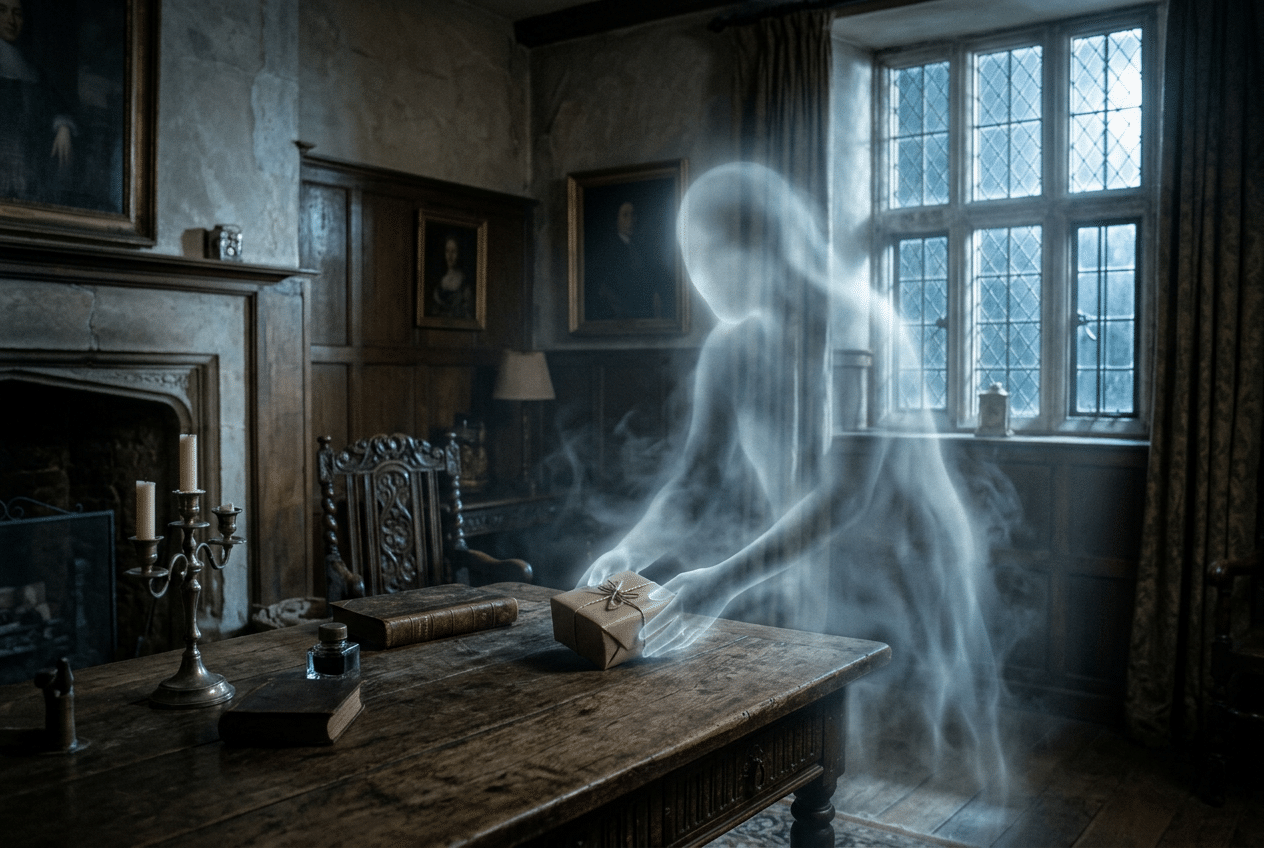
Ghosts Who Leave Gifts: Key Points
- Ghosts who leave gifts supposedly provide coins, jewelry, flowers, or personal possessions. These objects are often interpreted as messages of love or reassurance from deceased relatives.
- Gift-giving ghosts may appear as translucent figures, deceased family members, shadows, or invisible presences. Their gifts often appear unexpectedly in meaningful locations.
- European folklore describes household spirits such as brownies, hobs, and tomte that reward humans with coins, good fortune, or assistance. These traditions overlap with stories of friendly ghosts.
- Spiritualist traditions describe apports, objects supposedly transported or materialized through supernatural means. Flowers, coins, and jewelry appearing during séances are sometimes attributed to spirits.
- Theories include surviving consciousness, psychokinesis, mistaken memories, psychological influences, and deception. No scientific evidence establishes that ghosts can produce or transport objects.
- Gift-giving ghost stories express the desire to remain connected with deceased loved ones. They provide comfort, preserve memories, and suggest that affection might survive death.

Introduction
Ghosts are commonly connected with frightening apparitions, baffling sounds, and chilling encounters with the paranormal. Another tradition suggests that the dead are preserved as a physical reminder of the deceased person, allowing generously generous guests who leave gifts for the living. These presents may be currency, jewelry, flowers, personal effects, or things that arrive inexplicably in odd places. Occasionally the present is something that belonged to a deceased family member, but there are also tales of strange artifacts appearing with no known origin. These encounters are commonly viewed as signs of love, appreciation, protection, or comfort from beyond. Tales of supernatural gifts frequently connect with earlier beliefs of domestic spirits, fairies, and beneficent ancestors. No scientific proof exists that ghosts can make or move physical items. Such narratives do demonstrate a continuing belief that relationships can remain after death. The ghost that leaves behind a present subverts the typical idea of a spooky haunting and injects an interesting concept into the world of supernatural folklore: maybe some ghosts come back because they have something to give.
Appearance and Behavior of Gift-Giving Ghosts
Ghosts connected with presents are said to be ordinary individuals, not the horrible beasts of some supernatural stories. They can appear as transparent beings, shadowy outlines, or as recognizable deceased family members in familiar clothes. The old woman could be put in a beloved dress, or the dead spouse in his life clothes, or the child as a miniature figure by a bed. Other reports are of shadowy figures, or glowing shapes or apparitions that vanish when approached. Some claimed gift-giving spirits never make an appearance, their existence being simply deduced from objects appearing, disappearing, or moving around for no apparent reason. This variety is similar to the larger history of apparitional experiences in which witnesses record everything from detailed human forms to nebulous perceptions of an unseen presence (Society for Psychical Research, n.d.-a).
These ghosts tend to manifest more intimate than menacing behaviors. Instead of rattling chains or pursuing intruders, they are said to leave little objects where certain folks will find them. A penny could be on a bedside table, a piece of jewelry in a drawer, or a photograph among items already checked. In stories featuring dead family members, the things typically have emotional ties to the dead. A cherished piece of jewelry, for instance, can be evidence that the old owner is still around. The timing might be just as crucial as the gift itself. Such findings may be reported around birthdays, anniversaries, holidays, or periods of bereavement. The supernatural interpretation holds that these circumstances mean the spirit purposely chose a time at which its presence will be especially consoling. There are many such stories, and the tradition of ghosts that visit with a purpose and return to speak with the living is much larger (Society for Psychical Research, n.d.-a).

Folklore of Supernatural Gifts and Ancestor Spirits
One of the oldest themes related to supernatural gifts is the concept that spirits continue to have an interest in the families that they formerly occupied. Invisible or partially visible beings who guard homes, handle housework, and sometimes reward individuals for kindness or virtuous behavior are common in European folklore. Brownies, hobs, and other similar household spirits were notably linked with the hearth, the kitchen, and other domestic settings. Although their behaviors coincide with later stories of benign hauntings, they were typically thought to be otherworldly occupants, not the souls of dead humans. In some British customs, a servant or dairymaid who satisfied the resident ghost may receive a sixpence in her shoe. Such benefits imply that supernatural creatures may be aware of human behavior and may respond with material presents (Rivers Cofield, 2010).
An especially intriguing link between ghost legends and seasonal folklore serves as a physical reminder of the deceased person, allowing for the habit of gifts appearing in shoes or stockings. Supernatural visits in northern Europe were said to reward virtuous behavior with coins, candy, and other little presents. Household spirits of Scandinavia, such as the tomte and the nisse, were part of customs that eventually became connected with presenting gifts at Christmas. These figures were not normally categorized as human ghosts, although they had many features in common with benevolent spirits of the dead. They would enter houses, often undetected, and may alter the fate of the people living there. Offerings of oatmeal, milk, bread, or other food helped preserve a positive relationship with them. It was an interaction that contained a notion that humans and supernatural beings might establish reciprocal duties, where presents served as tangible proof of an invisible relationship (Rivers Cofield, 2010).
The relevance of supernatural gift-giving was established by the folklorist Stith Thompson in his Motif-Index of Folk-Literature. He classifies fairy traditions as including supernatural entities who provide humans money, wishes, and magical goods. Some stories talk of obviously useless things like coal or soil being turned to gold. Some are about mystery donors rewarding generosity or unexpected support. These are reports of fairies and similar supernatural entities, rather than ghosts as such, but they create a long-standing narrative pattern of otherworldly beings passing precious goods into human ownership (Thompson, 1955–1958). The similarity to recent ghost-gift stories is eerie. Both faiths see an unexpected object as a sign of communication between the ordinary world and an invisible one.
Japanese folklore also has a similar tradition in the form of the zashiki-warashi, a supernatural child who haunts traditional households, notably in the Tohoku region. They are usually described as youngsters with human features, often in old-fashioned clothes, who emerge for short periods of time. They are thought to bring good fortune to a house when they appear, and when they leave, bad luck may be on the way. The zashiki-warashi is generally considered a home spirit or kami; however, some local versions associate it with dead children. Its link to gift-giving is mostly indirect, as the advantage it is said to bring is continued good luck rather than a physical item. But the tradition shows that a supernatural presence might be perceived as a benevolent guardian, a childish presence whose prolonged existence benefits the living (Japan.je, n.d.).
The stories of dead relatives giving presents are closely related to ideas about ancestors. In many cultures it is believed that the deceased maintain an interest in the welfare of their living kin. Ancestors may be honored with offerings, prayers, memorial rites, and preservation of personal artifacts. Gift-giving is normally from the living to the dead, though the relationship can also be viewed as reciprocal. The living supply of nourishment, recollection, and ritual attention. Ancestors are believed to give protection, blessings, or good fortune. Asian ghost festivals have been discussed in religious and philosophical terms that emphasize the significance of presents in maintaining the bond between living societies and the deceased (Yeng, 2019).
The present serves as a physical reminder of the deceased person; allowing reciprocal relationships can explain why an unexpected object may be interpreted as a gift from a deceased loved one. Someone who recently lost a parent can see a familiar coin and remember a childhood memory. Someone grieving a spouse may come across a misplaced keepsake and take the discovery as a message that the affection continues. The item itself may be nothing special, but it holds extraordinary emotional value for the receiver. In this situation, the supposed ghost is usually considered a familiar entity. It’s a person—and we already know who that person is, what they’re like, and how they relate to the living. The present signifies the ongoing nature of a relationship that death has interrupted.
Apports, Hauntings, and Supernatural Objects
Some paranormal reports go beyond the surprising appearance of recognized objects and describe what investigators call apports. An apport is an object that is believed to have been transferred or materialized by paranormal methods, usually during a séance or other manifestation of spirits. In a spiritualist reading, these can be flowers, coins, stones, jewelry, or little personal possessions. An object may be said to materialize upon a table, or to drop from a space seeming devoid of content, or to be found in a room where witnesses are convinced it could not have been put by usual means. They are not just stories about lost things, because the core premise is about the unexplained presence of actual substance. Sometimes historical occult writers attributed such powers to spirits or other unseen entities, but the claims themselves do not show that supernatural transit occurred (Percival, n.d.).
The idea of apports was particularly alluring in the spiritualist movement, as it purported to provide physical proof of contact with the dead. A spoken word may be misinterpreted, imagined, or invented, but a physical thing appeared to be harder to dismiss. A flower emerging during a séance could be seen as a sign of love from a deceased relative. A coin can be used as proof that a spirit can manipulate the physical world. But its seeming firmness did not help in resolving the mystery of its genesis. The investigators had to examine the possibility that participants had hidden things, altered the environment, or misread what they had seen. Psychical research history shows that remarkable physical claims require careful attention to observation, recording, and possibilities of fraud (Society for Psychical Research, n.d.-b).
The understanding of an object as a supernatural gift also depends upon the behavior attributed to the spirit. During a haunting, objects may be hurled, destroyed, or moved in the normal course of frightening the inhabitants. In friendly hauntings, the same physical disruptions are seen as attempts toward communication or support. If you set a coin gently on a table, you could consider it a gift. You might view it as an assault if you toss the same coin across a room. The difference is mostly a matter of circumstance and the interpretation of the witness. Researchers investigating allegations of poltergeists have recorded accounts of misplaced objects, inexplicable sounds, and other physical disturbances. Some incidents are related to specific buildings, and some appear to be about people. The causes are still under discussion, and recorded instances of strange happenings do not prove that they were caused by spirits (Society for Psychical Research, n.d.-b).
But not all supernatural gifts are welcome. Some folk traditions hold that gifts from otherworldly beings entail obligations, concealed hazards, or expectations of return. Magic gold can lose its value, magic objects can bring bad luck, and accepting supernatural help might form a bond that is hard to break. These motifs show that receiving a gift from an invisible benefactor can be both lucky and unnerving. Thompson’s (1955–1958) taxonomy of fairy narratives shows how supernatural gifts could be rewards, tests, or instruments of magical control. Similar themes in ghost stories may bring up odd objects that create unsettling inquiries about the motives of the putative donor. It may be comforting to have a possession of a dead relative, but an object that keeps reappearing may be anxiety-inducing. Hence, the present is not always interpreted as a sign of kindness.
Different sources vary in how literally they take the phenomena. Some researchers view hauntings/gifts as actual happenings, while others emphasize social construction, psychological processes, or narrative elements. This disparity is expressly noted in texts that explore trustworthiness, epistemology, and genre fusion (Matiychak, 2019; Parker, 2021; Sommer, 2012). The ethical and cultural examination of gifts interacts with hauntology in different ways depending on the cultural setting. Derridean gift theory and Maussian frameworks provide a universal foundation, but ethnographic nuances (e.g., Southeast Asian gift rituals) demand careful translation into haunted narratives in different cultures (Yeng, 2019; Snodgrass, 2001). Some sources focus on the enabling role of modern media technologies in amplifying fright and haunt, while others are more concerned with psychological interpretation or anthropological ritual analysis, resulting in a spectrum of interpretations rather than a single consensus (Lilek, 2020; Matiychak, 2019; Paquet-Deyris, 2012; Parker, 2021).
Theories and Cultural Impact
One explanation for the gift-giving ghosts is the survival hypothesis. This theory states that human awareness survives physical death. The dead, in this view, have some personality, memory, and intention left. They may attempt to contact the surviving relative by means of dreams, apparitions, sounds, or the movement of tangible objects. So a ghost leaving a present would be expressing a familiar human sentiment through magical methods. The idea is that a surviving consciousness can affect matter in some way, either directly or via some unknown method. Some psychical researchers have investigated survival explanations for apparitional experiences, but no acceptable scientific demonstration has been made to show that departed individuals may transfer or materialize items (Society for Psychical Research, n.d.-a).
One related view is that of psychokinesis, the supposed power of the mind to affect physical objects without using ordinary physical contact. Some parapsychologists have claimed that apparent poltergeist activity may be the work of live humans experiencing psychological stress, rather than the dead. This explanation is sometimes known as repeated spontaneous psychokinesis. When considering gift-giving ghosts, it suggests the potential that an emotional attachment to an object by a living person could somehow be the cause of its mysterious movement. Yet psychokinesis itself has not been empirically proved and the hypothesis does not have a known method of generating items or moving them through solid boundaries. It remains a hypothetical paranormal explanation rather than an established alternative to common physical explanations (Society for Psychical Research, n.d.-b).
Psychological explanations provide an alternative view. In humans, memory is reconstructive, and people do not always properly remember where they put objects or when they last encountered them. Sometimes something that is thought to be lost has just been put away in an odd place and forgotten. It can seem unusual when it turns up again, especially if the object has emotional ties to a person who has passed on. Grief can make a person more sensitive to reminders of the dead. People may start seeing meaning in coincidences that they would not have noticed otherwise. This means the emotional experience is true. The comfort, surprise, or reassurance may be genuine even if the object’s appearance has an ordinary explanation.
Interpretation of divine gifts may also be influenced by environmental and societal factors. Dagnall et al. (2020) explored the link between alleged haunted sites and anomalous experiences, including the contribution of the physical environment, perception, expectation, and psychological processes to hauntings claims. Their conversation implies that supernatural explanations cannot be divorced from the context in which experiences occur. A person who already believes a house is haunted might see an unfamiliar object differently than someone who doesn’t have that anticipation. Similarly, families that often debate the potential of contact with dead relatives may be especially prone to inexplicable finds. Cultural beliefs influence the interpretation of strange events as chance, haunting, or dead people’s acts of compassion.
We must also examine the possibility of intentional deceit, particularly when apparent gifts are showcased in organized paranormal shows. Objects can be hidden, placed, or moved without observers knowing. In poor lighting, with emotional excitement and expectation of supernatural activity, it is difficult to notice such actions. Historically, the claims of materializations in séances highlight the significance of independent observation and controls. A proper investigation would have to find where the object came from, document the circumstances of its manifestation, and rule out ordinary potential for human participation. Even a genuinely unexplained discovery would not, on its own, prove that a ghost was responsible. And the lack of immediate explanation is not evidence of any special divine cause.
Ghost tales about gift-giving have a cultural influence beyond problems of paranormal proof. In these stories, the notion that death does not necessarily rule out charity, affection, or family duty is maintained. A grandma who has died but who leaves behind a prized thing continues to play a familiar function as a caring family member. A dead parent who gives a symbolic present is nevertheless a source of reassurance. Such stories can allow surviving families to mourn and to stay connected to individuals they’ve lost. The deceased are friends and guardians rather than dangers, and they provide a less threatening view of ghostly encounters.
Contemporary traditions around memorial objects and haunted locales reflect the influence of these beliefs. Visitors to the K. Pierce Mansion in Gardner, Massachusetts, have reportedly left flowers, perfume, jewels, coins, and personal notes for the spirits believed to inhabit the building. These donations, which move in the opposite direction of the gifts attributed to ghosts, imply a similar concept regarding the connection between the living and the dead. Visitors interact with the purported spirits as individuals who have personalities, likes, and emotional needs. Some leave items related to some of the former residents to show respect or to make a connection (S. K. Pierce Mansion, n.d.).
The gift-giving ghosts also have an intriguing place in the evolution of supernatural tales. Traditional traditions typically tell of the dead coming to demand justice, to reveal secret crimes, to ask for a proper burial or to warn their living family of danger. The gift-giving ghost disrupts this pattern in that the point of the haunting seems to be generosity. Instead, the spirit delivers something concrete, rather than asking the living to do a duty. Such a reversal may help explain the appeal of such stories. They transform a mundane item into a symbol of exceptional love, implying that the deceased still have the ability to look after the living. Though the supernatural present may be tiny, its purported provenance imparts it a meaning that much exceeds its monetary value.
The enduring popularity of these stories also shows the value of physical objects in keeping memory alive. People typically closely identify jewelry, photographs, notes, coins, and other belongings with themselves. These objects can attain emotional significance after death that they did not have in the person’s life. When something appears unexpectedly, it can seem like a deliberate act of communication. The gift serves as a physical reminder of the person, allowing the recipient to maintain a connection with someone who is no longer alive. So the cultural significance of the narrative does not rest solely on whether a ghost really moved the object. The story turns a common object into a sign of lasting relationships.
Conclusion
One of the most benevolent customs within the context of supernatural folklore is that of gift-giving ghosts. The purported apparitions and activities link contemporary narratives of deceased relatives to pre-existing concepts of home spirits, protection and magic by ancestors, and connection between the living and the dead. Some are described as unmistakable human figures. Others are invisible and only recognized by artifacts reportedly left behind. Theories include survival of consciousness, psychokinesis, psychological processes, memory misperceptions, and intentional deceit. No one has shown that ghosts can literally bring presents, yet the legends nonetheless hold emotional and cultural value. They want to believe that love can outlast death and that the dead may still remember their loved ones. Call them paranormal experiences, significant coincidences, or sorrow manifestations; they show a common human yearning that the dead may sometimes return and deliver something more soothing than terror.
References
Dagnall, N., Drinkwater, K. G., O’Keeffe, C., Ventola, A., Laythe, B., Jawer, M. A., Massullo, B., Caputo, G. B., & Houran, J. (2020). Things that go bump in the literature: An environmental appraisal of “haunted houses.” Frontiers in Psychology, 11, Article 1328. https://doi.org/10.3389/fpsyg.2020.01328
Japan.je. (n.d.). Zashiki-warashi (座敷童子): Child spirit of good fortune. https://japan.je/yokai/zashiki-warashi.html
Lilek, B. (2020). Horrors of society. Digital Literature Review, 7, 125–135. https://doi.org/10.33043/dlr.7.0.125-135
Matiychak, A. (2019). Narrative unreliability as a literary device and reception shift. Pitannâ Lìteraturoznavstva, 99, 135–150. https://doi.org/10.31861/pytlit2019.99.135
Paquet-Deyris, A.-M. (2012). The mechanics of fear: Organic haunted houses in American cinema. Transatlantica, 1. https://doi.org/10.4000/transatlantica.5988
Parker, A. (2021). Thought-forms gone rogue: A theory for psi-critics and parapsychologists. Journal of Scientific Exploration, 35(1), 91–128. https://doi.org/10.31275/20211901
Percival, H. W. (n.d.). Ghosts. The Word Foundation. https://thewordfoundation.org/wp-content/uploads/2017/12/Ghosts-by-Harold-W-Percival.pdf
Rivers Cofield, S. (2010). Why keep a crooked sixpence? Religion and magic at a Jesuit plantation in St. Inigoes, Maryland. Maryland Archeology, 46(1–2), 60–70. https://jefpat.maryland.gov/Documents/mac-lab/rivers-cofield-why-keep-crooked-sixpence.pdf
S. K. Pierce Mansion. (n.d.). Why do visitors leave gifts for the spirits of the S. K. Pierce Mansion? https://www.skhauntedmansion.com/blog/why-visitors-leave-gifts-for-spirits
Snodgrass, J. G. (2001). Beware of charitable souls: Contagion, roguish ghosts and the poison(s) of Hindu alms. Journal of the Royal Anthropological Institute, 7(4), 687–703. https://doi.org/10.1111/1467-9655.00084
Society for Psychical Research. (n.d.-a). Ghosts and apparitions in psi research (overview). Psi Encyclopedia. https://open-data.spr.ac.uk/articles/ghosts-and-apparitions-psi-research-overview/
Society for Psychical Research. (n.d.-b). Poltergeists (overview). Psi Encyclopedia. https://open-data.spr.ac.uk/articles/poltergeists-overview/
Sommer, A. U. (2012). Policing epistemic deviance: Albert von Schrenck-Notzing and Albert Moll 1. Medical History, 56(2), 255–276. https://doi.org/10.1017/mdh.2011.36
Thompson, S. (1955–1958). Motif-index of folk-literature: A classification of narrative elements in folktales, ballads, myths, fables, mediaeval romances, exempla, fabliaux, jest-books, and local legends (Rev. and enl. ed., Vols. 1–6). Indiana University Press.
Yeng, S. (2019). Gifts and ghosts: A Derridean reading of Theravada communities. Journal of French and Francophone Philosophy, 27(1), 34–49. https://doi.org/10.5195/jffp.2019.872
Leave a Reply