Haunting of White Hall: Key Points
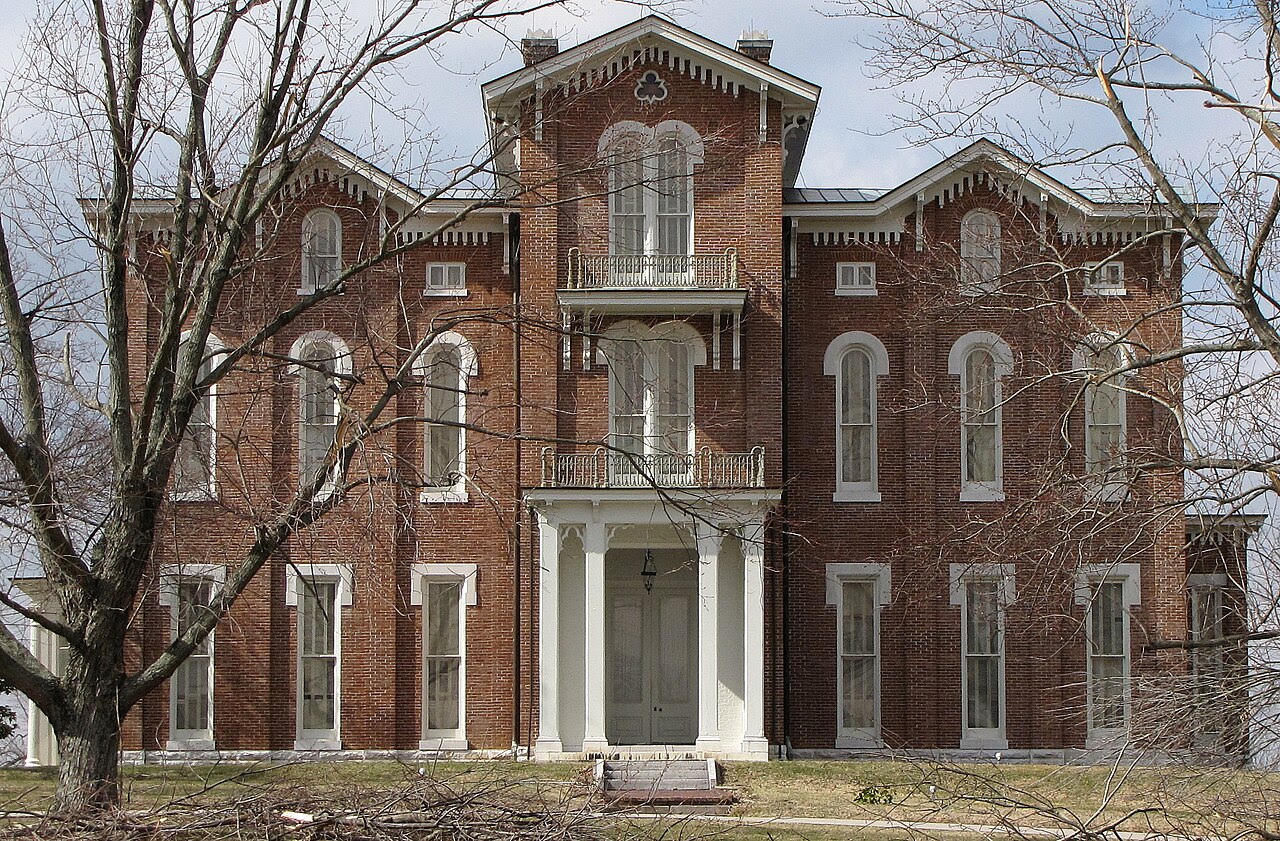
- White Hall sits in rolling farmland north of Richmond, Kentucky, at 500 White Hall Shrine Road, a nearly ten-thousand-square-foot Georgian and Italianate mansion built around the 1798 house Clermont and expanded during the Civil War into forty-five rooms.
- Guides and visitors describe apparitions in nineteenth-century dress, phantom footsteps, voices and piano or violin music in empty rooms, moving furniture, and the scents of cigar smoke and rose perfume, much of it occurring in daylight.
- The tradition passed orally among staff after the restored house opened in 1971, gained detail from 1980s guide Carolyn Siegel, and reached print when former guide Kevin McQueen devoted twenty pages of his 2001 Clay biography to it.
- Cassius Marcellus Clay was a gun-and-Bowie-knife abolitionist whose life included a bitter divorce, a marriage at eighty-four to a fifteen-year-old, two men killed at White Hall, and a father who chained prisoners in the basement.
- Explanations range from Grant Wilson’s categories of specters, poltergeists, and elementals to hard physical causes such as storm-driven water in the interior reservoir, groaning gables, bad plumbing, and faulty wiring.
- Colin Dickey’s argument that American ghosts are unresolved historical memories fits White Hall well, and staff member Stephanie Thurman reflects it by treating the house not as haunted but as still occupied by the Clay family.

Introduction
The stately home north of Richmond, Kentucky, appears to have been designed for haunting. White Hall State Historic Site, located at 500 White Hall Shrine Road, rises from the undulating farmland. It is a roughly ten-thousand-square-foot home, Georgian and Italianate in form, with gables and unusual angles that appear to encourage shadows (Visit Richmond Kentucky,2026). But its fame is built on more than architecture alone. For more than fifty years, guides, staff, and visitors have been reporting apparitions of people in nineteenth-century dress, ghostly footsteps, disembodied voices, and aromas of cigar smoke and rose perfume wafting through vacant rooms (Mitchell & Smith, 2025). This essay examines the reports at White Hall, how they became folklore, and the physical and psychological theories that explain them.
A House Built for Shadows
Start with the place itself for at White Hall the building and the ghost stories are inextricably linked. Clermont, as it was called, was a small two-story, seven-room brick house of around three thousand square feet built by Green Clay in 1798 (Mitchell & Smith, 2025). During the Civil War, Cassius Marcellus Clay was the American ambassador to Imperial Russia, and his wife, Mary Jane Warfield Clay, supervised an ambitious extension that resulted in the forty-five-room palace that exists today (White Hall State Historic Site, 2026). The result is a house of strata. Main stairways rise to three aboveground stories, although smaller stairs connect different levels of what is theoretically the same floor, and the whole design might disorient a first-time visitor. Beneath all of this construction is a claustrophobic basement with a low ceiling. A true wonder for its time, the mansion also had central heating and indoor plumbing, with rainwater from the roof collected in a vast reservoir between the second and third floors and then piped to a tub and a toilet (Visit Richmond Kentucky, 2026; Mitchell & Smith, 2025). The facility is available for tours for much of the year, with the 2026 season beginning Wednesday, June 3, and is currently under the care of the City of Richmond, while the surrounding playground, pond, and path are maintained by Madison County (Visit Richmond Kentucky, 2026.).

Reported Phenomena and the Making of a Folk Tradition
The reported occurrences are extremely similar across decades and among different witnesses. In a 2022 interview with researchers, White Hall employee Stephanie Thurman said guides had seen men, women, and children in period clothing appear and disappear in seconds (Mitchell & Smith, 2025). Furniture that moved by itself. There are steps where no one walks on. People have heard piano and violin music with no apparent source and voices emanating out of empty rooms (Visit Richmond Kentucky, 2026). The narratives are rife with smells, especially what the witnesses think is the cigar smoke of Cassius Clay and the rose-scented perfume of Mary Jane. One of the most repeated stories is about Kathleen, Thurman’s former supervisor, who saw a man’s hand slide down the banister near the back stairs. Over the hand was a white cuff and a hefty black sleeve. She departed in a hurry and subsequently remembered where she had seen that image: in a portrait of Clay at age eighty-four, where his hand emerges from a white cuff and black jacket and drapes over the arm of his chair (Mitchell & Smith, 2025). Others say they have seen a tall, black-haired man in nineteenth-century attire on the porch or crossing the lawn after dark. Notably, a large share of the activity that’s reported happens during the day, rather than at night, although it could just be a matter of when people are around to see anything at all (Visit Richmond Kentucky, 2026).
The folklore didn’t come all at once. The home was purchased from Clay’s descendants by the commonwealth of Kentucky in 1968, renovated with original furnishings and pictures of the family, and presented to the public in 1971, and it developed through oral transmission among the staff (Mitchell & Smith, 2025; White Hall State Historic Site, 2026). Guides relayed stories to other guides, who then shared them with visitors, creating a chain of storytelling that continued as each group of visitors told the tales to subsequent guides. In the 1980s, Carolyn L. Siegel, a guide and author of a book on Clay, added both anecdotes and atmosphere, remembering that she liked to be there before the summer storms because the gables and corners made the house whistle and groan like a ship at sea (Mitchell & Smith, 2025). The tradition found its way into literature in 2001, when Kevin McQueen, a former White Hall guide himself, devoted twenty pages of his biography of Clay to stories of unexplained happenings in the renovated mansion (McQueen, 2001). McQueen himself never had an unexplained experience, which is one of the things that makes his chapter intriguing; he was gathering the testimony of coworkers who described full-body apparitions, strange scents, sounds, and doors opening and closing by themselves (McQueen, 2001).
The Clay Family and Its Turbulent History
It helps that the family at the heart of the lore was really somewhat unstable. Cassius Marcellus Clay was born into riches in Madison County in 1810. A journalist, politician, emancipationist, and diplomat, he gained the nickname the Lion of White Hall. Clay’s student days at Yale were highlighted by an encounter with William Lloyd Garrison, which Medved (2021) describes as a moment when Clay split with his slaveholding family—like water to a parched traveler. In Lexington he founded the abolitionist newspaper, the True American, and helped fund Berea College. He was also combatively magnificent. David and Jeanne Heidler wrote that his first weapon of choice was a poisonous pen, followed by a Bowie knife, and that his expertise with the former made the latter advisable (as quoted in Medved, 2021). Clay fought off many assailants, once staged two brass cannons in defense of his newspaper office, and supposedly shot two intruders at White Hall in his eighties (Medved, 2021; Mitchell & Smith, 2025). He married Mary Jane for forty-five years, divorcing in 1878, when he returned from Russia with a small boy whom many assumed to be the product of his dalliance with a Russian ballerina. He married 15-year-old Dora Richardson when he was eighty-four and divorced her four years later. He died in 1903, and the home was leased to tenant farmers who kept cattle indoors, after which it was left empty and vulnerable to vandalism (Mitchell & Smith, 2025).
Meanwhile, Green Clay had worked for years as a justice of the peace. Prisoners waiting for the sheriff were chained in a dark part of the stifling cellar (Mitchell & Smith, 2025). It’s no surprise that the basement terrifies people. Siegel wasn’t going to go down alone, and McQueen tells of an afternoon when she and two other guides heard muffled chatter rising through the vents, armed themselves with a carving knife, a serving fork, and a thick metal hook, covered the basement entrances, and found no one (McQueen, 2001).
Explaining White Hall: Taxonomies, Physical Causes, and Historical Memory
There are several camps of theories about this whole thing. The other is the taxonomy approach. Restless spirits, according to Grant Wilson, a cofounder of The Atlantic Paranormal Society, are categorized into three types: specters, which are harmless residual images that tend to glide along stairways; poltergeists, which seem aware of the living and can move objects or transmit messages; and elementals, which are swirling masses of darkness that were never human and that Wilson’s team refuses to engage (Wilson, 2016). The lexicon of such categories, however, invites suspicion, as phrases such as “residual energy” and “spiritual vibrations” do not lend themselves to being quantified in volts, ohms, or watts and offer no explanation for the way the energy of a deceased body would be stored or conveyed (Mitchell & Smith, 2025).
A second approach is solidly physical. Wilson was a plumber before he hunted ghosts and has frequently attributed unexplained noises in the basement to faulty pipes (Wilson, 2016). The Oregon investigator Elaine Davison was forthright about it: Something unexplained is out there, but most of what people claim is poor wiring. The physical explanations, in White Hall, are very enticing. “Rainwater rushing into that interior reservoir made real creepy sounds,” says Siegel. Remarkably, several events documented by McQueen occurred during storms and were concentrated near the reservoir (McQueen, 2001; Mitchell & Smith, 2025). Twilight shadows on the window glass may readily suggest the silhouette of a tall man in a dark cloak.
A third technique extends beyond wiring and plumbing to memory. In Ghostland, Colin Dickey makes the case that many American ghosts are not ectoplasmic wraiths but unresolved historical memories, and he takes the story of Chloe at the Myrtles Plantation in Louisiana as his core instance. Chloe is alleged to have been sexually exploited by her enslaver, maimed for eavesdropping, and hanged after members of the household were killed by oleander leaves in a cake. There is no historical support for the story, even though tourists hear it repeatedly. Dickey says that these stories are attempts to provide a form of narrative justice to those who received none in life. Ghost stories are about how we confront or avoid the past, how we tell it, how we understand it, how we narrate it, and how we make sense of its voids (Dickey, 2017). Think of the number of hauntings born of injustice: a slain lover, a troubled burial location, death before its time. Dickey also claims that every time offers a symbolic matrix to explain weird events, and modern people keep a yearning for the enchanted world of previous centuries when ghosts on the stairs were not surprising (Dickey, 2017, 2020). The structure, applied to White Hall, is awkwardly fitting. Three generations of Clays produced inmates in a cellar, men executed for political reasons, a bitter divorce, and an old man’s extended seclusion in a big house (Mitchell & Smith, 2025).
Whatever the reason, the individuals who work at White Hall have made their peace with it. Thurman has had her name shouted while no one else was there, but she’s never felt in danger and won’t call the house haunted, just that it’s occupied by members of the Clay family. Mitchell & Smith (2025) note that she has declared her philosophy that the house is theirs, she will not evict anyone, and her job is to look after their belongings. Each morning she shouts a greeting and tells aloud what she is doing as she goes from room to room. She also has set boundaries, telling the spirits she didn’t like the morning she discovered candles from every room thrown across the floors and asking that no one touch her or jump out at her. Her account (Mitchell & Smith, 2025) is that the rules have held.
Conclusion
White Hall has a lot going on, and that’s precisely why it continues to be one of Kentucky’s most fascinating haunted destinations. The home is physically odd, featuring divided levels, whistling gables, an uncomfortable basement, and a subterranean reservoir that moans in the rain. Its story is one of war, violence, and sadness. The ghost tale has been passed down continually for decades by staff, not all of whom were believers in the supernatural, and it was put into print by a former guide who never saw anything himself (McQueen, 2001; Mitchell & Smith, 2025). Skeptics can take practically any single tale and invoke shadows, bad wiring, and outdated plumbing, and they are often right to do so. What they can’t simply dissolve is the pattern, or reason, that the stories keep finding an audience. Today, visitors who explore the mansion, either on a self-guided stroll between eleven and three or on a guided tour at three thirty, discover a house that recalls more than it can tell (Visit Richmond Kentucky, 2026). That is perhaps the purest sense in which White Hall is occupied.
References
Dickey, C. (2017). Ghostland: An American history in haunted places. Penguin.
Dickey, C. (2020). The unidentified: Mythical monsters, alien encounters, and our obsession with the unexplained. Viking.
McQueen, K. (2001). Cassius M. Clay: Freedom’s champion. Turner Publishing.
Medved, M. (2021, June 21). Americans should know the story of abolitionist Cassius Clay: Muhammad Ali’s namesake risked his career, wealth, and life to promote emancipation. The Wall Street Journal. https://www.wsj.com/articles/americans-should-know-the-story-of-abolitionist-cassius-clay-11624053172
Mitchell, M., & Smith, M. (2025). Paranormal Kentucky: An uncommonwealth of close encounters with aliens, ghosts, and cryptids. University Press of Kentucky.
Visit Richmond Kentucky. (2006). White Hall State Historic Site. https://visitrichmondky.com/listing/white-hall-state-historic-house/
White Hall State Historic Site. (2026). White Hall State Historic Site. https://whitehall.eku.edu/
Wilson, G. (2016, February 12). Speech to Model Laboratory School. Richmond, KY.

Leave a Reply