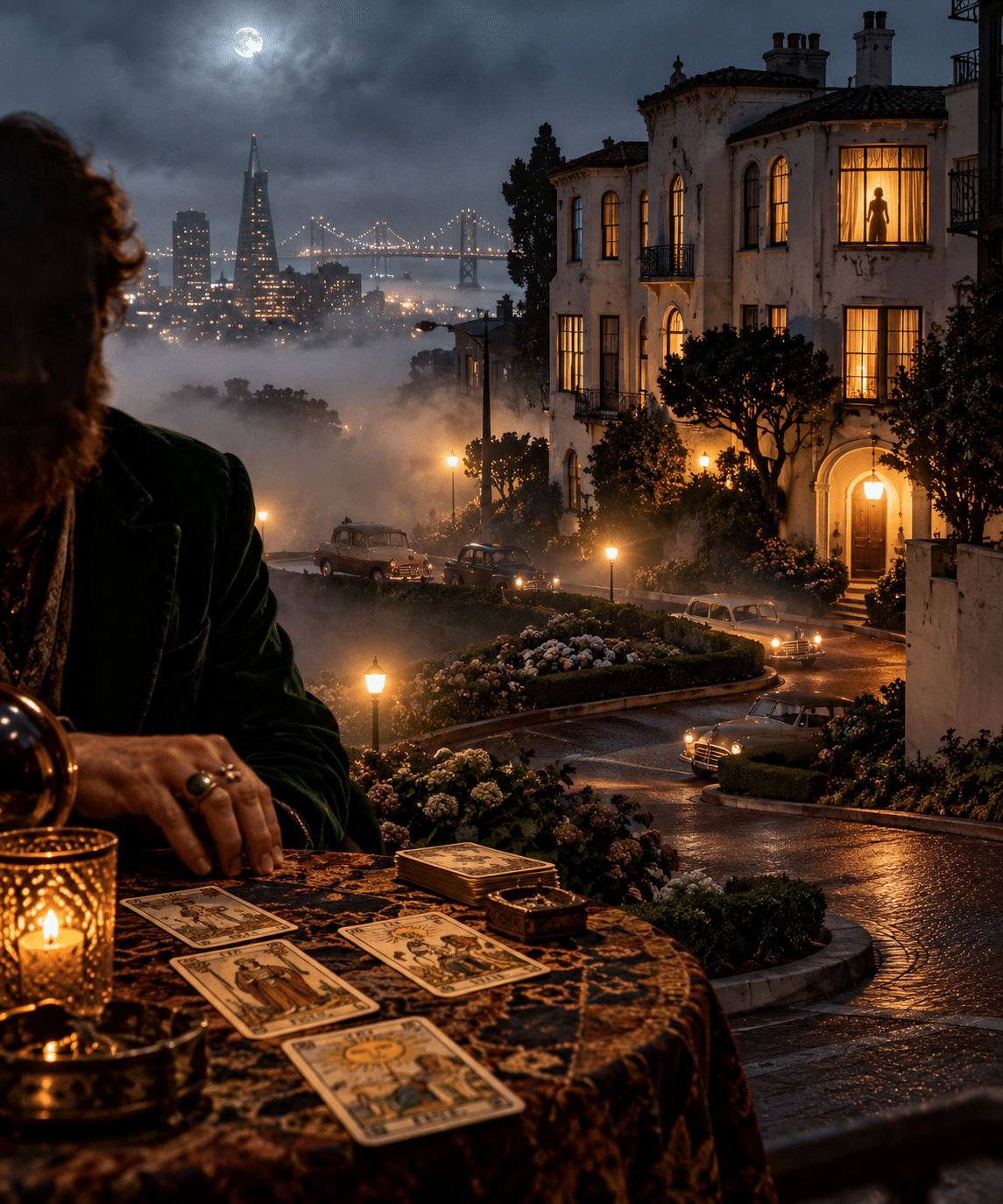
The Tarot Reader Who Cursed a San Francisco House: Key Points
- In 1968, Pat Montandon hosted an astrology party at 1000 Lombard Street, where a tarot reader cursed her and the house after she forgot his drink.
- Montandon reported doors and windows opening on their own, unexplained cold, harassing phone calls, and failing health. She later published these experiences in her 1975 book The Intruders.
- In 1969, her friend Mary Lou Ward died in a fire in the locked apartment, and two other women close to Montandon later died by suicide.
- Tarot began as a fifteenth-century card game, while curses date back to ancient tablets calling on spirits for harm.
- Theories include a real curse, an awakened presence, fear and expectation, and human harassment, though none explains Ward’s death.
- The story caused real grief and lasting harm to Montandon and the families involved. It remains a fixture of San Francisco ghost tours and local legend.

Introduction
Lombard Street climbs, with switchbacks bordered with hydrangeas and a cacophony of tourist cars. At the bottom of the curve is a white Spanish-style edifice with a gloomy reputation. In 1969, Pat Montandon, a San Francisco socialite, newspaper columnist, and television broadcaster, lived in the second-story apartment at 1000 Lombard Street. She later said that an irate guest at one occasion unleashed years of sorrow, terror, and death (Montandon, 1975). Her narrative spans more than half a century. It pairs the documentable—an unsolved death, a fire with no known cause, a series of personal disasters—with an unprovable explanation: a curse by a tarot reading. In this essay I will relate the story of the curse, offer a brief explanation of tarot and curses, discuss the notion that curses and tarot cards can summon ghosts, compare the leading explanations of what happened, and evaluate the continuing legacy of the haunting of 1000 Lombard Street.
The Curse of 1000 Lombard Street
The plot begins in 1968. Montandon, who was then renowned as a talented hostess and author of How to Be a Party Girl, hosted an astrology party for the city’s elite (Alexandra, 2020). The party matched guests by their zodiac signs. They may see a palmist, an astrologer, a crystal-ball gazer, and a tarot reader. Andrew Chamings (2022) described the tarot reader as a man with a “fierce, red beard” who arrived late with an unwanted retinue and wore a green velvet suit. He requested a drink from his hostess. Montandon was distracted and neglected to bring it with him. She finally came back to his table, and he burst out in anger. In The Intruders, she remembered him calling her an “insufferable, ungracious hostess” and promising that she would never have a joyful moment in the house again. Then he uttered his parting words, “A curse upon you and this house I lay.” (Montandon, 1975, referenced in Alexandra, 2020).
“Things started going wrong rather quickly,” Montandon said. Friends at the San Francisco Examiner told her that there were unusual phone calls that insulted her, and she said the tarot reader himself called her to say that the apartment was cursed forever (Chamings, 2022). She reported doors and windows opening by themselves, a cold that the heater couldn’t solve, and dizziness, headaches, and confusion that became so terrible she almost overdosed on medication (Alexandra, 2020). The locks were broken. Windows were broken. She was assaulted by a man she had dated on her own front steps (Chamings, 2022). The deadliest incident was in June 1969. By now Montandon had moved out to marry Alfred Wilsey. Her secretary and close friend, Mary Lou Ward, consented to stay in the unoccupied apartment. A neighbor noticed fire early on June 21. Montandon’s old bedroom, sealed chambers, had Ward lying face down on the bed, horribly burned (Alexandra, 2020; Chamings, 2022). The coroner detected nearly no carbon monoxide in her lungs, meaning she was already dead when the fire began. Ward did not smoke yet; a cigarette was first cited as the probable culprit (Chamings, 2022). Nobody could ever decide how she died. Within three years of the curse, Montandon’s cousin Carolyn and her young assistant Vera Scott, who had lived in the flat, also committed suicide (Alexandra, 2020).

Tarot, Curses, and Occult Belief
The danger of a tarot reader felt so great, in part, because of where tarot originated. Tarot cards were never meant for fortune telling. They emerged in fifteenth-century northern Italy as playing cards for a trick-taking game called tarocchi (Dummett, 1980). Three centuries later they were connected with the occult. The French scholar Antoine Court de Gébelin proclaimed in 1781 that the trump cards contained the secret wisdom of ancient Egypt. Historians dispute this, but it did alter people’s perceptions of the deck (Farley, 2009). In the nineteenth century and into the early twentieth, esoteric groups and writers reconstituted tarot as a tool of divination and spiritual insight. The most renowned product is the Rider-Waite-Smith deck (released in 1909) (Farley, 2009). By the 1960s, tarot meshed nicely with the burgeoning interest in astrology and the counterculture in San Francisco. In such a setting, a tarot reading was entertainment at a society function. To some of the guests he was also a man who might truly have access to hidden powers.
The story ties to a broader idea of tarot narrative fabulation (storying) as a micropolitical process enabling participants to describe experiences in a shared symbolic language outside of normal interview or survey formats (Ivinson, 2019). The related scholarship cited in this literature notes that tarot is a culturally legible system that structures meaning through the arrangement and position of cards, with the understanding that “meaning arises in relation to surrounding cards and layout,” thereby emphasizing the interpretive and relational nature of tarot readings (Kim, 2002; Akmal & Coulton, 2020). This approach is in line with design-oriented analyses that use tarot as a boundary object for investigating social relations in complex sociotechnical systems (Tarot of Things) (Akmal & Coulton, 2020).
Tarot is a lot more recent than curses. In ancient Greece and Rome, curses were written on thin sheets of lead, called defixiones, and buried in tombs or thrown down wells. They implored gods or spirits of the dead to “bind” a rival in love, business, athletics, or court (Gager, 1992). Some of the traits of those old curses recur on Lombard Street. They were frequently born of personal grudges. They named one specific target. They regularly asked spirits to perform malicious acts on their behalf. The curse of the tarot reader followed the same path. It was a social insult; it identified Montandon and her house. According to later accounts, it seemed to stir something that then acted on its own.
The Possibility of Summoning Spirits
That last aspect brings us to the subject of the ability of curses and tarot cards to summon spirits. In folk belief and popular occult writing, divinatory tools are sometimes treated as doors. That is how many think of the Ouija board and occasionally the tarot. This concept suggests that using the cards to explore the invisible world could attract entities or influences. And a person who read the cards would be able to direct them. Before she died, Mary Lou Ward stated another observation. “It was there already. I don’t think the curse was 100 percent of the reason,” she told Montandon. “It just called it out, maybe because of his influence” (Alexandra, 2020). She sees the curse as more of a trigger for the concept than its source. It means there was an evil force already sleeping in the walls, and the rage of the tarot reader just stirred it up. Montandon later investigated the history of the building and discovered factors that corroborated Ward’s theory, such as owners and tenants who battled alcoholism and divorce and at least one lady who took her life there (Alexandra, 2020). Neighbors said she had been playing the tune “Mockin’ Bird Hill” at all hours. Montandon’s cousin Carolyn reported she kept hearing the same music even after she moved out, before her suicide (Alexandra, 2020).
Explanations and Legacy of the Haunting
Several theories attempt to explain the occurrences. The first was the supernatural interpretation given by Montandon herself. The curse was real. It formed or unleashed a malevolent power. The second interpretation is Ward’s, which suggests that the house was already haunted and that the curse merely exacerbated the situation. This theory is backed up by the house’s difficult past, as well as the comment made by the former landlord after he sold the building in 1973. He remarked it “had a hex on it” and was “difficult to unload” (Alexandra, 2020). The third theory is psychological. “Researchers who research hauntings have shown that people see what they expect to see. If someone believes a place is haunted, normal drafts, sounds, and bad luck come to seem like signals (Lange & Houran, 1998). Wiseman and colleagues (2003) conducted a classic field investigation and showed that environmental characteristics like drafts, illumination, and room size correlated with odd experiences in reputedly haunted locations. These results could explain both the frigid temperatures in the rooms and the doors that appeared to open by themselves.
Physiologist Walter Cannon (1942) proposed an analogous hypothesis. He researched examples of “voodoo death,” in which people who believed they were cursed fell ill, often fatally. He argued that extreme, prolonged dread can inflict genuine damage on the body. Montandon’s headaches, dizziness, and collapse fit that pattern. The fourth theory is just human. Some of the threats were obviously from humans. These were genuine individuals who made the harassing phone calls, smashed the locks, and assaulted (Chamings, 2022). In that light, the “curse” may have been a campaign of intimidation and then a sequence of unconnected catastrophes that grief and memory spun into one story. None of these hypotheses explains the weirdest truth of all, how Mary Lou Ward died before a fire broke out in a locked room. That gap is a giant reason the mythology persists.
The haunting was thick. The human toll, first. Alexandra (2020) states that three young ladies close to Montandon died in a few years and that Ward’s family never knew how she died. Montandon, for her part, lost her health, her security, and for a time her standing in society. Parties halted and journalists assumed that she had tried to commit suicide (Chamings, 2022). She turned her private trauma into public mythology with her 1975 book, The Intruders. It also presented her as a woman who had to remake her life over and over again. She later became known for her peace activism and humanitarian efforts (Chamings, 2022). The story, too, has a cultural life of its own. You’ll see it on San Francisco ghost tours and in local history stories. Even real estate coverage notes it. The curse made headlines when the building listed units for millions of dollars (The Real Deal, 2022). The structure remains fixed in the city’s mind, and the tourists inching past it on the tortuous street never know what happened there.
Conclusion
The myth of 1000 Lombard Street lives on because it exists in the space between verifiable tragedy and explanations that no one can confirm. Montandon might explain a series of seemingly illogical and harsh events in terms of a forgotten drink, an angry tarot reading, and a dramatic curse. Tarot started as a card game and was later used as a means of reading fate. Curses date back to ancient lead tablets buried with the dead. The two converged together in one moment of wrath on Lombard Street. Whether it was a true curse, a presence existing in the house, the power of fear and expectation, the deeds of actual people, or a sad string of coincidences, the deaths and suffering were real. The mystery of Mary Lou Ward’s passing remains unresolved. Ultimately, the curse of 1000 Lombard Street shows how people turn to the supernatural when the ordinary fails to provide answers. It is also a testament to how a narrative told with enough emotion and conviction can outlive the individuals who lived it.
References
Akmal, H. A., & Coulton, P. (2020). A Tarot of Things: A supernatural approach to designing for IoT. Design Research Society Conference 2020. https://doi.org/10.21606/drs.2020.188
Alexandra, R. (2020, June 17). The haunted house on Lombard Street that left a trail of tragedy. KQED. https://www.kqed.org/arts/13881990/the-haunted-house-on-lombard-street-that-left-a-trail-of-tragedy
Cannon, W. B. (1942). “Voodoo” death. American Anthropologist, 44(2), 169–181.
Chamings, A. (2022, March 8). The last party on Lombard Street. The Press Democrat. https://www.pressdemocrat.com/2022/03/08/the-last-party-on-lombard-street/
Dummett, M. (1980). The game of tarot: From Ferrara to Salt Lake City. Duckworth.
Farley, H. (2009). A cultural history of tarot: From entertainment to esotericism. I.B. Tauris.
Gager, J. G. (Ed.). (1992). Curse tablets and binding spells from the ancient world. Oxford University Press.
Ivinson, G. (2019). Washing lines, whinberries and reworking ‘waste ground’: Women’s affective practices and a haunting within the haunting of the UK coalfields. Journal of Working-Class Studies, 4(2), 25–39. https://doi.org/10.13001/jwcs.v4i2.6225
Kim, J. (2002). Yeats’s expression of the world soul in his early fictions. The Yeats Journal of Korea, 18, 7–23. https://doi.org/10.14354/yjk.2002.18.7
Lange, R., & Houran, J. (1998). Delusions of the paranormal: A haunting question of perception. The Journal of Nervous and Mental Disease, 186(10), 637–645.
Montandon, P. (1975). The intruders. Coward, McCann & Geoghegan.
The Real Deal. (2022, March 8). “I do not forget and I do not forgive”: Lombard Street mansion’s haunted past. https://therealdeal.com/san-francisco/2022/03/08/i-do-not-forget-and-i-do-not-forgive-lombard-street-mansions-haunted-past/
Wiseman, R., Watt, C., Stevens, P., Greening, E., & O’Keeffe, C. (2003). An investigation into alleged “hauntings.” British Journal of Psychology, 94(2), 195–211.


Leave a Reply