Richat Structure and the Lost City of Atlantis: Key Points
- Plato described Atlantis as a powerful island civilization with a capital surrounded by rings of land and water.
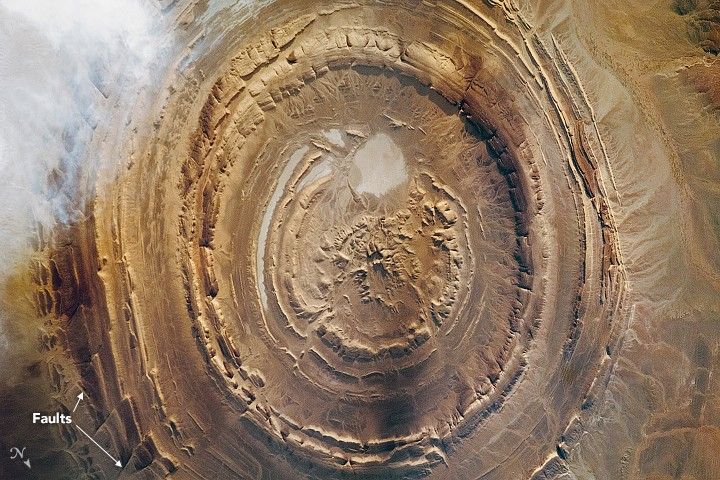
- The Richat Structure in Mauritania is a huge natural formation made of distinctive concentric rings.
- Supporters argue that Richat’s rings and location beyond Gibraltar resemble important details in Plato’s Atlantis story.
- The Sahara was once much wetter, with ancient waterways and human communities throughout the region.
- Richat’s rings formed naturally, and archaeologists haven’t found evidence of Plato’s advanced maritime civilization there.
- The Richat Structure remains a fascinating Atlantis theory, but current evidence doesn’t confirm the connection.

Introduction
The Richat Structure is one of the few places on Earth where the Atlantis concept appears feasible at first inspection. Its enormous circular rings in the Sahara uncannily resemble Plato’s account of Atlantis as a city built in alternating rings of land and water. The similarity has led to a current notion that the Richat Structure, also known as the Eye of the Sahara or Eye of Africa, holds the geological imprint of Atlantis. The concept is grounded in Plato’s descriptions, the topography of northwestern Africa, indications of a wetter Sahara in the distant past and the peculiar shape of the Richat Structure. But severe geological, archeological, and linguistic challenges must be evaluated against the similarities. The Richat Structure is real and spectacular, yet it requires more than its fantastic looks to be called Atlantis.
Plato’s Atlantis
The first written reference to Atlantis can be found in the works of the Greek philosopher Plato, who wrote about it in his dialogues Timaeus and Critias. Plato said that Atlantis was a mighty island civilization far to the West, beyond the Pillars of Heracles, usually taken to mean the Strait of Gibraltar. The Atlanteans were masters of a vast kingdom and finally went out to conquer peoples in the Mediterranean. Athens fought and beat them. Plato then goes on to describe cataclysmic earthquakes and floods that drowned Atlantis and made the sea difficult to sail (Timaeus, trans. Jowett, 360 B.C.E./1892). Plato’s account sets the fight some 9,000 years prior to Solon’s time, suggesting that the destruction of Atlantis occurred thousands of years before the emergence of the classical civilizations best known for their magnificent cities (Critias, trans. Bury, 360 B.C.E./1929).
Perhaps the most remarkable feature of Plato’s narrative is the layout of the Atlantean capital. Cleito was said to have been surrounded by circular zones, alternating about the central hill. Plato describes the layout as consisting of two rings of land and three rings of ocean surrounding the central hill. Later settlers built bridges, fortifications, harbors, docks, buildings, and a massive canal connecting the circular city with the sea. A vast flat of lush land lay beyond the capital, bounded by mountains. Atlantis too had elephants, woods, metals, agricultural land, ships, and a big population and was similarly rich in natural resources (Critias, trans. Jowett, 360 B.C.E./1892).
In scholarly and popular discourse, Atlantis has been used to explain huge, mysterious geological formations as “lost lands” or proof of ancient advanced civilizations. Other works survey the Atlantis myth, discuss its influence on later literary, philosophical, and cultural production, and include scholarly accounts that trace the myth’s reception in modern contexts (e.g., connections to science fiction, pseudoarchaeology, and urban iconography) (Planchon et al., 2024; Ginway, 2015; Kühne, n.d.; Morgan, 1998). Many such treatments use Atlantis as a symbolic or thematic device, not as a claim of earthly origin for specific geological structures.
The Richat Structure
The Richat Structure stands out because it meets this criterion in one obvious way. Richat is situated on the Adrar Plateau in Mauritania, Northwestern Africa. It comprises enormous concentric rings best viewed from the air and space. The formation is around 40 kilometers (25 miles) in length. Its size and circular shape make it a landmark, and it has received the moniker of the Eye of the Sahara (NASA Earth Observatory, 2026).
Its geologic history is much older than any possible human civilization. The circular aspect of Richat initially led scientists to think that it was an immense meteorite impact crater. Geological study eventually ruled this out. It is now thought to be an eroded geological dome connected with igneous activity. Rock layers were raised, and erosion, acting differentially on hard and soft materials, progressively exposed the concentric pattern observable today (International Union of Geological Sciences [IUGS], n.d.; NASA Earth Observatory, 2026). Recent geological studies reveal a complex history of magmatic eruptions spaced by ~100 million years followed by uplift and erosion (Abdeina et al., 2024).
What the Atlantis theory is about is the similarity of Richat to Plato’s round capitals. From the air, the Eye of the Sahara eerily resembles a giant city arranged in rings. Proponents of the theory can also point to its location. Mauritania sits west of Egypt, relatively near the Atlantic coast, so that from a Mediterranean perspective the territory is beyond the Pillars of Heracles. Plato explicitly links Atlantis with the Atlantic Ocean and writes of Atlantean authority spreading into Libya toward Egypt (Timaeus, trans. Jowett, 360 B.C.E./1892). So Northwestern Africa is not entirely divorced from the geography that is playing out in Plato’s story.
And the surrounding terrain adds comparisons. Plato portrays a wide plain attached to Atlantis, with mountains further inland. The Richat Structure is located in a wider Saharan context, whose current appearance does not necessarily reflect its condition throughout all of human prehistory. You may see ancient watercourses around the Adrar Plateau today. According to NASA, rushing water formerly sculpted valleys and a network of canals through the area (NASA Earth Observatory, 2026). Why does this matter? Because the current desert shouldn’t be simply extrapolated thousands of years back. So a wetter prehistoric environment does make human settlement around Richat totally feasible. However, such a scenario does not prove the existence of Atlantis.

Evidence and Problems With the Atlantis Theory
In the Atlantis-centric literature cited above, Richat is occasionally mentioned as a notable circular landform that has fired the public imagination as a potential relic of ancient civilizations or a contemporary “Atlantean” symbol. Sources often classify the postulated but unsupported impact origin hypotheses as geological structures rather than evidence for Atlantis itself. The geological literature is cautious in the methodology and does not equate enormous ring structures with Atlantis without independent validation (Reimold & Koeberl, 2014; Monegato et al., 2011).
The Atlantis literature also contains discussions of the historical fascination with large circular features as potential Atlantis-like sites or narratives of lost worlds (e.g., early 20th-century Atlantean hypotheses, the use of Atlantis in comparative myth and geography, and the exploration of mythic geography and colonial-era exploration). Kühne, n.d., Morgan, 1998. When Richat is brought up in such talks, it is usually as an example of contemporary geology intersecting myth, rather than as a piece of evidence converging on the Atlantis idea. Crucially, the referenced geological evaluations have little or no evidentiary basis to firmly support Richat as an impact crater and so any linkage with Atlantis remains interpretive/symbolic rather than evidential (Reimold & Koeberl, 2014; Monegato et al., 2011).
When we study more precisely the nuances of Plato’s thesis, it becomes more challenging. His Atlantis was not just round. It had been intentionally transformed, its rings outfitted with navigable streams, bridges, docks, walls, temples, buildings, and canals. Plato clearly mentions ships going between the zones and a canal leading from the sea to the outer ring. (Critias, trans. Jowett, 360 B.C.E./1892) The Richat rings are geological structures created by uplift and erosion. Geologists have found sedimentary rocks, igneous rocks, ring dikes, carbonatites, volcanic rocks, and other features compatible with natural geological processes (Matton & Jébrak, 2014).
There is another evident difficulty. Richat is not an island in the Atlantic Ocean. It is Mauritania in the interior. In Timaeus, Plato presents Atlantis as an island and states it fell under the sea after earthquakes and floods (Timaeus, trans. Jowett, 360 B.C.E./1892). Defenders of the Richat idea can say that Plato’s story changed over its transmission over the centuries, that old geographical terms aren’t necessarily to be taken literally, or that cataclysmic floods could have affected the area. Those alternatives can account for differences, but they are not evidence that such modifications did in fact take place. The more erroneous or metaphorical facts from Plato are, the weaker the literal association becomes.
There’s another problem, size. Plato’s round capital and rings were far smaller than the nearly 40-kilometer diameter of Richat. He also describes a large island, its capital, its farmland, mountains, towns, and other geographical aspects. The whole of the Richat Structure, as Plato’s ringed metropolis, is problematic in terms of scale. Some proponents would instead see Richat as a natural landmark that a settlement grew around. This interpretation is more geologically probable, as humans tend to construct communities around pre-existing geographic features. Archeological proof is still needed.
The primary problem with the Richat-Atlantis idea is arguably the absence of that crucial archeological evidence. Such a civilization, of the type Plato describes, should have material remains. One may anticipate a prosperous maritime society to leave a considerable archeological record, with its magnificent buildings, metalworking, temples, docks, canals, armies, and thousands of citizens. The Adrar region does include traces of prehistoric human activity, including Paleolithic stone tools and Neolithic rock art. However, the existence of ancient peoples in the region is not evidence of an Atlantean metropolis (NASA Earth Observatory, 2026). At Richat, there is no verified archaeological discovery to substantiate the great metropolis Plato wrote of.
Alternative Interpretations and Cultural Impact
Other interpretations of Atlantis are therefore still possible. Some scholars and writers have looked for locations around the Mediterranean, on Atlantic islands, in Spain, North Africa, and elsewhere. Another interpretation views Atlantis as a fundamentally philosophical story. Plato may have created a fictional society to investigate political power, morality, imperial ambition, corruption, and the perfect state. This view is supported by the surviving ending of Critias, for Plato describes the Atlanteans getting more and more greedy and unjust until Zeus determines that they must be punished (Critias, trans.). Jowett, 360 B.C.E./1892). Atlantis may, thus, be a blend of imaginary geography and aspects taken from authentic stories of earthquakes, floods, wars, and vanished civilizations.
However, the Richat idea has made a cultural impact, visibly, because satellite images revolutionized the way people can examine historical geographical puzzles. Now, within minutes, someone reading Plato can compare his descriptions with landscapes around the earth. The Richat structure is extremely intriguing in this setting. Its massive rings provide instant visual links that long geological narratives cannot readily erase from the imagination. The concept has served to popularize Mauritania, Saharan prehistory, geology, ancient climate change, and Plato’s works to a far larger audience. Even a wrong idea can be beneficial if it raises concerns that bring people back to the main texts and physical evidence.
The risk is when superficial likeness takes the place of archeological verification. Humans are really adept at spotting patterns, and concentric circles are especially compelling when the researchers already know that Plato wrote about a circular city. But Richat’s rings are much older than when humans might have built Atlantis. Their natural origin doesn’t preclude the idea that ancient people occupied or modified parts of the formation, but it changes the question. The strongest form of the hypothesis would be that the Atlanteans created the Eye of the Sahara. This would suggest that an alien race discovered this unusual natural structure, built within it, and somehow became the source of a story that reached Plato and was eventually recorded. It is an intriguing idea, but no evidence of the essential city has been uncovered.
Conclusion
The Richat Structure is a particularly intriguing candidate for Atlantis due to the numerous pieces that appear to align. The Richat Structure features concentric rings, is located in North Africa beyond Gibraltar, has surrounding plains, shows evidence of ancient human habitation in the broader region, and was once a prehistoric environment that held substantially more water than the Sahara does today. We should discuss that likeness instead of dismissing it simply because it is located in the current desert. However, when we compare Plato’s entire description to the evidence provided by geologists and archeologists, the case falls apart. Richat is an ancient natural geological formation; its rings weren’t built as canals, it is far inland and no archeological evidence now shows that a big marine city once populated it. For the moment, the Eye of the Sahara is best regarded as a tantalizing possible source of inspiration for conjecture about Atlantis, rather than the uncovered remnants of Plato’s lost metropolis. Perhaps its most valuable contribution to the Atlantis enigma is its demonstration of how readily the exceptional real may fill the void between geology and ancient literature and modern imagination.
References
Abdeina, E. H., et al. (2024). How old is the Eye of Africa? A polyphase history for the igneous Richat Structure, Mauritania. Lithos, 482–483, 107698. https://doi.org/10.1016/j.lithos.2024.107698
Ginway, M. E. (2015). The Amazon in Brazilian speculative fiction: Utopia and trauma. Alambique Revista Acadèmica De Ciencia Ficciòn Y Fantasia ∕ Jornal Acadêmico De Ficção Científica E Fantasía, 3(1). https://doi.org/10.5038/2167-6577.3.1.3
International Union of Geological Sciences. (n.d.). Richat Structure, a Cretaceous alkaline complex. IUGS Geoheritage.
Kühne, R. W. (n.d.). Did Ulysses travel to Atlantis? 509–514. https://doi.org/10.1007/978-1-4020-8784-4_38
Matton, G., & Jébrak, M. (2014). The “eye of Africa” (Richat dome, Mauritania): An isolated Cretaceous alkaline-hydrothermal complex. Journal of African Earth Sciences, 97, 109–124. https://doi.org/10.1016/j.jafrearsci.2014.04.006
Monegato, G., Massironi, M., Martellato, E., & Teza, G. (2011). Omeonga—A possible large impact structure on the Eastern Kasai Province (D.R. Congo)? Meteoritics and Planetary Science, 46(12), 1804–1813. https://doi.org/10.1111/j.1945-5100.2011.01296.x
Morgan, K. A. (1998). Designer history: Plato’s Atlantis story and fourth-century ideology. The Journal of Hellenic Studies, 118, 101–118. https://doi.org/10.2307/632233
NASA Earth Observatory. (2026, April 16). Eyeing the Richat Structure. NASA.
Planchon, O., Thomazo, C., Pouzet, P., & Allinne, C. (2024). Alien archaeology in science fiction cinema. Arts Et Sciences, 8(1). https://doi.org/10.21494/iste.op.2024.1180
Plato. (1892). Timaeus (B. Jowett, Trans.). (Original work published ca. 360 B.C.E.).
Plato. (1929). Critias (R. G. Bury, Trans.). Harvard University Press. (Original work published ca. 360 B.C.E.).
Reimold, W. U., & Koeberl, C. (2014). Impact structures in Africa: A review. Journal of African Earth Sciences (And the Middle East), 93, 57–175. https://doi.org/10.1016/j.jafrearsci.2014.01.008



Leave a Reply