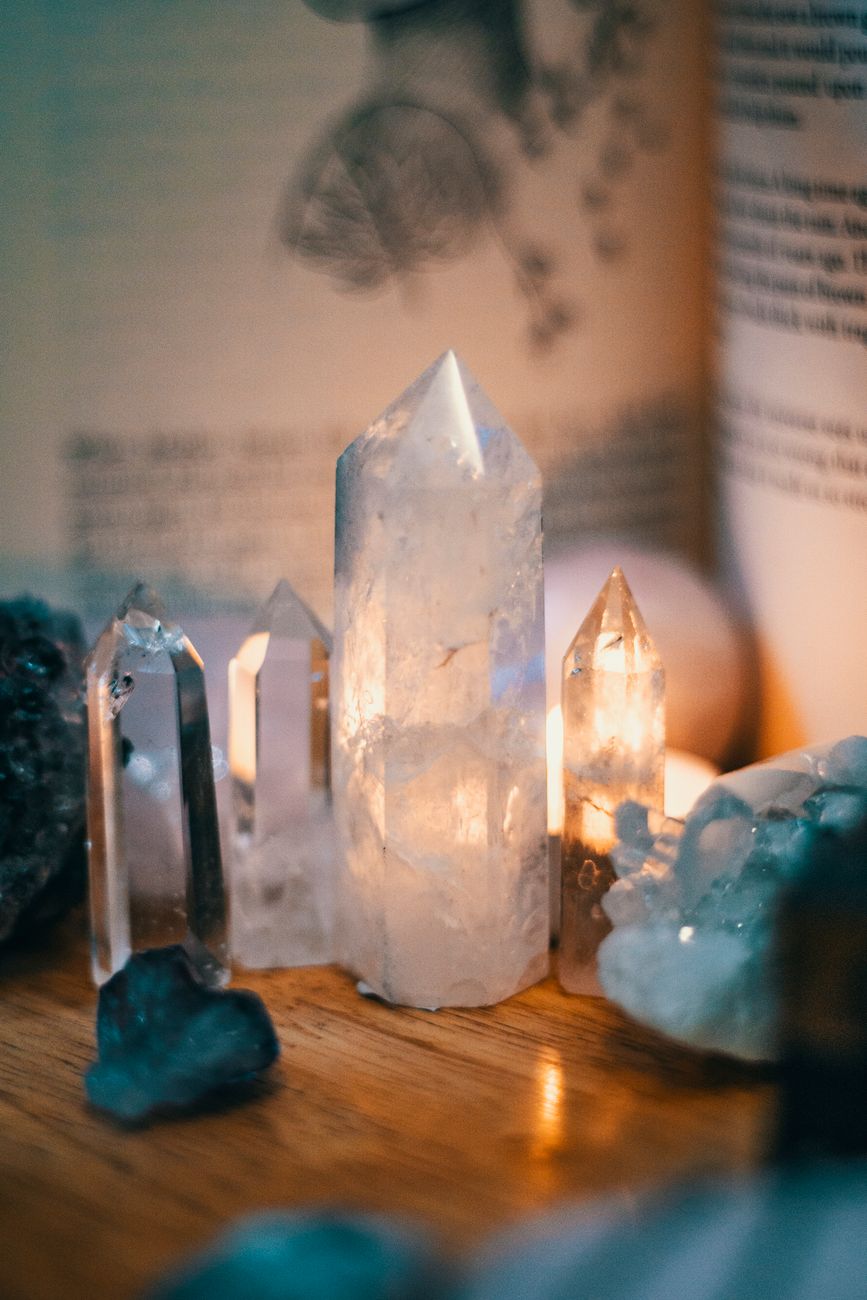
Crystals and Time Travel: Key Points
- Crystals have long been associated with paranormal beliefs involving healing, spiritual energy, divination, and hidden forces, while their real physical properties have helped inspire fictional ideas about controlling time.
- Real physics allows time dilation under relativity, but there is no scientific evidence that crystals can transport people into the past or future.
- Crystal time-travel theories imagine special minerals as energy sources, temporal resonators, navigational tools, or keys capable of opening wormholes and dimensional portals.
- Land of the Lost uses Altrusian crystals to control dimensional and temporal doorways, while Smallville features a Kryptonian crystal that allows Clark Kent to travel back and change a tragic event.
- Star Trek: Discovery portrays rare time crystals as powerful objects connected with temporal travel, while The Time Crystals explores the dangers of exploiting mine-based crystals capable of accessing time.
- If crystal-powered time travel existed, it could radically affect history, archaeology, economics, and politics, but for now it remains a compelling mixture of paranormal speculation, science fiction, and real scientific ideas about time.

Introduction
Crystals have had a curious position between the natural world and the supernatural imagination for generations. Yet they are actual minerals with quantifiable physical qualities. They have also been credited with healing, divination, spiritual communication, protection, and the storage or transfer of unexplained types of energy. Modern paranormal and New Age rituals typically maintain that crystals can focus intention or connect a person to forces undetectable by ordinary senses. Time travel takes this idea in an especially innovative way. Maybe a crystal that could affect time as well as ordinary space would be a key, a source of power, or a means of navigation between the ages. There is no scientific evidence that a normal crystal can convey a person to the past or the future. However, the notion has reappeared over and over in popular culture, because crystals offer an attractive connection between ancient magical artifacts and contemporary technology.
Crystals, Time, and the Paranormal
The paranormal usage of crystals usually begins with the assumption that minerals have certain energies or vibrations. Real quartz crystals are piezoelectric, which means that mechanical pressure can generate an electrical charge and that an applied electrical field can cause the crystal to bend somewhat. This makes quartz very significant. Thus quartz oscillators are used in clocks and other gadgets to produce very stable frequencies. These real physical qualities help explain why crystals might sound scientifically credible while fictitious stories ascribe to them considerably higher powers. A quartz crystal can assist a clock in measuring time with exceptional precision, but that is far different from altering time itself. Paranormal explanations range outside the bounds of known physics. Crystals can store memories, magnify human consciousness, or vibrate with undetected dimensions.
Time travel has a more convoluted relationship to genuine science. According to Einstein’s concept of relativity, you can go into the future quicker than anyone else. At fast enough speeds or under differing gravitational conditions, two observers can experience different amounts of elapsed time. Experiments with accurate clocks have measured slight relativistic variations so that this restricted kind of travel into the future is a real physical phenomenon (Smith, 2024). “Going back in time is a lot more speculative. Some solutions of general relativity offer closed timelike curves, pathways through spacetime that in theory might let an entity return to an earlier point in its history. Physicists and philosophers continue to dispute whether the conditions that might give rise to such paths could truly exist or be constructed (Earman et al., 2024). However, none of these suggestions endows crystals with a known ability to create time travel.
Paradoxes in time travel have been thoroughly researched. Grandfather/paradox (consistency) Bootstrap paradox (causally looped knowledge) Predestination paradox (self-originating causality) These appear regularly across the philosophy and physics literature and are also fundamental to SF narratives (Krasnikov, 2002; Smeenk & Wüthrich, 2011; Sfetcu, 2023; Hauser, 2019; Lloyd et al., 2011; Campbell, 2026). Self-consistency approaches (e.g., the Novikov principle) state that the actions of a time traveler would lead to a paradox; these actions are constrained or impossible, thereby preserving a single, consistent history of the timeline (Krasnikov, 2002; Smeenk & Wüthrich, 2011; Moldoveanu, 2007). Alternative histories/multiple histories models assume that time travel creates branching timelines or new histories where modifications to the past do not influence the original history and hence bootstrap and other paradoxes are resolved. This approach is becoming a popular interpretive frame in both theoretical discussions and SF narratives (Shoshany & Wogan, 2021; Hauser, 2019; Lloyd et al., 2011; Mulder & Dieks, 2017).
Crystals are commonly used in occulture as a physical form of energy, healing, and protection. In the scope of occult bricolage, occult symbols and rituals are patched into contemporary media, games, and cultural objects. Not all references will describe the specific crystal ritual or healing practice, but crystal-related practices (e.g., crystal healing, energy grids) fit the broader pattern of occult bricolage and the diffusion of paranormal motifs into everyday culture (Nosachev, 2018; Krasztev, 2019; Holloway & Thurgill, 2026). The literature on the paranormal foregrounds a diffuse ecology in which things such as crystals operate as accessible signs pointing to a wider cosmology where the paranormal, esoteric, and occult intersect with technoscience, psychology, and new-age spirituality. This paradigm helps explain why crystal-based treatments are present and debated in self-help, wellness, and spiritual communities, as well as in the “paranormal in transit” between the domains of the holy and the secular (Tidelius, 2020; Nosachev, 2018).
Theories of Crystal Time Travel
The idea becomes more intriguing when we envision crystals as instruments that interact with dimensions that humans cannot ordinarily comprehend. One theory would treat a time-travel crystal as a resonant system. Instead of only vibrating at a physical frequency, the crystal was supposed to vibrate at a particular moment in space-time. The traveler might “tune” the crystal to 1776, 1945, or 2126 like a radio is tuned to a certain frequency. Another idea suggests crystals are energy-storage devices that can hold the massive energy required to warp spacetime. A third alternative is to consider the crystal not as the origin of time movement but as a navigational device. In this case, a wormhole or dimensional portal would provide the passage, with the crystal determining where and when the passenger exited. These notions have no experimental backing but provide internally consistent explanations for accounts of the paranormal.
One of the most obvious fictional examples is the original Land of the Lost television series. The enigmatic Land holds advanced Altrusian technology, regulated by pylons and matrix tables with colorful crystals. Characters can arrange and manipulate crystals in specific combinations to create dimensional gateways connecting different locales and times. In “Elsewhen,” Rick Marshall thinks he can make a time gateway to bring his family home by choosing the right sequence of crystal hues (“Elsewhen,” 1974). The series even refers to some Altrusian crystal technology as relating to spatial navigation. That makes the stones more than magical. The story portrays them as remnants of a lost technology, with the human protagonists only partially grasping its principles.
The distinction is crucial because it provides one explanation for the purported paranormal crystals: sufficiently advanced technology might be misinterpreted for magic. An Altrusian crystal may appear to be a mineral of the common sort, although its structure may be constructed to respond to dimensions that cannot be reached by standard human technology. Land of the Lost is all about combinations. The crystal in itself may not be a complete time machine. The outcome depends on the surrounding matrix, the sequence, and the operator’s understanding. That seems like a computer system where individual electronic components are not much use without the right layout and instructions. The imaginary idea also presents a serious hazard. Manipulating a portal without knowing its coordinates could land you somewhere else, in the incorrect century, or on another plane of existence.

Crystals in Popular Culture
Smallville’s version of crystal-based time travel is more intimate and morally disturbing. In season five’s “Reckoning,” Clark Kent travels back in time with a Kryptonian crystal and saves Lana Lang from dying in a car accident. He succeeds in influencing that event, but his interference doesn’t result in a painless fixing of history. Jonathan Kent later dies, fulfilling Jor-El’s warning that changing events will have consequences (“Reckoning,” 2006). This story presents one of the oldest issues of time travel fiction: that changing the past may have unforeseen effects for the traveler. Philosophical discussions on time travel, for instance, consider whether the past might genuinely be changed or whether a traveler would realize that his acts were always part of history (Smith, 2024).
Star Trek: Discovery takes a different approach. Rare time crystals are located on the planet Boreth and secured by the Klingon Timekeepers. Searching for a solution to beat Control, Captain Christopher Pike meets them and is exposed to a crystal that gives him knowledge of a possible future. The crystals are perceived as immensely powerful and deadly items that the Klingons actively avoid using (“Through the Valley of Shadows,” 2019). Later the technology employs a time crystal to propel Discovery through a temporal wormhole into the far future. The narrative interweaves high physics with mineral images. Discovery does not see the crystal as a supernatural charm but as an unusual kind of matter that interacts with time processes.
“Time crystal” is a real scientific phrase as well, although it means something quite different than the science-fiction concept. Time crystals are strange forms of matter in physics that have to do with patterns repeating in time. They don’t carry individuals through time. The made-up phrase sounds very similar to real physics; therefore, the common language can be confusing. The scientific notion is that a mineral is not a doorway to ancient Rome or the Earth of the future. Fiction takes the evocative moniker and runs with it much beyond what experimental physics supports.
Literature for younger readers also features the use of crystals for time travel. The Time Crystals is a story about twelve-year-old Clara Callenick and a fight over crystals connected to a mine and the possibility of using their time-traveling abilities. The crystals were based on the unique granite of Cornwall known as luxuryanite. The idea also brings in another issue common to stories about remarkable minerals: control of a rare resource. “Once something that can be mined, owned, stolen, or sold is attached to time travel, temporal power becomes an economic and political issue.” If it does provide access to other periods, a crystal deposit may potentially be more valuable than gold, oil, or uranium.
Implications and Evidence
That idea exposes one of the most significant potential implications of crystal time travel. The discovery of such materials would revolutionize archeology and history overnight. Researchers could witness lost civilizations firsthand instead of reconstructing them from remnants. In theory, a crime could have witnesses after it occurs. Lost papers, vanished creatures, and forgotten languages may be available again. The economic fallout could be considerably more catastrophic. A person who can tap into the future would be able to predict financial markets, technology breakthroughs, natural calamities, or political events. Even a brief access would provide huge incentives for governments, corporations, and individuals to control the crystals.
There are various possibilities that could explain why such crystals, if they existed, might stay rare. Only minerals with a really weird lattice structure could interact with spacetime. It could take a significant amount of outside energy for a crystal’s time properties to work. Or perhaps the mind is involved and the mineral is an amplifier for something cerebral, not a mechanical time machine. More speculative paranormal theories can propose that crystals might store knowledge regarding events that have happened in their proximity and enable a person to sense those events. But technically this is looking at another time; I’m not going there. Philosophers make this exact distinction. Looking at the past or future through a crystal ball, or something like it, is not, in and of itself, time travel, because the observer remains in place (Smith, 2024).
Evidence remains the greatest problem. Quartz, granite, and other crystals possess extraordinary electrical, optical, and structural properties; however, no replicable experiment has demonstrated their ability to create temporal portals, alter history, or facilitate human transportation to a different era. The ideas presented do not support the concept of minerals enabling time travel on a human scale. Real physics offers stranger possibilities than one might expect from everyday experience. For example, there are relativistic effects such as time dilation and mathematical models that include closed timelike curves (Earman et al., 2024; Smith, 2024). This is why time travel through crystals remains the subject of paranormal theory and fiction, unless replicable physical evidence is revealed.
Conclusion
Yet crystals are peculiarly effective symbols and fictional devices for time travel. Their geometric forms, historic origins, durability, and genuine usage in technology such as clocks make the connection with time less arbitrary than it initially seems. Land of the Lost depicts crystals as elements of dimensional equipment, Smallville adapts a Kryptonian crystal to relive a personal tragedy, Star Trek: Discovery presents time crystals as hazardous natural resources capable of interacting with temporal events, and The Time Crystals investigates the implications of a valuable mineral that offers access to time itself. None of them show that time travel with crystals is possible in real life. But they do explain why the idea is still appealing. A crystal is something you can hold in your hand. Fiction can conceive a whole realm concealed inside. It is this contrast that makes a banal mineral such a striking emblem for one of humanity’s oldest unachievable desires: to escape the confines of time.
References
Bassett, T. (2021). The time crystals (2nd ed.). Authors Reach.
Earman, J., Smeenk, C., & Wüthrich, C. (2024). Time machines. In E. N. Zalta & U. Nodelman (Eds.), The Stanford encyclopedia of philosophy. Stanford University.
“Elsewhen.” (1974). Land of the Lost (Season 1, Episode 15). NBC.
Holloway, J., & Thurgill, J. (2026). Human geography and the occult: Weird walks, writing, and re-enchanting the landscape. Progress in Human Geography, 50(4), 533–555.
Krasnikov, S. (2002). The time travel paradox. Physical Review D, 65(6), 064013.
Krasztev, P. (2019). In the twilight of ideologies: Power and esotericism in Soviet state socialism. Colloquia Humanistica, 8, 37–56.
Lloyd, S., Maccone, L., Garcia-Patron, R., Giovannetti, V., Shikano, Y., Pirandola, S., Rozema, L. A., Darabi, A., Soudagar, Y., Shalm, L. K., & Steinberg, A. M. (2011). Closed timelike curves via postselection: Theory and experimental test of consistency. Physical Review Letters, 106(4), 040403.
Mulder, R. A., & Dieks, D. (2017). Is time travel too strange to be possible? Determinism and indeterminism on closed timelike curves. In Proceedings Varna 2016. Minkowski Institute.
Nosachev, P. (2018). The paranormal in Jane Jensen’s “Gray Matter.” Religions, 9(4), 134.
“Reckoning.” (2006). Smallville (Season 5, Episode 12). The WB.
Smeenk, C., & Wüthrich, C. (2011). Time travel and time machines. In C. Callender (Ed.), The Oxford handbook of philosophy of time (pp. 577–630). Oxford University Press.
Smith, N. J. J. (2024). Time travel. In E. N. Zalta & U. Nodelman (Eds.), The Stanford encyclopedia of philosophy. Stanford University.
“Through the Valley of Shadows.” (2019). Star Trek: Discovery (Season 2, Episode 12). CBS All Access.
Tidelius, C. (2020). The paranormal. Scripta Instituti Donneriani Aboensis, 29.

Leave a Reply