Lady Mary Howard Ghost: Key Points
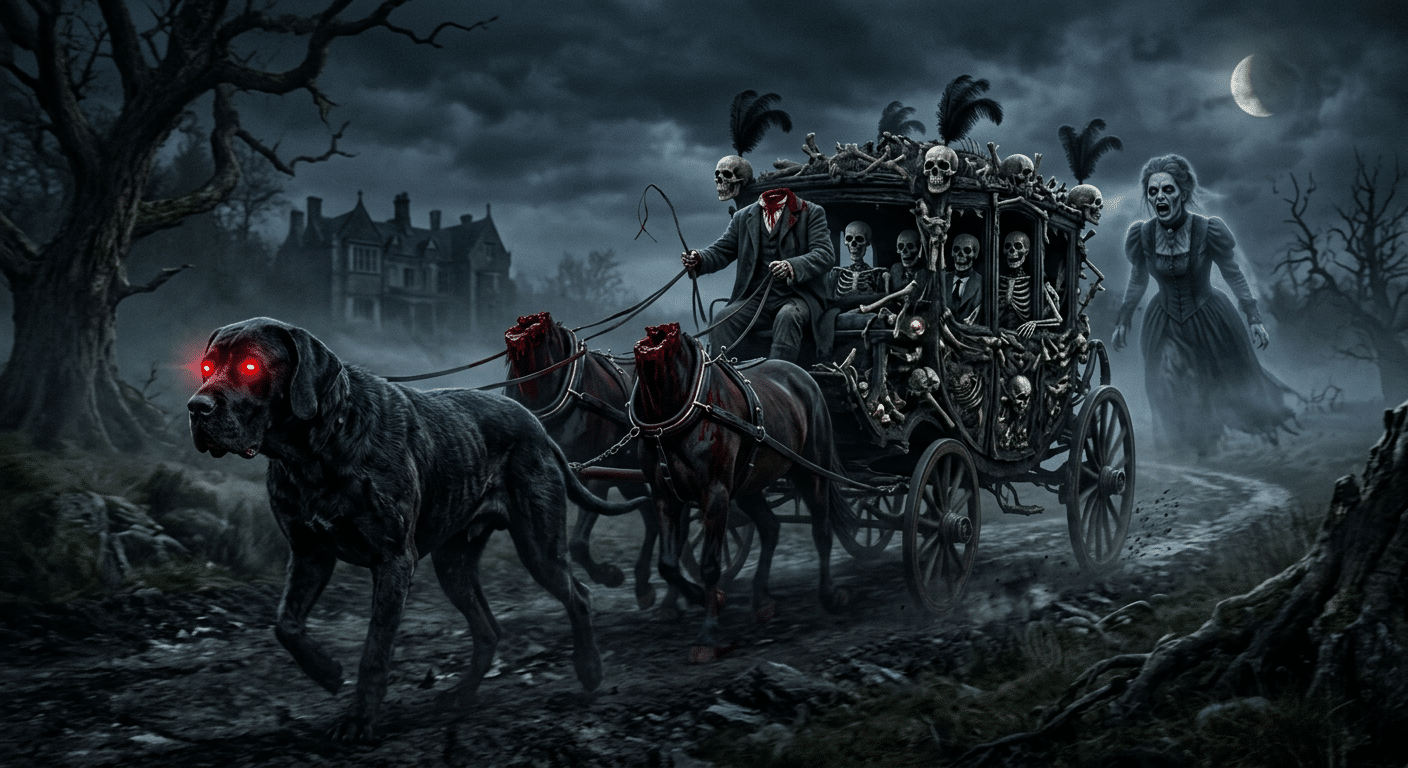
- Legend says Lady Mary Howard rides nightly from Tavistock to Okehampton Castle in a coach of husbands’ bones, with a headless driver and a black hound.
- Her penance ends only when the hound, plucking one blade of grass a night, strips the castle mound bare.
- The real Mary Fitz (1596–1671) inherited a fortune after her violent father’s suicide, and her wardship was sold to the Earl of Northumberland for £465.
- Married at twelve, she outlived four husbands, divorced and sued Sir Richard Grenville, and died at seventy five having murdered no one.
- The tale shows how folklore is manufactured, mixing an ancient impossible labor motif with local history, and it still shapes Dartmoor’s identity.
- Theories blame guilt transferred from her father, older Devon black dog lore, Grenville’s reputation, Victorian embellishment, or simple misogyny.

Introduction
On winter nights in Devon, when the wind falls from the high moor and the roads close up into walled tunnels of darkness, a story was told by the fire. The story was about a coach made of human bones, a headless coachman, and a spectral black hound with eyes like fire. Inside the bus was a woman, white as wax, cursed for all eternity to travel the same sixteen miles between Tavistock and Okehampton every night. Her name was Lady Mary Howard and she was real. And that is what makes the mythology so disturbing and unjust. The account of Lady Howard’s ghostly coach is one of the oldest and most graphic examples of Dartmoor folklore and, as the BBC’s own version admits, one of the least historically true (Spencer, 2005). The story of a wealthy seventeenth-century heiress who becomes a murderess in the imagination of her neighbors reveals important insights about folklore, Dartmoor, and the ways communities punish women who do not conform.
The Legend of the Bone Coach
The legend is something like this. But at midnight, the gates of Fitzford House, on the outskirts of Tavistock, open. Out comes the hound first, immense and black, with eyes sometimes described as flashing red and sometimes as a single eye in the middle of its forehead (Guiley, 2007). Behind the hound rolls a coach made of bones, which contains the skeletal remains of the four spouses that Lady Howard is alleged to have murdered, with a skull at each of the four corners and black plumes nodding above them. In many of the variations the horses are decapitated. The driver too. Witnesses say by the time the truck comes into view, the rattle of bones is audible. The coach is Lady Howard herself, who is eyeless and ashen; however, in some versions of the story, she is represented as the hound racing beside her funeral procession instead of being in the coach at all (Guiley, 2007). The old road along the border of the moor led the cortege to Okehampton Castle. There the dog mounts the castle mound with a kind of ceremony and picks out a solitary blade of grass between its teeth. And then the procession turns and carries the blade back to Fitzford. Where it is laid on a stone slab, and the whole company disappears. She must make this voyage every night till the mound is stripped naked. Then she will be set free. The verses that ensured the image remained in local memory were preserved by Baring-Gould, the Devon parson and collector of folk songs: “My ladye hath a sable coach, / And horses two and four; / My ladye hath a black bloodhound / That runneth on before. / My ladye’s coach hath nodding plumes, / The driver hath no head; / My ladye is an ashen white, / As one that long is dead” (Baring-Gould & Sheppard, 1891, cited in Spencer, 2005). By 1879, Murray’s guidebook could assert outright that “Okehampton Park is the scene of the nightly penance of Lady Howard,” as if the story were an established local attraction (Murray, 1879, as cited in Occult World, 2021).

The Historical Mary Fitz
The woman behind the mythology deserves more. Mary Fitz was born in 1596, the daughter of Sir John Fitz of Fitzford and Bridget Courtenay and granddaughter of the Earl of Devon (Mary Fitz, n.d.). Her childhood was a disaster. Her father received immense wealth at twenty-one and drank, brawled, and litigated his way through it, killing two men, one of them a friend, on his own doorstep, and earning the contempt of Tavistock before killing himself at about thirty (Spencer, 2005). Mary was nine years old. In the crude economics of Jacobean wardship, she was a commodity as sole heiress; her wardship was sold by James I to the Earl of Northumberland for £465, a bargain considering the size of her fortune and at twelve she was married in 1608 to the Earl’s brother, Sir Allan Percy (Spencer, 2005; Mary Fitz, n.d.). Percy died. Within months of their marriage, her second husband, Thomas Darcy, died. Her third husband, Sir Charles Howard, died in September 1622, and it is from him that she got the surname that the tale remembers (Mary Fitz, n.d.). During a long separation from Howard, she bore a son, George, whose father was said to be a servant, George Cuttford. The kid was christened under another name and his existence was kept secret until he was nine (George Howard, n.d.). Widowed and rich, she became a figure of some prominence at the court of Henrietta Maria, appreciated for her intellect as well as her charms (Spencer 2005). In November 1628 she married her fourth husband, the professional soldier Sir Richard Grenville, and insisted on a prenuptial agreement, a very unusual step for a woman of the period (Sir Richard Grenville, 1st Baronet, n.d.). Grenville bought a baronetcy with her money and supported a lavish lifestyle. The marriage didn’t take. Mary divorced him in 1632, linked herself with a former legal opponent, the Earl of Suffolk, and cooperated in suing Grenville for slander to the tune of £8,000, a debt that placed him in prison (Sir Richard Grenville, 1st Baronet, n.d.). Fitzford House was subsequently destroyed during the Civil War (Spencer, 2005). She died in 1671, aged seventy-five, outliving all four husbands and, by a matter of weeks, her son George (George Howard, n.d.). She didn’t kill anybody.
Gendered Ghosts, Heritage, and Cultural Memory
By including gendered ghost narratives in heritage studies (Roberts, 2014), Gothic literary contexts (Vuohelainen, 2021), and canonical ghost-story themes (Barrett, n.d.), a coherent picture of Lady Mary Howard as a potential ghostly presence can be discerned. This synthesis shows that if Mary Howard’s ghost had appeared in a narrative or exhibit, it would likely have functioned as a gendered, morally legible revenant, one that addressed inheritance, memory, and power, but also one that challenged elite, male-centered narratives. The interpretive framework I propose would place her ghost within a broader practice of reviving and reinterpreting aristocratic memory at sites like Blenheim or in textual ghost narratives, with a focus on how such figures engage with living spectators and readers (as in Roberts’ media-historical analyses) (Roberts, 2014).
So why is the tale important, other than the enjoyment of a good scare? First, because it is a near-perfect example of the way folklore is formed. The penance is an ancient form of tale, the difficult task continuously performed, freedom always just beyond reach; it is kin to Sisyphus and his rock (Spencer, 2005). The renowned scholar of Devon ghost tales, Theo Brown, has demonstrated that West Country stories concerning the destiny of the dead follow recognizably post-Reformation patterns; they fill the theological vacuum created by the removal of purgatory with local, geographical penances of exactly this kind (Brown, 1979, 1982). Second, the story is important as a case study in reputation. Mary Howard was rich, four times married, argumentative, sexually liberated, well-connected at court, and the daughter of the most loathed man in Tavistock. Any one of these things would have set her apart. Together they made her a target and the mystique that sprang up around her turned her survival into a burden. Third, the narrative matters because it still molds Dartmoor’s identity, inspiring songs, paintings, guidebooks, and ghost walks. Okehampton Castle and the remaining Fitzford gatehouse give it concrete points of reference.
The female ghost narrator in a heritage context represents a change of voice authority from patriarchal history to more personal, domestic, or servant perspectives. Roberts explains how a female ghost at Red and Heim Palace offers a voice through which intimate family tales can be foregrounded, opposing elite-centered history (Roberts, 2014). This is theoretically in line with the possibility of a Lady Mary Howard ghost operating in a similar fashion, enabling the public to engage with a feminine perspective on inheritance, family, and power. Sutherland’s discussion of photographic and materialized ghost motifs furthers thematic links between female spectral voices and contested histories and shows how material culture can give form to intangible hauntings and the governance of memory (Ivanhoe, 1939; Huxtable, 2022), not about Lady Mary. This coupling proposes a method of conceiving Lady Mary as a ghost mediating memory through tangible or commemorative forms.
Theories of Origin and the Politics of Inheritance
There are several hypotheses about the origin of the folklore. The most frequently cited is the thesis of transferred guilt: the murders and the insanity were John Fitz’s, and the community’s wrath of the father was visited upon the last living Fitz, his daughter (Spencer, 2005). A second idea is that the tale is much older than Mary herself and a real name was just grafted onto a pre-existing black dog haunting, of which Devon has many, including the Wisht Hounds of Wistman’s Wood (Guiley, 2007; Norman, 2015, as reviewed in Simpson, 2016). A third explanation is that of Grenville, infamous for his ferocity in battle; the husband’s notoriety may have tainted the wife who beat him in court. A fourth points to Victorian intervention, arguing that antiquarians, guidebook writers, and song collectors like Baring-Gould standardized, embellished, and popularized what was once fragmentary rumor, giving the coach its bones and its plumes (Murray, 1879, as cited in Occult World, 2021; Baring-Gould & Sheppard, 1891, as cited in Spencer, 2005). A fifth, less romantic view is that of simple misogyny working as folk history. The tale works as a warning about women who inherit, refuse, litigate, and outlive. These hypotheses are not mutually incompatible. The most likely explanation is complicated: an ancient tradition of moorland hounds, a disreputable local family, a truly eccentric woman, and two centuries of storytellers adding embellishments to the facts.
The material spectral trope of a will or “dead hand” is a recurring motif in ghost narratives where the dead seek to rectify a wrong or reveal a hidden truth (Candidate (Anthony, n.d.) as cited, which mentions a will and a ghost’s attempts to interact with the living to address a legal or moral wrong). If we consider Lady Mary Howard to be a ghost of a contested will or estate, then the ghost would enact the politics of inheritance that have long structured aristocratic networks for women. Restoration courts are a significant aspect of literature (O’Neill & Wilson, 1976; Simon & Wilson, 1979). (O’Neill & Wilson, 1976; Simon & Wilson, 1979) The background explores how women in the Howard network are represented in public memory through marital, political, and social structures. Ghosts in such a context could be read as memorialized agents reentering the social stage to critique or illuminate the archival record (O’Neill & Wilson, 1976; Simon & Wilson, 1979).
Conclusion
The ghost of Lady Mary Howard lives on because it is magnificent horror, all rattling bone and crimson eyes and hopeless repetition, and because it is rooted in a real road, a real castle mound and a genuine name. But the legend is also a slander, kept alive for three hundred years against a woman sold as a child, married at twelve, widowed three times over, and cunning enough to protect herself by contract and by lawsuit in an age that allowed women almost no protection at all. The correction is the more engaging yarn, and there is a justification for recounting the story with the correction included. And if there is any penance to be paid on that road between Tavistock and Okehampton, it is not hers.
References
Anthony, A. (n.d.). Touch of the troubled dead: Spectral trauma in 19th century ghost stories. https://doi.org/10.46569/20.500.12680/dn39x785p
Barrett, W. F. (n.d.). Hauntings and poltergeists. 187–210. https://doi.org/10.1037/13812-013
Brown, T. (1979). The fate of the dead: A study in folk eschatology in the West Country after the Reformation. Folklore Society.
Brown, T. (1982). Devon ghosts. Jarrold.
George Howard (died 1671). (n.d.). In Wikipedia. Retrieved from https://en.wikipedia.org/wiki/George_Howard_(died_1671)
Guiley, R. E. (2007). The encyclopedia of ghosts and spirits (3rd ed.). Facts on File.
Huxtable, S.-A. (2022). Tangible and intangible heritage: Charles Paget Wade and the creation of Snowshill Manor as a magical space. Preternature: Critical and Historical Studies on the Preternatural, 11(1), 25–42. https://doi.org/10.5325/preternature.11.1.0025
Ivanhoe. (1939). Books and bookmen. Library Review, 7(2), 85–91. https://doi.org/10.1108/eb060405
Mary Fitz. (n.d.). In Wikipedia. Retrieved from https://en.wikipedia.org/wiki/Mary_Fitz
Norman, M. (2015). Black dog folklore. Troy Books.
Occult World. (2021, July 6). Okehampton. https://occult-world.com/okehampton/
O’Neill, J. H., & Wilson, J. H. (1976). Court satires of the Restoration. Eighteenth-Century Studies, 10(1), 140. https://doi.org/10.2307/2737831
Roberts, R. (2014). ‘The untold story’: The mediated female ghost in England’s Blenheim Palace. European Journal of Cultural Studies, 18(1), 35–51. https://doi.org/10.1177/1367549414557802
Simon, I., & Wilson, J. H. (1979). Court satires of the Restoration. The Modern Language Review, 74(1), 165. https://doi.org/10.2307/3726936
Simpson, J. (2016). Review of Black dog folklore by Mark Norman. Gramarye: The Journal of the Sussex Centre for Folklore, Fairy Tales and Fantasy, (10), 82–83.
Sir Richard Grenville, 1st Baronet. (n.d.). In Wikipedia. Retrieved from https://en.wikipedia.org/wiki/Sir_Richard_Grenville,_1st_Baronet
Spencer, A. (2005). Lady Howard’s ghostly coach. BBC Devon. https://www.bbc.co.uk/devon/discovering/legends/lady_howard.shtml
Vuohelainen, M. (2021). Traveller’s tales: Rudyard Kipling’s Gothic short fiction. Gothic Studies, 23(2), 181–200. https://doi.org/10.3366/gothic.2021.0093

Leave a Reply