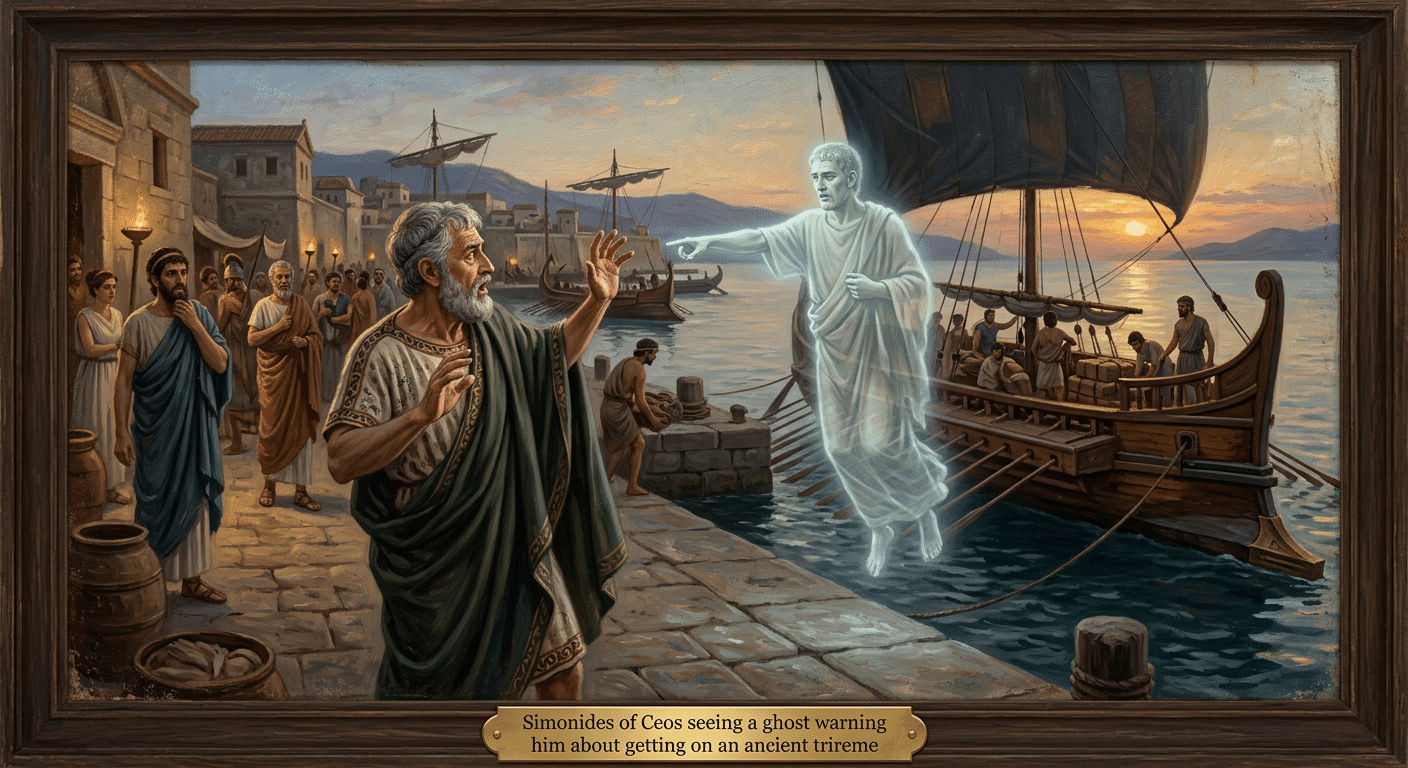
Simonides Ghost Story: Key Points
- The tale survives in Cicero’s On Divination (1.27.56), where it appears not as entertainment but as evidence in a debate over whether the gods send true dreams (Cicero, trans. 1923).
- Cicero (106-43 BCE) was a self-made Roman consul, augur, and philosopher who wrote his major philosophical works during political eclipse and grief, and was killed in the proscriptions of 43 BCE (Rawson, 1975; Everitt, 2001).
- Simonides of Ceos (c. 556-468 BCE) was a widely traveled lyric poet, famed for dirges and epitaphs for the war dead, making him a natural magnet for a story about honoring a corpse (Molyneux, 1992; Campbell, 1991).
- Simonides buries an unidentified corpse he finds on a shore; the dead man’s ghost later warns him in a dream not to sail; he obeys, and the ship sinks with all aboard.
- It documents the Greek belief that the unburied dead cannot rest and that burial creates a reciprocal debt, and it is the earliest firm ancestor of the “Grateful Dead” folktale type (Johnston, 1999; Felton, 1999; Gerould, 1908).
- Scholars read it variously as a migratory legend attached to a celebrity, as a twin of the memory-palace banquet legend in De oratore, or as a specimen of survivorship bias that Cicero’s second book quietly demolishes (Molyneux, 1992; Yates, 1966; Wardle, 2006).

Introduction
Few stories handed down from classical antiquity are as short, as morally neat, or as important as the story of the poet Simonides and the thankful ghost. It is preserved in a single short section from Cicero’s philosophical discourse. On Divination, it is not presented as amusement but as proof in an argument about whether the gods contact mankind through dreams (Cicero, trans. 1923, De Divinatione 1.27.56). The anecdote is brief enough to be told in one breath. But it had an afterlife of two thousand years of European folklore and was the progenitor of a vast family of tales in which the dead repaid the living for the gift of burial. To understand the story, one must know the Greek poet who is its hero, the Roman statesman who is its carrier, and the theological beliefs that made such a tale seem realistic to ancient audiences.
The Two Men Behind the Anecdote
Marcus Tullius Cicero was born in 106 BCE in Arpinum, a hill town southeast of Rome, to a family of local stature but without senatorial heritage. He was a novus homo in the Roman sense, a new man who had attained the peak of public life without inherited privilege (Lorenzen, 2023). Educated in eloquence and philosophy at Rome and then in Athens and Rhodes, he developed his career on the strength of his voice, garnering national notoriety in 70 BCE with his prosecution of the corrupt governor Verres. In 63 BC he was consul and suppressed the conspiracy of Catiline, which he always regarded as the salvation of the republic and never allowed others to forget. He was thereafter exiled in 58 BCE, before an unhappy homecoming and then the catastrophe of civil war, in which he backed Pompey and was pardoned by Caesar (Rawson, 1975). Those years of political eclipse were literally fecund. In 46-44 BCE, partially in mourning for the death of his daughter Tullia, Cicero wrote intellectual works that brought Greek thought into Latin, including On Divination (Everitt, 2001). He himself had been chosen for the college of augurs, the priesthood whose business it was to read the will of Jupiter in the flight of birds, and this appointment lends a special point to his interest in the matter. In the Philippines, he attacked Mark Antony after Caesar’s assassination and was banned and sought and slain in 43 BCE.
Simonides of Ceos, the protagonist in the story, lived c. 556-468 BCE. Born on the little Cycladic island of Ceos in the town of Ioulis, he was one of the nine lyric poets of the Alexandrian canon and one of the most widely traveled artists of the archaic world. He was employed at Athens under Hipparchus, afterward with the Thessalian princes Scopadae and Aleuadae, and died at the court of Hieron of Syracuse in Sicily (Molyneux, 1992). He is attributed by ancient tradition as being the first to write for pay, the professionalization of poetry, and thus a reputation for avarice that succeeding writers loved repeating (Campbell, 1991). But above all, he was famous as a poet of mourning. The melancholy of his dirges was notorious; the epigrammatic tradition that has clung to his name supplied him with a body of epitaphs for the war dead, notably the famous couplet for the Spartans at Thermopylae. A poet, whose art was mostly about honoring the dead, is precisely the kind of figure to whom a story about burying a stranger would attach itself.

The Story and Its Ancient Versions
The story itself is in three neat stages. First, the nice thing. Walking along the shore, Simonides discovers an unburied body lying uncovered. The body belongs to an unknown man, and Simonides has no way of identifying him. Anyway, he performs the rites and gives the deceased due burial. Then the warning comes. Later, when the poet is about to sail, the dead man appears to him in a dream and tells him not to board the ship, because that would be death by shipwreck. Third: the aftermath. Simonides refuses to go on the expedition; the ship sails without him and is lost in a storm with all on board. Cicero’s own account is quite brief, a few phrases by his brother Quintus in a list of prophetic dreams (Cicero, trans. 1923, De divinatione 1.27.56). Later readers take details such as the very island where the corpse was found for granted, but they come out of this wider tradition of retelling, and it is clear from versions in Valerius Maximus and the fabulist Phaedrus just how freely the anecdote could be reshaped (Valerius Maximus, trans. 2000, 1.7.ext.3; Phaedrus, trans. 1965, 4.26).
Ghost Belief and the Folktale Tradition
The story is relevant for a variety of reasons. It is foundational to the study of ancient ghost belief. Classical spirits are seldom superfluous. They arise because they are missing, and the most typical thing missing in business is the lack of a suitable burial (Felton, 1999; Ogden, 2002). In Greek theology, the ataphoi, the unburied, were a separate and hazardous category of the dead, souls who could not complete the passage out of the world of the living and so were subject to lingering, disturbing, and, occasionally, bargaining (Johnston, 1999). The fear that haunts Sophocles’ Antigone is based upon the same idea. Seen in this light, Simonides’ conduct is not sentimental charity but the performance of a sacred duty due by any passer-by to any body, and the ghost’s warning is the obvious conclusion of a reciprocal exchange. Piety pays itself back, and the poet’s life is the interest of the debt.
Equally important is the story’s position as an ancestor of a major family of folktales. Folklorists describe tales where a buried or ransomed body returns to help its benefactor as the Grateful Dead, and they are included in the international tale type index and as motif E341 in the standard motif index (Thompson, 1955–1958; Uther, 2004). Gerould’s classic study followed hundreds of medieval and modern variants across Europe and the Near East, from the Book of Tobit to Scandinavian ballads to the folk tales of Sicily, and identified the ancient anecdote about Simonides as one of the earliest recorded appearances of the pattern (Gerould, 1908). The Simonides story is therefore a touchstone for anyone trying to date the motif and to debate whether such patterns spread by dispersion or develop independently from common theological fears.
Competing Interpretations
Several theories exist to explain the story. The folklore approach interprets it as a migratory legend that acquired for itself a famous name, as anecdotes tend to cluster around celebrities, and Simonides was a magnet for stories, like Aesop or Diogenes. One literary variant of that theory is that the tale was formed in reverse out of the poet’s own corpus, spun from an epigram about a stranger’s tomb until the epigram became a biography (Molyneux 1992). A structural reading observes that the tale is of a matched pair. In the better-known version of the legend, Cicero tells us that Simonides was called out of the banqueting hall of Scopas by two young men, identified as the divine twins Castor and Pollux, just before the roof came crashing down on the guests, and that the poet then identified the mangled bodies by recalling where each diner had reclined, an act of recollection that is credited with giving birth to the method of loci (Cicero, trans. De oratore 2.86.351-354, 1942; Yates, 1966). There is a supernatural warning in both tales, a narrow escape, a mass death, and a debt paid to corpses. This story is a consistent mythical portrait of Simonides as the guy whose veneration for the dead keeps protecting him.
A third line of thought is philosophical and concerns Cicero’s intent rather than the poet’s. On Divination is a two sided dialogue. In the first book, Quintus assembles Stoic style proofs that the gods send real visions, and the Simonides story is one of his exhibits. In the second book, the character Marcus takes the thesis apart, insisting that tales of this sort prove nothing, since chance produces coincidences in plenty and nobody notes the countless dreams that came to nothing (Cicero, trans. 1923, De divinatione 2.126-147; Wardle, 2006). Seen in that light, the story is an example of ancient survivorship bias, saved precisely because the dreamer lived. Cicero the augur does not say plainly which side he believes, and that reluctance is part of the passage’s enduring interest.
Conclusion
The tale of Simonides and the thankful ghost lives on because it does several different kinds of labor at once. It is a ghost story that has a satisfying shape, a religious lesson about the responsibility owed to the anonymous dead, a piece of evidence in a Roman debate about the boundaries of knowledge, and the earliest certain ancestor of a folktale pattern that will circulate for generations. It survived by accident of literary history, the survival of a philosophical dialogue penned by a Roman politician in the latter months of his life. But its significance depends on something more enduring, a broadly held belief that the dead have demands on the living, claims that might be respected or neglected at real cost. Simonides paid a debt no creditor may sue a stranger for, and tradition praised him.
References
Campbell, D. A. (Ed. & Trans.). (1991). Greek lyric III: Stesichorus, Ibycus, Simonides, and others. Harvard University Press.
Cicero, M. T. (1923). De senectute, De amicitia, De divinatione (W. A. Falconer, Trans.). Harvard University Press.
Cicero, M. T. (1942). De oratore, books I-II (E. W. Sutton & H. Rackham, Trans.). Harvard University Press.
Everitt, A. (2001). Cicero: The life and times of Rome’s greatest politician. Random House.
Felton, D. (1999). Haunted Greece and Rome: Ghost stories from classical antiquity. University of Texas Press.
Gerould, G. H. (1908). The grateful dead: The history of a folk story. David Nutt.
Johnston, S. I. (1999). Restless dead: Encounters between the living and the dead in ancient Greece. University of California Press.
Lorenzen, M. (2023). Cicero. In B. A. Geier (Ed.), The Palgrave handbook of educational thinkers (pp. 1-14). Palgrave Macmillan, Cham. https://doi.org/10.1007/978-3-030-81037-5_4-1
Molyneux, J. H. (1992). Simonides: A historical study. Bolchazy-Carducci.
New Revised Standard Version Bible. (1989). National Council of the Churches of Christ.
Ogden, D. (2002). Magic, witchcraft, and ghosts in the Greek and Roman worlds: A sourcebook. Oxford University Press.
Phaedrus. (1965). Babrius and Phaedrus (B. E. Perry, Trans.). Harvard University Press.
Rawson, E. (1975). Cicero: A portrait. Allen Lane.
Sophocles. (1984). Antigone (R. Fagles, Trans.). Penguin Books.
Thompson, S. (1955-1958). Motif-index of folk-literature (Rev. ed., Vols. 1-6). Indiana University Press.
Uther, H.-J. (2004). The types of international folktales: A classification and bibliography. Suomalainen Tiedeakatemia.
Valerius Maximus. (2000). Memorable doings and sayings (D. R. Shackleton Bailey, Trans.). Harvard University Press.
Wardle, D. (2006). Cicero on divination: De divinatione, book 1. Oxford University Press.
Yates, F. A. (1966). The art of memory. University of Chicago Press.




Leave a Reply