Hand of Glory: Key Points
- The Hand of Glory is a preserved severed hand taken from a hanged criminal, used in European occult tradition primarily as a tool by thieves and burglars.
- It was created through an elaborate preservation process involving salt, saltpeter, herbs, and drying, with accompanying candles made from the corpse’s own fat and hair.
- Its chief power was the ability to render all occupants of a household into an unnatural, unbreakable sleep, with additional abilities including opening locks, revealing treasure, and producing a light only the bearer could see.
- The belief is documented across England, France, Germany, and Ireland from at least the early eighteenth century, with a famous Irish incident in 1831 and physical specimens surviving to this day, including one housed at the Whitby Museum in Yorkshire.
- One prominent theory holds that the name derives from a linguistic corruption of “mandragore,” the French word for mandrake, a plant with strikingly similar magical associations that was also said to grow beneath gallows.
- More broadly, scholars connect the Hand of Glory to widespread beliefs about the magical potency of executed criminals’ remains, and some suggest it was a genuine artifact of professional criminal subculture rather than mere peasant superstition.

Introduction
One of the most frightening and fascinating artifacts of European occult heritage, the Hand of Glory occupies a unique place in the history of dark magic and criminal mythology. It is an object that blurs the line between superstition and real cultural anxiety, between the pragmatic anxieties of thieves and the deepest fears of a culture obsessed with death, crime, and the supernatural. It is one of the most enduring relics of folk magic the Western world has ever produced; few magical devices have been so thoroughly documented across so many centuries and in so many different nations.
The Talisman and Amuletic Tradition
Amulets and talismans are regularly described throughout the early modern to medieval and modern periods as objects designed to protect the bearer or the household from harm, luckless events, or malevolent powers. The literature foregrounds not only the items themselves but also the symbolic economy in which they are embedded: inscriptions, images, and inscriptions on things; the materiality of the talisman; and the social and devotional contexts in which talismans circulate. Studies of textual amulets and the broader amuletic economy clearly establish this concept. For instance, a study of textual amulets in early modern France reveals how individuals wore or carried words, characters, and symbols as protective or therapeutic devices and how theologians argued about their use (Dauge-Roth, 2018). This source places talismanic practice inside material culture and interpretive discourse, an important context for interpreting a Hand of Glory-type object as a protective instrument in a domestic or street-level context (Dauge-Roth, 2018).
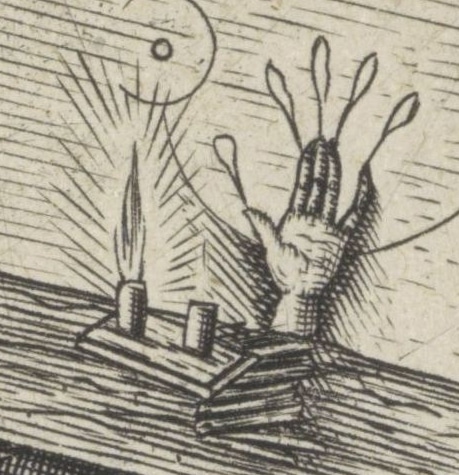
The most basic version of the Hand of Glory is the severed and preserved hand of a hanging criminal, most often a man executed for murder or some other serious offense. Mostly this was the left hand; however, there are other texts saying that the hand used to perform the crime for which the individual was executed should be used. In other traditions, the whole hand is dried and used as a candleholder, with candles inserted between the stiffened fingers. In other variations, the fat from the corpse was converted into candles, which were then held in the hand, or the fingers of the hand were actually set alight and used directly as wicks. The item was thus both intensely intimate and intensely morbid, its alleged power derived precisely from its origins in death by public execution.
This larger material-cultural scholarship on amulets and talismans also emphasizes the ambivalent logic through which such objects work: protective power is often embedded in a recognizable iconographic or scriptural code, and the efficacy of the talisman is tied to ritual practices and belief systems around relics, images, and words (the “amulet” versus “talisman” distinction is discussed in the context of Byzantine to Renaissance material culture) (Kiyanrad et al., 2018). Therefore, we see an object, similar to a hand of glory, operating as a structured artifact with known symbolic language and ceremonial possibilities.

Construction, Powers, and Countermeasures
The procedure of constructing a hand of glory was documented in some depth in several grimoires and magical writings. The process was complicated, ceremonial, and profoundly horrible (Rinsler, 1960). The most commonly quoted recipe, in the eighteenth-century French grimoire Secrets du Petit Albert, required that the hand be removed from a hanged man while he was still on the gibbet, preferably during a moon eclipse or other auspicious time. The hand was then wrapped in a piece of funeral shroud, pressed of all blood, and put in an earthenware vase with salt, saltpeter, zimat (a term often understood as a zinc compound), and various peppers and herbs. This pickling concoction kept the hand for several weeks, after which the hand was taken out and dried, at times in the sun during the dog days of summer and at others in an oven heated with vervain and ferns. The candles to go with the hand had to be created from the fat of the hanged man combined with virgin wax and Lapland sesame, and the whole wick had to be formed from the hanged man’s hair. Those who recorded and presumably followed these instructions took them seriously, as evidenced by their specificity and complexity.
The Hand of Glory was said to possess many powers, but its main and most destructive capability was to make everyone within a house unable to move or wake (Shah, 2021). If a robber entered a house with the Hand of Glory and lit the candles, all those who were sleeping in the house fell into an unusually deep sleep and could not be woken by any normal methods (McCorristine, 2009). It was stated that one person was made insensible for each finger that burnt, so that a hand with all five fingers/candles alight would incapacitate a whole household. But the Hand of Glory was not claimed to do simply this paralyzing function. It was also said to work as a light that only the bearer could see, but that was invisible to everyone else, which made it the perfect accomplice for a nocturnal burglar. Some legends ascribed to it the power of unlocking closed doors, either by direct magical action or by exposing hidden locks and mechanisms. It was also claimed to be able to find buried wealth and, in some tellings, even protect the criminal from detection or arrest during a heist.
Folklore had equally specific and unusual countermeasures to the Hand of Glory, but these were the only reliable ones. They reported that the flame resisted usual means, including ordinary water or breath. The candles could only be quenched with certain ingredients, the most frequent of which was milk, while some legends mention blood or a unique mixture of a cat’s gall, white hen’s fat, and the gall of a black snake. In some accounts, a single member of the household might be spared if they had previously rubbed one of these protective potions on their person or on the threshold of their home. This is interesting because it redefines the Hand of Glory not as an unstoppable force but as one that may be foreseen and fought by the wise or the lucky, providing the folktale with a narrative structure that could allow for heroic resistance.
Historical Record and Physical Evidence
The story of the Hand of Glory may be tracked back several hundred years and is present throughout England, France, Germany, Ireland, and other parts of Europe with extraordinary consistency. The concept itself is almost certainly earlier, but one of the earliest detailed written depictions appears in the aforementioned Petit Albert, a popular French magical text initially published in the early eighteenth century. Legal and court documents from England in the seventeenth and eighteenth centuries occasionally relate to accusations involving the Hand of Glory, and the object occurs in trial transcripts in ways that show that ordinary people actually feared it. A well-known story in Ireland tells of a band of men trying a heist at Loughcrew in County Meath in 1831 who supposedly employed a Hand of Glory to paralyze the household, only to be foiled when one servant girl stayed awake and put out the hand with milk. This story was widely reported in newspapers at the time and helped spread belief in the British Isles’ common currency.
There are several actual objects that are said to be genuine Hands of Glory that have survived to the present day, giving the subject a weird tangibility that most folklore lacks. The most renowned surviving specimen is in the museum at Whitby in North Yorkshire, England, where it has been displayed for well over a century. It was donated to the museum in 1935 by a local surgeon who had apparently got it from an old woman who kept it in her house. The hand is shriveled and mummified, and while its exact history cannot be conclusively proven, it has been tested and verified to be a real human hand, preserved in some way consistent with historical accounts. Another alleged Hand of Glory was found in 1890, during renovations to a wall of a cottage on the North Yorkshire moors at Castleton, where it was concealed, probably as a protective talisman or as proof of its use. Whatever their exact origins, the presence of these physical artifacts indicates the seriousness with which the belief was treated by at least some persons who met it.
Theoretical Explanations and Origins
Many explanations have been put up by scholars and historians to illustrate not only the origin of the religion but also its amazing longevity. One of the most language-oriented is that the name “Hand of Glory” is in fact a mistranslation or linguistic perversion of the French term “main de gloire,” which is itself a folk etymology from the word “mandragore,” which is the French word for mandrake. The mandrake root was one of the most potent and feared plants in European magical history, long thought to grow beneath the gallows from the bodily fluids of hung individuals (Ross, 1975). The theory is that the Hand of Glory kind of absorbed the magical characteristics that were originally assigned to the mandrake root. It was a slow process of linguistic confusion and cultural drift that led to the change from plant to human part. Both artifacts are associated with hung prisoners, with sleep-inducing properties, and with hidden treasure. All these have much weight towards this view.
Another theoretical avenue positions the Hand of Glory within the broader context of execution magic practices prevalent throughout numerous cultures and historical periods (Davies & Matteoni, 2017). The concept that the remains or body parts of executed criminals have unique magical efficacy is astonishingly widespread, appearing in ancient Rome, medieval Europe, and many non-Western traditions. This belief is usually a matter of common sense: a publicly executed person has died at the intersection of law, community verdict, and violent death, thus becoming a liminal figure who is in a particularly charged way between the worlds of the living and the dead. The hand is especially symbolic as the tool of action, the bodily part most closely connected with work, crime, and deed. To cut off the hand of a criminal and put it to use is, then, to make a kind of dark inversion of justice, converting the instruments of crime into instruments of more crime, but with the extra power of death behind them.
A third, more anthropological interpretation relates the Hand of Glory to much older traditions of employing human remains in magical practice, traditions that precede Christianity and continue in fragmentary form throughout European folk magic. The use of body fat in candle manufacture has a long history in magical practice, including the Hand of Glory, particularly, while bones, hair, and skin of the deceased appeared routinely in folk medicines, charms, and folklore (Powell, 2023). Some scholars view the Hand of Glory as a late and particularly developed version of this tradition, one tied specifically to thieves and burglars, due to the culture of professional criminals that existed in early modern Europe with their own subcultures, rituals, and beliefs. This reading suggests that the Hand of Glory was not merely a superstition of credulous peasants but an actual artifact of criminal folk culture, something that professional thieves might have actually manufactured and employed, regardless of whether they truly believed in its powers or merely utilized it as a psychological tool to intimidate households prior to a robbery.
Conclusion
The Hand of Glory lives alive in the cultural imagination precisely because it occupies such rich metaphorical ground. It is the criminal’s fear of the night, the panic of waking up defenseless in your own home, and the transgressive force of death wielded against the living. It incorporates threads of folk magic, criminal culture, language history, and deep psychological concern about vulnerability and violation. It has been alluded to by writers from Sir Walter Scott to Terry Pratchett and continues to crop up in movies, games, and fantasy books as a shorthand for the worst form of occult object. Whatever one makes of it, as a historical curiosity, a piece of folklore awaiting serious anthropological study, or a simply wonderful gothic image, the Hand of Glory is one of the most compelling, most haunting artifacts in the entire canon of Western magical tradition, a testament to the strange and powerful ways human cultures have always sought to make sense of crime, death, and the darkness beyond the threshold.
References
Dauge-Roth, K. (2018). Prêt-à-porter: Paper, skin, and popular belief in early modern France = Prêt-à-porter: Amuletos textuales, creencias populares y definición de las supersticiones en la Francia de los siglos XVI y XVII. Espacio Tiempo Y Forma Serie VII Historia Del Arte, (6), 137. https://doi.org/10.5944/etfvii.6.2018.20769
Davies, O., & Matteoni, F. (2017). The places and tools of execution. In Executing magic in the modern era: Criminal bodies and the gallows in popular medicine (pp. 53–79). Palgrave Macmillan. https://doi.org/10.1007/978-3-319-59519-1_4
Kiyanrad, S., Theis, C., & Willer, L. (2018). Bild und Schrift auf “magischen” Artefakten. https://doi.org/10.1515/9783110604337
McCorristine, S. (2009). Ghost hands, hands of glory, and manumission in the fiction of Sheridan Le Fanu. Irish Studies Review, 17(3), 275–295.
Petit Albert. (1752). Secrets merveilleux de la magie naturelle et cabalistique du Petit Albert.
Powell, M. N. (2023). Thieving hooks, and the stories we tell about pirates. Digital Defoe: Studies in Defoe & His Contemporaries, 15, 41–71.
Rinsler, N. (1960). Nerval and Sir Walter Scott’s Antiquary. Revue de Littérature Comparée, 34, 448.
Ross, A. G. (1975). The mandrake. British Homeopathic Journal, 64(03), 188–192.
Shah, Z. H. (2021). (MIS)representations of otherness in detective fiction: The travelling gypsy as the criminal other in the case of the missing hand. Nevşehir Hacı Bektaş Veli Üniversitesi SBE Dergisi, 11(1), 406–414.




Leave a Reply