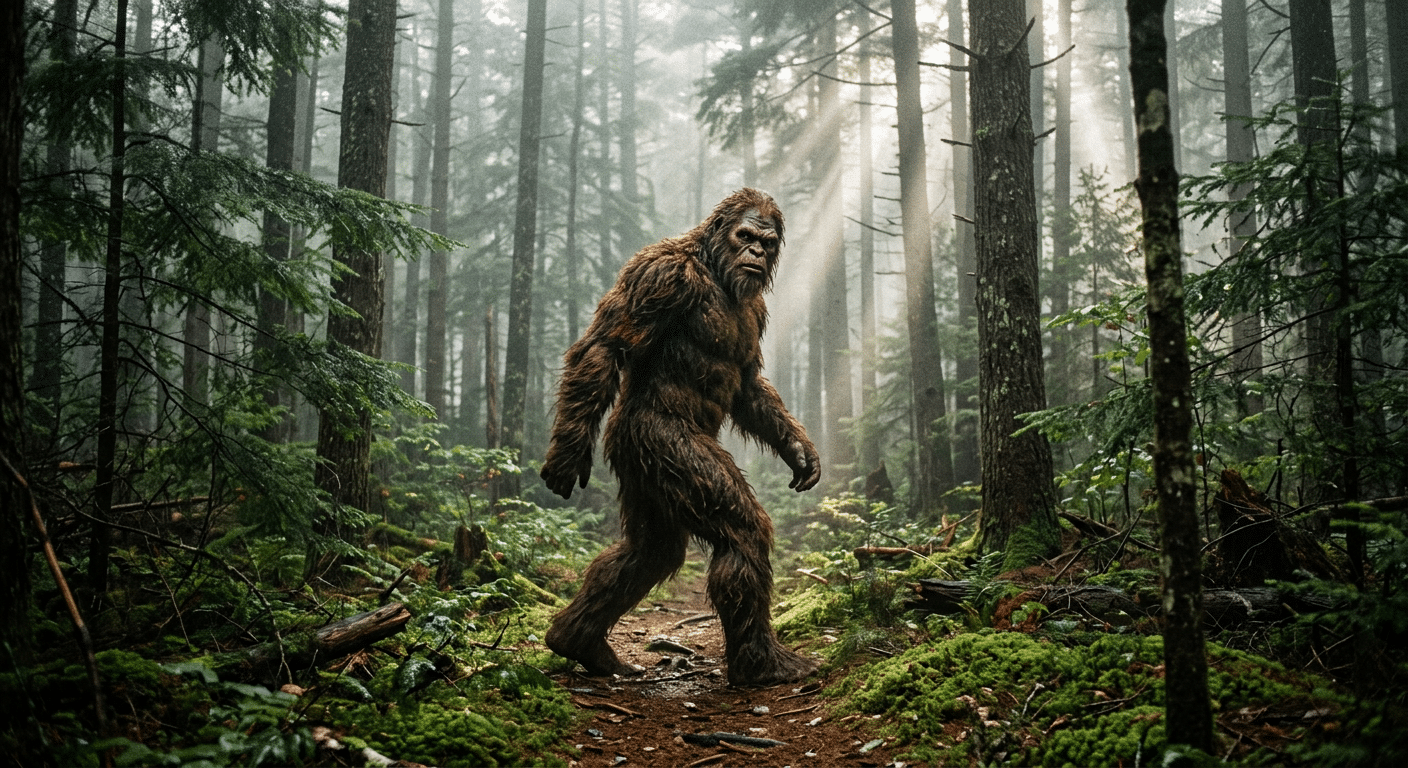
Bigfoot in Maine: Key Points
- Maine’s remote, roadless interior, with its ancient forests and vast wilderness, makes it a natural breeding ground for Bigfoot legends that have persisted for decades.
- Bigfoot is consistently described across thousands of reports as a massive, hair-covered bipedal creature standing seven to ten feet tall, with enormous feet, a human-like face, and a powerful, lingering odor.
- Maine’s version of Bigfoot is typically darker in color, closely associated with water, and behaves in a watchful and elusive manner rather than an aggressive one.
- The most concentrated sighting hotspots in Maine include the Allagash Wilderness Waterway, Baxter State Park, and the Moosehead Lake region, all areas of deep, largely inaccessible wilderness.
- Maine’s Bigfoot differs from the Pacific Northwest version by being more furtive and sound-based in its encounters, lacking the open-terrain visibility and mythological grandeur associated with western sightings.
- Mainstream science firmly rejects Bigfoot’s existence due to the complete absence of physical evidence like bones or verified DNA, and most sightings can reasonably be attributed to misidentification or the well-documented tendency of the human mind to fill in gaps with familiar patterns.

Introduction
Maine is a land of deep forests and granite-ribbed mountains and a wildness that seems genuinely ancient. The state’s core is so isolated that vast areas lack a permanent population, paved roads, or phone coverage. Maine’s terrain breeds stories, and one of the most persistent is that a large bipedal, unnamed creature is moving through the trees. Bigfoot goes by dozens of names across North America and his presence in Maine is easy to deny but surprisingly difficult to shake.
Bigfoot (also known as Sasquatch) is largely a legendary figure in North American and general global contexts. The figure of Bigfoot functions as a current tale and is investigated in folkloric, anthropological, and cultural-sociological contexts. Scholarly treatments stress that Bigfoot is rooted in narratives, memorates, and community practices rather than established biological knowledge, and that belief and storytelling about the figure shed light on how communities negotiate identity, place, and truth claims (Milligan, 1990; Bullard, 2023; Murray, 2021). Bigfoot is regularly approached in the literature as a phenomenon at the interface of myth, memory, and social practice rather than an experimentally validated entity; this perspective is at the heart of the study of folklore, which deals with the processes whereby stories are generated, distributed, and canonised. At the same time, a significant strand of cryptozoological and popular science discourse treats Bigfoot as a subject of enquiry, sometimes challenging this folkloric framing by seeking empirical corroboration or alternative naturalistic explanations; this tension is a core site of debate in the literature (Schembri 2011; Smith n.d.; Foxon, 2024; Simon, 2017). The confluence of folkloric and crypto-scientific interest points to the complicated status of Bigfoot as a cultural object, a topic that has spawned a substantial body of cross-disciplinary work on folklore, sightings, and social connotations (Capper, 2012; Puglia, 2023).

Physical Descriptions and Reported Characteristics
Across thousands of reported sightings, people consistently referred to the creature as Bigfoot. It is between seven and ten feet tall. Witnesses describe a muscular, upright physique, covered in shaggy hair ranging from dark brown to reddish black. Witnesses often describe the face as halfway between apes and humans, with a strong brow ridge, a flat nose, and dark, deep-set eyes that appear reflective in low light. The feet are gigantic, the prints varying from fourteen to twenty-four inches in length and presenting a decidedly human-like shape. Witnesses consistently notice the creature’s stench, a moist, musky, almost sulphurous stink that lingers in the air after it has vacated the area. What mystifies experts and fans alike is not any one account but the extent to which these descriptions cohere across widely varied geographies and cultures, from the swamps of Florida to the mountains of the Pacific North-west to the logging roads of northern New England.
Bigfoot in Maine: Regional Traits and Notable Hotspots
The monster in Maine takes on traits based on the environment itself. Bigfoot in Maine is often described as being a darker hue than its cousin to the west, with thick, matted fur for harsh winters and heavy brush. Many encounters with the animal have occurred in Maine near water. The heart of the state is largely a maze of rivers, lakes, and swampy lowlands, and many of the sighting accounts have originated from individuals fishing, hunting, or paddling in remote locations. In several cases, the creature was observed walking through shallow water and silently watching from the tree line along a riverbank. Sightings in Maine tend to be less aggressive and more observant than those from other parts of the country. Witnesses say they can feel they are being watched before they see anything. A strange silence, devoid of birdsong or insect noise, often precedes this encounter. The creature of Maine is more of a long-observed phenomenon than a recent announcement.
In some parts of Maine, sighting reports are much more frequent than in others. The 92 miles of lakes and rivers that make up the Allagash Wilderness Waterway in the far north have drawn attention for decades. The famous 1976 Allagash incident, where four men claimed a UFO abducted them while camping, also includes secondary claims of enormous, unexplained individuals in the adjacent woods. Whether you believe the abduction narrative or not, reports of big bipedal tracks and weird vocalisations continue to come in from the Allagash area. Another common hotspot is Baxter State Park, home to Mount Katahdin and some of the least visited countries in the eastern United States. Hikers and hunters in and near the area have reported strange tracks, tree structures and screaming sounds at night, not like any known Maine animals. The Moosehead Lake area, hundreds of square miles of forest in central Maine, generates a regular stream of stories, many from hunters who swear they have come across big, humanoid tracks in mud or snow near game trails. These locations are not remote. They are locations where seasoned outdoorsmen spend heavy-duty time, thus making the stories of sightings there more difficult to dismiss altogether.
A Tale of Two Cryptids: Maine and the Pacific Northwest
The Maine Bigfoot is different in several important ways from the renowned Pacific North-west version. It is also commonly described as very enormous and physically intimidating. The Pacific North-west creature is best known from the Patterson-Gimlin video of 1967, shot near Bluff Creek in Northern California. It is connected with extensive, ancient temperate rainforests. Sightings in Washington, Oregon and Northern California tend to depict a more noticeable, almost brazen animal that holds its position or is watched for longer durations in more open territory. In the Pacific North-West, “wild man” or similar forest-haunting figures appear in settler colonial narratives and Indigenous counter-narratives alike, illustrating how the same figure can be mobilised to critique colonial projects, reassert Indigenous authority, or critique late-capitalist ecologies—an example of how monstrous figures operate as social and political discourses in place (Murray 2019).
Maine’s creature, meanwhile, appears to operate in considerably tighter, more claustrophobic forest circumstances. The boreal and mixed hardwood forests of Maine provide less visibility for witnesses and presumably for the creature itself. Meetings in Maine are usually short. More typically they are described in terms of sound rather than sight: wood-knocking, deep howls that witnesses swear are unlike those of a coyote or moose, heavy footfalls heard just beyond the reach of a flashlight. The Pacific North-west has a mythic grandeur to it, built up over decades of television documentaries and a well-funded research community. Maine’s Bigfoot has a sneaky quality. Local. More akin to a creature that has simply learned to evade human presence in an environment where such evasion is relatively uncomplicated. These cross-cultural examples show that Bigfoot-like creatures function through shared folkloric structures (monsters, odd woodland inhabitants, or cryptid-like figures) that have local significance while echoing global patterns of monster folklore (Smith, n.d.; Murray, 2021).
Folklore, Skepticism, and the Limits of Evidence
One of the most oft-repeated claims in folklore study is that the “truth” of Bigfoot is less essential than its purpose in storytelling, community bonding, and cultural memory, with the mythology growing through argument and reinterpretation as it migrates through media and generations. Milligan (1990). Contemporary legend scholarship has addressed the processes by which such narratives enter public discourse, including the transition from localised memory to national or transnational mythmaking and how communities negotiate authenticity, credibility, and the social meaning of belief (Bullard, 2023; Lewis & Bartlett, 2024). In this sense, Bigfoot in Maine is also a site to explore the ways in which folklore grapples with uncertainty, standards of evidence, and competing epistemologies without the need for verification of a biological entity; such enquiry is central to the analytic project of folklore in understanding belief as social meaning rather than as factual coinage. The works of Milligan (1990), Bullard (2023), Murray (2021), and Lewis & Bartlett (2024) contribute to this discussion.
Scepticism is, of course, the completely sensible default. The scientific community has never embraced the idea of Bigfoot and there are legitimate reasons for that. No body was ever recovered. Bones, teeth, and a verifiable DNA sample matched a known species. The trails that form the backbone of physical evidence often can, and have, been falsified. The Patterson-Gimlin tape is probably the most scrutinised footage in cryptozoology and it is still widely debated. Critics have successfully argued that it shows a man in a suit, while proponents cite physical attributes that they say could not have been faked in 1967. Maine’s woodlands notably have black bears, moose, and big dogs that can leave perplexing tracks, ruffle foliage in odd ways, and make noises that are positively scary in the dark. In many of the described situations, misidentification is not just possible but likely. Human psychology also plays a significant role. People in threatening or novel contexts are prepared to sense threat and agency in ambiguous inputs. A snapped branch is footsteps. The shadowy shape takes on a form. You see, the mind creates stories of incomplete knowledge, since that’s what minds do, and forests at night are a near-infinite source of incomplete information.
In Maine, the relationship between folklore and science is fluid as folklorists focus on meaning-making, memory, and identity, while crypto-scientific work influences popular understandings of science and policy debates related to wildlife, conservation, and indigenous knowledge systems, reflecting a complex interface where myth, mythmaking, and empirical enquiry meet or conflict (Schembri 2011; Foxon 2024; Smith n.d.; Simon 2017). Bigfoot will probably be a topic of conversation in Maine for a long time to come.
Conclusion
Maine won’t solve the Bigfoot dispute. Probably nothing will, except physical proof the scientific community cannot deny or explain away. But the legend lives on and lives on in Maine with a certain persistence that is worth taking seriously, if only as a cultural phenomenon. And the sheer remoteness of the state means that great swathes of it remain really unmapped at ground level. “People do discover things in those woods that they have a difficult time explaining.” The stories pile up year after year, whispered silently by hunters and hikers who have nothing evident to gain by sharing them, whether it is an undiscovered ape a misidentified black bear or the trick of a fatigued mind in unfamiliar darkness. Maine is a place of mysteries. Whatever is or isn’t moving through its trees, the environment itself is big enough, old enough, and wild enough to make just about anything feel feasible.
References
Bullard, E. (2023). North American Monsters: A Contemporary Legend Casebook, edited by David J. Puglia. Journal of Scientific Exploration, 36(4), 816–824. https://doi.org/10.31275/20222723
Capper, D. (2012). The Friendly Yeti. Journal for the Study of Religion Nature and Culture, 6(1), 71–87. https://doi.org/10.1558/jsrnc.v6i1.71
Foxon, F. (2024a). Bigfoot: If it’s there, could it be a bear? Journal of Zoology, 323(1), 1–8. https://doi.org/10.1111/jzo.13148
Foxon, F. (2024b). Heuvelmans the Heretic and Hidden Animals. Interdisciplinary Science Reviews, 49(3–4), 332–348. https://doi.org/10.1177/03080188241233107
Lewis, J., & Bartlett, A. (2024). The Shape of Bigfoot: Transmuting Absences into Credible Knowledge Claims. Cultural Sociology, 20(1), 75–95. https://doi.org/10.1177/17499755241264879
Milligan, L. (1990). The “Truth” about the Bigfoot Legend. Western Folklore, 49(1), 83. https://doi.org/10.2307/1499483
Murray, C. E. (2019). Locating the Wild Man: Rain Forest Enchantments and Settler Colonial Fantasies Amid the Ruins of the Anthropocene. Journal of Historical Sociology, 32(1), 60–73. https://doi.org/10.1111/johs.12224
Murray, C. E. (2021). Introduction: Extraordinary, Ambiguous and Unsettling. Ethnologia Actualis, 21(1), 1–10. https://doi.org/10.2478/eas-2021-0017
Patterson, R., & Gimlin, B. (1967). Patterson-Gimlin film [Film].
Puglia, D. J. (2023). The (Mostly) Unseen World of Cryptids: Legendary Monsters in North America. Humanities, 13(1), 1. https://doi.org/10.3390/h13010001
Schembri, E. (2011). Cryptozoology as a Pseudoscience: Beasts in Transition. Surg Journal, 5(1), 5–10. https://doi.org/10.21083/surg.v5i1.1341
Simon, E. (2017). Why Sasquatch and Other Crypto‐Beasts Haunt Our Imaginations. Anthropology of Consciousness, 28(2), 117–120. https://doi.org/10.1111/anoc.12072
Smith, C. D. (n.d.). Living in colliding worlds: Exploring cultural tensions in “Three Day Road” and “Monkey Beach”. https://doi.org/10.24124/2011/bpgub775



Leave a Reply