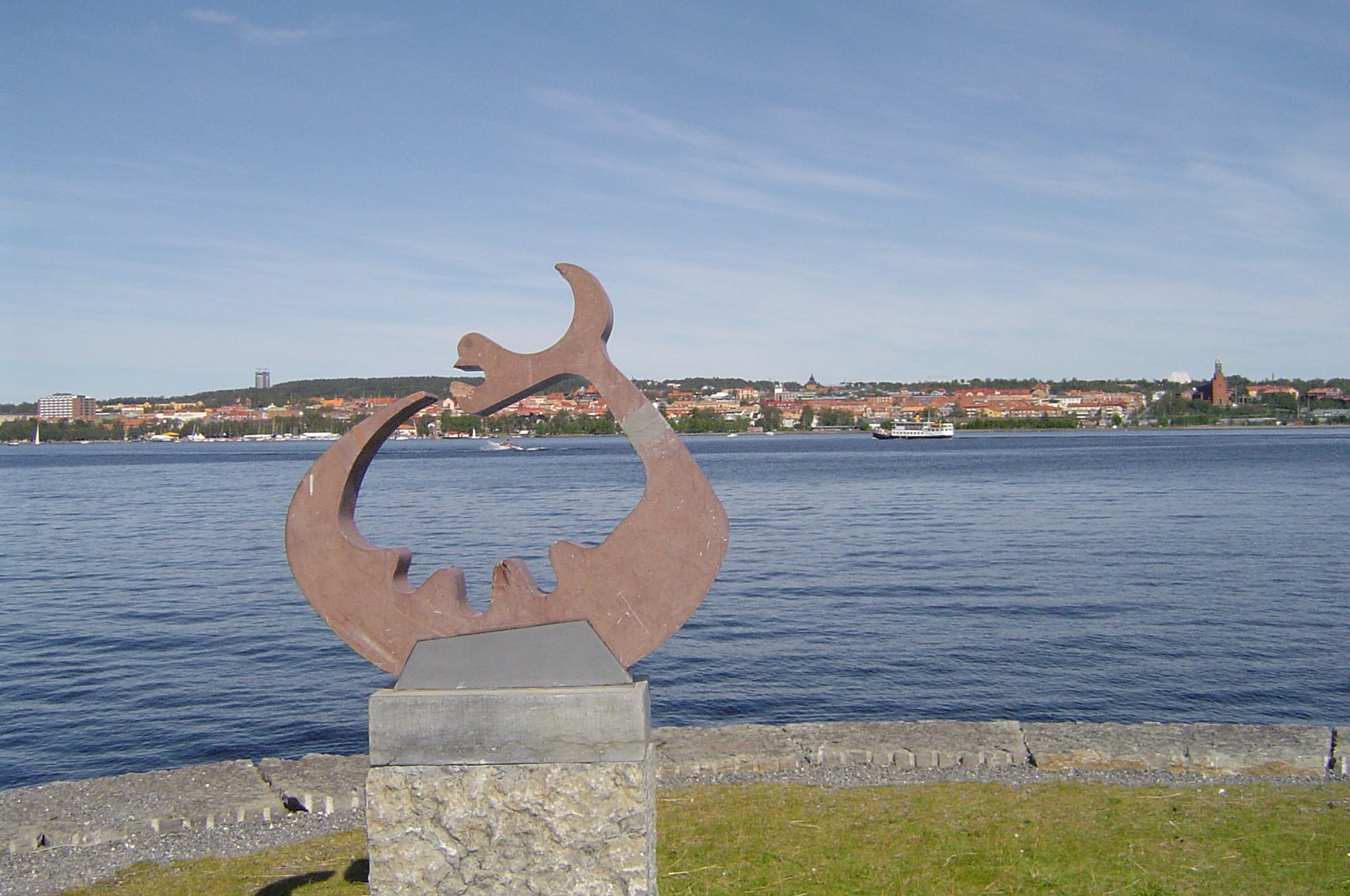
Storsjöodjure: Key Points
- Storsjöodjuret is a mythical lake monster said to live in the deep waters of Lake Storsjön in central Sweden, which plunges to about 300 feet (91 meters).
- It is described as a serpentine creature roughly 19 feet (6 meters) long, with fins, several humps on its back, a long neck, and a distinctive dog-like head with a snout (Stankovic, 2022).
- The first account came from vicar Morgens Pedersen in 1635, telling how two trolls brewed a concoction that birthed the monster, while a second legend by Andreas Plantin in 1685 described a serpent buried beneath a stone (Stankovic, 2022).
- Both legends reference a “stone” now understood to be the Frösö Runestone, the world’s northernmost runestone, which notably features a carving of a large serpent (Stankovic, 2022).
- Interest surged in the 1890s with a capture effort backed by King Oscar II, and in 1986 the creature was even declared an endangered species, though this protected status was annulled in 2005 due to lack of evidence (Stankovic, 2022).
- In 2008, filmmakers claimed thermal footage of something warm-blooded and unusual in the water, and explanations for the monster range from folklore to misidentified natural phenomena to a genuine unknown animal (Stankovic, 2022).

Introduction
One of Scandinavia’s most lasting mysteries swims in the cold, deep waters of Lake Storsjön in central Sweden. The Storsjöodjuret, usually translated as “the Great Lake Monster,” has caught the imaginations of locals and cryptid aficionados for ages. Said to dwell in a lake about 300 feet (91 meters) deep, the monster occupies a weird location, somewhere between mythology, natural history, and modern theory. It tells a story that draws on medieval myth, nineteenth-century civic ambition, and even a bit of modern film technology. To understand why this monster continues to captivate people even today, it helps to explore what it’s purportedly like, how it behaves, where its mythology originated, and what ideas try to explain it.
Physical Appearance and Behavior
Physically, the Storsjöodjuret is most commonly described as a sinuous aquatic mammal. Witnesses said it was a long, snake-like body, perhaps 19 feet (6 meters) long; however, some reports lengthen it (Stankovic, 2022). Many descriptions include fins and a series of humps rising along its back, a feature common to lake monster reports around the world. Perhaps the most noticeable feature is its head. Instead of the reptile visage you might expect, some witnesses have reported a dog-like head complete with a nose, sitting on a long, flexible neck (Stankovic, 2022). This combination of a canine face and a coiling body provides the creature an unusual and memorable silhouette.
Eyewitness reports of the creature have never come together into a unified form. Depending on the account, it has been described as a big serpent, a bizarre body with the head of a dog, a large reptile, or simply a group of incomprehensible waves moving across the ocean (Cederholm et al., 2014). Other observers have described it as shaped like an upturned boat, a series of humps, a horse-like head, and a lengthy neck (Johnson, 2023). Such variation is characteristic of cryptid narratives more broadly, but in the case of the Storsjöodjuret, it has fueled centuries of speculation and record-keeping, with numerous documented observations since the nineteenth century (Cederholm et al., 2014).
The behavior ascribed to the Storsjöodjuret is primarily elusive and shy. It is believed to swim with a smooth, undulating rhythm, surfacing every now and then before sinking into the depths again. Sightings are momentary. This slippery, hard-to-notice nature is part of what has made definitive proof so difficult to obtain and fits the general pattern of aquatic cryptids that tend to eschew continuous human interaction.

Origins of the Legend
The legend has a history of about four hundred years. The first recorded depiction is from a tale by the vicar Morgens Pedersen in 1635 (Stankovic, 2022). In his story, two trolls created a weird and powerful potion from which a giant serpentine creature emerged that lived in the lake. Prolocutor Andreas Plantin recorded a second tradition about a big serpent buried under a stone in 1685 (Stanković, 2022). What makes these two stories particularly interesting is that they both reference a “stone.” That stone is currently called the Frösö Runestone, the northernmost raised runestone in the world with a runic inscription. The stone’s etching depicts a large serpent, suggesting a close relationship between the mythology and the real object (Stankovic, 2022).
Interest waned and then revived in the 1890s. After several sightings, a group of local citizens was created with the aim of catching the animal, and the endeavor was supported by none other than King Oscar II (Stankovic, 2022). The campaign failed, but the interest lingered. The protection was removed in 2005, mostly because there was never any physical evidence of the creature. But the tale would not go away. In 2008, a team of filmmakers claimed to have filmed the beast, their thermal cameras allegedly capturing a warm-blooded, strange creature swimming below the surface (Stankovic, 2022).
Strengths, Weaknesses, and Explanations
The creature is not presented as a magical or supernatural beast for its powers and vulnerabilities, as many folkloric monsters are. Its major strength is the lake itself. The vast depth of Storsjön provides an enormous, dark refuge where an animal could plausibly hide from human eyes, and its speed and stealth in the water make it seem almost impossible to catch. Its weaknesses are the same as those of any genuine animal. The fact that it was once given legal protection is an admission that, if it exists, it can be threatened by human action. But its most significant weakness, to skeptics, is that it has never been caught or definitively documented.
There are several possibilities to explain these reports. The oldest explanation is the folkloric one, linking the monster to the legends of trolls and the snake on the Frösö Runestone, suggesting the myth originated from an old story people told about their landscape. A skeptical, natural explanation is that sightings can be illustrated by common occurrences such as large fish, otters swimming in a line, floating logs, waves, or simple misinterpretation. A third and more speculative view treats Storsjöodjuret as a genuine unknown animal, perhaps a relic species that has survived undetected, a theory that the 2008 thermal footage is sometimes used to support. None of these theories has been proved, yet each still attracts believers and doubters alike.
Attempts to rationalize these sightings have produced competing explanations. One zoologist has proposed that most encounters are in fact sightings of swimming moose, a suggestion that others in the field dispute (Johnson, 2023). This tension between naturalistic explanation and continued belief reflects the broader relationship between folklore and science that surrounds the creature. Händén-Svensson (2024) investigates exactly this dynamic, the historical and discursive forms the monster has taken, and their relation to changing views of nature and science. Using an analytical framework built around nature, society, community, and the individual person, Händén-Svensson (2024) illuminates how the Storsjöodjuret has been shaped by understandings of landscape, place, history, and culture.
Cultural Significance
The monster is more than a novelty in terms of cultural importance. Händén-Svensson (2025) analyzes legends and observation narratives, or memorates, from the seventeenth century onwards and argues that tales of the Great Lake Monster act as intermediaries linking humans, history, landscape, and societal transformation in the local Swedish community. In this interpretation, the Storsjöodjuret acts as a kind of protective spirit of the locality, a genius loci, conveying a strong sense of place and belonging for the people of Jämtland (Händén-Svensson, 2025).
Perhaps the most telling sign of the creature’s cultural standing is its legal history. In 1986, the Storsjöodjuret was granted protected status by the Swedish Environmental Protection Agency, prohibiting the killing, injuring, or capturing of this animal by law, although this protection was later revoked (Cederholm et al., 2014). This is an unusual legislative act, which demonstrates that a creature whose existence has not been confirmed can actually play a real role in the social, cultural, and historical landscape of a region.
Conclusion
In the end, the Storsjöodjuret survives not because it has been caught or proven, but because it occupies a place where so many human interests converge. It links a medieval runestone to a serpent legend, a royal-backed hunting expedition to a modern conservation ruling, and old folklore to thermal camera footage. Whether it is a troll’s creation, a misidentified natural sight, or a real creature hiding in the depths, the monster of Lake Storsjön remains one of Sweden’s most beloved mysteries. The story is sure to keep swimming through the minds of people who gaze out across its waters, as long as the lake remains dark and deep.
References
Cederholm, E. A., Björck, A., Jennbert, K., & Lönngren, A. S. (2014). Exploring the animal turn: Human-animal relations in science, society and culture. The Pufendorf Institute of Advanced Studies, Lund University.
Händén-Svensson, S. (2024). Storsjöodjuret i ett kalejdoskop. Humanekologiska perspektiv på en svensk kryptid. Lund University.
Händén-Svensson, S. (2025). The lake and its monster: Communicating connections with landscape, belonging and sense of place with great lake monster narratives. Arv, 81, 112–129.
Johnson, B. (2023). The big book of cryptid trivia: Fun facts and fascinating folklore about Bigfoot, Mothman, Loch Ness Monster, the Yeti, and more elusive creatures. Simon and Schuster.
Stankovic, V. (2022). The natural history of cryptid creatures. Curious Garden Publishing.

Leave a Reply