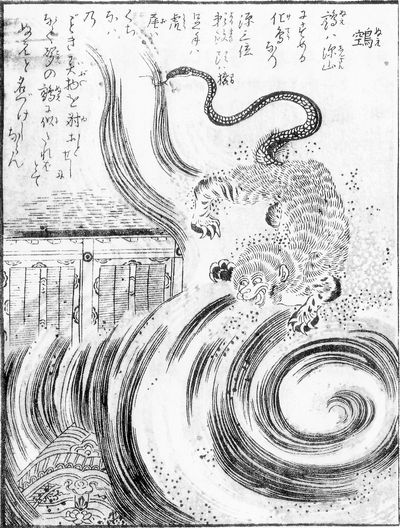
Nue in Japanese Folklore: Key Points
- The Nue is a hybrid creature often called the Japanese Chimera, with the head of a monkey, the body of a tanuki, the legs of a tiger, and a snake for a tail (Rosen, 2009).
- Rather than attacking openly, it spreads sickness and misfortune quietly, harming its victims through dread and disease while remaining hidden.
- Its most notable ability is transforming into a black cloud so it can fly unseen and strike from above, bringing illness to those below (Rosen, 2009).
- Despite its supernatural menace, the Nue can be killed by a mortal weapon, as a single well aimed arrow was enough to bring one down.
- In The Tale of the Heike, the Emperor Konoe fell ill in 1153 due to a dark cloud on the palace roof, until the samurai Yorimasa Minamoto shot the Nue and sank its body in the Sea of Japan (Rosen, 2009).
- The Nue serves as an omen of disorder and may represent a way for people to give shape and cause to illnesses they could not otherwise explain.

Introduction
The Nue is one of the most disturbing creatures in Japanese legend, a monster so bizarre in its design that it is often called the Japanese chimera (Rosen, 2009). It is not one animal but a patchwork of a number woven together into a form that defies easy description. For generations it has tormented the mind of the Japanese people, appearing in ancient literature, art, and regional tradition as a harbinger of sickness and dread. To grasp the Nue is to understand how fear itself may be given form, action, and a place in history. This essay explores the physical form of the creature, its conduct, its historical appearances, its powers and weaknesses, and the theories scholars have offered to explain its origins.
The Physical Shape of the Nue
The Nue is a Japanese yokai with multiple bodies. Traditionally, the Nue is a composite monster with the head of a monkey, the body of a tiger, the tail of a snake and the belly of a tanuki. Its canonical form and name appear in Muromachi-period theater and later Noh dramatizations, where it is often treated as a demon or monstrous figure within a larger yokai category (Nishiyama, 2000). Contemporary scholarship often places Nue within broader yokai taxonomy alongside bakemono and yōkai, illustrating how historical demonology has been reinterpreted across media and periods (Nishiyama, 2000).
Physically, the Nue is a strange hybrid. The beast has a monkey’s head, a tanuki or raccoon dog’s body, the legs of a tiger and a snake for a tail (Rosen, 2009). Each portion is from a separate species, and they make something that is not of any. The monkey has a strange intelligence in its face. The tiger’s legs speak of power and speed. The serpent’s tail lends a note of venom and menace. The Nue’s composite anatomy earns it a chimera’s reputation, and its refusal to be one thing makes it frightening.
Weaknesses, Behaviors and Legends
Its appearance is as threatening as its attitude. The Nue is intimately associated with the onset of disaster and disease, and it does not strike openly, like a wolf or a bear. Instead, it works through dread and sickness. It comes in silence. It makes people sick for no apparent reason. The origin of their affliction is hidden in the night sky, not on the ground. This indirect, almost invisible way of causing harm, is what distinguishes the Nue from more conventional monsters and adds to its aura of supernatural malevolence.
The historical importance of the Nue rests largely on one famous story contained in the Tale of the Heike, a foundational work of medieval Japanese literature. Rosen (2009) tells that Emperor Konoe began to have nightmares and a mystery illness around 1153. Each night a black cloud hung over the roof of the palace, and with it the emperor’s torture came. Finally the court recognized that the ailment was not a common sickness. On the roof of the palace, the samurai Yorimasa Minamoto watched, trying to break the curse. He loosed an arrow at the cloud as it appeared. The samurai disposed of the body by sinking the deceased Nue into the Sea of Japan (Rosen, 2009). The legend persisted, and the emperor recovered.
This story will tell us about the creature’s powers and about its weaknesses. Its most remarkable ability is to change. The Nue can change into a black cloud and fly, allowing it to travel unobserved and to attack from above (Rosen, 2009). This cloud carries disease and disaster; it destroys human beings who never see the real form of their tormentor. But the Nue is not invulnerable, in spite of all its otherworldly menace. The tale of Minamoto Yorimasa shows that a single well-aimed arrow was enough to bring it down. In the hands of a resolute and able fighter, it could be slain with a mortal weapon, and its body could be handled and cast aside like that of any common beast. Its power was in secrecy and terror, not in true invulnerability.

Folkloric Significance and Classification
In the noh repertoires of Zeami and Nobumitsu, the nue is clearly described as a demon/monstrous figure, notable for its composite anatomy and its nature’s mobility between genres. In Zeami’s Nue, the creature has a monkey head, tiger body, tanuki tail, and snake-like tail segment and a voice compared to toratsugumi; it can fly even though it has no wings. This depiction shows the Edo to Muromachi lineage of the “demon/monster” classification that later scholars interpret as entangled with bakemono and yōkai categories (Nishiyama, 2000). Komatsu’s analysis in the same body of scholarship explains how bakemono and yōkai terms operate in the Muromachi to early modern periods, with Nue demonstrating the broad, almost opportunistic use of “demon/monster” figures in Japanese theatre and folklore. This helps explain why Nue can be treated as a demon in some contexts and as a yokai or bakemono in others, depending on era and medium (Nishiyama, 2000).
In folk tales, the Nue was a portent. Its appearance indicated that something was wrong at the highest levels of natural or political order, and the illness of an emperor was seen as a sign of disorder within the realm itself. The creature was therefore more than a monster to be slain. It was a symbol of chaos, of the unseen forces thought to cause plague and disaster. The hero who defeated it, Minamoto Yorimasa, was praised for restoring the health of the emperor and, in so doing, the stability of the land.
Theories of Behaviors and the Modern Cultural Heritage
There are many theories as to how such a creature entered the popular imagination, and one reading of the Nue takes it as a personification of disease, a way of giving shape and cause to illnesses whose cause could not otherwise be discerned. When a ruler fell ill for no visible reason. monster in the sky provided an explanation (and, more significantly, in the form of a hero). Another interpretation focuses on the hybrid body itself and suggests that the combination of familiar animals into an unnatural whole was a deliberate strategy for producing horror, since the mind recoils from forms that cannot be neatly named. The strange nocturnal cry attributed to the Nue in various traditions may also derive from real animals, whose calls, heard in the dark, seemed to belong to no known creature.
The Nue is an example of the Japanese tradition of folklore that combines animal hybridity with moral and social meanings. This pattern is evident in premodern literature and emaki, as well as in modern popular culture representations (anime, manga, theater), where such beings are reconfigured for new audiences while retaining the core motifs of uncanny hybridity (Nishiyama, 2000; Prostak, n.d.; Balgimbayeva, 2019). Scholars emphasize the fluidity of the boundary between demons (oni), yōkai, bakemono, and other terms, noting that the Nue is part of a historically evolving vocabulary used by researchers to describe supernatural creatures in the cultural imagination of Japan (Nishiyama, 2000). This nuance is crucial to the synthesis of sources from folklore studies, historical plays, and modern media.
The Nue and other yokai have remained relevant to Japanese popular culture with Meiji and post-Meiji reinterpretations that brought the Nue back to life in new media such as anime and theatrical productions. Scholars note how yokai such as Nue are reinterpreted in various media while preserving key features (hybrid form, spooky voice, and otherworldly movement). Finally, add to their recognition by audiences (Hirota, 2022; Papp, 2009). Contemporary studies examine the continuity and change of yokai imagery from classic emaki and noh to contemporary anime, manga, and film, revealing a vibrant cultural metabolism in which Nue-like monsters function as nodes connecting past and present conceptions of the uncanny and the monstrous in Japan. In this way, through this synthesis of elements, Nue becomes a link between traditional demonology and the present popular culture fascination with hybrid entities (Balgimbayeva, 2019; Papp, 2009; Prostak, n.d.).
Conclusion
The Nue survives because it plays on a very human fear, the fear of harm that comes from nowhere and cannot be seen. Its monkey’s head, tiger’s legs, tanuki’s body, and serpent’s tail create a memorable creature out of the impossible; a habit of descending as a black cloud means that it has a reach that no ordinary predator can match (Rosen, 2009). The story of Emperor Konoe and the samurai Yorimasa Minamoto is a culture that meets the invisible and conquers it with courage and skill. The Nue is one of the most intriguing monsters in Japan’s rich folklore past, whether as a metaphor for disease, a work of imaginative horror, or a true article of belief.
References
Balgimbayeva, N. (2019). The Re-creation of Yokai Character Images in the Context of Contemporary Japanese Popular Culture: An Example of the Yo-kai Watch Anime Series. Mutual Images Journal, (6), 21–51. https://doi.org/10.32926/2018.6.bal.recre
Hirota, R. (2022). Traversing the Natural, Supernatural, and Paranormal: Yōkai in Postwar Japan. Japanese Journal of Religious Studies, 48(2), 321–339. https://doi.org/10.18874/jjrs.48.2.2021.321-339
Nishiyama, J. (2000). Confronting Noh Demons: Zeami’s Demon Pacifying Noh and Nobumitsu’s Demon Killing Noh. https://doi.org/10.15760/etd.7011
Papp, Z. (2009). Monsters at War: The Great Yōkai Wars, 1968–2005. Mechademia Second Arc, 4(1), 225–239. https://doi.org/10.1353/mec.0.0073
Prostak, M. L. (n.d.). Monstrous Maternity: Folkloric Expressions of the Feminine in Images of the Ubume. https://doi.org/10.25148/etd.fidc004088
Rosen, B. (2009). The mythical creatures bible: The definitive guide to legendary beings. Union Square & Co.
The Tale of the Heike (H. C. McCullough, Trans.). (1988). Stanford University Press.

Leave a Reply