The Champawat Tiger: Key Points
- The Champawat Tiger was a Bengal tigress responsible for killing an estimated 436 people across Nepal and northern India between the 1890s and 1907, making her the deadliest known animal predator of humans in recorded history.
- She began her killing spree in Nepal, was driven out by the Nepalese Army, and continued her rampage in the Kumaon hills of India until hunter Jim Corbett tracked and killed her in 1907.
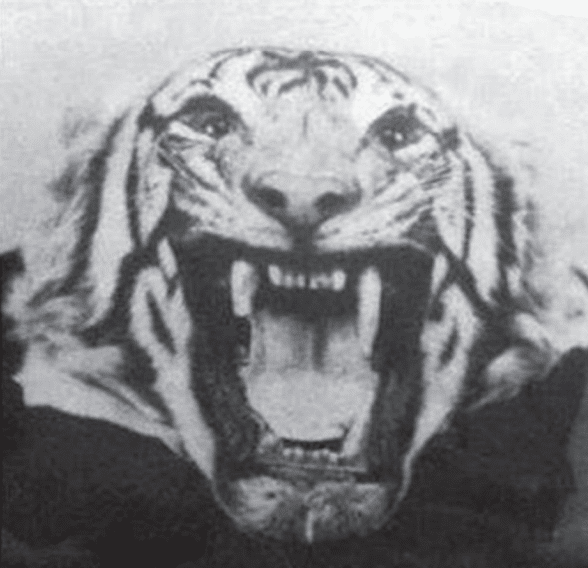
- Corbett discovered that her upper and lower right canine teeth had been broken, likely by a gunshot, which prevented her from hunting natural prey and forced her to target comparatively defenseless humans instead.
- As a Bengal tigress she was a large, powerfully built, and expertly camouflaged predator, and despite her injury she remained more than capable of killing adult humans with speed and force.
- The weretiger is a deeply rooted supernatural figure in South and Southeast Asian folklore, depicted as a being that blurs the boundary between human and tiger, possessing unnatural cunning and malevolent intelligence far beyond that of an ordinary animal.
- The villagers of Kumaon widely believed the Champawat Tiger was a weretiger or demon, a belief fueled by the impossible scale of her kills and her ability to evade armies and hunters, and while science attributes her behavior to injury and circumstance, the supernatural explanation has never entirely lost its grip on her legend.

Introduction
At the turn of the twentieth century, a creature stalked the forested hills of Nepal and northern India. She was so lethal, so seemingly unstoppable, and so far beyond the ordinary boundaries of animal behavior that the terrified communities in her path could only conclude that something supernatural was abroad among them. To the people who lived in her shadow, the Champawat Tiger, the Bengal tigress responsible for the deaths of an estimated 436 people from the 1890s to 1907, was not merely a man-eating animal but a possible weretiger, a demon in the flesh, a creature whose cunning and relentlessness surpassed anything that nature alone could produce. Was she a weretiger? Her story weaves together strands of colonial history, natural history, indigenous belief, and supernatural mythology in a way that few animal stories have ever done, and the question of what she really was, a beast or something more, persists after the facts of her life have been tallied.
The Champawat Tiger: History and the Evidence of Broken Teeth
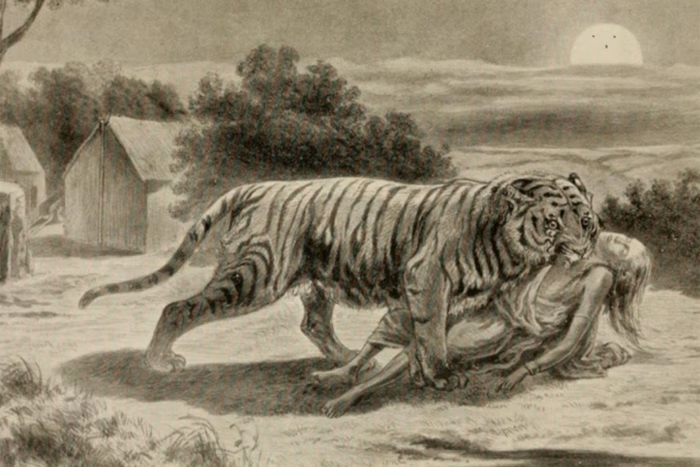
The tale of the Champawat Tiger starts in Nepal, where she initially started preying on humans sometime in the 1890s. She is thought to have claimed 200 lives during her killing rampage in Nepal until the Nepalese army was ordered to combat the threat. Their persistent pursuit eventually pushed her across the border into the Kumaon hills of what is now the Indian state of Uttarakhand. Once in India, she went on a spree in and around the Champawat district, adding an estimated 236 more fatalities to her tally and terrifying entire villages to the point that towns were paralyzed with dread, with residents unwilling to step outside their homes even during the day. The tigress acquired a certain notoriety that extended over the entire region, and the British colonial authority in India finally recognized that the issue had become a real crisis requiring immediate response. Finally, it was Jim Corbett, a legendary hunter and naturalist born in the hill town of Nainital, who was called upon to track and kill the tigress in 1907, an endeavor that proved extraordinarily dangerous and required considerable skill and persistence before he ultimately succeeded (Rani & Kumar, 2017; Roy, 2021; Crane & Fletcher, 2014).
When Jim Corbett went to examine the body of the Champawat Tiger after he had killed her, he uncovered a find that would go a long way towards explaining her remarkable behavior. He observed that her upper and lower canine teeth on the right side of her mouth had been fractured, most probably as the result of a gunshot wound received at some earlier stage of her life, most possibly in a battle with hunters in Nepal. Such broken teeth would have significantly limited her capacity to deliver the fast, clean kills that a tiger relies upon when hunting its native prey, such as deer and wild pigs—fast-moving animals that require a precise and powerful killing bite. Humans weren’t able to hunt efficiently like tigers and so would have been fairly easy prey for them. People working in the fields or gathering firewood in the forest would have offered far less opposition than a fleeing deer or struggling wild boar. The injuries thus made an ordinary predator a highly specialized and devastatingly efficient killer of people, not by nature but by the intervention of an earlier interaction with man.
Colonial Ecology and the Politics of the Hunt
The ethical human-animal landscape of ‘man-eaters’ has been interpreted beyond identification via the perspective of imperial administration and modernity. The incident of Champawat encapsulates the thesis that the colonial state’s attitude to wildlife was part of a larger goal of ordering nature and society: the tiger is rendered a problem to be solved by experienced hunters, quasi-military operations, and, later, legal and conservation frameworks. Works on imperial ecologies stress that these hunts are not just zoological episodes but political acts that define the administration of space, animals, and populations under empire (Roy, 2021).
Physically, the Champawat Tiger was a big, powerful Bengal tigress but not outstandingly enormous for her species. Bengals are among the largest of all wild cats, with adult females often weighing 100-160 kg and measuring about 2.5-2.7 m in total length, including the tail. Their coloring is the famous orange and black striped coat that is such an efficient camouflage in the dappled light and shade of dense forest foliage. Their muscular, powerfully built bodies make them fearsome predators even in a weakened physical condition. In his narrative, Corbett observed that the tigress had the usual wear and aging that one might anticipate of an animal that had spent a long and arduous existence in the wild, and her physical state reflected the harsh circumstances that had caused her to become a man-eater. She was a strongly built animal, and her oral injury was more than enough to provide her the speed and efficiency to overwhelm and kill an adult human being.
The Weretiger: Myth, Folklore, and Indigenous Belief
The concept of the weretiger is a profound and old one, based in the folklore and mythic traditions of South Asia and Southeast Asia. Just as European civilizations developed the werewolf into a figure of dread and transformation, many cultures across India, Bangladesh, Malaysia, Indonesia, and surrounding countries developed the weretiger into an equally potent supernatural monster. In these traditions, were-tigers are usually depicted as humans who can change into tigers or tigers who can assume human form, often with a duality that makes them more cunning and more dangerous than either a normal human or a normal tiger. In some cultures, were-tigers are linked to shamans, magicians, or humans who have entered into pacts with supernatural powers, while in others they are envisioned as spirits residing within the bodies of actual tigers and guiding their aggression with conscious, malicious intent. The weretiger was a natural and culturally resonant extension of this existing veneration and dread, as the tiger already had an incredibly powerful symbolic function as a creature of divine might and frightening authority in Hindu, animist, and diverse indigenous belief systems of the region.
Weretigers are a specific folkloric theme in some parts of India, expressing a belief that some people are able to turn their spirits into tigers. This type of lycanthropy is rooted in local cosmologies and is used in stories, ritual practice, and moral economies surrounding wildlife. In academic work on Nagaland, Easterine Kire’s literature is read as a vehicle to convey “Naga mysticism” (A.P. & Bhattacharya, 2019) and the insider view on weretiger lore, challenging misconceptions about northeast India (Bhattacharyya, 2024). The motif of the weretiger in India is not a standalone narrative but fits into a broader carnivore folklore of the region with stories of tiger-related shapeshifting and other supernatural beings linked to shamanic and ritual practices among various communities (e.g., Mishmi in the Dibang Valley) (Beggiora & Exley, 2024). These stories are pertinent to current issues surrounding tiger conservation and human-wildlife relationships in India (Oommen, 2021; Bhatia et al., 2021).
In Indian and Nepalese folk belief, particularly among the inhabitants of the Kumaon highlands who had been directly afflicted by the predations of the Champawat Tiger, there circulated whispered notions that the creature was not an ordinary animal at all. Some villagers thought the tigress was something supernatural, a weretiger or a demon in animal form, the only way to explain how one monster could kill so many people over so many years while outwitting the greatest attempts of trained hunters and soldiers to stop her. The scale of her kills, the intelligence she showed in dodging traps and ambushes, and her immunity to organized hunts all fostered the idea that something beyond the natural world was at play in those wooded hills. In rural Kumaon, the world of culture, such catastrophic, apparently unexplainable catastrophes were not unusual to be explained by supernatural causes, and a man-eating tiger of such unprecedented lethality was just the kind of phenomenon to encourage them. For the inhabitants of that land, living in fear, the line between a very clever beast and a supernatural predator was not necessarily a clear or meaningful one, and the weretiger paradigm offered a way to make sense of a horror that was outside the normal boundaries of cognition.
Analytical Perspectives and Contemporary Conservation
From a more analytical standpoint, there are several explanations presented over the years to illustrate different facets of the incredible narrative of the Champawat Tiger, both the factual and the mythical elements. The most popular scientific explanation, suggested by Jim Corbett himself, was that the broken teeth of the tigress were the cause for her man-eating. Other cases of injured or old tigers and leopards turning to man-eating as an easier source of food supported the theory. Some historians and wildlife researchers have argued that the widespread deforestation and the sharp decline in the populations of natural prey in the region during the colonial period also put additional pressure on tigers in general, making desperate encounters between humans and predators much more common than they otherwise would have been. Only a few commentators have suggested that the 436 death toll may have become inflated over the years, either by combining kills from several animals or by the natural exaggeration that all legendary stories tend toward—but this interpretation is a minority view, and Corbett’s own careful, systematic investigations lend a great deal of credibility to the general story. None of these supernatural notions are seriously considered literal explanations by scientists or historians, but they are, nevertheless, valuable as cultural archives, revealing how communities make sense of great pain, creating meaning in the face of frightening and apparently incomprehensible suffering.
A continuing methodological and ethical challenge in the Champawat literature is how a predator becomes branded a man-eater in the first place and what counts as reliable proof to warrant lethal action. Ethnographic and anthropological studies on big-cat identification have demonstrated that identifications are often dependent, situational, and bound up with the bureaucratic, legal, and political pressures that attend animal-human conflict in the Anthropocene. Mathur (Beastly identification in India) argues that Indian wildlife law requires identification of a big cat as the killer before killing is sanctioned, but the actual process of identification is fraught with limitations, local knowledge, and affective knowledge that may not meet formal evidentiary standards. This suggests a structural tension: the beheading of a “man-eater” is as much a political as a scientific act, and the Champawat case exists within this framework of contested identification and necropolitical administration (Mathur, 2021).
The Champawat tiger may be a creature of a historical period, but its interpretations continue to echo in present debates on human-wildlife cooperation in landscapes such as the Terai-Arc and other human-dominated ecotones. Modern tiger ecology studies emphasize the role of large predators in shaping ecosystem dynamics but also that conflict is common where human livelihoods overlap with tiger habitats, particularly outside protected areas. Recent research indicates that the dynamics between tigers and their prey, habitat alterations, and livestock depredations are crucial in understanding the current human-tiger relationship. This points out the necessity of policies integrating scientific surveillance, community involvement, and prudent landscape management to reduce conflicts (Biswas et al., 2022; Chouksey & Singh, 2018; Ranjan et al., 2025).
Conclusion
The Champawat Tiger is one of history’s most haunted creatures precisely because no one explanation, however compelling, can totally contain her.” Science leaves us with broken teeth and decimated prey populations; history with the convulsions of colonialism and deforestation; and folklore with the ancient and persistent notion of the weretiger, a figure of preternatural cunning and supernatural malevolence that haunts the edge of the human world. The fact that her killing spree crossed two countries, lasted longer than military efforts, and reached levels that no normal animal could handle gives the weretiger idea a strange and lasting importance, not as a literal truth but as a deeply human reaction to something that seems completely out of the natural order. Jim Corbett might have seen an eye looking back at him when he examined the body of a broken-toothed tigress, but the villagers of Kumaon had previously stared into those same eyes and perceived something older and darker looking back. Was she a wounded animal or a monster in fur? The Champawat Tiger had burned her name into the landscape of human terror in a way that rational explanation never quite managed to erase.
References
A.P, D., & Bhattacharya, S. (2019). The Praxis of the Wedded Mystic: a Divergent Reading of Easterine Kire’s novel When the River Sleeps. Rupkatha Journal on Interdisciplinary Studies in Humanities, 11(3). https://doi.org/10.21659/rupkatha.v11n3.05
Beggiora, S., & Exley, V. M. (2024). Coexistence in the Anthropocene: Tigers and Humans of the Dibang Valley. The Oriental Anthropologist a Bi-Annual International Journal of the Science of Man, 24(1), 141–165. https://doi.org/10.1177/0972558×241227858
Bhatia, S., Suryawanshi, K., Redpath, S. M., Namgail, S., & Mishra, C. (2021). Understanding People’s Relationship With Wildlife in Trans-Himalayan Folklore. Frontiers in Environmental Science, 9. https://doi.org/10.3389/fenvs.2021.595169
Bhattacharyya, P. (2024). Ecology of the ‘Other’: A Posthumanist Study of Easterine Kire’s When the River Sleeps (2014). Humanities, 13(1), 19. https://doi.org/10.3390/h13010019
Biswas, S., Kumar, S., Bandhopadhyay, M., Patel, S. K., Lyngdoh, S., Pandav, B., & Mondol, S. (2022). What drives prey selection? Assessment of tiger food habits across the Terai-Arc landscape, India. https://doi.org/10.1101/2022.07.20.500750
Chouksey, S., & Singh, S. (2018). Assessments on the impact of human-tiger conflict and community-based conservation in Bandhavgarh Tiger Reserve, Madhya Pradesh, India. Journal of Threatened Taxa, 10(7), 11844. https://doi.org/10.11609/jott.3015.10.7.11844-11849
Crane, R., & Fletcher, L. (2014). PICTURING THE INDIAN TIGER: IMPERIAL ICONOGRAPHY IN THE NINETEENTH CENTURY. Victorian Literature and Culture, 42(3), 369–386. https://doi.org/10.1017/s1060150314000047
Mathur, N. (2021). Beastly identification in India. American Ethnologist, 48(2), 167–179. https://doi.org/10.1111/amet.13021
Oommen, M. A. (2021). Beasts in the Garden: Human-Wildlife Coexistence in India’s Past and Present. Frontiers in Conservation Science, 2. https://doi.org/10.3389/fcosc.2021.703432
Rani, P., & Kumar, N. (2017). Man-Eaters of Kumaon: a Critique of Modernity. Rupkatha Journal on Interdisciplinary Studies in Humanities, 9(1). https://doi.org/10.21659/rupkatha.v9n1.21
Ranjan, V., Badola, R., Hussain, S. A., & Dhakate, P. M. (2025). Assessing the implications of habitat transformations on human-large carnivore interactions outside protected areas. Scientific Reports, 15(1). https://doi.org/10.1038/s41598-025-13808-4
Roy, P. (2021). The Strange Ecologies of Empire. Victorian Literature and Culture, 49(1), 73–105. https://doi.org/10.1017/s1060150319000640




Leave a Reply