Kusarikku: Key Points
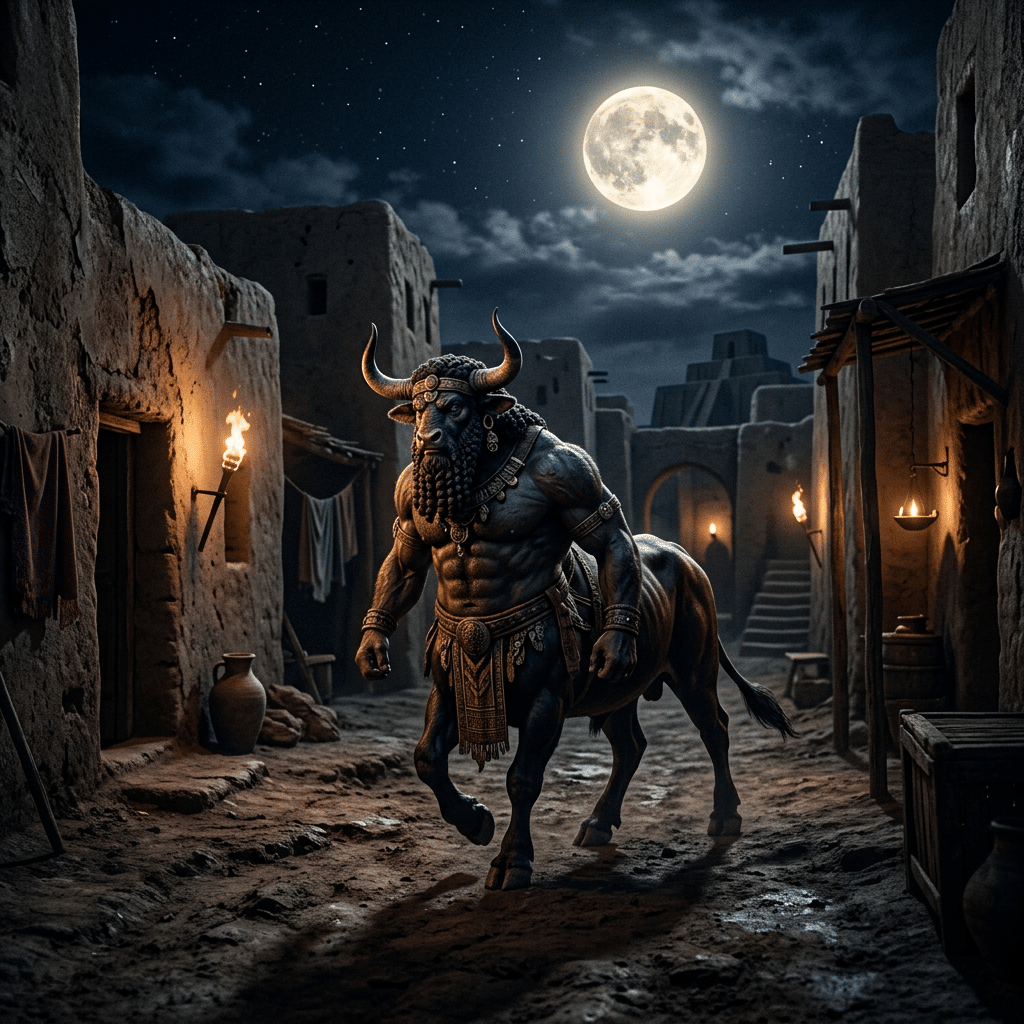
- The kusarikku was a Mesopotamian bull-man hybrid with a bearded human torso and the lower body of a bull, frequently depicted with horns and exaggerated musculature.
- It was ferociously powerful but divinely directed, commonly shown wrestling lions in “contest scenes” symbolizing cosmic order triumphing over chaos.
- Rooted in early Sumerian bull symbolism, the kusarikku became closely associated with the sun god Utu and his Akkadian counterpart Shamash.
- It appeared among Tiamat’s war monsters in the Babylonian creation epic Enuma Elish, confirming its deep penetration into ancient Near Eastern mythology.
- Statues were placed at temple and palace gates to repel evil spirits, while cylinder seal amulets bearing its image served as personal protection.
- Scholars interpret the kusarikku as a metaphor for tamed natural force, a figure tied to the constellation Taurus, or a divine embodiment of royal power.

Introduction
The ancient world blurred the lines between the natural and unnatural, making the Mesopotamian kusarikku the most notable and enduring. The Kusarikku grew out of the fecund mythological soil of ancient Sumer, later folded into the Babylonian and Assyrian religious culture. It filled a special niche in the spiritual imagination of the ancient Near East. It was neither beast nor man. It was something more grandiose, something that purposely defied the categories that ordinary minds employ to make sense of the universe. To study the kusarikku is to enter a world in which divine might was embodied in hybrid flesh, in which guardianship was hideous by design, and in which the boundary between protector and fear was purposely blurred.
Iconography and Behavioral Characteristics
Kusarikku is described in iconographic and linguistic materials as a bull-man. Elmohsen (2022) clearly analyzes the kusarikku (bull-man) and sets it in the context of other horned entities who litter Mesopotamian myth and art, particularly its function as an antagonist of Ninurta/Ningirsu in works from the Kassite period (and associated legendary cycles). This places Kusarikku in a group of horned and bull-related entities that have contact with storm /deity figures in Mesopotamian religion. Kusarikku is attested specifically as a house god or threshold guardian figure in iconographic and literary contexts. Scurlock (Ancient Mesopotamian House Gods) lists the kusarikku among the守卫 entities that guarded domestic and temple places, implying a ceremonial function as a protective presence at doorways or inside household buildings (Scurlock, 2003).
Most often, the kusarikku is described as a bull-man, a creature with the upper half of a man and the powerful lower half of a bull. Artistic images preserved on cylinder seals, relief carvings, and ornate friezes portray a muscular figure with a bearded human face and body that below the waist blends into the large haunches and cloven hooves of a bull. Some representations show the horns emerging from the human head, further emphasizing the dual nature of the monster. It was generally depicted with exaggerated musculature, suggesting raw and overwhelming physical might. In creative situations, the kusarikku was often intentionally large relative to the other figures, stressing its supernatural nature. There are slight differences in the iconography of the different periods and places of Mesopotamia, but the basic hybrid nature of the creatures is similar throughout.
Behaviorally, the kusarikku was imagined as a being of wild strength that might be channeled for defensive purposes. From the Early Dynastic period onward, the bull-man appears regularly on cylinder seals in what experts term the “contest scene,” struggling with lions or grappling with other frightening beasts. These sceneries were not purely decorative. They had a lot of symbolic weight. The kusarikku’s domination of the lion, the top predator of the ancient Near Eastern terrain, symbolized the triumph of heavenly order over chaos. The creature was aggressive, capable of immense violence and terrible to witness, yet its brutality was righteous and intentional. It favored the gods, not against them. There is also textual evidence that the kusarikku was also associated with the roar of thunder and the roaring of storms, thus connecting its temperament to the most hazardous and sublime aspects of the natural world.

Origins and Mythological Significance
The kusarikku has a lengthy and deep history in the Sumerian and wider Mesopotamian pantheon. It seems to have arisen in the early days of Sumerian civilization, when the symbolism of the bull was already deeply rooted in the religious and royal culture. The bull was a symbol of fertility, strength, and heavenly power. The kusarikku figure combined human intellect and bovine force, an idealized merging of faculties. Eventually the creature became linked to certain deities, most notably Utu in the Sumerian religion and his Akkadian counterpart Shamash, the sun god. This link with the solar deity gave the kusarikku a cosmic dimension, elevating it above a basic guard animal to a creature that positioned the architecture of the universe itself. The kusarikku also appears in the Enuma Elish, the great Babylonian creation epic, when the Babylonians received and adapted the Sumerian mythical traditions. It is named among the horrible monsters made by Tiamat to wage war on the younger gods. Its mention in such a basic cosmology work reveals how thoroughly the creature had entered the mythological mind of the entire region. The kusarikku was considered the adversary, but its strength was clear.
Schwemer’s essay on Any Evil (a bull-headed demon in first-millennium cuneiform texts) explains how a catch-all demon figure may be expressed in incantations and ritual practice, with the bull-headed motif operating as a readily recognizable template within Mesopotamian demonology. Any Evil is a demon with a bull’s head, employed in ritual language to manifest a universal curative or protective aim in the context of illness (Schwemer, 2020). The Any Evil theme of a bull-headed demon provides a useful comparison paradigm for contemplating Kusarikku, which is also treated in a bull/animal-headed or bull-man typology in iconography and myth. These sources, taken together, reveal a common cultural repertoire, wherein bull- or horned creatures function both in antagonistic mythic roles (as enemies of major gods like Ninurta) and in ritual/apotropaic contexts (as demon figures invoked or depicted in incantations and scenes) (Elmohsen 2022, Schwemer 2020). In formal Greek-to-Mesopotamian terminology discussions of demons and their corporeal forms, kusarikku belongs to a larger class of horned beings used to demarcate liminal or boundary-passing powers (gateways, thresholds, and entrances) in ritual and domestic spaces (Scurlock, 2003; Lecompte, 2014).
Ritual and Apotropaic Functions
Evidence for the worship and ritual use of the kusarikku is chiefly to be found in the presentation of the creature as an apotropaic figure in the archaeological and textual record, deployed to fend off undesirable forces. Statues and sculptures of the bull-man were set up at temple and palace thresholds, notably at gates and gateways, where they acted as ghostly sentinels. This location at liminal sites, at the limits between inside and outside, sacred and profane, was deliberate and theologically significant. The ancient Mesopotamians thought that entrances were weak spots, places where evil spirits would seek to enter, and the fierce force of the kusarikku made it a suitable defender of such passageways. Cylinder seals showing the bull-man were worn as personal amulets and stamped on clay to seal documents and containers. Wearing this image, a person can take on the protecting power of the creature. The kusarikku is called upon in ritual incantations in rituals to expel demons and ward against disaster, as part of a larger system of spiritual protection.
In Lecompte’s survey of temple architecture and decoration, kusarikku are among the “statuary of the gods” decorating temple grounds, in particular as gate-guarding figures embodying the protective powers of household gods. The kusarikku appears in the text in conjunction with lahmu, Humbaba-like visages, and other protective themes, thereby further supporting its position as a guardian figure in temple and home contexts (Lecompte, 2014). The Assur temple material in Maul (Die tägliche Speisung des Assur) connects kusarikku to the daily logistical and theological economy of gināʾu offerings and sacred gifts. Kusarikku acquires material and ritual significance within temple cults, thereby demonstrating its continuing importance in late second-millennium Mesopotamian religious life (Maul, 2013).
Scholarly Interpretations
Scholars have proposed a number of interpretations concerning the more profound meaning of the kusarikku and what it tells about Sumerian religious philosophy. One frequent explanation is that the bull-man stands for the subjugation of wild nature by divine might. The body of the creature itself is a metaphor: brute animal strength directed and given purpose by human-like intelligence and will. This reading reflects a wider Mesopotamian religious interest in the struggle between order and chaos, between civilization and wildness. Another line of theory looks at heavenly associations. Some researchers have suggested that the Kusarikku is related to the later constellation of Taurus and that its function as protector of the sun god reflects an astronomical mythology in which the bull-man watches over the sun god’s voyage across the sky. This would explain the creature’s continued relationship with Utu and Shamash, as well as its resurfacing in the visual language of the sun’s ascent and descent. A further interpretation is that the kusarikku are the token of a distinctively royal philosophy. Mesopotamian kings sometimes likened themselves to bulls. The bull-man could have been a divine double of royal power, symbolizing the king’s power and his duty to maintain cosmic order. The placement of kusarikku statues at entrances to palaces supports this understanding, for they guarded not only a physical space but also the sacred power of the sovereign within.
There is also the more general theoretical question of how hybrid creatures functioned in Mesopotamian religion. The kusarikku shared its conceptual space with entities such as the lion-man, the scorpion-man, and the fish-man. Together they were a kind of creatures who dwelt on the border between many planes of existence. These were not mistakes of nature, but intentional heavenly creations, and their hybridity was itself a sign of their strength. To be in between categories was to be unchained from the limits of any one of them. The kusarikku was strong like a bull, observant like a man. It might be a human world of temples and palaces. The world beyond the city’s boundaries could be untamed. This double membership made it particularly suited to standing at thresholds and acting as a mediator between the visible and invisible realms.
Conclusion
The kusarikku remains one of the most symbolically fertile characters to emerge from the ancient Near East. The lasting ideas it represented can be seen in how long it stayed important in Mesopotamian religion and how it adapted over thousands of years, even as religious power shifted from Sumerian to Babylonian to Assyrian. Strength, guardianship, ordering of chaos, and the uniting of human and animal nature were themes that rang true through generations of worshippers and rulers. The bull-man at the gate of the temple was not for show. It was a theological assertion about the nature of divine protection, about the powers that maintained the universe stable despite the ever-present threat of destruction. To comprehend the kusarikku is to understand something vital about how the inhabitants of ancient Mesopotamia thought about power, about danger, and about the holy boundaries that made civilized life not just possible but meaningful.
References
Elmohsen, I. M. A. (2022). The horns: symbol of power An iconographical study in Mesopotamian Art. مجلة کلية الآثار جامعة القاهرة, 12(2022), 247–288. https://doi.org/10.21608/jarch.2022.212070
Lambert, W. G. (2013). Babylonian creation myths. Eisenbrauns.
Lecompte, C. (2014). Kai Kainuth, Anne Löhnert, Jared L. Miller, Adelheid Otto, Michael Roaf & Walther Sallaberger (éd.), Tempel im Alten Orient. Syria, 91, 454–457. https://doi.org/10.4000/syria.2311
Maul, S. M. (2013). Die tägliche Speisung des Assur (gināʾu) und deren politische Bedeutung. 561–574. https://doi.org/10.5325/j.ctv1bxgzf2.50
Schwemer, D. (2020). Any Evil, a Stalking Ghost, and the Bull-Headed Demon. Zeitschrift Für Assyriologie Und Vorderasiatische Archäologie, 110(2), 141–160. https://doi.org/10.1515/za-2020-0015
Scurlock, J. (2003). Ancient Mesopotamian House Gods. Journal of Ancient Near Eastern Religions, 3(1), 99–106. https://doi.org/10.1163/1569212031960339


Leave a Reply