Yeti and the CIA: Key Points
- The Himalayas sat where the Soviet Union, China, and India met, making remote regions like Tibet and Xinjiang prime targets for Western intelligence during the Cold War.
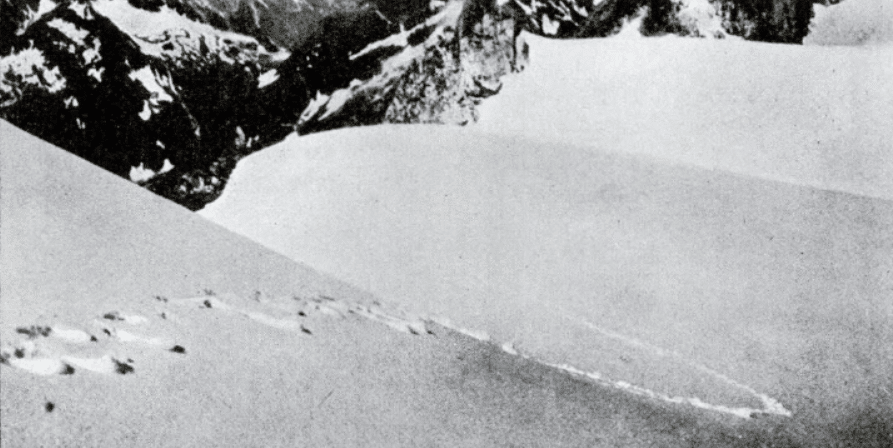
- Once a local Buddhist legend, the Yeti became a Western obsession by the late 1950s, boosted by Eric Shipton’s 1951 footprint photos.
- Oil millionaire Tom Slick funded the expeditions, while Peter Byrne smuggled a supposed Yeti finger to London with help from actor Jimmy Stewart.
- Byrne, the hunt’s leader, also joined the 1959 operation to extract the Dalai Lama from Tibet, showing how the search masked spy work.
- The US Embassy in Nepal issued formal rules for Yeti hunters, a diplomatic move to keep Nepal aligned with America against the Soviets.
- Anthropologist Carleton S. Coon joined the 1954 expedition hoping a semi-human find would prove his discredited racial theories.

Introduction
The Himalayas have long been a secretive landscape. High peaks, secluded monasteries, and thin mountain air have long nurtured tales of a gigantic, bipedal beast prowling the snows. Westerners poured money and effort into the search for this creature, the Abominable Snowman, the Yeti, for decades. But behind the surface of these missions lurks a more worldly and calculating story. Valid reasons suggest that the search for the Yeti, at the height of the Cold War, was at least in part a useful cover for Western intelligence operations in one of the most strategically sensitive regions on earth.
The Geopolitical Stakes of the Roof of the World
You have to think like a neurotic superpower to understand why the roof of the globe mattered so much. Central Asia was the meeting point of empires. To the north, the Soviet Union. To the east, China is tightening its grip. To the south, India is maintaining its uneasy position. Nepal and Tibet occupy the small, mountain-ridged region located between these two titans. For sea-based nations such as Britain and the United States, this landlocked interior was maddeningly difficult to reach and even harder to influence. The old British fixation with the so-called Great Game, the shadow struggle with Russia for northern access to India, never completely faded. It just changed uniforms. Western planners saw China’s far western reaches, such as Xinjiang, as the vulnerable underbelly of a rival empire—remote, restless, and historically prone to warlord rule. During the Republican era, western China was often ruled by the Ma clan, a family of Muslim Chinese warlords, and the central government’s tenuous grasp there made the region seem ripe for peeling away. Border confrontations flared during the 1950s and 1960s and were mostly underreported in the Western press. Lop Nor nuclear plants became a source of enormous fear. Henry Kissinger later said that Soviet officials had queried him in a sort of hypothetical way about how the United States might respond if Moscow attacked the Chinese atomic plants, a topic Kissinger tried to dissuade them from asking. In this atmosphere, any opportunity to place Westerners equipped with cameras, radios, and mapping tools near these frontiers was invaluable.
The Yeti in Myth and Popular Culture
The Yeti is rooted in Himalayan mythology and has featured in various literary and popular culture contexts, sometimes being anthropomorphized or reinterpreted (e.g., Gaia in Andrevon’s ecological narrative) or presented as a folkloric creature rather than a scientifically documented animal (Gadomska & Swoboda, 2020). Such representations affect how viewers anticipate probable institutional involvement, including that of a governmental actor. The Yeti in folklore and modern legend provokes epistemological problems regarding belief, legend, and the endurance of myth in academic discourse (Milligan, 1990; Ritvo, 2015; Yu & Riedl, 2021; Frew, 2019; “Limits of Science,” n.d.). These sources show the Yeti’s cultural capital.
The Yeti itself has a long and fascinating ancestry. Until the twentieth century it was a creature of local belief, part of the spiritual traditions of Himalayan Buddhists and of no concern to others. Things got intriguing when explorers started threading through the region in the 1800s, scribbling weird tales in their journals. As the climbing fever took hold, along with the mountaineers’ ambition to scale the highest peaks, came a curiosity about the native apeman. In 1951, climber Eric Shipton took photographs of a line of enormous prints in the snow, and these pictures captivated the audience by seeming to indicate something walking upright with a strange arrangement of toes. Even Edmund Hillary and Tenzing Norgay, on their historic first climb of Everest, claimed to have seen strange footsteps. By the late 1950s, the fad had gained momentum, with wealthy Americans financing entire expeditions to search for evidence (Heggie, 2014).

Adventurers or Agents? Tom Slick and Peter Byrne
And this is when the intelligence ties become inescapable. Take Tom Slick, the Texas oil millionaire who funded a number of high-profile Yeti expeditions in the mid- to late 1950s (Liechty, 2017). Slick was not merely a wealthy eccentric. He lived in a world of government relationships and secret interests, and his searches for the Abominable Snowman offered him a valid excuse to work along some of the most sensitive borders on the globe (Regal, 2011). Beside him was adventurer Peter Byrne, who was to become the public face of the quest (Sykes, 2016). In 1958 Byrne went to Nepal and saw a claimed yeti hand kept in the Pangboche Monastery. He came back the next year, anxious to obtain a portion of it for London to test. The events that followed resemble the plot of a spy movie. Byrne succeeded in sneaking a finger from the relic out of Nepal and into India, and with the help of Hollywood star Jimmy Stewart, who was passing through the area, the finger was smuggled into London. Finally, when the specimen was examined, it turned out to be a human finger, an ordinary one.
The espionage angle sharpens when you observe the activities of these very same men when you see what these very same men were doing away from the cameras. Byrne, the leader of the famous snowman expedition, was part of the delicate operation in 1959 to smuggle the 14th Dalai Lama out of Tibet into India as Chinese power tightened and the Tibetan uprising crumbled. A man of unique worth as an intelligence asset. He was a man who could easily traverse Himalayan passes while pretending to follow a famous monkey. A roving scientist or explorer attracted significantly less suspicion than an evident government agent. Permits could be obtained, distant valleys investigated, monks and villagers nurtured as contacts, all under the innocuous banner of cryptozoology. Slick’s financial resources provided the equipment, Byrne’s charisma facilitated their entry, and the Yeti served as a compelling rationale for why anyone would wish to be present in that location (Hanks, 2023).
Diplomacy, Discredited Science, and Hidden Agendas
The official reaction is more proof for the theory. Even the United States Embassy in Nepal, led by Ambassador Ernest Fisk, issued a formal note setting forth regulations for Americans who wanted to pursue the Yeti. For hopeful seekers, permits were to cost a five thousand rupee royalty to the Nepalese government. They were told that the creature could be photographed or captured but never killed except in genuine self-defense and that any photographs of it, dead or alive, had to be handed over to Nepalese authorities. And, on top of that, no news confirming the animal’s existence could be released to the press without the specific consent of Nepal. At first glance, it appears to be an aberration: a government earnestly regulating the pursuit of a myth. Look closer and the logic is clear. These rules were a diplomatic device. In honoring Nepalese sovereignty over the fabled beast, Washington signaled its friendship to a little nation sandwiched between China and India, striving to keep it in the American sphere of influence and out of reach of the Soviets. When the memo later appeared, officials were quick to underline that none of the information suggested the government genuinely believed in the Yeti.
Additionally, a peculiar theme linked to discredited scientific ideas runs throughout the entire discussion. to discredit scientific ideas. The hunt for prehistoric wild men held a certain allure for those who still believed that human races had evolved individually, along autonomous lineages, almost as if they were different species. On one occasion, Carleton S. Coon, an anthropologist and president of the American Anthropological Association and a leading advocate of these racial theories, was invited to attend the 1954 Slick and Byrne trip (Regal, 2009). In his novels, Coon spent a chapter arguing for the existence of monsters like the yeti and Bigfoot because he believed that a semi-human walking erect in Asia would provide proof of the existence of monsters like the yeti and Bigfoot. A semi-human walking erect humanoid in Asia would have been the ultimate proof of independent human evolution. So the expeditions drew a curious selection of passengers. There were real adventurers, there were agents with charts to make and lines to monitor, and there were ideologues praying that the mountains would prove theories the scientific establishment was already rejecting.
Conclusion
None of this proves that such a creature does not exist in those vast, remote areas. The point is more fascinating and more narrow. The Western hunt for the Yeti was never a simply innocent scientific effort. From the beginning it was caught up in the machinery of espionage and the ambitions of paranoid empires contending over a far-flung and essential corner of the map. Behind the footprints and the remains of the monastery were men such as Tom Slick and Peter Byrne, who moved between the roles of adventurer and agent, and behind them were the silent calculations of governments in Washington, London, Moscow, and Beijing. The visible tale was simply the tip of a much bigger iceberg. Under it all were listening sites, extraction plans, contested frontiers, and the never-ending maneuvering of the Cold War. Perhaps the Yeti was the ultimate intelligence asset, a myth so powerful that no one actually stopped to investigate what its hunters were after.
References
Frew, L. (2019). “A Whole New Take on Indigenous”: Margaret Atwood’s Oryx and Crake as Wild Animal Story. Studies in Canadian Literature, 39(1). https://doi.org/10.7202/1062362ar
Gadomska, K., & Swoboda, A. (2020). Ecology and the Fantastic. The Example of “Le monde enfin” by Jean-Pierre Andrevon. Brumal Revista De Investigación Sobre Lo Fantástico, 8(2), 165–181. https://doi.org/10.5565/rev/brumal.628
Hanks, M. (2023, April 12). The secret life of Tom Slick: The CIA and the search for the Yeti. The Debrief. https://thedebrief.org/the-secret-life-of-tom-slick-the-cia-and-the-search-for-the-yeti/
Heggie, V. (2014, October 31). Monstrous science: How the Yeti gets research funded. The Guardian. https://www.theguardian.com/science/the-h-word/2014/oct/31/halloween-monstrous-science-how-the-yeti-gets-research-funded
Liechty, M. (2017). Far out: Countercultural seekers and the tourist encounter in Nepal. University of Chicago Press.
Limits of Science. (n.d.). 36–50. https://doi.org/10.2307/j.ctt6wrbw0.6
Milligan, L. (1990). The “Truth” about the Bigfoot Legend. Western Folklore, 49(1), 83. https://doi.org/10.2307/1499483
Regal, B. (2009). Entering dubious realms: Grover Krantz, science, and sasquatch. Annals of Science, 66(1), 83–102.
Regal, B. (2011). Searching for sasquatch: Crackpots, eggheads, and cryptozoology. Springer.
Ritvo, H. (2015). Brian Regal. Searching for Sasquatch: Crackpots, Eggheads, and Cryptozoology. The American Historical Review, 120(2), 586–587. https://doi.org/10.1093/ahr/120.2.586
Sykes, B. (2016). Bigfoot, Yeti, and the Last Neanderthal: A Geneticist’s Search for Modern Apemen. Red Wheel/Weiser.
Yu, H., & Riedl, M. (2021). Data-Driven Personalized Drama Management. Proceedings of the Aaai Conference on Artificial Intelligence and Interactive Digital Entertainment, 9(1), 191–197. https://doi.org/10.1609/aiide.v9i1.12665

Leave a Reply