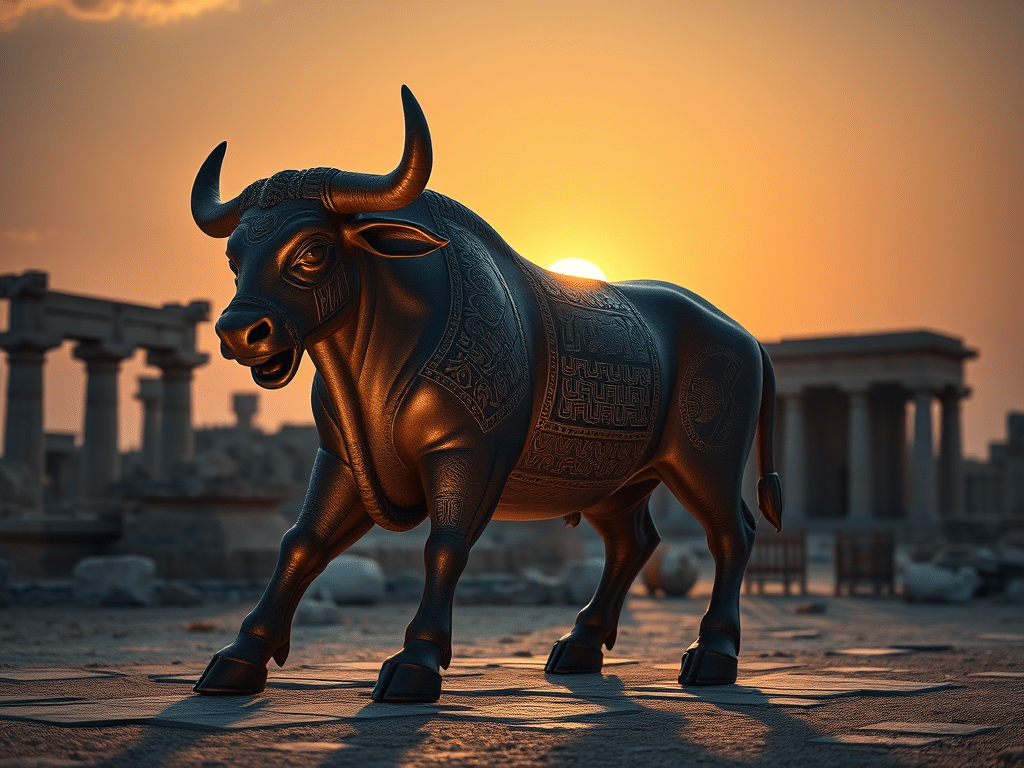
Sumerian Bull: Key Points
-
The bull appears across world mythologies as a symbol of divine power, fertility, and cosmic order, from Egyptian to Greek to Hindu traditions.
-
In Sumerian mythology, the Bull of Heaven punished heroes in Gilgamesh, while bulls represented storm gods and the moon god Nanna at temple complexes.
-
Sumerian bull mythology emphasized cosmic order and divine justice more than other traditions, reflecting the complex polytheistic bureaucracy of Mesopotamian religion.
-
Scholars analyze Sumerian bull symbolism via agricultural imperatives, political structures, Jungian archetypes, and associations with cattle domestication and plough agriculture.
-
The Bull of Heaven represented tests of heroic virtue and divine boundaries, while bull sacrifices mediated between human and divine realms.
-
Sumerian bull mythology influenced later Mesopotamian cultures, Biblical traditions, zodiacal symbolism, and Islamic art, demonstrating enduring symbolic power across civilizations.

Introduction
The bull is one of the most ancient and strong mythological figures in human history. It has been seen as a representation of divine strength, fertility, and cosmic order in many different cultures and civilizations. From the Mediterranean cultures that worshiped the sun to the old Near Eastern societies that lived on farms, the bull has always stood for both the good and bad forces that shape human life. Many cultures revered this powerful animal, but the Sumerians created a particularly rich and complicated mythology about bulls that would have a huge impact on later Mesopotamian cultures and continue to resonate through thousands of years of religious thought. This essay looks at the role of bulls in Sumerian mythology as well as their larger importance in mythologies around the world. It also looks at what these beliefs can teach us about ancient people’s concerns and understanding of the universe.
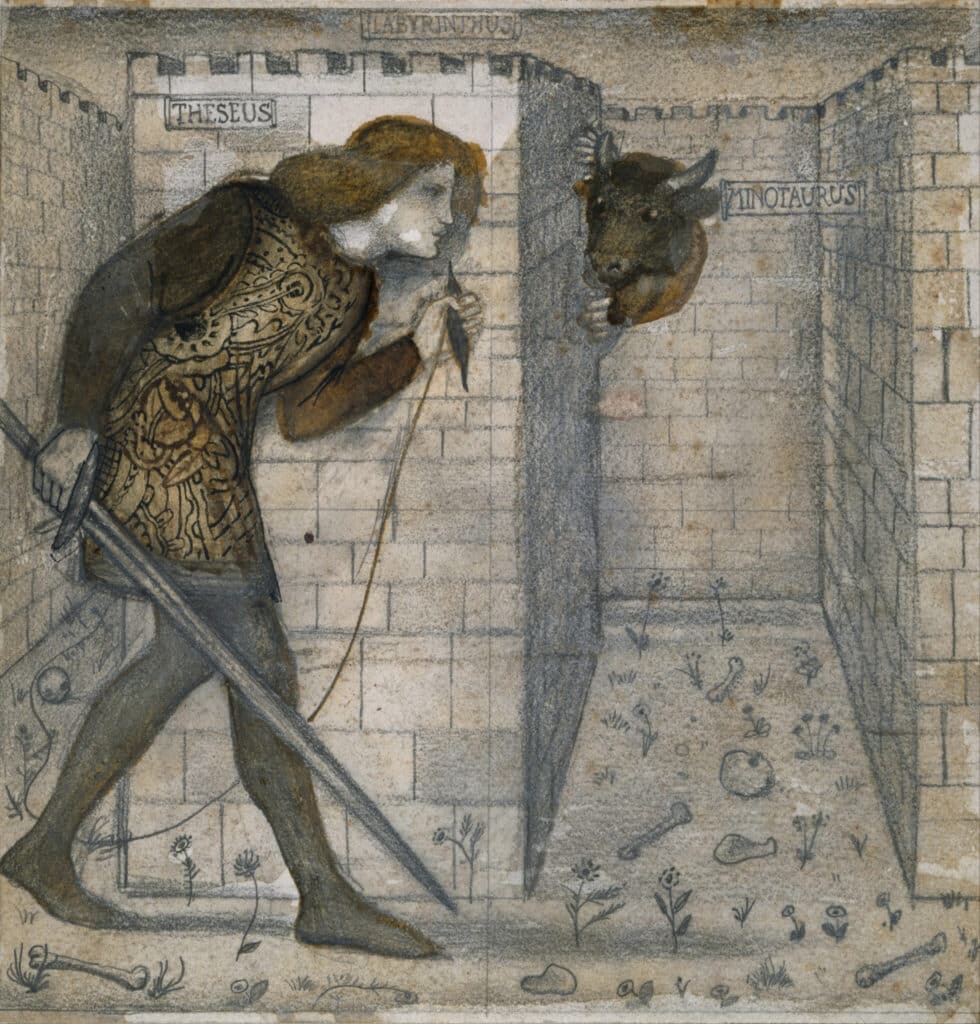
In mythology around the world, bulls are used as many different kinds of symbols, including ones that represent masculine strength, agricultural abundance, and heavenly authority. In Egyptian religion, the Apis bull was a living form of the god Ptah. Later, it was linked to Osiris and stood for resurrection and the circle of death and rebirth that ruled Egyptian spiritual life. The elaborate frescoes at Knossos show ceremonies where bulls were jumped over, and the legendary Minotaur is at the center of the maze. These artifacts show that bull worship was a big part of the Minoan religion on Crete. Bulls show up in many different ways in Greek myths. For example, Zeus turned into a white bull to kidnap Europa, and sacred bulls were sacrificed to Poseidon, the god of the sea and earthquakes. In Hindu mythology, Nandi the bull is Lord Shiva’s loyal mount and guardian. The bull is a symbol of power, virility, and devotion to God. There are themes of power, fertility, and the bridge between the earthly and celestial worlds in all of these different depictions. This suggests that the bull’s physical strength and ability to reproduce made it a perfect way for people to show their relationship with forces beyond their control.
The Bull in Sumerian Religious Thought and Symbolism
In Sumerian folklore, bulls were important to both the religious worldview and everyday worship. They were considered powerful symbols of the gods and as holy animals that should be respected. In Sumerian mythology, the Bull of Heaven was the most important bull figure. It was a heavenly being sent by the goddess Inanna to punish the hero Gilgamesh for turning down her sexual advances in the Epic of Gilgamesh. This bull in the sky could spell disaster and drought, killing hundreds of men with every snort of its breath and drying up the Euphrates River to show what happens when God gets frustrated. In Akkadian mythology, the storm god Ishkur, who was later called Adad, was linked to bulls. The bulls’ roars were thought to represent thunder, and their moves across the sky were believed to be like storm clouds. One of the most important Sumerian gods, Nanna, was often shown as a bull or with bull symbols. These depictions showed a connection between the animal and the lunar cycles that controlled religious events and farming seasons. In Sumer, sacred herds of bulls were kept in temple buildings all over the country. The ziggurat at Ur was decorated with detailed images of bulls, which suggests that these animals were more than just symbols; they were real people who represented God on earth.
In ancient Mesopotamian society, the bull had many deep meanings. It stood for everything, from divine power to things that happen in space. Husseina (2020) says that in old Mesopotamian thinking, the bull stood for power, fertility, reproduction, great gods, divinity, wisdom, balance, and protection from evil spirits. The Sumerians used a bull with rising sunrays as a representation of the sun god and his power, showing that the animal was linked to the sun god (Husseina, 2020). The sign Taurus, which is called the “Bull of Heaven,” showed how bulls could also represent the sky. Sołtysiak (2001) looked into this imagery in old Mesopotamian cultures and found that the Sumerian word for the Bull of Heaven was gud.an.na. Other related words include gud.dumu.an.na, which means “bull, son of heaven,” and gud.alim, which means “a bull.” The Bull of Heaven plays a big role in the Gilgamesh story. It strikes the hero on the orders of Inanna, the Venusian goddess (Sołtysiak, 2001). The name of Ereshkigal’s husband, “Gugalanna,” means “The Great Bull of Heaven” in Sumerian, according to Hoffman (2004). It also stands for the star Taurus.
The bull had religious meanings in addition to its mythological ones. Gabbay (2018) talked about the Bull of Heaven myth in the setting of the lilis kettledrum ritual, which involved putting a bull’s hide over the drum. The most detailed story of a fight featuring a mythical bull can be found in the Sumerian poem Gilgameš and the Bull of Heaven (Gabbay, 2018). Inanna begs her father, An, to allow the Bull of Heaven to engage in combat with Gilgamesh. Gilgamesh and Enkidu slay the Bull of Heaven, symbolizing Gugalanna or Dumuzi (Hoffman, 2004). Several Mesopotamian gods were linked to the bull as a sign. Dijk-Coombes (2018) said that Lahar and Shakkan were Sumerian gods of cattle and the bull in folklore. Mythology says that the Sumerian storm god Iškur, whose Akkadian name was Adad, was linked to the bull. This legend wasn’t there in the original language, but later writings compared him to a great ox (Dijk-Coombes, 2018; El Shaieb, 2025). Rock reliefs from Neo-Assyria show that the bull was the god Adad’s mount, which Scurlock (2002) confirmed.
Other names for the moon god Nanna/Suen included words that meant “calf” and “young calf of Enlil.” These names connected the Moon God to the bull mainly because the crescent moon looks like a bull’s horns (Dijk-Coombes, 2018). El Shaieb (2025) said that the bull was an important part of Sumerian art, especially when it came to representing the lunar god, which comes from old Mesopotamian beliefs. A Sumerian book also compared the god Enlil to “a mighty steer, whose horns shine like the rays of the sun god” (El Shaieb, 2025). Enlil was called a “raging storm” and a “wild bull.” Hoffman (2004) said that in royal settings, the king was often called a “virile bull,” which is a figure from bull mythology. The nickname was because the king was the god Dumuzi. In Sumerian folklore, composite creatures like the bull-man Kusarikku played a big role (Husseina, 2020). In 2002, Scurlock wrote about šēdu, which were winged bulls with human heads that stood guard at the gates of royal Assyrian houses. Bulls were also used in business rituals. For example, Scurlock (2002) talks about a rite in which a bull made of certain materials could be buried under a vat to make sure a beer merchant made money.

Comparative Analysis: Sumerian Bull Mythology and Global Traditions
Sumerian ideas about bulls were different from other mythologies because they focused on the order of the universe, the success of farming, and the structured relationship between people and gods. Greek myths frequently depict gods using bulls to punish or appease them, such as in the story of Europa or the curse on Pasipha. Sumerian bulls stood for more organized parts of the universe’s control and the upkeep of society. Even though it was very destructive, the Bull of Heaven behaved according to divine justice rather than random cruelty. It showed up in reaction to a specific violation of divine authority. Sumerian bulls kept their many forms, showing up in different ways connected to different gods and nature events, unlike the Egyptian Apis bull, which turned into a single, never-ending god. In Hinduism, Nandi stands for eternal, devoted service to a single god. In Sumerian religion, on the other hand, bulls represented the power of many gods and nature forces, which shows how complicated Mesopotamian religion was. The difference between these two shows how these cultures thought about divine power. For example, the Sumerians saw their gods as a complicated bureaucracy that needed many forms and middlemen, while other religions see gods as more unified or hierarchical.
Scholars have come up with different ideas about why bulls were such important symbols in Sumerian myths. These ideas try to connect religious beliefs with everyday life in ancient Mesopotamia. According to the agricultural interpretation, bulls stood for the life-giving power of irrigation and plowing, which were important activities in the river valley society that relied on controlling and routing the Tigris and Euphrates rivers. Thorkild Jacobsen, an anthropologist, said that Sumerian religion showed how city-states were organized socially and politically. He said that divine bulls showed how powerful kings were and how institutions kept order in the face of nature’s chaos. Carl Jung’s ideas about archetypes have had an impact on psychoanalytic approaches. These approaches see the bull as a universal sign of the masculine principle, showing both creative power and dangerous, uncontrolled instinct that needs to be managed through sacrifice and worship. Feminist scholars have examined how bull mythology reinforced patriarchal structures, demonstrating the dominance of male gods and their bull forms over female goddesses. However, this reading needs to be weighed against the fact that powerful female gods like Inanna could control even the bulls in heaven. More recent approaches that combine archaeological evidence with textual analysis suggest that bull worship developed at the same time that humans tamed cattle and learned how to farm with a plow. Such an interpretation means that these animals were both symbols of humans’ control over nature and reminders of the violent power that humans could never fully control.
Theological and Cultural Implications of Bull Symbolism
Sumerian bull folklore has many different meanings and symbols that go beyond simple fertility themes. It also has deep ideas about power, cosmic balance, and the right way to relate to death and gods. The Epic of Gilgamesh doesn’t just show the Bull of Heaven as a monster that needs to be slain; it also uses it as a test of heroism and as a way for Gilgamesh to grow spiritually. Gilgamesh and Enkidu are very proud of themselves when they kill the Bull of Heaven. This leads to Enkidu’s death and Gilgamesh’s search for life. This metaphor suggests that the bull stood for limits that heroes crossed at their own risk. The Sumerians’ association of bulls with both the storm god and the moon god demonstrates their belief in the divine control of natural cycles. The bull’s strength symbolizes the immense power of weather and celestial movements, which can either benefit or harm human society. In ritual settings, bull sacrifices were a way for people to connect with the gods. The death of the animal opened a line of contact with the gods and renewed the promise that kept society running. This aspect of sacrifice shows that the Sumerians saw their relationship with the divine as two-way, needing ongoing upkeep through rituals that recognized both humans’ need for divine help and their responsibility to keep the universe in balance.
Later Mesopotamian cultures and beyond were influenced by Sumerian bull mythology. This shows that these old symbols have continued to shape religious and artistic expression for thousands of years. The Akkadians, Babylonians, and Assyrians took Sumerian bull images and used them in their own mythologies, but they kept the connection between the bull and divine power and natural forces. From the story of the golden calf in Exodus to the beasts of the end times in the Book of Revelation, there are clear inspirations from Mesopotamian bull mythology. However, the original meanings are often turned around to emphasize the monotheistic rejection of idol worship. People in ancient Mesopotamia thought that Taurus was connected to the Bull of Heaven and the spring equinox. This link between Sumerian astronomy and the astrological traditions that spread throughout the Hellenistic world shows how the zodiac sign Taurus is related to the stars. In places that were once ruled by Mesopotamian civilizations, Islamic art and buildings sometimes use stylized bull images. This shows how pre-Islamic symbols could be taken up and interpreted in new religious settings. These similarities suggest that the meaning of the bull goes beyond specific religions and touches on basic human feelings about nature, power, and the sacred that are important across cultures.
Conclusion
In Sumerian mythology, the bull is more than just an animal totem or a sign of fertility. It represents a complex web of ideas about God’s power, natural order, and the human situation. By looking at Sumerian beliefs along with other mythologies from around the world, we can see both general patterns in how people have thought about sacred power and specific changes that were made because of the specific circumstances of the ancient Mesopotamian society. Sumerians built their society on farming, had to deal with order and chaos all the time in a difficult environment, and came up with complex theological systems. All of these things made the bull a key figure in their religious imagination. We can learn more about how symbols work in human culture and how religious systems form in response to both material and existential concerns by looking at these old beliefs through the lens of modern anthropology and psychology, as well as archaeological evidence and comparative mythology. In the end, the Sumerian bull tells us that mythology is more than just a simple way to explain natural events. It’s also a sophisticated way to talk about deep truths about power, death, and our place in a universe that is both beautiful and scary.
Reference
Dijk-Coombes, R. M. (2018). Mesopotamian Gods and the Bull. Sociedades Precapitalistas, 8(1), e028. https://memoria.fahce.unlp.edu.ar
El Shaieb, M. F. (2025). The Symbolism of the Bull in Ancient Egypt and Mesopotamia. Journal of Ancient Near Eastern Civilization. https://east.zu.edu.eg
Gabbay, U. (2018). Drums, Hearts, Bulls, and Dead Gods: The Theology of the Ancient Mesopotamian Kettledrum. Journal of Ancient Near Eastern Religions, 18(1), 1-47. https://doi.org/10.1163/15692124-12341299
Hoffman, C. (2004). Dumuzi’s Dream: Dream Analysis in Ancient Mesopotamia. Dreaming, 14(4), 240-254. https://doi.org/10.1037/1053-0797.14.4.240
Husseina, I. L. (2020). Bull Symbolism in Ancient Iraqi Thought. International Journal of Innovation, Creativity and Change, 11(2). https://www.ijicc.net
Scurlock, J. (2002). Animals in ancient Mesopotamian religion. In B. J. Collins (Ed.), A history of the animal world in the ancient Near East (pp. 361-387). Brill.
Sołtysiak, A. (2001). The bull of heaven in Mesopotamian sources. Culture and Cosmos, 5(2), 43-69. https://www.cultureandcosmos.org



Leave a Reply